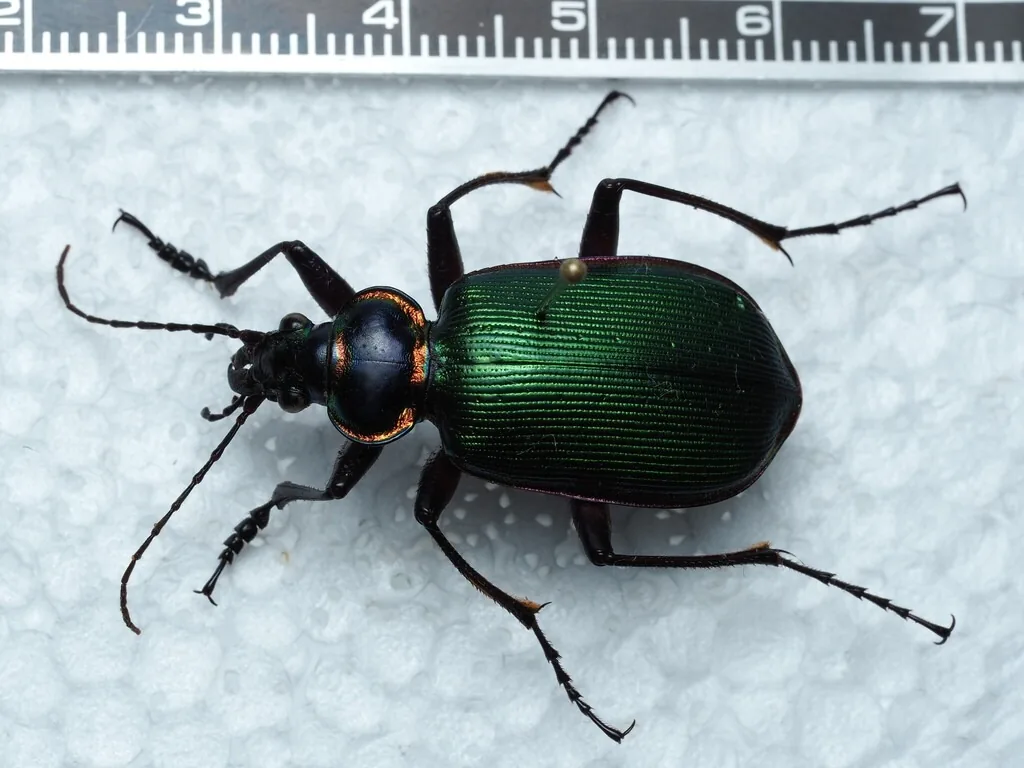
How to identify it
- Most are shiny black or dark reddish, with ridged or grooved wing covers; some are brightly metallic or iridescent.[1][3]
- The head is smaller than the thorax, the antennae are threadlike and unclubbed, and the legs are long.[1][2][3]
- Most common species are about 1/8 to 1/2 inch long, though a few reach about 1 inch.[2][3]
- They run quickly when disturbed and seldom fly, though some species come to lights at night.[1][3]
- The fiery searcher, a common Kentucky species, is a large, brilliantly colored ground beetle.[1]
Look-alikes
| Look-alike | How to tell them apart |
|---|---|
| Oriental cockroach | Both are shiny and very dark, but beetles have hard front wings, while roaches have leathery wings or none and a hood that hides the head from above.[1] |
| Darkling beetles | Darkling beetles lack the enlarged segments at the base of the hind legs that ground beetles have, and their antennae attach beneath a ridge on the head.[3] |
Where it lives
More than 2,200 species live in North America, in nearly every habitat from forests and fields to farms, gardens and buildings.[1][2][3]
Biology and life cycle
Adults hunt at night and hide by day under rocks, logs, mulch, leaf litter and woodpiles, especially in damp spots.[1][2][3]
Females lay eggs in moist soil or damp organic matter; larvae live in the soil or litter and are predators too.[2][3]
Many species take about a year to develop from egg to adult, and adults can live two years or more.[3]
Bombardier beetles, a group of ground beetles, spray a hot, irritating chemical with a popping sound when threatened.[1][2]
Damage and signs
Health risk
Harmless to people and pets, though larger species can pinch if handled roughly, and some release an irritating or bad-smelling chemical. Don't handle them bare-handed.[2][4]
Control
Prevention
Outdoors, no control is needed. Ground beetles eat caterpillars, root maggots, slugs, snails and other soft-bodied pests.[4][1]
Turn off porch lights when not needed, reposition them, or switch to yellow bulbs, which attract fewer night-flying insects.[2][1]
Keep them out
Caulk and weatherstrip gaps around doors, windows, foundations and pipe entries, and keep screens and door sweeps in good repair.[2][1]
Sanitation
Reduce hiding spots against the house: pull back mulch, debris and overgrown vegetation from the foundation and store firewood away from the house.[2][1]
Traps and physical control
Sweep up, vacuum or carry stray beetles back outside; they won't survive or multiply indoors.[1][2][4]
Pesticides
Perimeter insecticide treatments aren't necessary unless large numbers keep getting inside, and they work best alongside sealing and habitat changes.[2]
Common questions
- Are ground beetles in the house a sign of an infestation?
- No. They wander in by accident from outdoors, prefer to live outside where prey is common, and don't breed indoors.[1][2]
- Do ground beetles bite?
- Larger species can give a painful pinch with their jaws if handled roughly, so don't handle them bare-handed; sweep them up or capture them and release them outside.[2][4]
Sources
- University of Kentucky Entomology Extension, “Ground Beetles, ENTFACT-706 (revised August 2022).” entomology.ca.uky.edu/files/ef706.pdf (accessed 2026-10-06)
- Virginia Cooperative Extension, Virginia Tech, “Ground Beetles, ENTO-530NP (revised November 2022).” pubs.ext.vt.edu/ENTO/ENTO-249/ENTO-249.html (accessed 2026-10-06)
- University of California Statewide IPM Program, “Predaceous Ground Beetles (Natural Enemies Gallery).” ipm.ucanr.edu/natural-enemies/predaceous-ground-beetles/ (accessed 2026-10-06)
- Washington State University Extension, “Predaceous Ground Beetles (Carabids), PestSense Fact Sheet.” pestsense.cahnrs.wsu.edu/fact-sheet/predaceous-ground-beetles-carabids/ (accessed 2026-10-06)
- iNaturalist, “Calosoma scrutator taxon page (order and family).” www.inaturalist.org/taxa/118855 (accessed 2026-10-06)