❓ Common Questions About 🪳 Oriental Cockroach (Black Beetle, Water Bug)
How do I confirm I actually have this pest (not something similar)?
The most reliable confirmation is a physical specimen — capture one and compare to reference images on this page. For cryptic pests (bed bugs, termites), look for secondary signs: frass, shed skins, mud tubes, or bites with a specific pattern. When uncertain, a professional inspection is faster than months of misidentification.
Can I treat this myself or do I need a professional?
DIY is effective for small, accessible infestations caught early. Professionals are worth the cost when: the infestation is inside wall voids or structural elements, multiple rooms are affected, you have health-risk pests (hantavirus, venomous species), or DIY has already failed twice.
How long until the infestation is completely gone?
Expect 3–8 weeks for most infestations with proper treatment. Insects with dormant life stages (pupae, eggs) extend the timeline because those stages are impervious to most insecticides. Follow-up treatments at 2 and 4 weeks catch each new cohort as they emerge.
What's the most common mistake people make treating this pest?
Treating only the visible pest population while ignoring the harborage site, entry point, or breeding location. Killing adults provides temporary relief but the population rebuilds from hidden egg cases, pupae, or new arrivals through unaddressed entry points.
Sanitation thresholds that actually matter for cockroach control
Sanitation advice for cockroach control is often delivered as a generic 'keep things clean,' which is unhelpful because cockroaches will survive in almost any kitchen. The specific sanitation interventions that change population dynamics: eliminate standing water (drips, condensation, pet bowls left overnight), reduce harborage clutter (cardboard, paper bags, stored items behind appliances), and remove the secondary food sources cockroaches rely on overnight (uncleaned pet food bowls, grease accumulation on stovetops and behind ranges, spilled dry goods inside cabinets). German cockroaches can survive on the food residues most kitchens leave overnight; the goal isn't sterility but reducing the food available to a point where bait is more attractive than ambient resources. This is what makes bait programs work — competition with food, not absence of food.
How professional pest control programs differ from one-off treatments
A single treatment — DIY or professional — addresses what's visible today, but most pest pressure is cyclical. Professional pest control programs that work long-term are structured around inspection, monitoring, treatment, and follow-up as a recurring cycle rather than discrete events. The inspection phase identifies conducive conditions (moisture, harborage, food access, exclusion gaps) that one-time treatments don't address. The monitoring phase uses sticky traps, bait stations, or visual sweeps to catch population rebounds early, before they become visible infestations again. The treatment phase targets the specific life stages active during that visit — different than blanket spraying everything. The follow-up phase verifies treatment efficacy and adjusts. Homeowners can replicate this structure on a quarterly or seasonal schedule without buying expensive equipment, and the underlying logic — track, treat targeted, verify — produces consistently better results than reactive treatment after problems become obvious.
Species identification matters more than people think
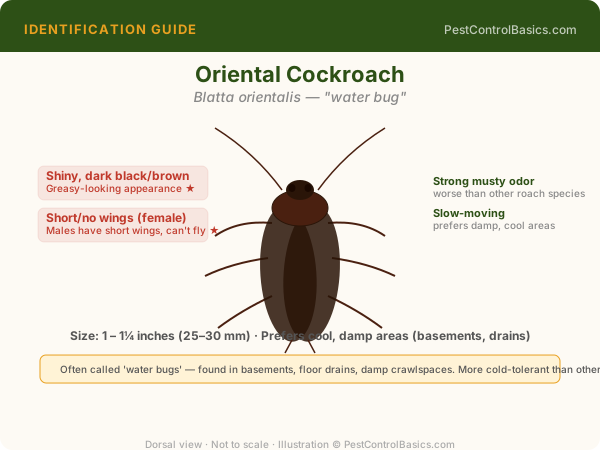
Treatment that works for German cockroaches frequently fails for American or Oriental cockroaches, and vice versa. German cockroaches are indoor-breeding, kitchen and bathroom-dwelling, and respond well to gel baits at harborage. American and Oriental cockroaches typically breed outdoors or in basements, moist crawlspaces, and sewers, and enter from outside — perimeter exterior treatment matters as much as interior bait. Brown-banded cockroaches favor warmer, drier areas (electronics, upper cabinets, behind picture frames) rather than kitchens and bathrooms, and bait placement needs to follow. A correct identification before treatment, ideally with a sticky monitor catch confirming species, saves more time and money than any product upgrade. Most extension services will identify cockroach species from a photo or specimen at no charge.
Why repellents undermine cockroach bait programs
One of the most common mistakes in cockroach control: spraying a repellent pyrethroid in the same areas where baits are placed. Cockroaches detect the repellent and avoid the area, including the bait, so the bait sits untouched while the population persists in adjacent harborage. If using both, the spray should be limited to perimeter zones the bait isn't intended to reach (exterior thresholds, expansion joints), with baits handling all interior treatment. For German cockroaches specifically, the IPM-recommended approach is bait-only inside the structure — modern bait formulations transfer through the colony via cannibalism and fecal sharing, achieving population-level kill without the repellency that breaks the kill chain.
Common DIY mistakes that defeat otherwise correct treatments
Most DIY pest control failures aren't product failures — they're application failures. The recurring patterns we see across reader emails and field experience: treating only where pests are visible rather than where they live (the active surface is rarely the harborage), spraying repellents over residual products and breaking the residual film, applying baits in already-treated areas (the residual kills foragers before they return with bait), overdiluting product because 'less chemical is safer' (it's not — it accelerates resistance), expecting overnight results when the kill curve is two to four weeks for most products, and stopping treatment at the first sign of improvement rather than completing the protocol. Each of these failure modes is independently preventable with attention to the product label and the pest's biology, and avoiding them improves outcomes more than upgrading to a more expensive product.
Sanitation and cockroach treatment: complementary, not substitutive
The advice to 'keep the kitchen clean' for cockroach control is correct but routinely overemphasized in ways that mislead. Pristine cleanliness alone won't eliminate an established German cockroach population; the insects find sufficient food in cooking residues, drain biofilm, pet food, and ambient debris that no realistic household can entirely eliminate. Conversely, baits do work even in homes with elevated soil levels, just somewhat less efficiently. The right framing is complementary: sanitation reduces competing food sources so bait becomes relatively more attractive, while bait does the actual killing. The high-yield sanitation targets aren't cosmetic surface cleaning but specific harborage and feeding zones — under and behind the stove and refrigerator (where grease accumulates), drain traps and disposal units (where biofilm feeds populations), pet food bowl areas (where dropped kibble feeds nymphs), and pantry shelves (where spilled grain dust accumulates). A focused weekend of cleaning these zones followed by proper bait placement produces results that neither cleaning alone nor bait alone matches.
The cost of doing nothing: implicit pest tolerance and its hidden expenses
Pest control discussions usually frame the costs of treatment without quantifying the costs of non-treatment, but the latter are often larger and almost always less visible. Cockroach allergens add measurable healthcare costs in homes with asthma. Rodent activity in attics damages insulation (reducing R-value and adding seasonal heating and cooling costs) and creates fire risk through wire chewing that doesn't show up until something fails. Termite damage in unmonitored properties produces structural repair bills in the five-figure range, often discovered during unrelated renovation. Stored-product pests destroy food inventory at rates that aren't tracked because items are discarded individually rather than tallied. The cumulative cost of doing nothing isn't a single line item but a sum of small chronic losses across years. The framing that helps: pest control isn't a luxury expense layered onto a working baseline; it's a maintenance expense that competes with the slow accumulating cost of allowing a problem to continue. Households running the comparison honestly almost always find that modest preventive spending is the cheaper path.
Cockroach behavior after baiting: what to expect and why
When a German cockroach population is being controlled with bait, the visible behavior of survivors often confuses homeowners into thinking treatment isn't working. Late-stage symptoms include: increased daytime sightings (sick or dying roaches lose photophobic behavior), individuals appearing in unusual locations as harborage becomes overcrowded relative to a shrinking resource base, and a brief uptick in oothecae deposition as gravid females respond to stress. These signs reliably appear in successful treatments and shouldn't trigger product changes. The diagnostic that actually matters is sticky-monitor catch counts: a properly functioning bait program reduces catches week-over-week on a consistent downward slope, with full elimination typically taking six to twelve weeks depending on initial population size. Switching products or adding aerosols during the visible-distress phase frequently disrupts bait acceptance and lengthens the treatment timeline. The harder discipline is patience — letting the bait work through the population including the nymphs that hatch from oothecae deposited before treatment began — rather than escalating intervention in response to alarming individual sightings.
Bait station strategy: why placement and quantity beat product choice
Cockroach bait stations work on a principle that's easy to undermine through misuse. A bait station has to be encountered by a cockroach within its normal foraging range, which for a German cockroach is on the order of a few meters and frequently much less. A program that places a small number of stations in obvious central locations misses most of the actual harborage, because cockroaches are harborage-bound and don't travel further than they have to. Effective bait station programs place many small stations in close proximity to harborage — under refrigerators, behind dishwashers, in cabinet corners, in voids around plumbing penetrations — rather than fewer stations in visible kitchen spaces. The other variable people get wrong is refresh cadence: gel bait dries, dust-contaminated bait loses palatability, and station throughput drops dramatically once the bait is no longer attractive. Programs that refresh bait every few weeks during active infestation, and inspect uneaten stations to confirm placement is correct, produce dramatically better outcomes than programs that place stations and walk away.
Coordinating pest control with renovation and construction work
Renovation work is one of the highest-value moments for pest intervention, and it's also one of the most consistently missed. When walls are open, when slabs are exposed, when crawlspaces are accessible, when sill plates are visible — these are the windows during which exclusion work, soil treatment, perimeter sealing, and harborage elimination can be done at a fraction of their normal cost and with dramatically better completeness. The same caulk-and-foam exclusion job that takes hours of awkward work after the fact can be done in minutes when the wall cavity is open. A pre-construction termite soil treatment is dramatically more effective than any post-construction equivalent, but it has to happen before the slab is poured. Even non-structural renovations like flooring replacement, kitchen rework, or basement finishing create windows during which the home's pest-relevant geometry can be improved. The cost of pulling in a pest professional during the renovation envelope, even just for an inspection and recommendations, is almost always recovered in reduced future treatment costs and avoided structural damage. The conversation to have with general contractors is whether they're willing to coordinate with a pest specialist during the open-wall phase, and most reputable contractors are, particularly on larger jobs where the small additional scheduling complexity is offset by the value-add for the homeowner.
Ootheca management: why egg cases need separate handling
A cockroach egg case is a hardened protein structure designed specifically to protect developing nymphs from desiccation, predators, and many insecticides. Spray and bait treatments that kill adults very effectively often leave intact ootheca behind, and those ootheca hatch on their own schedule weeks after treatment. This is the predictable pattern behind the complaint that a successful initial treatment seemed to come back from nowhere a month later — it didn't come back from nowhere, it hatched from cases that survived. Effective programs anticipate this by scheduling follow-up treatment to catch the hatch, using insect growth regulators that disrupt nymph development even when adults aren't present, and physically removing visible ootheca during inspection. German cockroach ootheca are carried by the female until close to hatch, which gives bait programs a window of opportunity if adults are killed before deposition; American and Oriental species deposit ootheca much earlier, which means the cases are typically already separated from adults by the time treatment happens. Knowing which species you're dealing with shapes how you handle this problem.