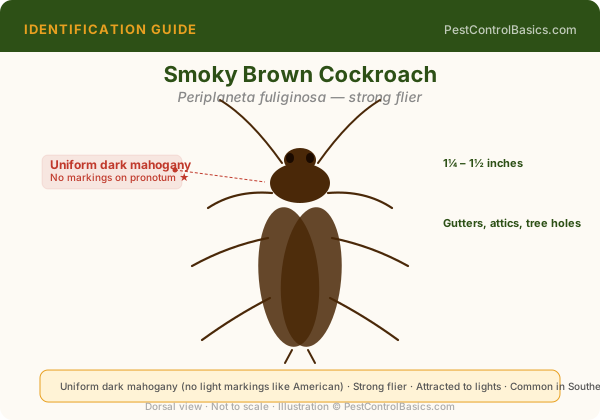
Uniform dark mahogany-brown with a full set of wings — smoky browns are excellent fliers drawn to lights at night. Common in the Southeast and Gulf Coast, they live outdoors in gutters, tree holes, and mulch. Understanding their outdoor origin is key to control.
ColorUniform dark mahogany — no markings
Flies?Yes — strongly attracted to light
RangeSoutheast, Gulf Coast, Texas
HabitatOutdoor — mulch, gutters, tree holes
ControlPerimeter spray + lighting change
📐 FIELD GUIDE ILLUSTRATION
Original illustration by PestControlBasics.com. Use anatomical labels above to confirm your identification.
Identification
Smoky brown vs. American cockroach
Smoky brown cockroaches are frequently confused with American cockroaches (palmetto bugs). The key difference: smoky browns are uniform dark mahogany with no markings. American cockroaches have a distinctive pale yellow figure-8 pattern on the pronotum (the shield behind the head). If you see a marking — American cockroach. Uniform dark brown — smoky brown.
Both are large outdoor roaches that wander inside, but smoky browns are strongly phototaxic — they fly directly toward light sources at night. If roaches are showing up near lit doorways, windows, or around light fixtures at night, suspect smoky brown cockroaches.
They also require more moisture than American cockroaches — they dry out and die quickly in low-humidity indoor environments. Dehumidification reduces their ability to survive inside.
Control
Outdoor-focused treatment is most effective
Replace exterior white lights with yellow LEDs: This single change dramatically reduces smoky brown attraction to your structure. They fly toward white/blue spectrum light; yellow 2700K LEDs are nearly invisible to them.
Bifenthrin perimeter spray: Apply to the full foundation perimeter, around all windows and doors, and to any mulched areas adjacent to the structure. Reapply every 4–6 weeks during active season (spring through fall).
Tree and gutter maintenance: Smoky browns nest in clogged gutters, hollow trees, and dense ivy. Cleaning gutters in spring, trimming trees away from the roofline, and removing dense ground cover near the structure eliminates primary harborage.
Bait in outdoor areas: Cockroach bait stations placed in garden beds, under AC units, and around outdoor utility areas reduce the population pressure approaching the structure.
DG
Derek Giordano
Certified Pest Control Operator · Former Business Owner
Derek ran his own pest control company in Florida for several years, servicing thousands of regular customers. All content is based on hands-on field experience and current EPA & university extension guidelines.
Reviewed by Derek GiordanoContent on PestControlBasics.com is developed with input from certified pest management professionals and cross-referenced against EPA, CDC, and university extension guidance. Last reviewed: April 2026.
When to escalate Smoky Brown Cockroach control beyond DIY
Most Smoky Brown Cockroach situations are within the range of a careful homeowner, but a handful of scenarios genuinely warrant a licensed applicator. Multi-unit buildings are at the top of that list — shared walls, plumbing, and ductwork mean a localized treatment in one unit often just relocates the population to a neighbor. Any infestation that involves wall voids, attic insulation, or sub-slab plumbing is also harder to reach with consumer products and benefits from professional equipment and labeled product concentrations.
Health-sensitive situations are the second escalation trigger. Pregnancy, infants, immunocompromised residents, and pets with known sensitivities all narrow the available product list considerably. A licensed professional can apply restricted-use products and reduced-risk reformulations that achieve control with lower household exposure than over-the-counter alternatives. The cost difference is usually less than two seasons of DIY spending once the time investment is factored in.
The third escalation point is recurrence. If the same pest returns within six weeks of an apparently successful treatment, the source is usually structural or environmental rather than chemical, and a professional inspection often finds the cause faster than a second round of self-treatment.
Confirming a Smoky Brown Cockroach infestation in the field
Misidentification is the most common reason home treatment fails for Smoky Brown Cockroach. Look-alike species often respond to completely different active ingredients, so a 30-second confirmation step before any spraying or baiting saves the most time over a season. The practical workflow begins with where you found the specimen — kitchen, bathroom, garden, attic — because habitat narrows the candidate list faster than morphology alone.
Specific cues for Smoky Brown Cockroach include body proportions, leg count, antenna shape, and any wing structure if present. Adults are usually the easiest stage to identify, but most real-world infestations show juveniles or evidence (frass, shed skins, webbing, damage patterns) more often than adults themselves. Photograph the specimen against a ruler or coin for scale, then compare against a regional reference rather than a global one — range maps from state Extension services beat generic online identification sites.
When two species look genuinely similar, the deciding factor is often where they congregate at dusk versus dawn, or whether they leave a visible trail. A test of three common DIY treatments — one bait, one residual spray, one mechanical barrier — applied in different areas can also confirm identity by which works.
Prevention strategies that actually reduce Smoky Brown Cockroach pressure
Most pest pressure traces back to one or two environmental conditions that are easier to fix than the infestation itself is to spray. For Smoky Brown Cockroach, the highest-leverage changes typically involve moisture management, food access, and exclusion at structural entry points. Reducing standing water within 20 feet of the foundation eliminates more pest problems than any single chemical application, and the effect persists year over year rather than requiring a rebuy every quarter.
Exclusion work is unglamorous but durable. A common entry-point audit covers door sweeps, weep holes, utility penetrations, dryer vents, soffit gaps, and the base of siding. Most homes have between five and fifteen openings larger than the minimum required for the target pest to enter, and sealing even half of them measurably reduces indoor sightings within one season. Stainless steel mesh, copper wool, and exterior-grade sealant cover most situations; expanding foam alone is not sufficient because rodents and some insects chew through it.
Storage practices matter too. Pantry pests, fabric pests, and overwintering insects all exploit cardboard, paper, and natural-fiber storage in basements and garages. Switching to sealed plastic bins for seasonal storage removes a significant amount of harborage that is otherwise impossible to spray effectively.
Why timing changes everything with Smoky Brown Cockroach
The same product applied two weeks apart can produce a complete kill or near-zero effect depending on where the Smoky Brown Cockroach population sits in its life cycle. Egg-stage pests are nearly immune to contact sprays, so a perfectly applied treatment during a major hatch event will leave the next generation completely unaffected. The professional standard is two applications spaced 10 to 14 days apart for most household pests — the first kills the active adults, the second catches anything that emerges from eggs in the interim.
Temperature also drives treatment success. Most residual sprays lose efficacy above 90°F or below 50°F, and pyrethroid products in particular can repel rather than kill when applied during high heat. The best window is early morning when surface temperatures are still moderate and target pests are moving but not yet at peak activity. Indoor treatment is less weather-dependent but still benefits from being applied when household air movement is low — running ceiling fans during application redistributes droplets away from the intended surface.
Seasonal pressure for Smoky Brown Cockroach usually has two or three predictable peaks per year. A treatment calendar built around those peaks costs less and works better than reactive spraying after a problem is already established.
Published: Jan 1, 2025 · Updated: Apr 7, 2026
Oriental and Smokybrown cockroaches: the outdoor species in your home
Oriental and smokybrown cockroaches are less familiar than German cockroaches but produce a meaningful share of residential complaints, particularly in the Southeast and lower Midwest. Both species are primarily outdoor-living, breeding in mulch, leaf litter, sewer systems, and crawlspaces rather than inside the home. Indoor sightings represent intrusions rather than established interior populations, which changes treatment priorities. Effective control emphasizes the exterior: reducing harborage by removing leaf litter near the foundation, thinning mulch beds within several feet of the structure, ensuring grade slopes away from the foundation, and applying perimeter granular bait or residual treatment to the outer wall and adjacent ground surface. Interior treatment is supplemental — sealing entry points, glue monitors in basements and crawlspaces to confirm species and assess pressure, and limited bait placement at known intrusion points. Treating these species the way German cockroaches are treated — with heavy interior bait deployment — wastes product because the population isn't living inside in any significant numbers.
The cost of doing nothing: implicit pest tolerance and its hidden expenses
Pest control discussions usually frame the costs of treatment without quantifying the costs of non-treatment, but the latter are often larger and almost always less visible. Cockroach allergens add measurable healthcare costs in homes with asthma. Rodent activity in attics damages insulation (reducing R-value and adding seasonal heating and cooling costs) and creates fire risk through wire chewing that doesn't show up until something fails. Termite damage in unmonitored properties produces structural repair bills in the five-figure range, often discovered during unrelated renovation. Stored-product pests destroy food inventory at rates that aren't tracked because items are discarded individually rather than tallied. The cumulative cost of doing nothing isn't a single line item but a sum of small chronic losses across years. The framing that helps: pest control isn't a luxury expense layered onto a working baseline; it's a maintenance expense that competes with the slow accumulating cost of allowing a problem to continue. Households running the comparison honestly almost always find that modest preventive spending is the cheaper path.
Sanitation and cockroach treatment: complementary, not substitutive
The advice to 'keep the kitchen clean' for cockroach control is correct but routinely overemphasized in ways that mislead. Pristine cleanliness alone won't eliminate an established German cockroach population; the insects find sufficient food in cooking residues, drain biofilm, pet food, and ambient debris that no realistic household can entirely eliminate. Conversely, baits do work even in homes with elevated soil levels, just somewhat less efficiently. The right framing is complementary: sanitation reduces competing food sources so bait becomes relatively more attractive, while bait does the actual killing. The high-yield sanitation targets aren't cosmetic surface cleaning but specific harborage and feeding zones — under and behind the stove and refrigerator (where grease accumulates), drain traps and disposal units (where biofilm feeds populations), pet food bowl areas (where dropped kibble feeds nymphs), and pantry shelves (where spilled grain dust accumulates). A focused weekend of cleaning these zones followed by proper bait placement produces results that neither cleaning alone nor bait alone matches.
Cockroach allergens: a health dimension separate from the infestation itself
Cockroach allergens are a documented trigger for asthma and allergic rhinitis, particularly in children, and the allergen load in a home doesn't disappear immediately when the cockroaches do. Cockroach saliva, droppings, and shed exoskeletons accumulate in dust, carpets, soft furnishings, and HVAC systems over the course of an infestation, and even after the population is eliminated, the allergen reservoir can persist for many months without active remediation. This is the underappreciated reason that aggressive cleaning after cockroach treatment matters beyond aesthetics. Steam cleaning of carpets, replacing HVAC filters, washing soft goods, and HEPA vacuuming visible harborage areas all reduce the post-treatment allergen burden. For households with members who have asthma or known cockroach allergy, the cleanup phase is arguably as important as the kill phase, and skipping it can mean that respiratory symptoms continue long after the visible pest problem is solved. Pest control companies focused exclusively on the insect side of the problem sometimes miss this dimension entirely, and homeowners with affected family members are usually best served by treating the cleanup as a coordinated second project rather than as a casual followup activity to the original treatment.
Pesticide residual life and reapplication intervals
The residual life of a pesticide is one of the most misunderstood properties in household pest management. Active ingredients vary widely in how long they remain bioavailable on a treated surface, and the same active can behave very differently depending on substrate, exposure to sunlight and rain, temperature, and the formulation it's carried in. A pyrethroid applied to a porous masonry surface in full sun will degrade in days; the same active in a microencapsulated formulation on a protected interior surface may remain effective for months. Understanding this is the difference between an evidence-based treatment schedule and one driven by superstition. Reapplying too soon wastes product and increases selection pressure for resistant individuals; reapplying too late creates gaps in coverage during which pest populations rebound. The right answer depends on specific conditions and is not the same number printed on the bottle in all circumstances. Field experience and willingness to monitor for early signs of pest return are what calibrate the schedule. The label is a guide, but conditions in front of you are the real input.
Pyrethroid resistance in German cockroaches: a real and growing problem
German cockroach populations in many regions now carry significant resistance to commonly used pyrethroid insecticides, and the resistance is heritable rather than situational. A population that didn't respond well to a pyrethroid treatment last year is not going to respond better to the same active this year, and using the same chemistry repeatedly accelerates the problem. This is the practical reason that contemporary cockroach control programs have shifted toward gel baits with non-pyrethroid actives like indoxacarb, fipronil, dinotefuran, or hydramethylnon, and away from spray-and-flush approaches that select heavily for resistance. The shift also explains why some over-the-counter aerosol products that worked in the 1990s now produce frustrating results — the chemistry is the same but the populations have changed. The right move when a treatment doesn't perform is to switch chemistry class, not to apply more of the same product, and to incorporate non-chemical control like sanitation, exclusion, and trapping to reduce the population by means that resistance can't undo. Households that find themselves repeatedly treating with the same product and getting diminishing returns are watching resistance evolve in their own kitchens, and the only way out is a chemistry change.
🗺️ US Distribution — Smoky Brown Cockroach
Common Occasional Not Present
States Present
10
Occasional
7
Primary Region
Gulf Coast & Deep South
📊 Source: University extension services, USDA, CDC vector data, and published entomological surveys.