❓ Common Questions About 🪳 American Cockroach (Palmetto Bug)
How do I confirm I actually have this pest (not something similar)?
The most reliable confirmation is a physical specimen — capture one and compare to reference images on this page. For cryptic pests (bed bugs, termites), look for secondary signs: frass, shed skins, mud tubes, or bites with a specific pattern. When uncertain, a professional inspection is faster than months of misidentification.
Can I treat this myself or do I need a professional?
DIY is effective for small, accessible infestations caught early. Professionals are worth the cost when: the infestation is inside wall voids or structural elements, multiple rooms are affected, you have health-risk pests (hantavirus, venomous species), or DIY has already failed twice.
How long until the infestation is completely gone?
Expect 3–8 weeks for most infestations with proper treatment. Insects with dormant life stages (pupae, eggs) extend the timeline because those stages are impervious to most insecticides. Follow-up treatments at 2 and 4 weeks catch each new cohort as they emerge.
What's the most common mistake people make treating this pest?
Treating only the visible pest population while ignoring the harborage site, entry point, or breeding location. Killing adults provides temporary relief but the population rebuilds from hidden egg cases, pupae, or new arrivals through unaddressed entry points.
Cockroach treatment essentials beyond the spray
Cockroach control routinely fails when the treatment focuses on visible adults and ignores the egg cases (oothecae), nymphs, and harborage. Adult cockroaches you see are typically less than 10% of the population — the rest is in inaccessible voids, behind appliances, and inside electronics. Effective control requires bait placement at harborage, not at activity points; gel baits placed at the back of cabinet runs, beneath appliances, and along plumbing penetrations outperform spray applied to the same surfaces. Sticky monitors used before treatment identify harborage location, then again after treatment verify population decline. German cockroaches in particular develop resistance to pyrethroids quickly; rotate among bait actives (indoxacarb, fipronil, hydramethylnon, abamectin) every few months to prevent feeding aversion and bait-shyness from developing in the local population.
Why integrated pest management produces better outcomes
Integrated Pest Management (IPM) is the framework most pest management professionals follow and the framework the EPA recommends for residential and commercial settings. IPM is not anti-pesticide; it's a sequencing approach that uses cultural controls (sanitation, exclusion, moisture management) first, mechanical controls (traps, vacuuming, physical removal) second, biological controls (beneficial insects, microbial agents) where applicable, and chemical controls last and targeted. The benefit isn't ideological — it's empirical. IPM-treated sites have lower long-term pest pressure than chemical-only treated sites, because chemicals address the visible population without addressing why the population developed. Homeowners who adopt IPM principles see longer intervals between treatments, lower total pesticide use, and better outcomes during the times when chemicals are appropriate. The shift from 'spray when I see them' to 'fix the conditions, monitor, treat targeted' is the single highest-leverage change most DIY practitioners can make.
Insect growth regulators (IGRs) and why they belong in cockroach programs
Adulticides kill adult cockroaches but don't affect eggs in oothecae. The population can rebound within weeks as new adults emerge from egg cases that were present during treatment. IGRs — hydroprene, pyriproxyfen, and a few others — interrupt the development cycle so emerging nymphs never reach reproductive maturity. Combined with bait, IGRs collapse the population over the full reproductive cycle rather than just removing what's currently adult. The cost is low and the residual is long (often 90+ days), so an IGR added to a bait program is one of the highest-leverage additions a DIY practitioner can make. Many commercial IGR products are point-source (small disks placed in harborage) rather than broadcast, which keeps human exposure minimal.
When professional treatment is justified for cockroaches
DIY cockroach control with quality gel bait and an IGR resolves most German cockroach problems caught early. Professional treatment is justified when: the infestation is established (sticky monitor catches in double digits per night per trap), the structure shares walls with other units (apartment buildings, condos) where adjacent harborage feeds the unit, the cockroaches are species that breed outside and require perimeter and entry-point work, or after two rounds of DIY haven't reduced sticky monitor counts. Heavy infestations may require structural cleanout (removing cardboard, debris in voids, sometimes appliances) that goes beyond what DIY treatment can handle. Professional programs at the moderate-heavy level usually combine bait, IGR, dust in wall voids, and exclusion work over two to four visits at four-to-six-week intervals.
How resistance develops and how to slow it down
Pesticide resistance is now common enough across major pest categories — cockroaches, bedbugs, mosquitoes, certain ant species, some flies — that treatment recommendations have shifted to account for it. Resistance develops through repeated exposure to a single active ingredient class; the surviving population reproduces, and over generations the population shifts toward resistance. Slowing resistance development requires rotating active ingredient classes (not just brands), using full label rates rather than reduced rates, and avoiding routine prophylactic spraying when it isn't needed. The EPA mode-of-action (MoA) classification on product labels helps with rotation: alternating between products in different MoA classes is more effective than alternating brand names within the same class. For homeowners, the practical translation is: don't use the same product month after month; if you're spraying regularly, rotate among at least two unrelated chemistries; and don't spray when monitoring suggests no active population.
Cockroach behavior after baiting: what to expect and why
When a German cockroach population is being controlled with bait, the visible behavior of survivors often confuses homeowners into thinking treatment isn't working. Late-stage symptoms include: increased daytime sightings (sick or dying roaches lose photophobic behavior), individuals appearing in unusual locations as harborage becomes overcrowded relative to a shrinking resource base, and a brief uptick in oothecae deposition as gravid females respond to stress. These signs reliably appear in successful treatments and shouldn't trigger product changes. The diagnostic that actually matters is sticky-monitor catch counts: a properly functioning bait program reduces catches week-over-week on a consistent downward slope, with full elimination typically taking six to twelve weeks depending on initial population size. Switching products or adding aerosols during the visible-distress phase frequently disrupts bait acceptance and lengthens the treatment timeline. The harder discipline is patience — letting the bait work through the population including the nymphs that hatch from oothecae deposited before treatment began — rather than escalating intervention in response to alarming individual sightings.
Building a pest control file: documentation that compounds over years
Most homeowners treat pest issues episodically and lose information between events. Building a simple ongoing pest file — even a single document in a notes app or folder of photos — produces compounding benefits across years of property ownership. The contents that matter: date and location of every notable sighting, identification (with photos where possible), treatment applied and product names used, professional service records and warranty terms, structural sealing work performed and where, drainage and moisture correction work performed, and observations across seasons. Over two or three years, patterns emerge that aren't visible in single incidents: which months reliably bring ant activity, which exterior corner gets wasps every spring, which entry points keep failing, which products actually worked versus which were tried and abandoned. This file becomes useful at property sale (documenting professional treatment and remediation), at insurance claim time (documenting pre-existing conditions or treatment history), and at any future pest problem (where past records narrow the diagnostic space immediately). The effort to maintain is minimal — a few minutes per incident — and the cumulative information value substantial.
Oriental and Smokybrown cockroaches: the outdoor species in your home
Oriental and smokybrown cockroaches are less familiar than German cockroaches but produce a meaningful share of residential complaints, particularly in the Southeast and lower Midwest. Both species are primarily outdoor-living, breeding in mulch, leaf litter, sewer systems, and crawlspaces rather than inside the home. Indoor sightings represent intrusions rather than established interior populations, which changes treatment priorities. Effective control emphasizes the exterior: reducing harborage by removing leaf litter near the foundation, thinning mulch beds within several feet of the structure, ensuring grade slopes away from the foundation, and applying perimeter granular bait or residual treatment to the outer wall and adjacent ground surface. Interior treatment is supplemental — sealing entry points, glue monitors in basements and crawlspaces to confirm species and assess pressure, and limited bait placement at known intrusion points. Treating these species the way German cockroaches are treated — with heavy interior bait deployment — wastes product because the population isn't living inside in any significant numbers.
Cockroach allergens: a health dimension separate from the infestation itself
Cockroach allergens are a documented trigger for asthma and allergic rhinitis, particularly in children, and the allergen load in a home doesn't disappear immediately when the cockroaches do. Cockroach saliva, droppings, and shed exoskeletons accumulate in dust, carpets, soft furnishings, and HVAC systems over the course of an infestation, and even after the population is eliminated, the allergen reservoir can persist for many months without active remediation. This is the underappreciated reason that aggressive cleaning after cockroach treatment matters beyond aesthetics. Steam cleaning of carpets, replacing HVAC filters, washing soft goods, and HEPA vacuuming visible harborage areas all reduce the post-treatment allergen burden. For households with members who have asthma or known cockroach allergy, the cleanup phase is arguably as important as the kill phase, and skipping it can mean that respiratory symptoms continue long after the visible pest problem is solved. Pest control companies focused exclusively on the insect side of the problem sometimes miss this dimension entirely, and homeowners with affected family members are usually best served by treating the cleanup as a coordinated second project rather than as a casual followup activity to the original treatment.
The economics of preventive versus reactive treatment
Preventive treatment costs money in a year when nothing is happening, which is precisely why most households avoid it. The decision to spend on prevention requires a willingness to compare what you actually spend against a counterfactual you never directly observe — the infestations you would have had without it. This is a hard mental move, and it's why preventive pest control consistently underconsumed relative to its economic value. The way to think about it more clearly is to compute the expected annual cost of treatment for a property like yours given local pest pressure, then compare that against the cost of a preventive program. In most regions and for most property types, a preventive program comes in lower in expected value, sometimes substantially. The variance is also lower: instead of a year with zero pest spending followed by a year with a large unexpected expense, you have a small consistent line item that smooths out the cash flow. For households where unexpected expenses are particularly painful, that variance reduction is itself worth something even before counting the expected-value benefit.
The relationship between humidity and cockroach pressure
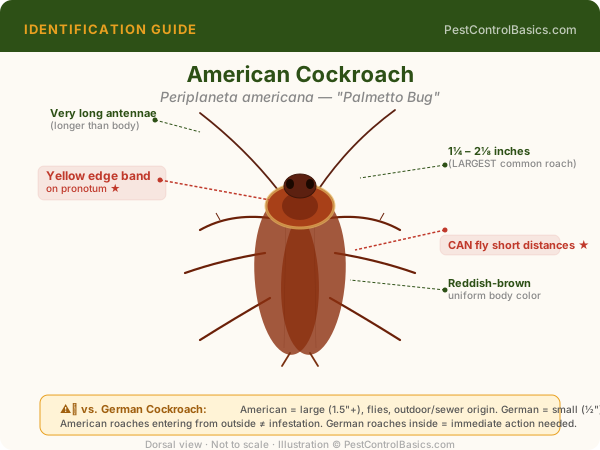
Cockroaches are humidity-sensitive in ways that drive their distribution within a home more than most homeowners realize. German cockroaches need access to water and prefer microclimates above about 70% relative humidity; American cockroaches range further into outdoor and crawlspace environments because they tolerate broader conditions; Oriental cockroaches are particularly tied to damp areas like basements, around floor drains, and along foundation perimeters. The practical implication is that dehumidification and moisture management aren't just adjacent to pest control — they're a direct intervention. A basement that runs at 50% humidity rather than 75% supports a fraction of the Oriental cockroach population that the wetter basement would; a kitchen with a fixed undersink leak supports a population that wouldn't exist with the leak repaired. This is the reason competent pest inspections include moisture meter readings and probe inspections of pipe penetrations: the moisture conditions are part of the diagnosis, not background context. Homeowners who address chronic moisture issues — running dehumidifiers in basements, repairing slow leaks, improving bathroom ventilation, sealing crawlspace vapor barriers — often see cockroach pressure drop substantially without any direct pest treatment, simply because the microclimate that supported the population is no longer available.