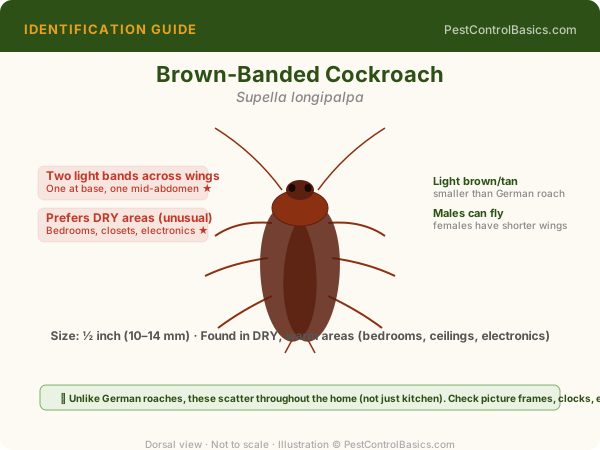
❓ Common Questions About 🪳 Brown-Banded Cockroach
How do I confirm I actually have this pest (not something similar)?
The most reliable confirmation is a physical specimen — capture one and compare to reference images on this page. For cryptic pests (bed bugs, termites), look for secondary signs: frass, shed skins, mud tubes, or bites with a specific pattern. When uncertain, a professional inspection is faster than months of misidentification.
Can I treat this myself or do I need a professional?
DIY is effective for small, accessible infestations caught early. Professionals are worth the cost when: the infestation is inside wall voids or structural elements, multiple rooms are affected, you have health-risk pests (hantavirus, venomous species), or DIY has already failed twice.
How long until the infestation is completely gone?
Expect 3–8 weeks for most infestations with proper treatment. Insects with dormant life stages (pupae, eggs) extend the timeline because those stages are impervious to most insecticides. Follow-up treatments at 2 and 4 weeks catch each new cohort as they emerge.
What's the most common mistake people make treating this pest?
Treating only the visible pest population while ignoring the harborage site, entry point, or breeding location. Killing adults provides temporary relief but the population rebuilds from hidden egg cases, pupae, or new arrivals through unaddressed entry points.
Sanitation thresholds that actually matter for cockroach control
Sanitation advice for cockroach control is often delivered as a generic 'keep things clean,' which is unhelpful because cockroaches will survive in almost any kitchen. The specific sanitation interventions that change population dynamics: eliminate standing water (drips, condensation, pet bowls left overnight), reduce harborage clutter (cardboard, paper bags, stored items behind appliances), and remove the secondary food sources cockroaches rely on overnight (uncleaned pet food bowls, grease accumulation on stovetops and behind ranges, spilled dry goods inside cabinets). German cockroaches can survive on the food residues most kitchens leave overnight; the goal isn't sterility but reducing the food available to a point where bait is more attractive than ambient resources. This is what makes bait programs work — competition with food, not absence of food.
How resistance develops and how to slow it down
Pesticide resistance is now common enough across major pest categories — cockroaches, bedbugs, mosquitoes, certain ant species, some flies — that treatment recommendations have shifted to account for it. Resistance develops through repeated exposure to a single active ingredient class; the surviving population reproduces, and over generations the population shifts toward resistance. Slowing resistance development requires rotating active ingredient classes (not just brands), using full label rates rather than reduced rates, and avoiding routine prophylactic spraying when it isn't needed. The EPA mode-of-action (MoA) classification on product labels helps with rotation: alternating between products in different MoA classes is more effective than alternating brand names within the same class. For homeowners, the practical translation is: don't use the same product month after month; if you're spraying regularly, rotate among at least two unrelated chemistries; and don't spray when monitoring suggests no active population.
Species identification matters more than people think
Treatment that works for German cockroaches frequently fails for American or Oriental cockroaches, and vice versa. German cockroaches are indoor-breeding, kitchen and bathroom-dwelling, and respond well to gel baits at harborage. American and Oriental cockroaches typically breed outdoors or in basements, moist crawlspaces, and sewers, and enter from outside — perimeter exterior treatment matters as much as interior bait. Brown-banded cockroaches favor warmer, drier areas (electronics, upper cabinets, behind picture frames) rather than kitchens and bathrooms, and bait placement needs to follow. A correct identification before treatment, ideally with a sticky monitor catch confirming species, saves more time and money than any product upgrade. Most extension services will identify cockroach species from a photo or specimen at no charge.
Insect growth regulators (IGRs) and why they belong in cockroach programs
Adulticides kill adult cockroaches but don't affect eggs in oothecae. The population can rebound within weeks as new adults emerge from egg cases that were present during treatment. IGRs — hydroprene, pyriproxyfen, and a few others — interrupt the development cycle so emerging nymphs never reach reproductive maturity. Combined with bait, IGRs collapse the population over the full reproductive cycle rather than just removing what's currently adult. The cost is low and the residual is long (often 90+ days), so an IGR added to a bait program is one of the highest-leverage additions a DIY practitioner can make. Many commercial IGR products are point-source (small disks placed in harborage) rather than broadcast, which keeps human exposure minimal.
Choosing the right product formulation for the situation
Active ingredient gets most of the attention, but formulation often determines outcome. The same active ingredient in different formulations performs very differently: microencapsulated formulations last longer on porous surfaces and reduce human re-entry exposure, wettable powders give the longest residual on porous substrates but leave visible residue, suspended concentrates give a balance of residual and appearance, dusts are uniquely effective in wall voids and dry harborage but should never be broadcast indoors, baits are appropriate when pests must transport active to the colony or nest, and aerosols are appropriate for direct contact and quick knockdown but rarely give meaningful residual. Choosing formulation by the substrate (porous vs. nonporous), the access (open spray vs. crack-and-crevice vs. void), and the goal (knockdown vs. residual vs. transferable) routinely improves outcomes more than upgrading active ingredient.
Why aerosol sprays often make cockroach problems worse
Aerosol cockroach sprays remain among the best-selling pest control products despite being among the worst choices for actual cockroach control. The mechanism of harm is twofold. First, aerosols are repellent: they drive surviving cockroaches deeper into harborage or into adjacent untreated areas, sometimes expanding the problem across a building. Second, aerosols are contaminating: bait acceptance drops significantly on surfaces with aerosol residue, so a homeowner who has been spraying and then switches to bait often gets poor results from the bait that would have worked on a clean substrate. Professional German cockroach programs specifically avoid aerosols for these reasons, relying on baits, dusts in voids, growth regulators, and targeted residuals applied via crack-and-crevice rather than space sprays. Homeowners who have been treating with aerosols and not getting results should typically stop spraying, wait a week or two for surfaces to ventilate, then switch to bait — counterintuitively, doing less initially produces better long-term results.
The role of caulk, sealant, and exclusion in long-term pest control
Sealing entry points is the most underrated pest control activity in residential settings, partly because it produces no immediate visible result and partly because it feels like home repair rather than pest control. The yield is substantial: a thoroughly sealed structure with appropriate exterior caulking, intact weatherstripping, sealed utility penetrations, and screen integrity has dramatically lower pest pressure than the same structure without those interventions. Specific high-yield targets include gaps around dryer vents, electrical and plumbing penetrations through exterior walls, gaps where siding meets foundation, mortar joints in older brick, weep holes in newer brick (which should be screened, not sealed), garage door bottom seals (where rodents commonly enter), and the gap above door thresholds where many ants and small insects pass. Materials matter: silicone-based caulk for moisture areas, polyurethane sealant for foundation cracks, copper mesh for rodent exclusion at utility penetrations (steel wool degrades), and 1/4-inch hardware cloth for larger openings. A weekend of methodical sealing in spring or fall — when activity is moderate and weather permits exterior work — produces lasting reduction that no single treatment matches.
Cockroach behavior after baiting: what to expect and why
When a German cockroach population is being controlled with bait, the visible behavior of survivors often confuses homeowners into thinking treatment isn't working. Late-stage symptoms include: increased daytime sightings (sick or dying roaches lose photophobic behavior), individuals appearing in unusual locations as harborage becomes overcrowded relative to a shrinking resource base, and a brief uptick in oothecae deposition as gravid females respond to stress. These signs reliably appear in successful treatments and shouldn't trigger product changes. The diagnostic that actually matters is sticky-monitor catch counts: a properly functioning bait program reduces catches week-over-week on a consistent downward slope, with full elimination typically taking six to twelve weeks depending on initial population size. Switching products or adding aerosols during the visible-distress phase frequently disrupts bait acceptance and lengthens the treatment timeline. The harder discipline is patience — letting the bait work through the population including the nymphs that hatch from oothecae deposited before treatment began — rather than escalating intervention in response to alarming individual sightings.
Ootheca management: why egg cases need separate handling
A cockroach egg case is a hardened protein structure designed specifically to protect developing nymphs from desiccation, predators, and many insecticides. Spray and bait treatments that kill adults very effectively often leave intact ootheca behind, and those ootheca hatch on their own schedule weeks after treatment. This is the predictable pattern behind the complaint that a successful initial treatment seemed to come back from nowhere a month later — it didn't come back from nowhere, it hatched from cases that survived. Effective programs anticipate this by scheduling follow-up treatment to catch the hatch, using insect growth regulators that disrupt nymph development even when adults aren't present, and physically removing visible ootheca during inspection. German cockroach ootheca are carried by the female until close to hatch, which gives bait programs a window of opportunity if adults are killed before deposition; American and Oriental species deposit ootheca much earlier, which means the cases are typically already separated from adults by the time treatment happens. Knowing which species you're dealing with shapes how you handle this problem.
Pet-safe pest control: what the label actually communicates
Pet-safe is a marketing phrase that does specific work, and the work it does is narrower than most pet owners assume. A product labeled pet-safe is generally one that, when used according to label directions and after the specified re-entry interval, presents a low risk of acute toxicity to pets at expected exposure levels. That is not the same thing as zero risk, and it doesn't say anything about chronic exposure, behavioral effects, or exposure to pets with unusual physiology, age, or pre-existing conditions. The other thing it doesn't account for is real-world misuse: pets that lick treated surfaces immediately after application, products applied in higher concentrations than directed, or applications in locations the label didn't anticipate. The practical interpretation is that pet-safe products are a reasonable choice when used carefully, but the safer overall practice with any pet in the home is to keep animals out of treatment areas until products are fully dry or absorbed, choose lower-toxicity formulations like bait stations over surface sprays when feasible, and ask explicitly about ingredients and re-entry intervals rather than relying on the label phrase alone.
Cockroach allergens: a health dimension separate from the infestation itself
Cockroach allergens are a documented trigger for asthma and allergic rhinitis, particularly in children, and the allergen load in a home doesn't disappear immediately when the cockroaches do. Cockroach saliva, droppings, and shed exoskeletons accumulate in dust, carpets, soft furnishings, and HVAC systems over the course of an infestation, and even after the population is eliminated, the allergen reservoir can persist for many months without active remediation. This is the underappreciated reason that aggressive cleaning after cockroach treatment matters beyond aesthetics. Steam cleaning of carpets, replacing HVAC filters, washing soft goods, and HEPA vacuuming visible harborage areas all reduce the post-treatment allergen burden. For households with members who have asthma or known cockroach allergy, the cleanup phase is arguably as important as the kill phase, and skipping it can mean that respiratory symptoms continue long after the visible pest problem is solved. Pest control companies focused exclusively on the insect side of the problem sometimes miss this dimension entirely, and homeowners with affected family members are usually best served by treating the cleanup as a coordinated second project rather than as a casual followup activity to the original treatment.