The short answer
- Leave the adults alone. They live a short time, don't feed on the lawn and can't bite; control is aimed at the larvae.[2][6][8]
- Confirm the larvae before doing anything. Cut a square of sod where grass is thinning or birds are digging, peel it back, and count the gray, legless larvae in the top inch or two of soil.[1][6]
- Treat only when counts pass about 25 larvae per square foot. A well-kept lawn can carry 40 per square foot without visible damage, while a thin, stressed lawn may need treatment at 10 to 15.[1][3][6][5][7]
- Dry out egg-laying sites. Turning off or cutting back irrigation around Labor Day, when females look for wet soil, kills eggs and young larvae; fixing drainage helps every year.[1][3]
- Keep the grass growing: regular summer watering, mowing and fertilizing let turf outgrow moderate feeding and recover.[1][4]
- If you do need an insecticide, timing matters more than product. Oregon State says treat in winter before damage shows, because spring treatments come too late; Washington State and Cornell give other windows, covered below.[1][4][2]
Related lawn pests and visitors
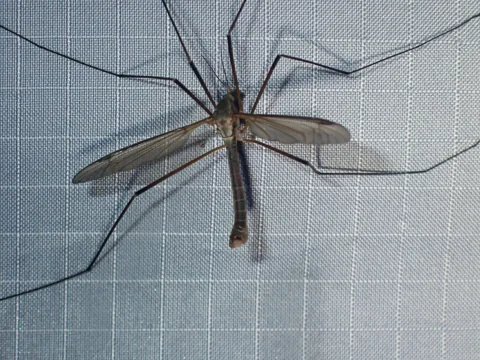 Crane Flies
Family Tipulidae (e.g., Tipula paludosa, the European crane fly)
Adult crane flies are long-legged, mosquito-shaped insects that bump around walls and ceilings in late summer. They don't bite or eat mosquitoes. The concern is the larvae of two invasive European species, called leatherjackets, which feed on lawn roots, crowns and shoots.
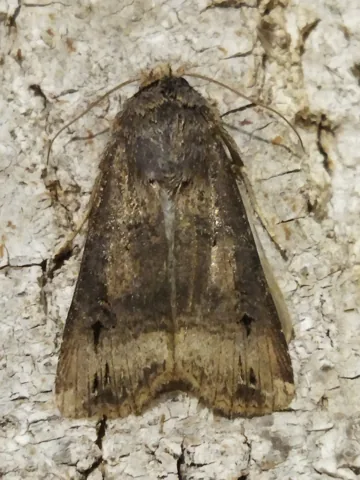 Cutworms
Several moth species, e.g., black cutworm (Agrotis ipsilon)
Cutworm is a general name for the caterpillars of dozens of moth species. They earned the name by cutting off young plants at or just below the soil line, and seedlings and fresh transplants suffer most.
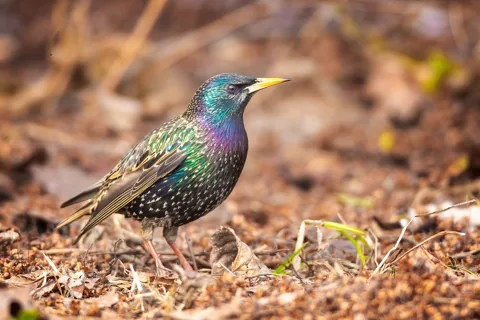 European starling
Sturnus vulgaris
The European starling is a stocky, short-tailed, non-native bird that now lives across most of North America. Pairs nest in building cavities and vents in spring, and fall and winter flocks of thousands foul roost sites with noise and droppings. The Missouri Department of Conservation lists it as invasive.
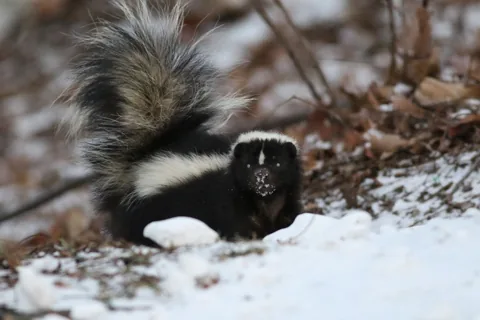 Striped skunk
Mephitis mephitis
The striped skunk is a cat-sized, black and white mammal that often lives under porches, decks and sheds. It digs lawns for grubs, sprays pets that corner it, and is one of the main wildlife carriers of rabies.
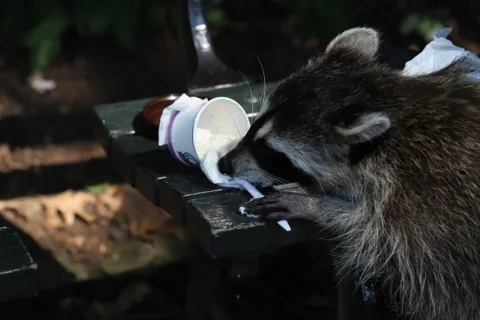 Raccoon
Procyon lotor
Raccoons are masked, ring-tailed mammals that adapt very well to towns and suburbs. They raid garbage and gardens, den in attics, chimneys and under decks, and can carry rabies and raccoon roundworm.
Is it crane flies?
Adult European crane flies are tan, mosquito-shaped flies with very long legs. Oregon State and Washington State give a body length of about 1 inch (Washington State: not counting the legs); the PNW Insect Management Handbook gives 14 to 19 mm for males and 19 to 25 mm for females. Cornell lists the adults at about 2.5 to 3 inches long.[1][6][3][2]
Crane flies aren't mosquitoes. They lack the piercing, tubelike mouth and the scales on the wing veins, and the Missouri Department of Conservation says they don't bite and are completely harmless.[8]
The larvae are the stage to look for: grayish to gray-brown, legless and wormlike, with tough leathery skin, no well-defined head, and fingerlike projections at the rear end. Full-grown larvae are 1 to 1.5 inches long.[1][3][4]
Not every crane fly is a pest. North America has hundreds of species; many have aquatic larvae that eat decaying plants, and some eat mosquito larvae. Cornell counts more than 250 native species in New York alone, some with clear wings like the pest species.[8][2]
The Northeastern IPM Center says native crane flies don't gather in large groups over turf, while big numbers of adults hovering over a lawn in May or September are a telltale sign of the European species. Because the two are hard to tell apart, ask your county extension office whether European crane fly has been found in your area.[7]
Surface feeding by leatherjackets can look like black cutworm damage, so dig and look for the larvae themselves. White grubs, armyworms and sod webworms have their own guides, linked below.[2]
Where the lawn-damaging species live
Both species came from Europe. The common European crane fly was first found in western North America in 1965, in British Columbia; Oregon State says the marsh crane fly reached the Pacific Northwest more recently.[1][3]
They do best where rain is plentiful. Oregon State lists British Columbia, Washington, Oregon and northern California, with outbreaks east of the Cascades in Bend, Oregon and Spokane, Washington; the PNW handbook says the range extends as far south as central California.[1][3]
In the Northeast, both species were first detected in New York in 2004. Within one or two seasons, 56 to 97% of the golf course putting greens and tee boxes surveyed were already infested by T. paludosa and 22 to 56% by T. oleracea. The Northeastern IPM Center describes the insect as not widespread in the Northeast but expanding.[10][2][7]
Both species are believed to have spread to North America in infested soil media. Washington State encourages the sod industry to treat in fall partly to avoid shipping crane flies to uninfested areas.[2][5]
The calendar that drives control
T. paludosa has one generation a year. T. oleracea, the marsh crane fly, has two, so in New York its adults appear in late April to early May as well as in late summer.[1][2][3]
- Adults: emerge from late summer into fall. Oregon State says adults are above ground in the first two weeks of September; Washington State's Hortsense says late August through September; the PNW handbook says emergence can begin anytime from July to mid-October; Cornell says late July to early September in New York.[1][4][3][2]
- Adult life span, by source: 2 to 14 days (PNW handbook) or about one month (Oregon State). Adults don't feed; they only drink water.[3][1]
- Eggs: females mate and lay eggs within 24 hours of emerging (PNW handbook, Washington State); Cornell says T. paludosa lays within 2 days of emergence and mating, while T. oleracea lays over about 2 weeks. Each female lays up to 300 eggs at or near the soil surface, choosing low, wet spots, often next to waterways.[3][5][2][1]
- Hatch: about 11 to 15 days (PNW handbook); Cornell gives 1.5 to 2 weeks for T. paludosa and about 1 week for T. oleracea. Eggs are extremely sensitive to drought.[3][2]
- Fall and winter: larvae feed in the top inch or so of soil and reach full size around December. They usually stay underground by day but come up to feed on damp, warm nights.[1][2][5]
- Spring: thinning starts as early as February, and the worst damage comes in March to May, depending on the source and region. Feeding stops between mid-May and mid-June, and larvae rest in the soil through summer before pupating.[1][3][6][5][2]
- Warm winters: Washington State notes the larvae hibernate only weakly, so a long warm spell in December or January can bring early feeding and lawn damage then.[5]
How to count leatherjackets
Counting larvae, not waiting for brown patches, is the basis of every extension recommendation here. Peck and Olmstead note that because damage thresholds are fairly high, scouting for the insect rather than its injury catches infestations earlier.[1][10]
- Where: low spots where water pools or soil stays near saturation, areas that were damaged before, and anywhere birds keep pecking or animals keep digging. Adults return to the same wet areas to lay eggs year after year.[1][3]
- When, by source: Oregon State says November through January, before significant damage; the PNW handbook says starting in November; Washington State's Hortsense says February or March, or mid-November to December if you've had serious infestations; the Northeastern IPM Center says March; Cornell says fall or spring.[1][3][4][7][2]
- How: with a square-ended shovel, cut a piece of sod 1 foot long, 1 foot wide and 1 inch deep, flip it over, and count larvae in the soil and thatch. Check three or four spots and average them, because heavy numbers in one spot can sit 15 feet from none.[1][6][7]
- Smaller samples: count the larvae in a 6-by-6-inch square and multiply by 4 to get larvae per square foot. With a 4-inch cup cutter, multiply each core's count by 11.5.[5][7]
- Flashlight check: Washington State suggests looking over the lawn at night with a flashlight, when larvae may be feeding at the surface.[6]
- In badly damaged, bare patches the larvae sit deeper in the soil than where some green grass remains.[6]
How many is too many
The common action threshold is 25 larvae per square foot in a well-maintained lawn (Oregon State, PNW handbook, Washington State). Hortsense phrases it as 25 to 30.[1][3][6][4]
Healthy turf can carry more. Washington State and the Northeastern IPM Center say lawns under good care have had 40 larvae per square foot with no visible damage, and Hortsense says well-established, properly watered and fertilized lawns rarely need treatment even above 25.[6][5][7][4]
Weak turf can carry less. Washington State says a generally unthrifty lawn may need treatment at 10 to 15 larvae per square foot; the Northeastern IPM Center says as few as 15 will damage stressed turf.[5][7]
Fall counts overstate spring risk. Washington State says natural controls often eliminate high fall populations, which is why it recommends checking again in early spring before deciding. In pastures it found larval numbers generally fall by half between mid-March and mid-May.[5]
Dry out the egg-laying window and keep the lawn growing
Cultural care comes first in every source here. Oregon State says properly maintained turf on well-drained soil resists crane fly damage, and well-kept lawns can outgrow moderate feeding.[1][4]
- Cut irrigation around Labor Day. Adults look for wet soil to lay eggs in early September, and eggs and young larvae die in dry soil. Oregon State says turning irrigation off or reducing it then cuts egg-laying and egg survival and is unlikely to stress turf in cooler, shorter days. The PNW handbook says in Oregon's Willamette Valley this often reduces larvae without hurting the lawn.[1][3]
- Plan seeding around it. Labor Day is also when many lawns are seeded or overseeded. The PNW handbook says that on a newly seeded site with a history of heavy infestations, a preventive treatment at seeding can protect the new grass.[3]
- Fix drainage. French drains and drain tiles with a catch basin or drywell can substantially improve saturated soil and lower crane fly numbers.[1]
- Mow once a week at 2 to 3 inches and return the clippings.[1]
- Water through summer. Oregon State suggests 0.25 inch four times a week (1 inch total) from Memorial Day to Labor Day, adjusted for weather, so roots and crowns damaged over winter and spring can recover.[1]
- Fertilize on schedule. Oregon State's table gives perennial ryegrass and Kentucky bluegrass four 1-pound nitrogen applications per 1,000 square feet a year (late May, late June, late September, late October), and tall and fine fescues 1 pound in spring and 1 in fall. Washington State notes that good fertilizer programs have masked crane fly feeding.[1][5]
- Keep up general turf care. The Northeastern IPM Center lists keeping soil pH at 6.0 to 6.8, overseeding thin spots, choosing grass suited to the site and removing thatch.[7]
Birds, skunks and raccoons
Starlings, robins and many predatory insects eat leatherjackets, and Washington State says they often bring numbers below damaging levels by spring. Washington State's Pacific County office recommends insecticide only when counts exceed 25 per square foot and birds aren't feeding on the larvae.[4][6]
The flip side: birds, skunks and raccoons digging and pecking for larvae tear up infested turf further. Treat that digging as a clue to sample, not as proof the lawn needs spraying. Our skunk guide covers the digging animals themselves.[1][3][2]
When to treat: sources disagree
Extension programs give different windows, partly because of climate and partly because some favor prevention and others favor treating only proven problems. Pick one window based on your counts; Washington State says two applications a year are unnecessary and not to treat in fall if an effective spring treatment was made.[4][5]
- Winter (Oregon State): apply in the winter months before damage shows. Spring applications won't prevent damage, because most of it has already happened, and winter treatment also lowers the risk to bees, which forage in spring and summer.[1]
- Early spring (Washington State): Hortsense says monitor in February or March and treat if counts exceed 25 to 30. Washington State's older bulletin EB0856 named April 1 to 15 for lawns and does not recommend fall preventive spraying for homeowners, since fall populations often crash on their own.[4][5]
- Late fall to early winter (Washington State, history of problems): Hortsense says if you've had serious infestations or missed the spring window, sample in mid-November to December, when larvae are about 3/8 inch long, and treat if counts exceed 25 to 30.[4]
- September to October (Cornell, New York): preventive applications are best at egg laying or while larvae are small and active near the surface; curative applications can go on in May once heavy feeding populations are found. Where T. oleracea is present, Cornell says a late fall application targets both species and both of its generations.[2]
- In Cornell field trials against T. paludosa, five of the tested products gave at least 70% control of young larvae in autumn in both trials, while only two stood out against full-grown larvae in spring (details in the next section).[9]
What insecticide trials and labels show
Read and follow the label; it is the law. Oregon State says some crane fly insecticides need a state applicator's license and that you may need repeated applications over several years for complete control.[1]
- Home-use active ingredients listed by the PNW handbook include carbaryl, chlorantraniliprole, imidacloprid, indoxacarb, lambda-cyhalothrin, pyrethrins and plant essential oils; it marks bifenthrin as restricted use. Oregon State's table also lists esfenvalerate, clothianidin and thiamethoxam.[3][1]
- Autumn trials (Cornell, two years): bifenthrin, carbaryl, chlorantraniliprole, clothianidin and trichlorfon gave at least 70% control of young larvae in both trials. Results varied for azadirachtin, Beauveria bassiana, cyfluthrin, dinotefuran, imidacloprid, imidacloprid plus bifenthrin and indoxacarb.[9]
- Spring trials: clothianidin and dinotefuran worked best against fourth-instar larvae; imidacloprid, indoxacarb and trichlorfon gave variable results.[9]
- Lower-toxicity options: Hortsense lists an azadirachtin-plus-pyrethrins product for home use, and the PNW handbook notes some pyrethrin and plant essential oil formulations are OMRI-listed for organic use. In the Cornell trials azadirachtin's results varied.[4][3][9]
- Neonicotinoids: the PNW handbook notes some have been banned from use on public properties.[3]
- Protect bees and water. Many lawn insecticides on these lists are toxic to bees and aquatic life. Mow or remove flowering weeds before treating, and don't apply bee-toxic products while weeds or flowers are blooming in or around the lawn.[1][4]
Beneficial nematodes and other biologicals
The PNW handbook lists beneficial nematodes as the biological control option for European crane fly. Published results are modest. In a British laboratory and greenhouse study, Heterorhabditis bacteriophora killed 28% of T. paludosa larvae after 4 weeks and 65% after 8 weeks, against 100% for a chemical standard at 4 weeks.[3][11]
Crane fly larvae also fight back. In a German lab study, T. oleracea larvae walled off (encapsulated) about 80% of Steinernema feltiae nematodes injected at one per larva, and 33 to 34% at 20 per larva.[12]
In the same British study, one strain of the fungus Metarhizium robertsii killed all larvae within 4 weeks, while strains of Beauveria bassiana and two other fungi didn't infect them; the authors see potential for the fungus, but it was a lab and greenhouse result. If you try nematodes, the beneficial nematode guide covers species choice, storage and watering them in.[11]
Repairing a damaged lawn
Grass usually recovers once the larvae stop feeding in late spring, but weeds can move into the weakened areas. Regular summer watering is what helps damaged crowns and roots come back.[4][1]
For badly damaged lawns, Washington State's Pacific County office suggests power raking to remove thatch and overseeding with a mix of half fine fescue and half ryegrass at 3 to 4 pounds per 1,000 square feet. Power raking or aerating also cuts up and kills leatherjackets.[6]
Keep sampling the same spots for the next few years. Oregon State says larval survival swings with moisture, bird predation and other factors, so a quiet year doesn't mean the problem is gone.[1]
Common questions
- Do crane flies damage lawns?
- The adults don't. Their larvae, leatherjackets, eat grass roots, crowns and blades from fall to spring, and in wet, low-lying areas can kill the turf by April or May.[6][1]
- Should I spray the adult crane flies?
- No. Adults live only a short time and are harmless; management should target the larvae.[2][8]
- How many crane fly larvae per square foot is too many?
- Usually more than 25 in a well-kept lawn. Healthy turf has carried 40 without damage, while stressed turf may be hurt by 10 to 15.[1][6][5][7]
- What's the best time to treat for crane fly larvae?
- Sources differ: Oregon State says winter, before damage shows; Washington State says early spring after sampling, or November to December if you've had serious problems; Cornell says September to October to prevent, or May to cure.[1][4][2]
- Will stopping watering get rid of crane flies?
- It helps. Turning off or reducing irrigation around Labor Day, when females lay eggs, dries the soil and kills eggs and young larvae, but water the lawn again through the following summer.[1][3]
- Do beneficial nematodes work on leatherjackets?
- They're listed as an option, but in a laboratory and greenhouse study one nematode species killed 65% of larvae after 8 weeks, slower and lower than a chemical standard.[3][11]
Photo credits
- Crane Flies: (c) Louis Imbeau, some rights reserved (CC BY) — via iNaturalist, CC BY 4.0
- Cutworms: (c) SteveM4560, some rights reserved (CC BY) — via iNaturalist, CC BY 4.0
- European starling: (c) egorbirder, some rights reserved (CC BY) — via iNaturalist, CC BY 4.0
- Striped skunk: (c) Richard Poort, some rights reserved (CC BY) — via iNaturalist, CC BY 4.0
- Raccoon: (c) Steven Bodzin, some rights reserved (CC BY) — via iNaturalist, CC BY 4.0
Sources
- Oregon State University Extension Service, “Managing Crane Fly in Lawns, EM 9296 (Kowalewski, Edmunds, McDonald and Braithwaite, September 2020).” extension.oregonstate.edu/sites/default/files/documents/em9296.pdf (accessed 2026-11-10)
- Cornell University, College of Agriculture and Life Sciences, Integrated Pest Management, “European Crane Flies (Tipula paludosa and Tipula oleracea), Ornamental IPM Fact Sheet (updated May 2026).” cals.cornell.edu/integrated-pest-management/outreach-education/fact-sheets/european-crane-flies-tipula-paludosa-and-tipula-oleracea-ornamental-ipm-fact-sheet (accessed 2026-11-10)
- Pacific Northwest Pest Management Handbooks (Oregon State, Washington State and University of Idaho Extension), “Turfgrass-Crane fly (European crane fly), Pacific Northwest Insect Management Handbook.” pnwhandbooks.org/insect/hort/turfgrass/turfgrass-crane-fly (accessed 2026-11-10)
- Washington State University Extension, “Lawn and Turf: European Crane Fly (Hortsense).” hortsense.cahnrs.wsu.edu/fact-sheet/european-crane-fly/ (accessed 2026-11-10)
- Washington State University Cooperative Extension, “European Crane Fly: A Lawn and Pasture Pest, EB0856 (Antonelli and Stahnke, revised July 1998).” rex.libraries.wsu.edu/view/pdfCoverPage?instCode=01ALLIANCE_WSU&filePid=13332957230001842&download=true (accessed 2026-11-10)
- Washington State University Extension, “European Craneflies Prolific Here (Pacific County, 2014).” extension.wsu.edu/pacific/2014/02/european-craneflies/ (accessed 2026-11-10)
- Northeastern IPM Center and New York State IPM Program, Cornell University, “European Crane Fly, School IPM Best Practices (reviewed February 2020).” www.northeastipm.org/schools/pests/european-crane-fly/ (accessed 2026-11-10)
- Missouri Department of Conservation, “Large Crane Flies (Field Guide).” mdc.mo.gov/discover-nature/field-guide/large-crane-flies (accessed 2026-11-10)
- Pest Management Science (PubMed 18416446), “Peck DC, Olmstead D, Morales A. Application timing and efficacy of alternatives for the insecticidal control of Tipula paludosa Meigen, a new invasive pest of turf in the northeastern United States. Pest Manag Sci 2008;64(10):989-1000.” pubmed.ncbi.nlm.nih.gov/18416446/ (accessed 2026-11-10)
- Journal of Economic Entomology (PubMed 19449646), “Peck DC, Olmstead D. Invasive Tipula in turfgrass of the northeast United States: geographic distribution and local incidence three years after detection. J Econ Entomol 2009;102(2):652-8.” pubmed.ncbi.nlm.nih.gov/19449646/ (accessed 2026-11-10)
- Pest Management Science (PubMed 22740286), “Ansari MA, Butt TM. Evaluation of entomopathogenic fungi and a nematode against the soil-dwelling stages of the crane fly Tipula paludosa. Pest Manag Sci 2012;68(10):1337-44.” pubmed.ncbi.nlm.nih.gov/22740286/ (accessed 2026-11-10)
- Journal of Invertebrate Pathology (PubMed 9170347), “Peters A, Ehlers RU. Encapsulation of the entomopathogenic nematode Steinernema feltiae in Tipula oleracea. J Invertebr Pathol 1997;69(3):218-22.” pubmed.ncbi.nlm.nih.gov/9170347/ (accessed 2026-11-10)