The short answer
- Pull on the dead grass. If the sod lifts like a loose carpet and C-shaped white grubs lie in the soil underneath, it's white grubs. If the stems snap off at the crown and are hollow with sawdust-like frass inside, it's billbugs.[3][9][2]
- Push a can with both ends cut out into the edge of a yellowing patch and fill it with water. Chinch bugs float to the top within a few minutes.[12][10]
- Pour 1 to 2 fluid ounces of dish soap in a gallon of water over a square yard of turf. Sod webworms, armyworms, cutworms, chinch bugs and adult billbugs come to the surface within about 10 minutes.[1]
- Count before you treat. University of California guidelines say lawns tolerate moderate numbers of most insect pests, and many insects found in turf are not pests at all.[1]
Lawn insect profiles
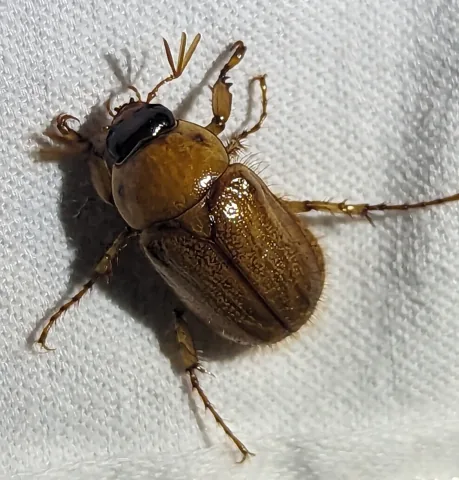 Masked Chafers
Cyclocephala species (northern masked chafer, C. borealis; southern masked chafer, C. lurida)
Masked chafers are native North American beetles whose larvae, called white grubs, feed on turfgrass roots. The adults don't feed at all; the grubs do the damage, mostly in late summer and fall.
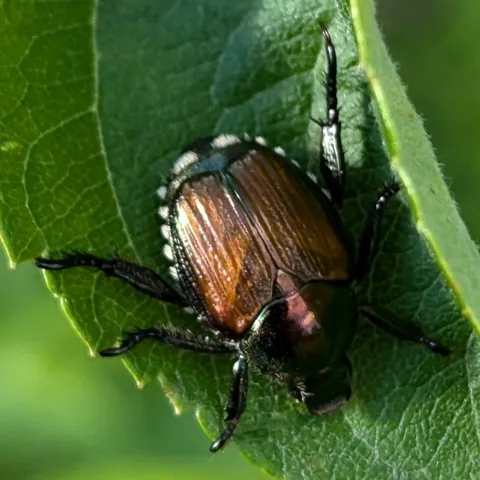 Japanese Beetle
Popillia japonica
The Japanese beetle damages landscapes twice: metallic green adults chew the leaves, flowers and fruit of hundreds of plants in early summer, and their white grubs feed on grass roots underground. A review of its biology calls it the most widespread and destructive insect pest of turf, landscapes and nursery crops in the eastern United States.
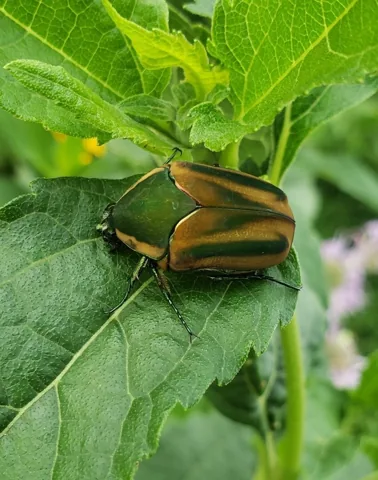 Green June Beetle
Cotinis nitida
Green June beetles are large, metallic green scarabs that cruise a few feet above lawns on summer days with a loud buzz. They are harmless to people; the adults damage ripe fruit, and their oversized grubs burrow in lawns rich in organic matter.
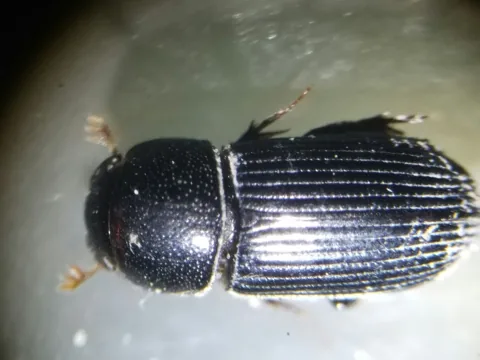 Black Turfgrass Ataenius
Ataenius spretulus
The black turfgrass ataenius is a small scarab beetle whose tiny white grubs feed on grass roots. It is mainly a golf course pest of greens, tees and fairways, and it only occasionally damages home lawns.
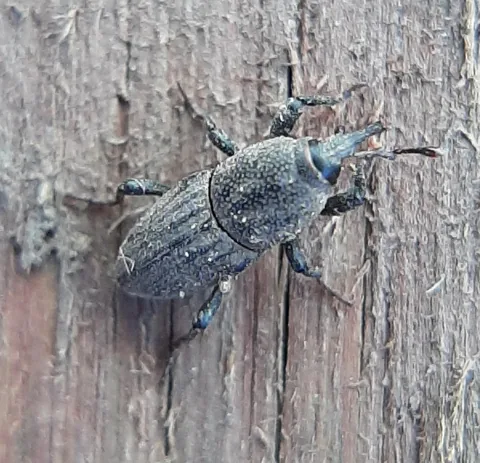 Billbugs
Sphenophorus species, e.g., S. parvulus (bluegrass billbug) and S. venatus vestitus (hunting billbug)
Billbugs are small weevils with a long snout. Their legless grubs bore inside grass stems and later feed on crowns and roots, killing scattered patches that are one of the most commonly misdiagnosed lawn problems.
No photo yet
Annual bluegrass weevil
Listronotus maculicollis
The annual bluegrass weevil is a tiny snout beetle whose larvae bore into and eat short-mown annual bluegrass on golf course greens, tees and fairways; it has spread from the Northeast into the Midwest and South, but Illinois Extension says home lawns are not at risk of damaging injury.
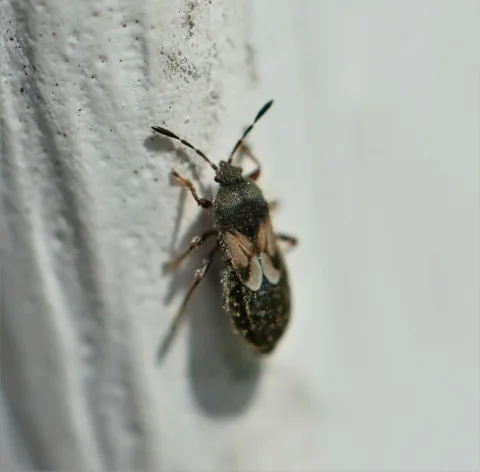 Southern Chinch Bug
Blissus insularis
The southern chinch bug is a tiny sap-sucking bug and the most important insect pest of St. Augustinegrass lawns in the southern United States. Feeding groups kill grass in spreading, irregular patches, often first in hot, dry, sunny spots.
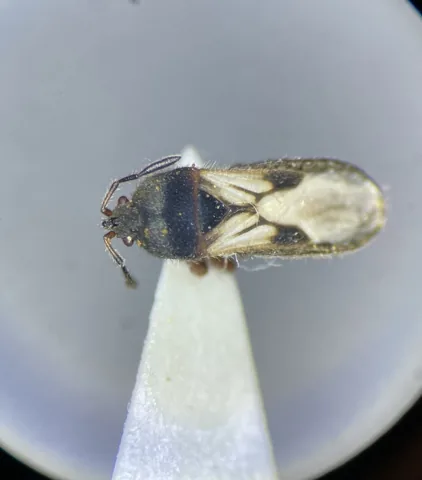 Hairy chinch bug
Blissus leucopterus hirtus
The hairy chinch bug is the chinch bug of northern lawns. Adults and nymphs hide in the thatch and suck sap from grass stems, and the saliva they inject clogs the plant's water-conducting tissue, so patches turn yellow, then brown, and can die in hot, dry weather even when watered.
No photo yet
Western chinch bug
Blissus occiduus
The western chinch bug is a small black true bug that has become a serious pest of buffalograss lawns in Nebraska and, more recently, of zoysiagrass. It feeds on sap in the grass crowns, and damage shows up as patches that yellow and then dry to straw brown.
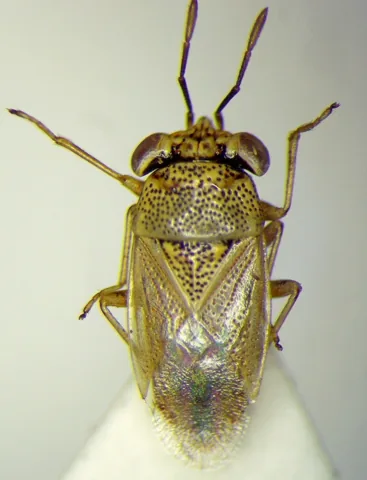 Bigeyed Bugs
Geocoris species (e.g., G. punctipes)
Bigeyed bugs are small true bugs that hunt mites, aphids, whiteflies and insect eggs on low-growing plants. They resemble chinch bugs, and they're sometimes sprayed by mistake.
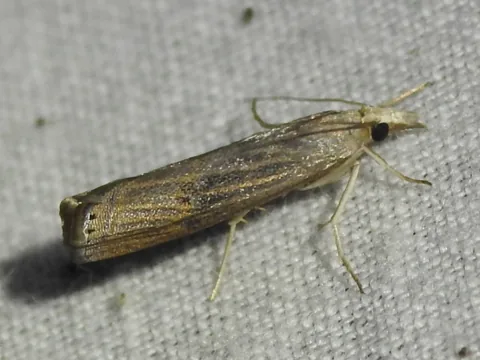 Sod Webworms
Crambinae lawn moths, e.g., Parapediasia teterrella (bluegrass sod webworm), Pediasia trisecta and Crambus species
Sod webworms are caterpillars of small, pale lawn moths with snout-like mouthparts. The larvae hide in silk-lined tunnels in the thatch by day and chew grass blades at night, leaving small brown patches that can merge during dry summers.
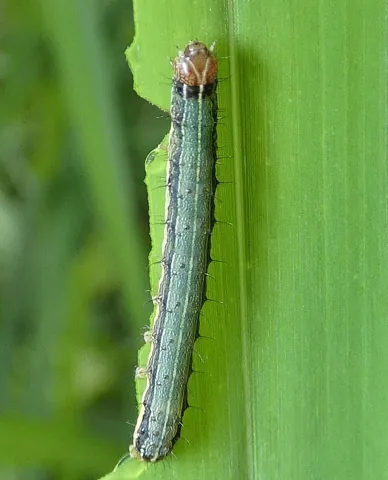 Fall Armyworm
Spodoptera frugiperda
Fall armyworms are moth caterpillars that prefer grasses. Often noticed in late summer, large numbers can turn a green lawn brown in a few hours or practically overnight, and they feed and move in groups, which is how they earned the armyworm name.
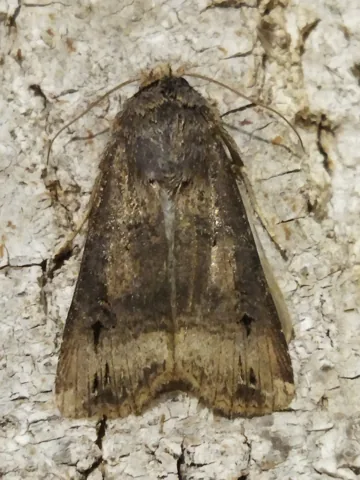 Cutworms
Several moth species, e.g., black cutworm (Agrotis ipsilon)
Cutworm is a general name for the caterpillars of dozens of moth species. They earned the name by cutting off young plants at or just below the soil line, and seedlings and fresh transplants suffer most.
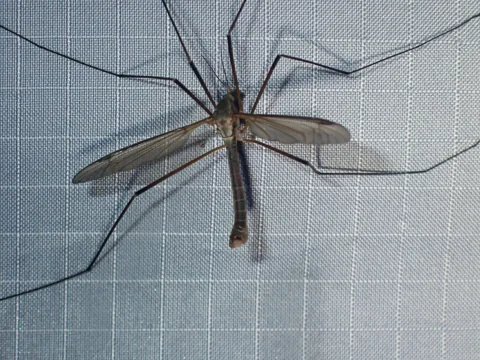 Crane Flies
Family Tipulidae (e.g., Tipula paludosa, the European crane fly)
Adult crane flies are long-legged, mosquito-shaped insects that bump around walls and ceilings in late summer. They don't bite or eat mosquitoes. The concern is the larvae of two invasive European species, called leatherjackets, which feed on lawn roots, crowns and shoots.
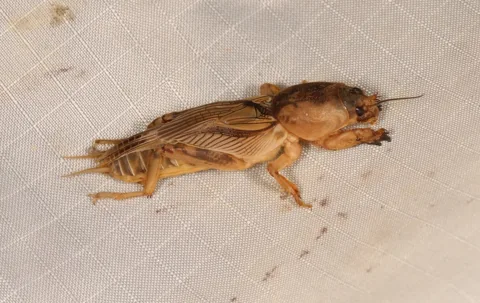 Mole Crickets
Neoscapteriscus species (tawny, southern and shortwinged mole crickets; N. vicinus shown)
Tawny and southern mole crickets are introduced species, thought to have arrived from South America in ships' ballast and first found in Southeastern port towns in the late 1800s and early 1900s. They are now serious turf pests in the sandy coastal Southeast: both tunnel just under the lawn, uprooting and drying out grass, and the tawny mole cricket also feeds on grass roots and shoots.
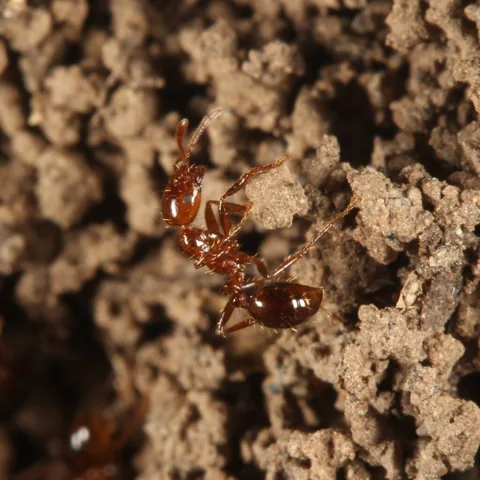 Red Imported Fire Ant
Solenopsis invicta
The red imported fire ant is an aggressive stinging ant that infests most of the southern United States and parts of California, building mounds in open, sunny areas such as lawns, parks and roadsides. USDA APHIS says imported fire ants came from South America, probably in soil on cargo ships, and now infest more than 367 million acres in Alabama, Arkansas, California, Florida, Georgia, Louisiana, Mississippi, North Carolina, Oklahoma, South Carolina, Tennessee, Texas, Virginia and Puerto Rico.
Read the damage pattern first
The shape and location of the damage narrows the list before you dig. Look at where the patches are (sun, shade, wet spots, along pavement), how they feel underfoot and whether the grass is cut, chewed or simply dying in place.[12][18][5]
- Sod pulls up or rolls back like a loose carpet, the ground feels spongy and the roots are gone: white grubs. Missouri says damage is usually noticed in late July to early August.[3][7][6]
- Spotty dead patches that pull up easily, with stems that break off at the crown, are hollow and hold light brown frass: billbugs. Missouri calls billbug damage one of the most commonly misdiagnosed turf problems.[4][9]
- Irregular patches that turn yellow, then brown, keep spreading and don't green up with watering, worst in hot sun along sidewalks, driveways and slopes: chinch bugs.[11][12][13][10]
- Small brown patches (Penn State says up to the size of a baseball) with grass blades chewed off near the soil, silk-lined tunnels in the thatch and sometimes pencil-sized holes where birds probed: sod webworms.[15][5]
- A wide area that looks scorched or scalped, often in late summer, with only stems left as the caterpillars move across the lawn. Clemson says they can turn green turf brown in a few hours: fall armyworms.[14][5]
- Small circular brown spots 1 to 2 inches across around a burrow, with blades cut off close to the ground: cutworms.[5]
- Turf that thins from February and dies out by April and May in wet, low-lying areas of a Pacific Northwest lawn, with birds working the spot: European crane fly larvae (leatherjackets).[18][19]
- Loosened soil, tunneling and small mounds, with roots so badly eaten that heavily infested turf has almost none left: mole crickets.[20][4]
- Piles of soil with thin, dry grass around them: ants. UMass says the mounds are mostly unsightly, though tunneling can break roots and dry out the soil, and large mounds can smother grass.[21][22]
Birds, skunks and moles as clues
Animals tearing at the lawn are often the first sign of a soil insect. Treat them as a reason to dig and look, not as proof.[7][6]
- Skunks, raccoons and armadillos digging up sod point to grubs. Clemson notes the digging itself can do significant damage, and Missouri says skunks and raccoons often dig for grubs.[6][3]
- Penn State lists skunks, crows or moles feeding on turf as a good indication of grubs, but warns that moles also eat earthworms and insects on shallow tree roots, so moles alone don't confirm grubs.[7]
- Birds probing a lawn, leaving pencil-sized holes in brown patches, can mean sod webworms.[15]
- Heavy bird activity on Pacific Northwest turf is a common clue to crane fly larvae, and Oregon State says birds, skunks and raccoons forage for the larvae in infested areas.[19][18]
The tug test: grubs or billbugs?
Grab a handful of dead or dying grass at the edge of a patch and pull straight up. What breaks, and what you see when it does, separates the two root-zone beetles.[9][2]
- Grubs: the roots are eaten away, so a whole section of sod lifts or rolls back like carpet. Look in the soil just below for whitish, C-shaped larvae with brown heads and six legs.[3][7][1]
- Billbugs: the grass breaks off at the crown, and the stems are hollow and packed with sawdust-like frass. Utah State calls this the tug test and says it is one of the easiest ways to detect billbug larvae.[9][4]
- Why they differ: UC IPM says billbug larvae feed higher up on the roots than white grubs, so billbug-damaged turf pulls up more easily because it breaks at the crown.[2]
- Check the larva: billbug larvae are legless, cream colored, with a red-brown head and only up to about 1/3 inch long. White grubs have six legs and lie in a C shape.[9][8][1]
- Look for frass too: UC IPM says fine, whitish, sawdust-like frass on the soil surface at the base of plants is a billbug sign, and where you find it you should dig for larvae.[2]
Square-foot dig: counting grubs and leatherjackets
Root-feeding grubs, billbug larvae and black turfgrass ataenius don't come up for soap, so you have to dig. UC IPM's guidance is to cut beneath the thatch and look at the soil around roots and crowns.[1]
- Clemson's method: cut three sides of a 12-inch square with a stout knife or shovel, fold the flap back, and check the root zone and the top 1 to 3 inches of soil.[6]
- Penn State's method: lift a square foot of turf and soil 2 to 4 inches deep in several spots, look through soil, thatch and turf, then press the sod back in place and water it so it doesn't dry out.[7]
- Sample several spots and average them. Grub problems tend to repeat in the same limited areas where adult beetles prefer to lay eggs.[6][1]
- Timing for grubs: Penn State says sampling in August through early September gives the best read for a curative treatment, while grubs are small and near the surface.[7]
- Leatherjackets (crane fly larvae) are counted the same way, in the top 2 inches of soil with a shovel. The crane fly guide covers where and when to sample in the Northwest.[19][18]
- Billbug larvae: Utah State suggests a trowel or golf-course cup cutter once larvae have left the stems, checking the thatch and top few inches of soil.[9]
The flotation test for chinch bugs
Chinch bugs hide down in the thatch, so they're easy to miss by looking. Wisconsin Extension calls flotation a reliable way to find them.[12]
- Make the tool: cut both ends out of a coffee can or a one-gallon can.[12][10]
- Where: work the edges of yellowing or dying areas, not the dead centers, and test several parts of the lawn.[12][10]
- How: twist or push the can through the turf and thatch into the soil, fill it with water and stir the grass with your hand. Keep an inch or two of water above the grass, adding more if it drains.[12][10]
- Watch: adults and nymphs float up. Clemson says both should surface within five minutes.[10][12]
- No can? Ohio State and Clemson describe kneeling and spreading the grass apart until you can see the soil, then watching for adults and nymphs. Repeat in several spots.[11][10]
- Sort what floats: bigeyed bugs, a predator of chinch bugs, often turn up in the same test and are commonly mistaken for them.[12]
The soap flush for caterpillars and other surface insects
Soapy water irritates insects living in the thatch and drives them up where you can see and count them. The recipes vary a little by source but the idea is the same.[1][14]
- UC IPM: 1 to 2 fluid ounces of liquid dish soap in 1 gallon of water, sprinkled as evenly as possible over 1 square yard. Insects move to the surface within 10 minutes.[1]
- Where: pour on healthy-looking turf right next to the damage, where the insects are still feeding. NC State says sod webworms surface at the border between living and dead turf.[14][17]
- What it finds: cutworms, sod webworms, armyworms, southern chinch bugs, fiery skipper larvae and billbug adults (UC IPM), and mole crickets (Clemson).[1][20]
- What it misses: white grubs, black turfgrass ataenius larvae and billbug larvae don't respond, so dig for those instead.[1]
- Mole crickets: Clemson's version uses 1 to 2 fluid ounces of dish soap per gallon over a 2-square-foot area, then maps the infested spots, since mole crickets return to the same areas year after year.[20]
- Sod webworm extras: Minnesota suggests sinking a can with both ends removed and pouring the soapy water into it. Look for dew sparkling on webs early in the morning, and for silk tunnels with green fecal pellets in the thatch.[16][15]
Billbug adults on sidewalks and in traps
- Adult billbugs are snout beetles 1/4 to 1/2 inch long, black to red-brown, with a long curved snout and elbowed, clubbed antennae.[9][2]
- Utah State says they can't fly but move around a lot and are often seen on short-mown grass or sidewalks on warm days.[9]
- A simple pitfall trap (two nested cups buried to the lip) catches adults in spring. Utah State uses it for early detection, before larvae do damage.[9]
- Adults also turn up in a soap flush, though the larvae don't.[1]
What your count means
Treatment thresholds differ by source, region, grass type and lawn health, so take these as rough guides. A well-watered, well-fed lawn tolerates more insects than a stressed one.[6][7][1]
- White grubs: Penn State uses 5 to 10 per square foot as a common threshold for curative treatment, depending on species. Clemson says healthy turf can tolerate 5 to 7, and UC IPM's California threshold is 6 per square foot. Clemson adds that 6 to 8 Japanese beetle grubs per square foot may be a safer trigger where animals are digging.[7][6][1]
- Billbugs: UC IPM gives 1 to 10 larvae per square foot depending on grass and climate. Utah State uses an average of one or more larvae per cup-cutter sample.[1][9]
- Chinch bugs: Wisconsin says treatment may be needed at an average of two to three per flotation test. Clemson gives 20 to 25 per square foot for southern chinch bugs in St. Augustinegrass, and UC IPM 15 nymphs and adults per square foot.[12][10][1]
- Sod webworms: UC IPM gives 15 per square yard. Minnesota says to tolerate up to 12 larvae per square foot, while NC State recommends control at three or four per square foot.[1][16][17]
- Armyworms and cutworms: UC IPM gives 5 per square yard.[1]
- Crane fly larvae: the PNW handbook's action threshold for well-maintained turf is 25 per square foot. Missouri says a healthy lawn can support 40 to 60.[19][4]
- Black turfgrass ataenius: UC IPM gives 40 per square foot. Missouri notes it is mainly a golf course pest, not a home lawn one.[1][3]
Season calendar: what to check when
Timing differs by region, so use this as a guide to when each pest is usually active, then confirm with a test. The months below are the ones each source gives for its own area.[7][5][9]
- Late winter to spring: crane fly damage shows from February and peaks in April and May in wet Northwest lawns (Oregon State). Mole cricket adults fly and males call for about an hour after sunset in late March and April (Clemson, South Carolina). Billbug adults emerge in March and April (Utah State) or April and May (UC IPM).[18][20][9][2]
- Spring: grub damage can show in April and May from larger overwintered grubs (Penn State). Chinch bug adults that spent the winter become active, and Missouri says they emerge in May.[7][11][5]
- June and July: billbug larvae are found during peak activity and damage (Missouri). Minnesota says to scout for sod webworms in June and again in early August. Chinch bug damage runs in hot, dry weather from June into September (Ohio State).[4][16][11]
- Late summer: grub damage is usually noticed late July to early August (Missouri), and Penn State's survey window is August to early September. Sod webworm damage is worst in July and August (Penn State). Late-stage billbug larvae peak in July and August (Utah State). Fall armyworm problems build in late summer and fall (Missouri).[3][7][15][9][5]
- Fall: grub damage shows again in September and October (Penn State). Mole crickets do their main damage from late August to October as they mature (Clemson). Crane fly adults emerge in late August through September (Missouri), and the PNW handbook says to start checking turf for larvae in November.[7][20][4][19]
When it isn't insects
If the tests come up empty, look elsewhere before you treat. Insecticide won't fix drought, disease or poor growing conditions.[1][4]
- Drought: chinch bug and billbug damage both look like drought stress. Washington State says chinch bug-damaged grass doesn't recover with watering, and Utah State notes billbugs are more common in dry areas, so the two problems can occur together.[13][9][11]
- Disease: Missouri lists drought and disease along with chinch bugs and white grubs as problems billbug damage gets confused with, and Ohio State says chinch bug feeding can resemble turf disease.[4][11]
- Harmless insects: UC IPM says many insects in turf aren't pests. Missouri says many native crane flies don't damage lawns, and Texas A&M notes that a fire ant mound has no opening in the center, unlike most ant mounds.[1][4][23]
Where to go next
Once you've found and counted the insect, go to its guide for control, timing and product choices. Those pages carry the treatment details, so they aren't repeated here.[1]
- White grubs: see the lawn insects page for grub timing (preventive in spring, curative in late summer) and the beneficial nematodes guide. Japanese beetle grubs are covered in the Japanese beetle guide.[6]
- Chinch bugs: the chinch bug guide covers thatch, watering, resistant grasses, bigeyed bugs and insecticide timing.[10][12]
- Armyworms, sod webworms and cutworms: see the lawn caterpillar guide and the cutworm guide.[14][15]
- Crane flies: the crane fly guide covers sampling, the Northwest calendar and treatment timing.[18][19]
- Billbugs: the billbug profile covers treatment timing. UC IPM and Missouri both point to spring, when overwintered adults are active and before eggs are laid.[2][4]
- Ants: see the ant hills in the lawn guide, or the fire ant guide if the mound is fluffy worked soil with no opening in the center.[21][23]
Common questions
- How do I know if I have grubs or something else?
- Pull up a patch of dead grass. With grubs the roots are gone, the sod lifts like carpet and white C-shaped larvae with six legs lie in the soil below. If the stems snap at the crown and are hollow with sawdust-like frass, look for billbugs instead.[3][9][2]
- What is the soap test for lawn insects?
- Mix 1 to 2 fluid ounces of dish soap into a gallon of water and pour it over a square yard of turf beside the damage. Caterpillars, chinch bugs and adult billbugs come up within about 10 minutes. White grubs don't, so dig for them.[1][14]
- How do I check for chinch bugs?
- Push a can with both ends removed into the edge of a yellowing patch, fill it with water and stir the grass. Chinch bugs float to the surface, usually within five minutes.[12][10]
- Is it chinch bugs or drought?
- Both turn grass yellow and brown in hot, dry weather, but Washington State says chinch bug damage doesn't recover with watering. A flotation test settles it.[13][12]
- Why are skunks digging up my lawn?
- Usually they're after white grubs. Dig a square foot of sod where they've been digging and count what you find before you decide on treatment.[3][6][7]
Photo credits
- Masked Chafers: (c) Michael, Antoni and Nihat Hinczewski, some rights reserved (CC BY) — via iNaturalist, CC BY 4.0
- Japanese Beetle: (c) Emmett Collins-Sussman, some rights reserved (CC BY) — via iNaturalist, CC BY 4.0
- Green June Beetle: Jack, public domain (CC0), via iNaturalist
- Black Turfgrass Ataenius: (c) Tyler Bishop, some rights reserved (CC BY) — via iNaturalist, CC BY 4.0
- Billbugs: (c) Will Linnard, some rights reserved (CC BY) — via iNaturalist, CC BY 4.0
- Southern Chinch Bug: (c) Barry Cottam, some rights reserved (CC BY) — via iNaturalist, CC BY 4.0
- Hairy chinch bug: (c) Jacob Weston, some rights reserved (CC BY) — via iNaturalist, CC BY 4.0
- Bigeyed Bugs: (c) Konstantin Grebennikov, some rights reserved (CC BY) — via iNaturalist, CC BY 4.0
- Sod Webworms: (c) Sam Kieschnick, some rights reserved (CC BY) — via iNaturalist, CC BY 4.0
- Fall Armyworm: (c) Helio Lourencini, some rights reserved (CC BY) — via iNaturalist, CC BY 4.0
- Cutworms: (c) SteveM4560, some rights reserved (CC BY) — via iNaturalist, CC BY 4.0
- Crane Flies: (c) Louis Imbeau, some rights reserved (CC BY) — via iNaturalist, CC BY 4.0
- Mole Crickets: (c) Laura Gaudette, some rights reserved (CC BY) — via iNaturalist, CC BY 4.0
- Red Imported Fire Ant: (c) Natasha Taylor, some rights reserved (CC BY) — via iNaturalist, CC BY 4.0
Sources
- University of California Statewide IPM Program, “Monitoring and Treating Insects and Mites (Turfgrass Pest Management Guidelines).” ipm.ucanr.edu/agriculture/turfgrass/monitoring-and-treating-insects-and-mites/ (accessed 2026-11-10)
- University of California Statewide IPM Program, “Billbugs (Turfgrass Pest Management Guidelines).” ipm.ucanr.edu/agriculture/turfgrass/billbugs/ (accessed 2026-11-10)
- University of Missouri Extension, “Turfgrass Insects, IPM1020, page 2: annual white grub species.” extension.missouri.edu/publications/ipm1020/2 (accessed 2026-11-10)
- University of Missouri Extension, “Turfgrass Insects, IPM1020, page 3: other subsurface-feeding insects.” extension.missouri.edu/publications/ipm1020/3 (accessed 2026-11-10)
- University of Missouri Extension, “Turfgrass Insects, IPM1020, page 4: surface-feeding insects.” extension.missouri.edu/publications/ipm1020/4 (accessed 2026-11-10)
- Clemson Cooperative Extension Home & Garden Information Center, “White Grub Management in Turfgrass (HGIC).” hgic.clemson.edu/factsheet/white-grub-management-in-turfgrass/ (accessed 2026-11-10)
- Penn State Extension, “White Grubs in Home Lawns.” extension.psu.edu/white-grubs-in-home-lawns (accessed 2026-11-10)
- NC State Extension, “White Grubs in Turf.” content.ces.ncsu.edu/white-grubs-in-turf (accessed 2026-11-10)
- Utah State University Extension, “Billbugs in Turfgrass.” extension.usu.edu/planthealth/research/billbugs (accessed 2026-11-10)
- Clemson Cooperative Extension Home & Garden Information Center, “Chinch Bugs (HGIC 2487).” hgic.clemson.edu/factsheet/chinch-bugs/ (accessed 2026-11-10)
- Ohio State University Extension, “Chinch Bugs in Turfgrass, HYG-2503 (D. J. Shetlar, J. Andon, 2012).” ohioline.osu.edu/factsheet/HYG-2503-11 (accessed 2026-11-10)
- University of Wisconsin-Extension, “Turfgrass Disorder: Chinch Bug, A3237 (R. C. Williamson, D. L. Mahr, R. Kachadoorian, 2005).” hort.extension.wisc.edu/files/2023/12/A3237-1.pdf (accessed 2026-11-10)
- Washington State University Extension, “Lawn and Turf: Chinch bugs (Hortsense).” hortsense.cahnrs.wsu.edu/fact-sheet/chinch-bugs/ (accessed 2026-11-10)
- Clemson Cooperative Extension Home & Garden Information Center, “Armyworms: Identification, Damage, & Control in Turfgrass (HGIC 2159, updated July 15, 2025).” hgic.clemson.edu/factsheet/armyworms-identification-damage-control-in-turfgrass/ (accessed 2026-11-10)
- Penn State Extension, “Sod Webworms in Home Lawns.” extension.psu.edu/sod-webworms-in-home-lawns (accessed 2026-11-10)
- University of Minnesota Extension, “Sod webworms (reviewed 2018).” extension.umn.edu/yard-and-garden-insects/sod-webworms (accessed 2026-11-10)
- NC State Extension, “Sod Webworms in Turf.” content.ces.ncsu.edu/sod-webworm-in-turf (accessed 2026-11-10)
- Oregon State University Extension Service, “Managing Crane Fly in Lawns, EM 9296 (Kowalewski, Edmunds, McDonald and Braithwaite, September 2020).” extension.oregonstate.edu/sites/default/files/documents/em9296.pdf (accessed 2026-11-10)
- Pacific Northwest Pest Management Handbooks (Oregon State, Washington State and University of Idaho Extension), “Turfgrass-Crane fly (European crane fly), Pacific Northwest Insect Management Handbook.” pnwhandbooks.org/insect/hort/turfgrass/turfgrass-crane-fly (accessed 2026-11-10)
- Clemson Cooperative Extension Home & Garden Information Center, “Mole Cricket Management in Turfgrass (HGIC).” hgic.clemson.edu/factsheet/mole-cricket-management-in-turfgrass/ (accessed 2026-11-10)
- UMass Amherst Center for Agriculture, Food, and the Environment, “Ants in Lawns (P. Vittum, revised May 2011).” www.umass.edu/agriculture-food-environment/home-lawn-garden/fact-sheets/ants-in-lawns (accessed 2026-11-10)
- University of Minnesota Extension, “Ants.” extension.umn.edu/insects-infest-homes/ants (accessed 2026-11-10)
- Texas A&M AgriLife Texas Imported Fire Ant Research and Management Project, “How to Tell if You Have Fire Ants.” fireant.tamu.edu/learn/how-to-tell/ (accessed 2026-11-10)