The short answer
- Confirm it's an armadillo: cone-shaped holes 1 to 3 inches deep and 3 to 5 inches wide, uprooted flowers, and burrows 7 to 8 inches across, mostly dug from dusk through early morning in summer.[3][6][10][2]
- Fence the areas that matter most, such as flower beds and gardens: at least 3 feet high, buried 12 to 18 inches (deeper in sandy soil), with the top slanted outward at about 40 degrees so they can't climb over. Missouri Extension adds that a single electric strand 3 to 4 inches off the ground can protect a garden.[4][6][7]
- Trap with a two-door cage trap set along a path to the burrow or against a fence or wall, with two 6-foot boards angled out from the opening as wings to funnel the armadillo in. Bait isn't needed.[4][6][7][8][10]
- Don't count on grub control, repellents or scare devices. Insects make up most of the diet but armadillos also eat earthworms and many other soil animals, no repellents or toxicants are registered, and no frightening devices are known to work.[2][7][4][6]
- Check state law before you trap, shoot or move one. Some states, including North Carolina and South Carolina, don't allow trapped armadillos to be relocated.[10][6][1]
- Wear gloves if you handle an armadillo, alive or dead. CDC says some armadillos in the southern US carry the bacteria that cause leprosy, but the risk is very low and most people who have contact with armadillos are unlikely to get it.[12][9][10]
Related profiles
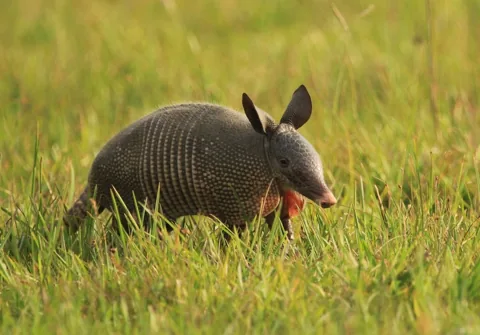 Nine-banded armadillo
Dasypus novemcinctus
The nine-banded armadillo is an armored, insect-eating mammal that has colonized much of the southern United States in the last 200 years. It roots through lawns, gardens and flower beds for insects and earthworms, and it digs burrows under foundations, slabs, driveways and pools.
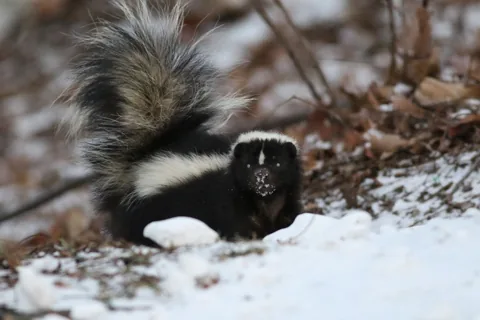 Striped skunk
Mephitis mephitis
The striped skunk is a cat-sized, black and white mammal that often lives under porches, decks and sheds. It digs lawns for grubs, sprays pets that corner it, and is one of the main wildlife carriers of rabies.
 Raccoon
Procyon lotor
Raccoons are masked, ring-tailed mammals that adapt very well to towns and suburbs. They raid garbage and gardens, den in attics, chimneys and under decks, and can carry rabies and raccoon roundworm.
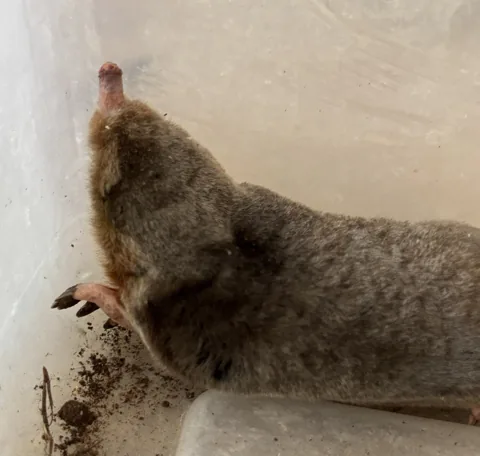 Moles
Talpidae (shown: eastern mole, Scalopus aquaticus; Scapanus species in the West)
Moles are small insect-eating mammals related to shrews, not rodents. They spend almost their whole lives underground hunting earthworms and insects, and their tunneling leaves raised ridges and mounds that disfigure lawns and gardens.
Why you're seeing armadillos now
The nine-banded armadillo is the only armadillo found in the US. It was first recorded in Texas in 1849 (Missouri Extension says it moved in from Mexico in the 1850s) and has spread north and east ever since. According to the North Carolina Wildlife Resources Commission, it crossed the Mississippi River in the early 1940s, showed up in western Tennessee in 1980 and reached North Carolina in the late 2000s.[6][11][10][7]
Eastern populations also have a second origin: a small group of animals released from captivity in Florida, which later merged with the animals spreading from Texas.[15]
A 2025 update of the range found armadillos now cover all of Missouri and are established in southern Iowa, all of South Carolina and Georgia and the western third of North Carolina, with expansion in Kansas, Illinois, Indiana, Kentucky and Tennessee. The authors' model shows room for further spread, especially in the eastern US.[11]
In North Carolina, confirmed sightings had reached 40 counties by the end of 2024, with breeding populations established in 8 western counties. The commission credits natural dispersal from Georgia, South Carolina and Tennessee rather than people moving them.[10]
Cold is the limit. Armadillos have little fur or body fat, don't hibernate and must dig for food, so long freezes kill them by cold or starvation. North Carolina's report links the spread there partly to fewer stretches of below-freezing weather.[7][9][10]
Is it an armadillo? Signs in the yard
Armadillos are about the size of an opossum, 8 to 17 pounds, with a bony shell and nine movable bands across the middle. They can't roll into a ball, and when startled they jump straight up, which is one reason so many are hit by cars.[1][6][9][10]
- Feeding holes: shallow, cone-shaped holes 1 to 3 inches deep and 3 to 5 inches wide, often several from a single visit.[3][6][10][8]
- Uprooted flowers and ornamentals, torn-up turf, disrupted insect mounds and broken yellowjacket nests. ICWDM notes that turf damage can be hard to tell from raccoon damage.[3][6]
- Burrows: 7 to 8 inches across and up to 15 feet long, under rock or brush piles, around stumps, in dense woods, and sometimes under foundations, slabs, driveways and pools. One armadillo often uses several burrows in an area.[2][7][3][6]
- Tracks: usually show the three front toes with sharp claw marks; the shell can drag and blur the prints.[1][7][9]
- Timing: in summer they're active from twilight through early morning; in winter they forage in the warmest part of the day.[2][8]
Will killing the grubs stop the digging?
Probably not on its own. Insects, especially larvae, make up more than 90% of an armadillo's diet, but it also eats earthworms, spiders, snails and other invertebrates, plus some fruit and small animals. Ants, beetles and their larvae, and flies are the main foods in Missouri.[2][10][9]
The sources split on how much a soil insecticide helps. ICWDM says controlling soil insects may reduce damage to turfgrass. Missouri Extension says removing the food source will often send armadillos elsewhere, but that clearing soil of all insects, worms and grubs isn't practical and may harm plants and other life. A Georgia county agent says treatment still may not work well because it won't kill everything, and calls it expensive and potentially dangerous.[4][7][8]
If you do use a soil insecticide, ICWDM says to follow the label carefully, both to make it work and to limit threats to non-target animals. The white grub profile linked below covers grub thresholds for lawns.[4]
Cover and lawn changes
Armadillos dig their burrows where there is cover, and prefer dense shade, brush, woods and creek or river edges with loose sandy or loamy soil. Removing brush and other ground cover near where you've seen activity makes the yard less attractive.[2][4][6]
Missouri Extension points out the trade-off: brushy areas are often good habitat for songbirds and other wildlife, and armadillo damage is usually localized and more a nuisance than an economic loss.[7]
Fencing: height, depth and slant
Armadillos burrow and climb, so a fence has to stop both. Fences work best around a defined area such as a flower bed, garden or poultry yard rather than a whole property.[7][10][4]
- Height: at least 3 feet above ground. Clemson notes armadillos can jump at least 3 to 4 feet high when provoked.[4][6]
- Depth: bury the bottom 12 to 18 inches, deeper in sandy soil.[4][6]
- Slant: angle the aboveground part outward at about 40 degrees to keep them from climbing over.[4][7]
- Electric option for gardens: a single strand 3 to 4 inches off the ground, per Missouri Extension. Take care where children play.[7]
- Poultry: protect eggs with proper housing or fencing, since armadillos occasionally eat poultry eggs.[4][3]
Trapping armadillos
Armadillos are hard to lure, so trap placement matters more than bait. Set the trap along a path to a burrow or along a fence, wall or the side of the house where the animal travels.[4][6][10][7]
Add wings: two boards (1 x 4 or 1 x 6 inches, about 6 feet long) set on edge and angled out from the trap opening to funnel the armadillo inside. A Georgia county agent suggests running the far end of one board up against a wall or fence.[4][7][6][8]
Bait is optional at best. Clemson and Missouri Extension say no bait is needed, especially with wings, but list overripe or spoiled fruit, rotten meat or mealworms if you want to try. The North Carolina commission cites a study in which unbaited cage traps caught armadillos as well as baited ones.[6][7][10][8]
- Trap size: ICWDM gives 10 x 12 x 32 inches for a single-door trap and 10 x 12 x 48 inches for a two-door trap; Missouri Extension gives 10 x 10 x 32 inches. Traps that open at both ends are preferred.[4][7][8]
- Use a sturdy, professionally made trap. ICWDM warns armadillos can destroy poorly built ones.[4]
- ICWDM also lists foothold traps, No. 220 body-gripping traps at burrow entrances and cable restraints. Some states restrict body-gripping trap sizes and their use in suburban areas, cable restraints are illegal in some states, and body-gripping traps shouldn't be set in burrows other animals use.[4]
State rules: relocating, shooting and permits
ICWDM says armadillos are unprotected in most states, but rules on trapping, relocation, night lights and firearms vary, so check with your state wildlife agency and local ordinances first.[1][4]
Relocation is often not allowed and rarely helps. ICWDM says relocation usually isn't practical and translocation isn't recommended; if it's legal and necessary, it says to move the animal at least 24 miles to suitable habitat. Missouri Extension calls relocation generally not a good idea.[5][7]
- North Carolina: relocating an armadillo is illegal; a trapped one must be released on the property where it was caught or euthanized. Trapping is allowed in the regulated trapping season (October 1, 2025 to February 28, 2026 for the current season), with a trapping license if you're not on your own property, or with a depredation permit or a licensed Wildlife Control Agent outside the season. Armadillos may be hunted year-round.[10]
- South Carolina: the Department of Natural Resources prohibits relocating or translocating trapped wildlife, so a trapped armadillo has to be humanely dispatched. There is no closed season on private land, but a hunting license is required, and night hunting is allowed only on properties registered with the department in advance.[6]
- Shooting: where it's legal to fire a gun, ICWDM and Clemson recommend a shotgun with No. 4 to BB-sized shot or a .22 rifle. Some states don't allow artificial lights for shooting at night, and local ordinances may bar firing a gun at all.[4][6][10][7]
- Euthanasia and disposal: ICWDM lists carbon dioxide as effective and says to check state rules on carcass disposal. Clemson points to state lists of wildlife removal services, which typically charge a fee.[5][6]
What doesn't work
Most of the shortcuts people try against armadillos have no registered product or evidence behind them.[4][7]
- Repellents: none are registered for armadillos, and the North Carolina commission says there are no known effective repellents.[4][7][10][6]
- Poisons: no toxicants are registered. North Carolina says poisoning is illegal and would kill other wild and domestic animals. Missouri Extension notes that no fumigants are registered for armadillos either.[4][10][7]
- Scare devices: no frightening devices are known to control armadillos.[4][6]
- Relocation, in states that allow it, mostly moves the problem; see the rules above.[5][7]
- Wiping out the food supply: ridding a lawn of all insects, worms and grubs isn't practical, and a soil insecticide won't kill everything.[7][8]
Leprosy risk: what CDC and the research say
CDC says that in the southern United States some armadillos are naturally infected with the bacteria that cause leprosy (Hansen's disease) and may be able to spread it to people, but the risk is very low and most people who come into contact with armadillos are unlikely to get it.[12]
Leprosy is rare in the US, with up to 225 cases a year, and most US patients were infected overseas. CDC's clinical guidance adds that several cases in the southern US in people who hadn't traveled were likely contracted from armadillos.[13][12]
The strongest evidence comes from a 2011 study in the New England Journal of Medicine: a strain of the bacterium found in 28 of 33 wild armadillos from five southern states was also found in 25 of 39 US patients who lived where armadillo exposure was possible, and the authors concluded leprosy may be a zoonosis in the region.[14]
Older guidance is more doubtful. Missouri Extension's guide says no conclusive evidence shows people can catch leprosy from armadillos and describes a hypothesis that both pick it up from soil; CDC's current position is the one given above.[7][12]
Infection rates vary by place. A 2009 survey of 500 armadillos in Mississippi, Alabama and Georgia found 0% to 10% infected per population, including some in eastern sites thought to be free of it. A 2024 study of 61 road-killed armadillos in Tennessee, near the northern edge of the range, found none with antibodies, giving no evidence that the range expansion is spreading leprosy.[15][16]
CDC says leprosy is hard to spread, about 95% of people can't get it because their immune system fights the bacteria off, and it's curable with a combination of antibiotics. Signs can take up to 20 years to appear and mainly affect the skin, nerves and lining of the nose.[12]
- Practical precautions: wear gloves if you must handle an armadillo, alive or dead, and avoid contact with its blood and body fluids. The North Carolina commission also advises gloves when gardening.[9][3][10]
- If you eat armadillo meat, cook it thoroughly, per the Missouri Department of Conservation.[9]
- CDC says healthcare providers diagnose leprosy with an exam that looks for skin patches lighter, darker or redder than normal skin that have lost feeling, confirmed with a skin or nerve sample.[12]
A plan for the yard
Damage is usually confined to one area, so concentrate on the beds or lawn being dug rather than the whole property.[7]
- Confirm the digger: look for 3- to 5-inch cone-shaped holes and 7- to 8-inch burrows, and check activity at dusk.[3][2][6]
- Clear brush and debris near the problem area to remove burrow cover.[4][6][7]
- Fence the beds or garden you care most about: 3 feet high, 12 to 18 inches deep, slanted out at 40 degrees, or a low electric strand.[4][6][7]
- Call your state wildlife agency and find out what's legal for trapping, release, shooting and disposal where you live.[1][10][6]
- Set a two-door cage trap with board wings on the armadillo's path, and wear gloves around the animal.[4][6][9]
- Expect new arrivals. Armadillos are still expanding their range, and North Carolina expects populations to become established in more counties in coming years.[11][10]
Common questions
- What do armadillo holes look like?
- Shallow, cone-shaped holes about 1 to 3 inches deep and 3 to 5 inches wide, often many in one night, along with uprooted plants. Burrows are much larger, 7 to 8 inches across.[3][6][2]
- What is the best bait for an armadillo trap?
- Usually none. Clemson and Missouri Extension say bait isn't needed when you use board wings, and a study cited by North Carolina found unbaited traps worked as well as baited ones. If you want bait, spoiled fruit, rotten meat or mealworms are the options sources mention.[6][7][10]
- Can you get leprosy from an armadillo?
- It's possible but very unlikely. CDC says some armadillos in the southern US carry the bacteria and several US cases were likely contracted from them, but the risk is very low. Wear gloves if you handle one.[12][13][9]
- Do armadillo repellents work?
- No repellents are registered for armadillos, and the North Carolina Wildlife Resources Commission says there are no known effective ones.[4][10]
- How high does an armadillo fence need to be?
- At least 3 feet, buried 12 to 18 inches deep and slanted outward at about 40 degrees. Clemson notes they can jump 3 to 4 feet when provoked.[4][6]
- Can I relocate an armadillo?
- Often not. North Carolina and South Carolina prohibit relocation, and ICWDM says it usually isn't practical; where it's legal, ICWDM says to go at least 24 miles.[10][6][5]
- Are armadillos moving north?
- Yes. A 2025 range update found them across all of Missouri, in southern Iowa and western North Carolina, and expanding in Illinois, Indiana, Kentucky and Tennessee. Hard freezes are the main limit.[11][7][10]
- How many babies do armadillos have?
- Four identical young of the same sex, in one litter a year in March or April after about 150 days of gestation.[2][7][6]
Photo credits
- Nine-banded armadillo: (c) Leo Lagos, some rights reserved (CC BY) — via iNaturalist, CC BY 4.0
- Striped skunk: (c) Richard Poort, some rights reserved (CC BY) — via iNaturalist, CC BY 4.0
- Raccoon: (c) Steven Bodzin, some rights reserved (CC BY) — via iNaturalist, CC BY 4.0
- Moles: (c) Sam Kieschnick, some rights reserved (CC BY) — via iNaturalist, CC BY 4.0
Sources
- Internet Center for Wildlife Damage Management, “Armadillos: identification, legal status and range.” icwdm.org/species/other-mammals/armadillos/ (accessed 2026-11-10). Run by university wildlife damage specialists; the armadillo module is based on the armadillo chapter by D.W. Hawthorne (USDA APHIS) in Prevention and Control of Wildlife Damage (Hygnstrom, Timm, Larson, eds., 1994).
- Internet Center for Wildlife Damage Management, “Armadillo Biology.” icwdm.org/species/other-mammals/armadillos/armadillo-biology/ (accessed 2026-11-10). Run by university wildlife damage specialists; the armadillo module is based on the armadillo chapter by D.W. Hawthorne (USDA APHIS) in Prevention and Control of Wildlife Damage (Hygnstrom, Timm, Larson, eds., 1994).
- Internet Center for Wildlife Damage Management, “Armadillo Damage Identification.” icwdm.org/species/other-mammals/armadillos/armadillo-damage-identification/ (accessed 2026-11-10). Run by university wildlife damage specialists; the armadillo module is based on the armadillo chapter by D.W. Hawthorne (USDA APHIS) in Prevention and Control of Wildlife Damage (Hygnstrom, Timm, Larson, eds., 1994).
- Internet Center for Wildlife Damage Management, “Armadillo Damage Prevention and Control Methods.” icwdm.org/species/other-mammals/armadillos/armadillo-damage-prevention-and-control-methods/ (accessed 2026-11-10). Run by university wildlife damage specialists; the armadillo module is based on the armadillo chapter by D.W. Hawthorne (USDA APHIS) in Prevention and Control of Wildlife Damage (Hygnstrom, Timm, Larson, eds., 1994).
- Internet Center for Wildlife Damage Management, “Armadillo Handling.” icwdm.org/species/other-mammals/armadillos/armadillo-handling/ (accessed 2026-11-10). Run by university wildlife damage specialists; the armadillo module is based on the armadillo chapter by D.W. Hawthorne (USDA APHIS) in Prevention and Control of Wildlife Damage (Hygnstrom, Timm, Larson, eds., 1994).
- Clemson Cooperative Extension Home & Garden Information Center, “Armadillos, HGIC 2912 (P.D. Johnson, T.C. Belken; published November 2024).” hgic.clemson.edu/factsheet/armadillos/ (accessed 2026-11-10)
- University of Missouri Extension, “Armadillos in Missouri: Techniques to Prevent and Control Damage, G9456 (R.A. Pierce II).” extension.missouri.edu/media/wysiwyg/Extensiondata/Pub/pdf/agguides/wildlife/g09456.pdf (accessed 2026-11-10)
- University of Georgia Cooperative Extension, “Armadillo Control (W. Chance, Houston County Extension Agent).” openscholar.uga.edu/record/26413/files/ArmadilloControl.pdf (accessed 2026-11-10)
- Missouri Department of Conservation, “Nine-Banded Armadillo (field guide).” mdc.mo.gov/discover-nature/field-guide/nine-banded-armadillo (accessed 2026-11-10)
- North Carolina Wildlife Resources Commission, “North Carolina Armadillo Range Expansion 2007 through 2024 (C. Brett, Furbearer Biologist).” www.ncwildlife.gov/wildlife-management/armadillo-range-expansion-2007-2024-report/open (accessed 2026-11-10)
- USGS Publications Warehouse, “Current distribution of the nine-banded armadillo (Dasypus novemcinctus) in the United States (DeGregorio and Deshwal, Diversity 17:138, 2025).” pubs.usgs.gov/publication/70269931 (accessed 2026-11-10)
- Centers for Disease Control and Prevention, “About Leprosy (Hansen's Disease).” www.cdc.gov/leprosy/about/index.html (accessed 2026-11-10)
- Centers for Disease Control and Prevention, “Clinical Overview of Leprosy.” www.cdc.gov/leprosy/hcp/clinical-overview/index.html (accessed 2026-11-10)
- PubMed, “Probable zoonotic leprosy in the southern United States (Truman et al., N Engl J Med 2011;364:1626-33).” pubmed.ncbi.nlm.nih.gov/21524213/ (accessed 2026-11-10)
- PubMed, “Is leprosy spreading among nine-banded armadillos in the southeastern United States? (Loughry et al., J Wildl Dis 2009;45:144-52).” pubmed.ncbi.nlm.nih.gov/19204343/ (accessed 2026-11-10)
- PubMed, “Seroprevalence of Leprosy in Nine-Banded Armadillos from Tennessee, USA, 2021-22 (Turner et al., J Wildl Dis 2024;60:758-762).” pubmed.ncbi.nlm.nih.gov/38757151/ (accessed 2026-11-10)