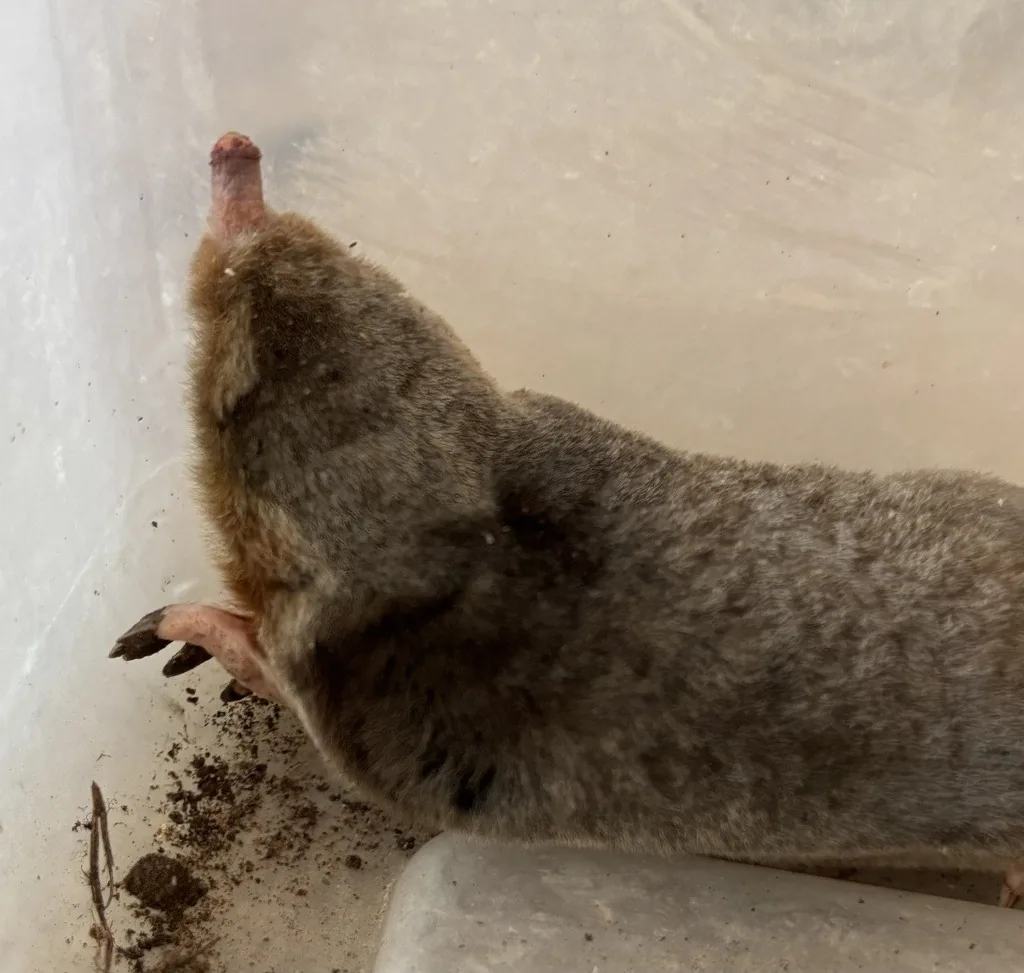
How to identify it
- A cylindrical body with a hairless, pointed snout, tiny eyes hidden in fur, and no external ears.[1][2]
- Large, spadelike front feet, broader than they are long in the eastern mole, with heavy claws for digging.[1][2]
- Short, dense, velvety fur and a short, nearly bare tail; male eastern moles are about 7 inches long.[1][2]
- Mounds are round and volcano-shaped, often in a line, and surface tunnels show as raised ridges that collapse when stepped on.[1][2][4]
Look-alikes
| Look-alike | How to tell them apart |
|---|---|
| Pocket gopher | Gopher mounds are crescent- or kidney-shaped with a plugged hole off to one side; gophers don't push up surface ridges, and unlike moles they feed on plant roots.[6][1][4] |
| Vole | Voles are plant-eating rodents that use open runways through grass; they often use mole tunnels and cause plant damage blamed on moles.[1][4] |
Where it lives
The eastern mole is the most common species, ranging across most of the eastern United States to Wyoming and Colorado; broad-footed, Townsend's and coast moles live west of the Rockies.[2][1]
Biology and life cycle
Moles have one litter a year of about 3 to 5 young, born mainly in early spring; they mature in about 10 months and may live 3 to 5 years.[3][1]
They are territorial and solitary, usually one per tunnel system except in the breeding season, and three to five per acre is considered an average to high density.[1][3]
Moles eat 70 to 100 percent of their body weight daily, mostly earthworms, grubs and other insects; plant material is eaten only incidentally.[3][1]
They are active year-round and most active after rain or watering, when soil is easy to dig; in dry spells they move to irrigated lawns.[1][3]
Damage and signs
- Tunneling dislodges plants and dries out their roots, and ridges and mounds disfigure turf and make mowing difficult.[1][4]
- Direct chewing damage to bulbs and roots is almost always caused by rodents such as voles or gophers, often using mole tunnels.[1][4]
- Structural damage is mostly limited to brick patios and pools, where digging can undermine them.[4]
Health risk
No diseases are known to be transmitted from moles to people; tunnels and mounds can create a tripping hazard.[4]
Control
Keep them out
Protect small, valuable beds with hardware cloth or 1/4-inch wire mesh buried about 2 feet deep with a lip bent outward; raised beds can get a wire-mesh bottom.[1][5]
Traps and physical control
Trapping is the most dependable method: set scissor-jaw, harpoon or pincer-style mole traps in straight, active tunnels, and follow the maker's instructions.[1][5]
Find active tunnels by tamping down short sections of ridge and watching which are raised again; set traps at least 18 inches from a mound.[1][5]
Pesticides
Grain baits rarely work because moles eat worms and insects; worm-shaped bromethalin gel baits placed in tunnels show more promise, used per the label.[1][5]
Castor oil repellents have shown some effect on eastern moles, but treated moles may simply move to the neighbor's lawn.[1][5]
When to call a professional
Aluminum phosphide burrow fumigant is a restricted-use pesticide for certified applicators and works poorly in porous, dry soil or shallow tunnels.[5][1]
Methods that don't work
Vibrating, sonic, magnetic and pinwheel devices haven't been shown to drive moles away.[1][5]
Home remedies such as broken glass, gum, mothballs, bleach or used cat litter in tunnels are ineffective, and some are environmentally hazardous.[1][5]
Flooding tunnels wastes water, and the mole plant, Euphorbia lathyris, is not recommended because it is poisonous and weedy.[1][5]
Killing lawn grubs with insecticide doesn't reliably reduce moles, which also eat earthworms; they may dig more while searching for food.[5][1]
Legal status
Moles are unprotected in most states; in California they are classified as nongame mammals that owners may control by legal means.[2][1]
Common questions
- Will killing grubs get rid of moles?
- Usually not. Moles also eat earthworms and other soil animals, and a lawn can be grub-free and still have moles.[5][1]
- Are moles rodents?
- No. Moles are insect-eating mammals related to shrews and bats, and they rarely eat plants.[1][2]
- Does one mound mean one mole?
- No. The number of mounds doesn't match the number of moles, and moles are territorial, so a yard often has only a few.[4][1]
Sources
- University of California Statewide IPM Program, “Moles (Pest Notes, Home and Landscape).” ipm.ucanr.edu/home-and-landscape/moles/ (accessed 2026-10-06)
- Internet Center for Wildlife Damage Management, “Moles: Identification.” icwdm.org/species/other-mammals/moles/ (accessed 2026-10-06). Run by university wildlife damage specialists (maintained at the University of Wisconsin-Stevens Point); species modules are based on Prevention and Control of Wildlife Damage (University of Nebraska Cooperative Extension, 1994).
- Internet Center for Wildlife Damage Management, “Mole Biology.” icwdm.org/species/other-mammals/moles/mole-biology/ (accessed 2026-10-06). Run by university wildlife damage specialists (maintained at the University of Wisconsin-Stevens Point); species modules are based on Prevention and Control of Wildlife Damage (University of Nebraska Cooperative Extension, 1994).
- Internet Center for Wildlife Damage Management, “Mole Damage Identification.” icwdm.org/species/other-mammals/moles/mole-damage-identification/ (accessed 2026-10-06). Run by university wildlife damage specialists (maintained at the University of Wisconsin-Stevens Point); species modules are based on Prevention and Control of Wildlife Damage (University of Nebraska Cooperative Extension, 1994).
- Internet Center for Wildlife Damage Management, “Mole Damage Prevention and Control Methods.” icwdm.org/species/other-mammals/moles/mole-damage-prevention-and-control-methods/ (accessed 2026-10-06). Run by university wildlife damage specialists (maintained at the University of Wisconsin-Stevens Point); species modules are based on Prevention and Control of Wildlife Damage (University of Nebraska Cooperative Extension, 1994).
- University of California Statewide IPM Program, “Pocket Gophers (Pest Notes, Home and Landscape).” ipm.ucanr.edu/home-and-landscape/pocket-gophers/ (accessed 2026-10-06)
- iNaturalist, “Scalopus aquaticus taxon page (order and family).” www.inaturalist.org/taxa/47014 (accessed 2026-10-06)