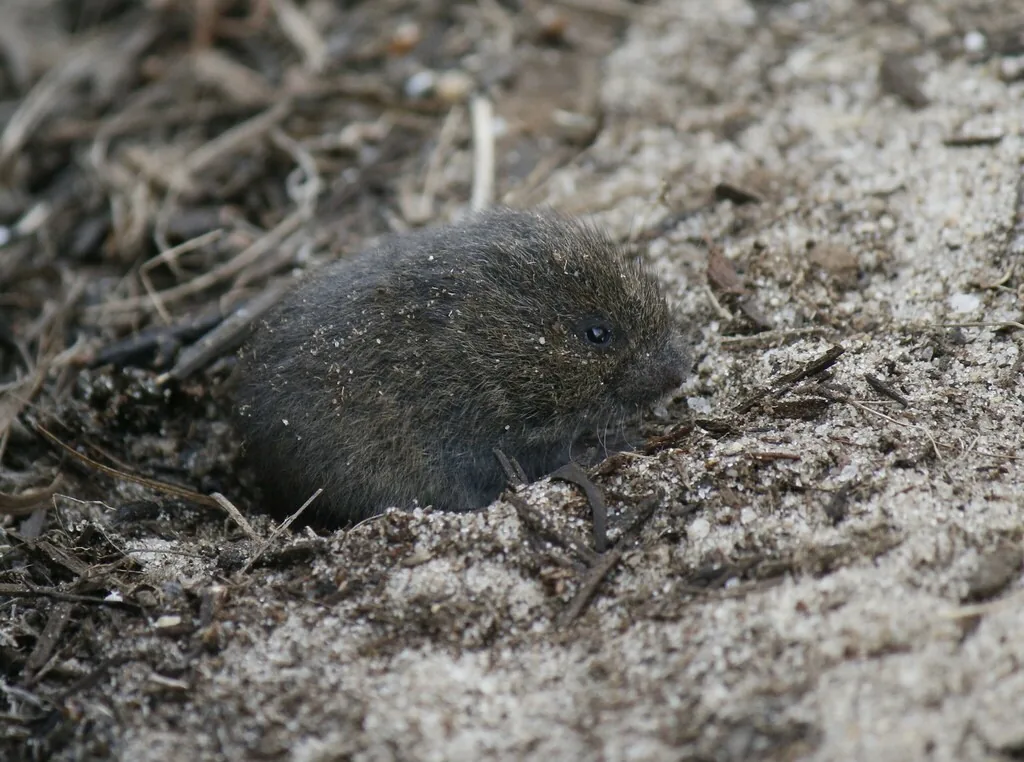
How to identify it
- A compact, heavy body with short legs, a short furred tail, small eyes and partly hidden ears.[1][2]
- Long, coarse fur that is usually blackish brown to grayish brown; fully grown voles measure about 5 to 8 inches including the tail.[1][2]
- Look for surface runways 1 to 2 inches wide connecting burrow openings about 1-1/2 to 2 inches across, usually hidden under grass or other cover.[1][4]
- Fresh grass clippings and greenish droppings about 3/16 inch long in the runways; the droppings turn brown or gray with age.[1]
Look-alikes
| Look-alike | How to tell them apart |
|---|---|
| House mouse | Voles are stockier, with a short tail and partly hidden ears, and they are poor climbers that usually stay outdoors rather than entering homes.[1] |
| Pocket gopher | Gophers leave closed dirt mounds and girdle trees mostly below ground; voles leave open burrow holes and runways and usually gnaw bark above ground.[1] |
| Mole | Moles are insect eaters with spadelike front feet that push up ridges and mounds; voles are plant-eating rodents that use surface runways.[6][1] |
Where it lives
Twenty-three vole species live in the United States, seven of them causing significant damage; the meadow vole is the most widely distributed, and the California vole is the most widespread in California.[2][1]
Biology and life cycle
Voles breed year-round, peaking in spring; females mature in 35 to 40 days, and litters usually hold 3 to 6 young.[1][3]
Most voles live less than a year, but populations often rise and crash in cycles every few years and have reached thousands per acre during outbreaks.[1][3]
They are active day and night all year and do not hibernate; under snow they tunnel through to the surface.[1][3]
They eat mostly grasses, other plants, bulbs and tubers, and gnaw bark and roots mainly in fall and winter.[1][3]
Damage and signs
- Voles feed on many garden crops, including lettuce, carrots, tomatoes, artichokes and sweet potatoes, and they damage turf and ground covers.[1][4]
- They gnaw bark of fruit and landscape trees near the soil line in irregular patches of marks about 1/8 inch wide; complete girdling can kill a tree.[1][4]
- Under snow, damage can extend a foot or more up the trunk and often goes unnoticed until spring.[1]
- Their chewing can puncture irrigation lines, and runways can divert irrigation water.[1][4]
- Voles only occasionally enter buildings, so they pose little threat to structures.[4]
Health risk
Voles pose no major public health hazard because they rarely contact people, but they can carry plague, tularemia and parasites such as mites and ticks; wear rubber gloves when handling them.[4][1]
Control
Prevention
Keep vole numbers from building by removing weeds, heavy mulch and dense ground cover, and mow lawns and grassy edges regularly.[1][5]
Keep a vegetation-free circle about 4 feet across around young trees and vines, pull mulch back from trunks, and clean up spilled bird seed.[1][5]
Keep them out
Wrap young trunks in hardware cloth cylinders of 1/4-inch mesh, buried about 6 inches and taller than expected snow.[5][1]
Protect a whole garden with 1/4-inch mesh fencing or flashing at least 12 inches high, with the bottom buried 6 to 10 inches.[1]
Traps and physical control
In small areas, set mouse snap traps at right angles across runways with the trigger in the runway, and cover them to protect birds.[1][5]
Pesticides
Toxic baits such as zinc phosphide are for heavy infestations over larger areas; UC IPM notes it is a restricted-use material for licensed applicators in non-residential turf and landscapes.[1][5]
Repellents containing capsaicin or castor oil give questionable results and must be applied before damage starts.[1][5]
What doesn't work on voles
Gas cartridges and other burrow fumigants fail because vole burrows are shallow and have many open holes.[1]
Ultrasonic and electromagnetic devices and flooding are ineffective, and no frightening device controls voles.[1][5]
Hawks, owls and other predators eat voles but rarely keep numbers below damaging levels around homes.[1][5]
Legal status
Voles are nongame mammals that can generally be controlled when they cause damage; check with your state wildlife agency for local rules.[2][1]
Common questions
- How do I know if I have voles or moles?
- Voles leave narrow surface runways through grass with open holes and clipped vegetation; moles push up soil ridges and volcano-shaped mounds.[1][6]
- Do voles come into the house?
- Rarely. They are poor climbers that live in grassy areas near buildings and only occasionally invade structures.[1][4]
- Why are there suddenly so many voles this year?
- Vole populations cycle and can surge to very high numbers in favorable years, so problems around homes usually come during outbreaks.[1][3]
Sources
- University of California Statewide IPM Program, “Voles (Pest Notes, Home and Landscape).” ipm.ucanr.edu/home-and-landscape/voles/ (accessed 2026-10-06)
- Internet Center for Wildlife Damage Management, “Voles: Identification.” icwdm.org/species/rodents/voles/ (accessed 2026-10-06). Run by university wildlife damage specialists (maintained at the University of Wisconsin-Stevens Point); species modules are based on Prevention and Control of Wildlife Damage (University of Nebraska Cooperative Extension, 1994).
- Internet Center for Wildlife Damage Management, “Vole Biology.” icwdm.org/species/rodents/voles/vole-biology/ (accessed 2026-10-06). Run by university wildlife damage specialists (maintained at the University of Wisconsin-Stevens Point); species modules are based on Prevention and Control of Wildlife Damage (University of Nebraska Cooperative Extension, 1994).
- Internet Center for Wildlife Damage Management, “Vole Damage Identification.” icwdm.org/species/rodents/voles/vole-damage/ (accessed 2026-10-06). Run by university wildlife damage specialists (maintained at the University of Wisconsin-Stevens Point); species modules are based on Prevention and Control of Wildlife Damage (University of Nebraska Cooperative Extension, 1994).
- Internet Center for Wildlife Damage Management, “Vole Damage Prevention and Control Methods.” icwdm.org/species/rodents/voles/vole-damage-prevention-and-control-methods/ (accessed 2026-10-06). Run by university wildlife damage specialists (maintained at the University of Wisconsin-Stevens Point); species modules are based on Prevention and Control of Wildlife Damage (University of Nebraska Cooperative Extension, 1994).
- University of California Statewide IPM Program, “Moles (Pest Notes, Home and Landscape).” ipm.ucanr.edu/home-and-landscape/moles/ (accessed 2026-10-06)
- iNaturalist, “Microtus pennsylvanicus taxon page (order and family).” www.inaturalist.org/taxa/44311 (accessed 2026-10-06)