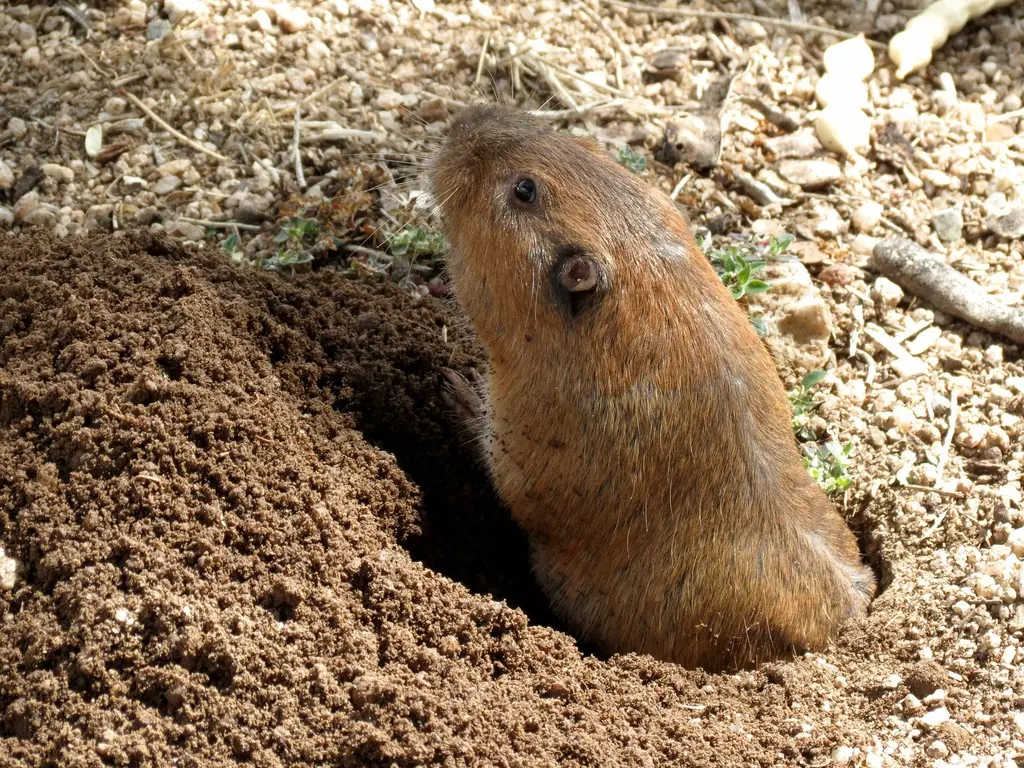
How to identify it
- A stout rodent usually 6 to 10 inches long, up to about 14 inches in the largest species, with powerful front legs, large-clawed front paws, a short sparsely haired tail, and small eyes and ears.[1][2]
- Fur-lined pouches on the outside of each cheek, used to carry food and nesting material.[1][2]
- Fur color varies widely, from nearly black to pale brown or almost white, and tends to match the local soil.[2]
- Mounds of fresh soil are crescent- or horseshoe-shaped from above, with a plugged hole off to one side.[1][2]
Look-alikes
| Look-alike | How to tell them apart |
|---|---|
| Mole | Mole mounds are round and volcano-shaped with the plug in the middle, and moles push up raised feeding ridges just under the surface.[1][2] |
| Vole | Voles leave open burrow holes and surface runways and usually girdle trees above ground; gopher holes are plugged and gopher girdling is mostly below ground.[6][1] |
| Ground squirrel | Ground squirrel burrows are left open without a dirt mound.[1] |
Where it lives
Pocket gophers live only in the Western Hemisphere; 14 species occur in the United States, with Thomomys gophers in the West and larger Geomys gophers on the central plains and in the Southeast.[2][3]
Biology and life cycle
Gophers live alone in burrow systems covering about 200 to 2,000 square feet, with feeding tunnels 6 to 12 inches deep and nest chambers as deep as 6 feet.[1]
They don't hibernate and can be active at any hour; one gopher can push up several mounds a day.[1]
Where soil is not irrigated, they usually raise one litter a year; in irrigated areas they can have up to three litters, typically averaging 5 to 6 young.[1]
They are strict plant eaters that feed mostly on roots met while digging, and sometimes on plants within a body length of an open hole.[1][3]
They do best in light, well-drained soils with plants that have fleshy roots, bulbs or tubers.[3]
Damage and signs
- Gophers eat roots and pull entire plants into their tunnels, damaging vegetables, ornamentals, vines, shrubs and trees.[1][4]
- They girdle trunks and large roots, mostly below ground, and under snow they can strip bark well up the trunk.[1][4]
- They gnaw flexible plastic water lines, drip irrigation and buried utility cables, and their tunnels can divert irrigation water and cause erosion.[1][4]
- Mounds in lawns interfere with mowing and spoil the look of turf.[1]
Health risk
Pocket gophers aren't considered a significant safety threat to people, but they bite hard when trapped; wear gloves, and keep toxic baits away from children and pets.[4][1]
Control
Prevention
After control, level old mounds and keep checking, since gophers move in from nearby fields and vacant lots.[1]
Keep them out
Line raised beds with hardware cloth or wire mesh, and plant shrubs and trees in wire baskets with room for roots to grow.[1][5]
Put 6 to 8 inches of coarse gravel, 1 inch or larger, around buried sprinkler lines and cables.[1][5]
Traps and physical control
Trapping is safe and effective: find the main tunnel with a probe near the plugged side of a fresh mound, then set pincer or box traps in pairs facing each other.[1][5]
Stake traps so they can be retrieved, cover the opening where people or pets go, check often, and move traps if nothing is caught within 1 to 2 days.[1]
Pesticides
Toxic baits go only into the main underground tunnel, never on the surface; clean up any spills, and don't bait gardens with root vegetables.[1][5]
When to call a professional
Aluminum phosphide fumigation requires a licensed applicator, and in California it can't be used within 100 feet of occupied buildings.[1]
Methods that don't work well
Smoke and gas cartridges usually fail because gophers quickly seal off their tunnels.[1]
No repellent has protected plants from gophers, and gopher purge, castor bean and garlic plants haven't been shown to repel them.[1][5]
Vibrating stakes, ultrasonic devices and pinwheels haven't worked in research, and gum or laxatives in burrows are also ineffective.[1][5]
Owls and other predators eat gophers but are too unreliable to protect a yard.[1]
Legal status
Pocket gophers generally aren't protected by federal or state law.[2]
In California they are nongame mammals that can be controlled at any time by legal means, and no trapping license is needed.[1]
In California, anticoagulant gopher baits are no longer legal for residential use; take old products to a household hazardous waste facility.[1]
Common questions
- How do I tell a gopher mound from a mole mound?
- A gopher mound is fan- or crescent-shaped with the plugged hole to one side; a mole mound is round and volcano-shaped.[1][2]
- Do gopher traps need bait?
- No. UC Davis researchers found no benefit from bait behind traps, and human scent doesn't affect trapping success.[1]
- Do pocket gophers hibernate?
- No. They stay active all year, even when you see no fresh mounds.[1]
Sources
- University of California Statewide IPM Program, “Pocket Gophers (Pest Notes, Home and Landscape).” ipm.ucanr.edu/home-and-landscape/pocket-gophers/ (accessed 2026-10-06)
- Internet Center for Wildlife Damage Management, “Pocket Gophers: Identification.” icwdm.org/species/rodents/pocket-gophers/ (accessed 2026-10-06). Run by university wildlife damage specialists (maintained at the University of Wisconsin-Stevens Point); species modules are based on Prevention and Control of Wildlife Damage (University of Nebraska Cooperative Extension, 1994).
- Internet Center for Wildlife Damage Management, “Pocket Gopher Biology.” icwdm.org/species/rodents/pocket-gophers/pocket-gopher-biology/ (accessed 2026-10-06). Run by university wildlife damage specialists (maintained at the University of Wisconsin-Stevens Point); species modules are based on Prevention and Control of Wildlife Damage (University of Nebraska Cooperative Extension, 1994).
- Internet Center for Wildlife Damage Management, “Pocket Gopher Damage Identification.” icwdm.org/species/rodents/pocket-gophers/pocket-gopher-damage-identification/ (accessed 2026-10-06). Run by university wildlife damage specialists (maintained at the University of Wisconsin-Stevens Point); species modules are based on Prevention and Control of Wildlife Damage (University of Nebraska Cooperative Extension, 1994).
- Internet Center for Wildlife Damage Management, “Pocket Gopher Damage Prevention and Control Methods.” icwdm.org/species/rodents/pocket-gophers/pocket-gopher-damage-prevention-and-control-methods/ (accessed 2026-10-06). Run by university wildlife damage specialists (maintained at the University of Wisconsin-Stevens Point); species modules are based on Prevention and Control of Wildlife Damage (University of Nebraska Cooperative Extension, 1994).
- University of California Statewide IPM Program, “Voles (Pest Notes, Home and Landscape).” ipm.ucanr.edu/home-and-landscape/voles/ (accessed 2026-10-06)
- iNaturalist, “Megascapheus bottae taxon page (order and family).” www.inaturalist.org/taxa/1624760 (accessed 2026-10-06)