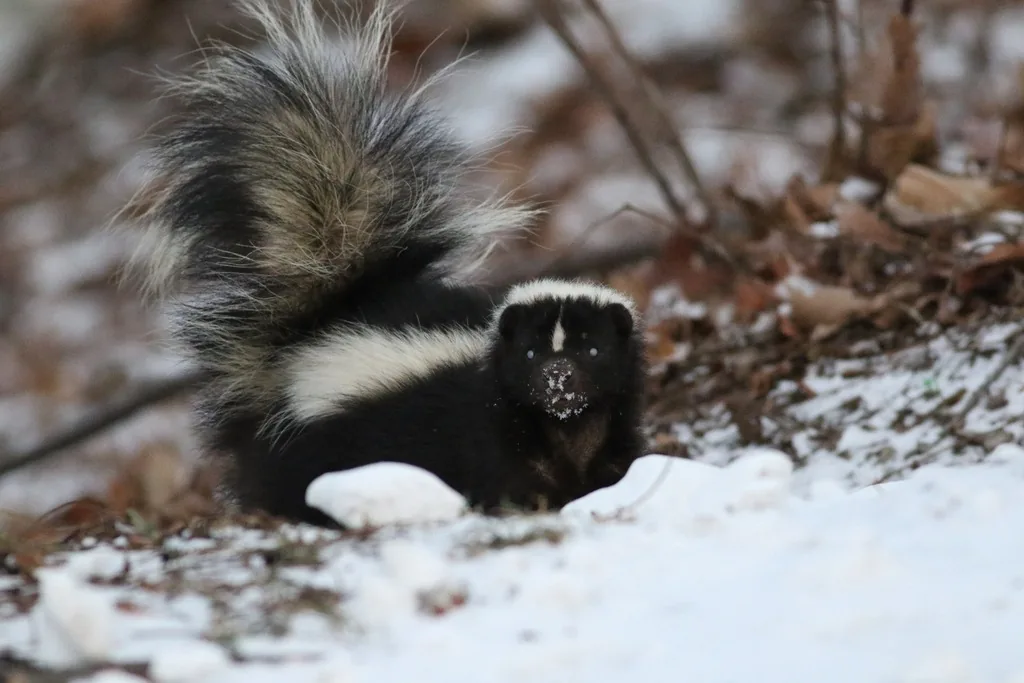
How to identify it
- Mostly black fur with white on the head and neck that usually splits into two white stripes down the back, though coat patterns vary.[1][2]
- About the size of a house cat, up to 29 inches long and around 8 pounds, with a triangular head, short legs and long claws for digging.[1][2]
- Tracks show five toes with claw marks, and the hind prints are about 2-1/2 inches long.[2]
- Droppings are 1/4 to 1/2 inch thick and 1 to 2 inches long, often full of insect parts.[2]
- Before spraying, a skunk usually stamps its front feet, hisses and arches its tail over its back.[1][4]
Look-alikes
| Look-alike | How to tell them apart |
|---|---|
| Raccoon | Skunks dig small cone-shaped holes in lawns, while raccoons tend to roll back sod; corn with knocked-down stalks points to raccoons rather than skunks.[7][4] |
| Opossum | Opossums can also give off a skunklike odor, so a smell alone does not prove a skunk is present.[2] |
| Spotted skunk | Spotted skunks are about half the size of striped skunks and have white spots and short broken stripes; they are fully protected in some states.[1][2] |
Where it lives
Striped skunks are common throughout the United States and Canada and are the most abundant of the four North American skunk species.[2]
Biology and life cycle
Skunks are mostly active at dawn, dusk and night, though striped skunks may move about in daytime near people.[1][3]
They breed from late January through March; after about 7 to 10 weeks, litters of usually 4 to 6 kits are born, mainly in May or June.[1][3]
They eat insects and grubs, mice, eggs, fruit, berries, pet food and garbage, and eat more insects in spring and summer.[1][3]
Skunks den in old burrows and under decks, porches and buildings; they do not truly hibernate but may stay in dens for weeks in the coldest weather.[1][3]
They see poorly but smell and hear well, and they can spray accurately 6 to 10 feet.[1]
Damage and signs
- Skunk odor can soak into cloth furniture, clothing and carpets, and can reach items several floors away from where it started.[4]
- They dig 3- to 4-inch cone-shaped holes or patches of upturned soil in lawns and gardens while hunting grubs, and may roll back sod.[4][1]
- Skunks den under porches, decks, sheds and houses, and spray dogs that bark at or rush them.[1]
- They sometimes eat poultry eggs, opening them at one end, and occasionally kill fowl.[4]
Health risk
Skunks are among the animals most often found with rabies in the U.S.; see a doctor promptly for any skunk bite and notify the local health department.[6][1][4]
Control
Prevention
Remove fallen fruit and spilled birdseed, keep tight lids on garbage cans, keep food scraps out of compost, bring pet food in by nightfall, and never feed skunks.[1][5]
Remove boards, rocks and debris from the ground, stack firewood tightly, and control mice and rats that skunks feed on.[1][5]
Keep them out
Close openings under porches, decks, sheds and houses with 1/4-inch hardware cloth, burying the bottom edge at least 6 inches to stop digging.[1][5]
Before sealing a den, spread a thin layer of flour at the entrance; fresh tracks after dark mean the skunk has left and the opening can be closed.[1]
A one-way door over the entrance lets skunks out but not back in, but it will not work while kits are too young to walk.[1][5]
Cover window wells and secure pits deeper than 3 inches so young skunks cannot become trapped in them.[5]
Traps and physical control
Where trapping is legal, enclosed plastic box traps or cage traps covered with a blanket reduce the chance of being sprayed.[1][5]
When to call a professional
If you have no skunk trapping experience, hire a professional wildlife control operator; some health departments also provide trappers.[1]
Removing skunk odor
UC IPM describes a home remedy of 1 quart of 3 percent hydrogen peroxide, 1/4 cup baking soda and 1 teaspoon of liquid soap.[1]
Mix it fresh and use it right away, because it cannot be bottled or stored; dilute leftovers with water and pour them down the drain.[1]
UC IPM says the mixture can be used on pets, people, clothing and furniture if kept out of the eyes, and treated pets should be rinsed well.[1]
For a sprayed dog or cat, call your veterinarian for current washing advice, and avoid handling the pet with bare hands until it is washed.[1][4]
Neutroleum-alpha neutralizes skunk odor on furniture and in buildings, but it should not be used on pets or people.[1]
Rabies warning signs
Treat with great caution any skunk that seems tame or listless, wanders oddly in daylight, or approaches without fear.[1][4]
Report skunks behaving abnormally to local animal control; only laboratory testing can confirm rabies.[4]
Keep dogs and cats vaccinated against rabies where skunks live.[1][6]
What doesn't work on skunks
There are no registered toxicants for skunks, and using rodent poison baits on them is illegal pesticide misuse.[1]
No frightening devices are effective, and commercial repellents do little.[5][1]
Ammonia and other strong-smelling repellents should not go under occupied buildings, because fumes can be drawn indoors.[1]
Legal status
Striped skunks are not protected in most states, but spotted skunks are fully protected in some; check with state wildlife officials before removing any skunk.[2]
Moving skunks is restricted in some states; California requires written permission, and rabies is one of the main reasons requests are denied.[1]
Common questions
- My dog was sprayed by a skunk. What should I do?
- Keep the dog outside, avoid touching it with bare hands, and call your veterinarian for washing advice and about rabies concerns.[4][1]
- What are the small cone-shaped holes in my lawn?
- They are often from skunks digging for grubs; the holes are about 3 to 4 inches across, and digging usually stops within about 3 weeks.[4][1]
- Will a skunk spray me if I walk by?
- Usually not. Skunks spray when startled or cornered and usually give a warning first, so back away slowly and quietly.[1][4]
Sources
- University of California Statewide IPM Program, “Skunks (Pest Notes, Home and Landscape).” ipm.ucanr.edu/home-and-landscape/skunks/ (accessed 2026-10-06)
- Internet Center for Wildlife Damage Management, “Skunks: Identification.” icwdm.org/species/carnivores/skunks/ (accessed 2026-10-06). Run by university wildlife damage specialists (maintained at the University of Wisconsin-Stevens Point); species modules are based on Prevention and Control of Wildlife Damage (University of Nebraska Cooperative Extension, 1994).
- Internet Center for Wildlife Damage Management, “Skunk Biology.” icwdm.org/species/carnivores/skunks/skunk-biology/ (accessed 2026-10-06). Run by university wildlife damage specialists (maintained at the University of Wisconsin-Stevens Point); species modules are based on Prevention and Control of Wildlife Damage (University of Nebraska Cooperative Extension, 1994).
- Internet Center for Wildlife Damage Management, “Skunk Damage Identification.” icwdm.org/species/carnivores/skunks/skunk-damage-identification/ (accessed 2026-10-06). Run by university wildlife damage specialists (maintained at the University of Wisconsin-Stevens Point); species modules are based on Prevention and Control of Wildlife Damage (University of Nebraska Cooperative Extension, 1994).
- Internet Center for Wildlife Damage Management, “Skunk Damage Prevention and Control Methods.” icwdm.org/species/carnivores/skunks/skunk-damage-prevention-and-control-methods/ (accessed 2026-10-06). Run by university wildlife damage specialists (maintained at the University of Wisconsin-Stevens Point); species modules are based on Prevention and Control of Wildlife Damage (University of Nebraska Cooperative Extension, 1994).
- U.S. Centers for Disease Control and Prevention, “About Rabies.” www.cdc.gov/rabies/about/index.html (accessed 2026-10-06)
- University of California Statewide IPM Program, “Raccoons (Pest Notes, Home and Landscape).” ipm.ucanr.edu/home-and-landscape/raccoons/ (accessed 2026-10-06)
- iNaturalist, “Mephitis mephitis taxon page (order and family).” www.inaturalist.org/taxa/41880 (accessed 2026-10-06)