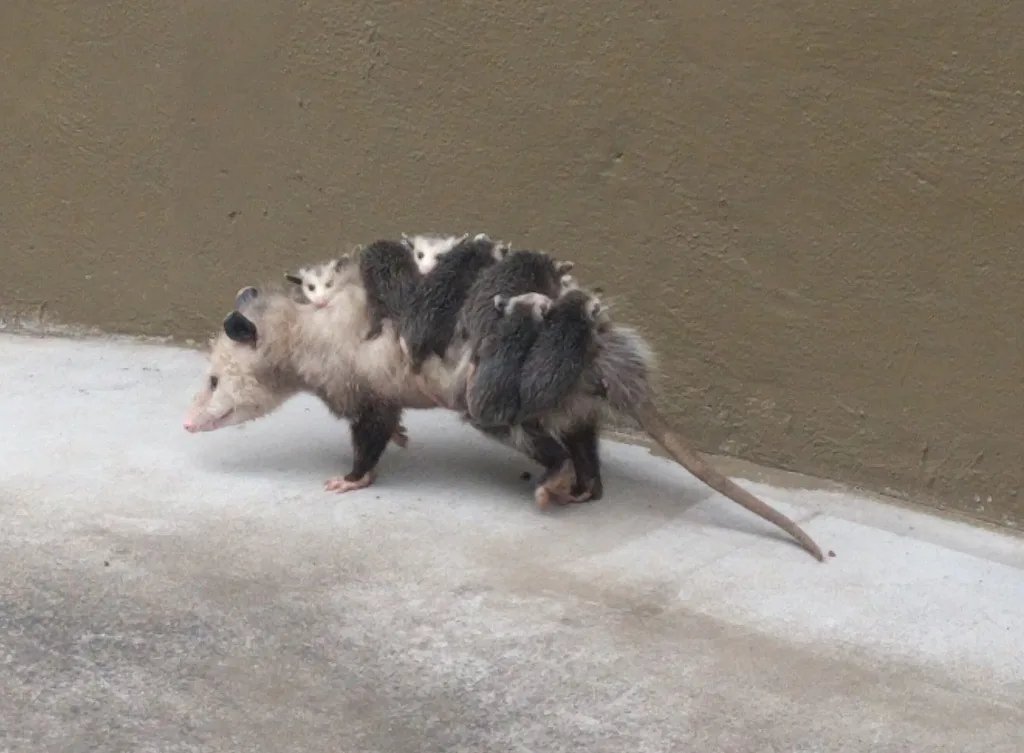
How to identify it
- About the size of a house cat, with coarse grayish fur, a long pointed face and rounded, hairless ears.[1][2]
- A long, hairless, grasping tail that makes up a little less than half the animal's total length.[1][2]
- Usually 2 to 3 feet long including the tail and most often 4 to 7 pounds, though large males may reach about 15 pounds.[1]
- Tracks look like small hands with widely spread fingers, and the hind foot has a thumblike, clawless toe.[1][2]
- When threatened it may hiss, growl, bare its teeth, or go limp and play dead; its mouth holds 50 teeth, more than any other North American mammal.[1][3][2]
Look-alikes
| Look-alike | How to tell them apart |
|---|---|
| Raccoon | A clear hind-foot track tells them apart; opossums usually use existing openings, while raccoons tear new ones into buildings.[4][2] |
| Striped skunk | Opossum signs are often confused with skunk signs, and opossums can give off a mild skunklike odor, so check tracks before deciding.[4][2][3] |
Where it lives
Opossums live in the eastern, central and West Coast states but are absent from the Rockies and most Plains states; they were introduced to California in 1910.[2][1]
Biology and life cycle
Opossums are mostly active at night, though they may forage by day in cold weather; they do not hibernate.[1][3]
They eat almost anything, including fruit, nuts, insects, snails, mice, rats, eggs, carrion, garbage and pet food.[1][3]
Young are born just 13 days after mating, crawl into the mother's pouch and stay attached there for about 8 weeks.[1][3]
Litters average about 7 young, and females usually raise 2 litters a year; older young ride on the mother's back.[1][3]
Opossums do not dig their own burrows; they use old burrows, tree cavities and brush piles, or spaces under steps, decks and houses.[3][1]
Most young die in their first year, and few opossums live beyond 3 years in the wild.[1][3]
Damage and signs
- They feed on berries, grapes, tree fruit, nuts and garden produce, and get into compost, garbage cans and bird feeders.[1][4]
- Opossums eat pet food left outside and may even come indoors through pet doors in search of food.[1]
- They den under houses and mobile homes and often get indoors through gaps around pipes and drains under sinks.[4][1]
- They leave droppings on garden paths and patios and can seriously injure dogs and cats in fights.[1]
- Opossums prey on chickens, ducks and pigeons and eat eggs of wild quail and turkeys.[4]
Health risk
Opossums often carry fleas, ticks, mites and lice, including cat and dog fleas linked to flea-borne typhus, and can carry leptospirosis and tularemia; they are more resistant to rabies than other mammals but not immune.[1][4]
Control
Prevention
Pick up fallen fruit, bring pet food in by nightfall, keep tight lids on garbage cans, and keep food scraps in compost bins with locking lids.[1][5]
Cut back overgrown shrubs, trim trees at least 5 feet from the roof, stack firewood tightly, and store lumber about 18 inches off the ground.[1]
Keep them out
Close openings under decks, porches, sheds and houses with 1/4-inch hardware cloth, burying the bottom edge so opossums cannot dig or squeeze under.[1][5]
Before sealing an opening, use a flour tracking patch to confirm the opossum has left; a mother carries her young with her when she goes.[1]
A one-way door over the main opening lets an opossum leave a structure but not get back in.[5]
Keep opossums out of gardens with a 4-foot poultry-wire fence whose top 12 to 18 inches bends outward unsupported, or add an electric wire near the top.[1][5]
Traps and physical control
Where trapping is legal, opossums are easy to catch in a cage trap at least 10 by 12 by 32 inches set along their travel routes.[1][5]
When to call a professional
Because moving opossums is illegal without a permit in some states, such as California, many homeowners hire a wildlife control operator instead.[1]
When an opossum plays dead
An opossum that will not move, plays dead or bares its teeth may simply be frightened rather than sick.[4][3]
Move people and pets away and give it time to leave; if it has not left within 24 hours, assume it is sick or injured and have it removed.[4]
What doesn't work on opossums
No repellents or toxicants are registered for opossums, and rodent poison baits must never be used on them.[5][1]
Mothballs, naphthalene and ammonia are not legal or recommended as opossum repellents because fumes can enter buildings.[1]
Motion-activated sprinklers and other frightening devices rarely work for more than a few days.[1][5]
Legal status
Laws covering opossums vary by state, and many states have hunting or trapping seasons; contact state wildlife authorities before removing one.[2]
In California opossums are nongame mammals, and relocating them requires written permission from the state wildlife department.[1]
Common questions
- Do opossums carry rabies?
- Rarely. Opossums are more resistant to rabies than any other mammal, but they are not immune.[4]
- There's an opossum lying still in my yard. Is it dead?
- It may be playing dead from fright. Keep people and pets away for up to 24 hours, and if it has not moved on, assume it is sick or injured.[4][1]
- Are opossums a danger to my pets?
- Fights between pets and opossums are fairly common and pets are often hurt, especially pets left outdoors at night; bringing pet food in by nightfall reduces these run-ins.[1]
Sources
- University of California Statewide IPM Program, “Opossum (Pest Notes, Home and Landscape, UC ANR Publication 74123).” ipm.ucanr.edu/home-and-landscape/opossum/ (accessed 2026-10-06)
- Internet Center for Wildlife Damage Management, “Opossums: Identification.” icwdm.org/species/other-mammals/opossums/ (accessed 2026-10-06). Run by university wildlife damage specialists (maintained at the University of Wisconsin-Stevens Point); species modules are based on Prevention and Control of Wildlife Damage (University of Nebraska Cooperative Extension, 1994).
- Internet Center for Wildlife Damage Management, “Opossum Biology.” icwdm.org/species/other-mammals/opossums/opossum-biology/ (accessed 2026-10-06). Run by university wildlife damage specialists (maintained at the University of Wisconsin-Stevens Point); species modules are based on Prevention and Control of Wildlife Damage (University of Nebraska Cooperative Extension, 1994).
- Internet Center for Wildlife Damage Management, “Opossum Damage Identification.” icwdm.org/species/other-mammals/opossums/opossum-damage-identification/ (accessed 2026-10-06). Run by university wildlife damage specialists (maintained at the University of Wisconsin-Stevens Point); species modules are based on Prevention and Control of Wildlife Damage (University of Nebraska Cooperative Extension, 1994).
- Internet Center for Wildlife Damage Management, “Opossum Damage Prevention and Control Methods.” icwdm.org/species/other-mammals/opossums/opossum-damage-prevention-and-control-methods/ (accessed 2026-10-06). Run by university wildlife damage specialists (maintained at the University of Wisconsin-Stevens Point); species modules are based on Prevention and Control of Wildlife Damage (University of Nebraska Cooperative Extension, 1994).
- iNaturalist, “Didelphis virginiana taxon page (order and family).” www.inaturalist.org/taxa/42652 (accessed 2026-10-06)