The short answer
- Find the den opening and close every other gap along the foundation, leaving only the main entrance open.[2][3]
- Check that the skunk has left: sprinkle a thin patch of flour in front of the hole and look for tracks after dark, or set a one-way door that lets it out but not back in.[1][2][3]
- Then seal the opening and skirt the deck or shed with mesh buried in the ground so it can't dig back under.[1][3][2]
- Don't close a den in late spring or summer without checking for young. Penn State warns that sealing a burrow from early May to mid-August can trap kits inside, and the Pennsylvania Game Commission suggests waiting until fall when a mother is raising young.[2][7]
- Remove what draws skunks in: pet food left out at night, fallen fruit, spilled birdseed, open garbage, and piles of lumber or debris.[1][2][3]
- If you or a pet is bitten, wash the wound with soap and water right away and get medical advice urgently. Being sprayed does not give you rabies.[9][10]
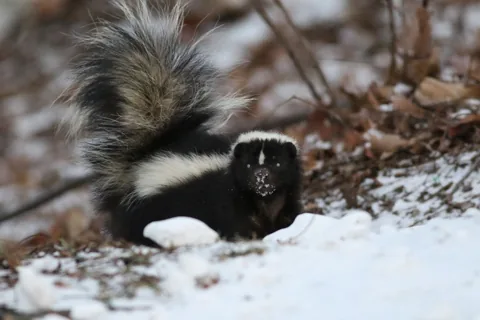
Skunk profile
Signs a skunk is living there
Skunks are mostly out at dawn, dusk and night, so many people never see one. Barking dogs, a faint musky smell along a regular route, or a dog that comes home sprayed are often the first signs.[1]
Odor alone doesn't prove a skunk lives under your house. Penn State notes that a sprayed dog or cat can crawl under a deck and leave the smell behind.[2]
- Small cone-shaped holes in the lawn about 3 to 4 inches across (UC IPM says 3 to 5 inches), dug while hunting grubs. ICWDM says this digging usually stops after about 3 weeks, once the grubs are used up.[2][5][1]
- Droppings ¼ to ½ inch across and 1 to 2 inches long, often full of insect parts.[2]
- Tracks with five toes on both front and hind feet, claws usually showing.[2]
- Eggs opened at one end with the edges crushed in, or one or two birds taken at a time. Skunks usually don't climb fences to reach poultry, unlike raccoons.[2][5]
- Skunk odor in late winter, when males spray while fighting over females, is a sign to block den sites before pregnant females move in.[1]
Why skunks move in
Skunks come into yards for food, water and shelter. They den under decks, porches, sheds and loose foundations, in old woodchuck burrows, and in brush or wood piles, and they eat insects and grubs, mice, berries, fallen fruit, pet food and garbage.[1][2][4]
They are not true hibernators, but they may sleep through about a month of the coldest weather (up to 2 months in the north) and sometimes share a den in winter.[4][1][2]
Skunks also help: Penn State and ICWDM describe them eating grasshoppers, beetles, crickets, white grubs and mice, and Penn State calls them more beneficial than problematic in most situations. A skunk passing through now and then may not need any action.[2][4][1]
Step 1: Take away food and cover
UC IPM calls cutting off food, water and shelter the most effective way to make a property less attractive to skunks.[1]
- Bring pet food in by nightfall and pick up fallen fruit and spilled birdseed often.[1][2]
- Use garbage cans with tight lids.[1][3]
- Keep table scraps out of compost bins and use a hot compost method rather than a cold one.[1]
- Clear boards, rocks, lumber and other debris from the ground, cut back overgrown shrubs, and stack firewood tightly, ideally at least 18 inches off the ground.[1][2][3]
- Control mice and rats in sheds, garages and crawl spaces, since rodents draw skunks.[2][3][1]
- Don't feed skunks on purpose. UC IPM warns that fed skunks can lose their fear of people, which raises the chance of a bite.[1]
- Treating lawn grubs may cut down digging, but Penn State notes that insecticides can affect other species too.[2][1]
Step 2: Check the calendar before you seal anything
Striped skunks breed in late winter (February and March, by UC IPM's account; ICWDM says adults start in late January) and have one litter a year, usually 4 to 6 young. Older females give birth in early May and yearlings in early June.[1][4][2]
UC IPM says young skunks start following their mother on her nightly rounds after 2 to 3 months, and ICWDM says they stay with her until fall.[1][4]
- Late winter and early spring, before births, is the time to block openings under buildings so pregnant females don't den there.[1]
- From early May to mid-August, sealing a den can leave young skunks trapped inside. A one-way door won't work if the kits can't walk yet.[2][1]
- If a mother has young under your deck, the Pennsylvania Game Commission suggests letting them leave on their own (fall is a good bet) and then blocking the den.[7]
Step 3: Make sure the skunk is out, then close the hole
First seal every other opening along the foundation, leaving the main entrance open. Skunks leave to feed after dark, which makes night the best time to close a den.[2][3]
- Flour test: sprinkle a smooth layer of flour in front of the hole (UC IPM says about 1/8 inch thick; Penn State describes a patch 2 feet around). Check after dark for tracks leading out. If there are none, check again an hour later.[1][2]
- Once the tracks show the skunk has gone, close the entrance right away. Penn State suggests reopening it for an hour after dark the next night so any remaining skunk can get out, then sealing it for good.[2]
- One-way door: UC IPM describes a flap of 1/2-inch hardware cloth, larger than the opening and hinged at the top, so it swings outward only. ICWDM says a one-way door should be at least 4 by 4 inches.[1][3]
- Leave the door up through several days of good weather, then check. Sticks pushed upright in the entrance show whether anything is still going in and out; ICWDM says no activity for 2 to 3 days means the den is likely empty.[3]
- A floodlight under the building, shining out through the entry, often helps drive skunks away, according to UC IPM. Penn State says lights or radios don't have a high success rate.[1][2]
Step 4: Skunk-proof decks, porches and sheds
Close off openings under houses, sheds, porches, decks and mobile homes with wire mesh, sheet metal or concrete. Skunks work hard to get into a good den, so make the fit tight.[1][2][3]
- Mesh size: UC IPM recommends 1/4-inch hardware cloth, which also keeps out rats and house mice; ICWDM gives 1/2-inch mesh.[1][3]
- Where skunks can dig, sources differ on how deep to go. UC IPM says bury the wire at least 6 inches; ICWDM describes an L-shaped apron set 2 inches down and bent out at least 12 inches from the wall, deeper and wider in sandy soil; Penn State says bury fencing 1½ to 2 feet.[1][3][2]
- Cover window wells with mesh or a well cover. ICWDM says any pit more than 3 inches deep should be secured so young skunks don't fall in.[3][2]
- For chickens, close ground-level openings in coops and shut doors at night. Penn State describes a 3-foot wire mesh fence with the lowest foot buried and the bottom 6 inches bent outward.[2][3]
A skunk in the garage or a window well
Penn State describes skunks as mild-tempered animals that will not defend themselves unless they are cornered or harmed, so give a trapped or wandering skunk a way out and let it leave.[2]
Live-trapping, and what your state allows
UC IPM advises anyone without experience trapping skunks to hire a professional wildlife control operator, who is much less likely to get sprayed. Before trapping, find out what you're allowed to do with the animal afterward.[1][2]
- California: Fish and Game regulations prohibit relocating skunks without written permission from the California Department of Fish and Wildlife, and UC IPM says that permission is unlikely because of rabies.[1]
- Pennsylvania: the Game Commission lists skunks among rabies vector species that should not be relocated, so a homeowner who traps one faces a choice between releasing it and dispatching it. Landowners should contact the Game Commission region office before trapping nuisance wildlife.[7]
- Pennsylvania also treats striped skunks as furbearers; Penn State says a property owner may trap skunks causing damage without a hunting license.[2]
- Elsewhere, check with your state wildlife agency. Some states restrict body-gripping traps on land, and some require a permit for gas cartridges.[3][1]
- Trap setup: a cage about 10 by 10 by 30 inches near the den entrance, baited with canned fish-flavored cat food, sardines or peanut butter. Cover the trap with a cloth or canvas for at least half its length, or use an enclosed plastic box trap, which UC IPM rates better than wire.[2][3][1]
- Approach a covered trap slowly and quietly, holding a tarp in front of you, then drape it over the whole trap. Covers reduce spraying but don't rule it out.[3][1][6]
- To avoid catching a skunk when you're after something else, close the trap before sunset and reset it in the morning, or set it at least 18 inches off the ground.[6]
- Don't use foothold or body-gripping traps near a house, because of the spray.[3]
- Drowning is not an acceptable or legal way to kill a trapped skunk, according to UC IPM.[1]
What doesn't work
Several common shortcuts either aren't legal, aren't safe near a house, or don't work on skunks.[1][2][3]
- Poison: no toxicants are registered for skunks. UC IPM warns that using rodent bait on skunks is pesticide misuse that can bring substantial penalties and often poisons pets.[1][2]
- Repellents: Penn State says no repellents are registered for skunks in Pennsylvania, and UC IPM says commercial products are not very effective. Mothballs need large amounts and frequent replacing and are only temporary.[2][1]
- Ammonia rags: UC IPM says ammonia and other strong-smelling repellents should not go under an occupied building, since fumes can be drawn indoors by a furnace.[1]
- Frightening devices: ICWDM says none are effective on skunks.[3]
- Gas cartridges: not for dens under or near buildings, because of fire risk and gas getting indoors.[1][3][2]
- Removing one skunk without closing the den site: UC IPM notes it may not be a permanent fix if nothing deters the next skunk.[1]
How to avoid getting sprayed
Skunks spray to defend themselves and would rather flee. They can hit a target 6 to 10 feet away, and the spray can cause nausea and, in the eyes, severe burning and temporary blindness.[1][2]
- Watch for the warning: rapid stamping of the front feet, hissing, and the tail arched over the back. Back away quietly and slowly.[1][2][5]
- Skunks see poorly. UC IPM says one may not react to a quiet person more than 10 feet away who stands still or moves slowly.[1]
- Crouch down rather than looming over a skunk; they get nervous when something is suddenly above them.[2][6]
- Wear leather or canvas gloves when handling traps.[6]
Getting rid of skunk smell
Penn State and UC IPM both give the same home recipe for people and pets: 1 quart of 3% hydrogen peroxide, 1/4 cup of baking soda and 1 teaspoon of liquid soap. Mix it fresh. It releases oxygen and can't be bottled or stored, so dilute any leftover with water and pour it down the drain.[2][1]
Wearing gloves, work it through the pet's fur, keep it out of the eyes, and rinse thoroughly with water. UC IPM also suggests calling your veterinarian for current advice on washing a sprayed dog or cat.[2][1]
- Clothes: wash with laundry detergent plus half a cup of baking soda.[2]
- No hydrogen peroxide on hand: Penn State says vinegar diluted with water also helps.[2]
- Walls and other building surfaces: wash with vinegar or baking soda solutions, or use neutroleum-alpha, a neutralizer sold through cleaning or wildlife control suppliers. Don't use neutroleum-alpha on pets or people. Fans speed up airing out.[2][1]
- Spray in the eyes: rinse with plenty of water. Penn State says temporary blindness of 10 or 15 minutes may follow.[2]
- Some people get asthma-like symptoms from skunk odor; ICWDM says they should leave the area.[5]
Rabies: what the health agencies say
CDC lists skunks among the animals most often found with rabies in the United States, along with bats, raccoons and foxes. Rabies is deadly once symptoms start, but it is preventable with prompt medical care after an exposure.[8][9]
Rabies spreads through saliva, most often in a bite. The Texas Department of State Health Services says you cannot get rabies from being sprayed by a skunk.[10][8]
- Warning signs in wildlife, per Texas DSHS: night animals such as skunks out in the daytime, wild animals that act friendly or tame, and animals that have trouble walking, eating or drinking.[10]
- Never handle wildlife, whether it looks healthy or sick, and teach children never to touch it. Call animal control about animals that seem sick or injured.[10][9]
- Keep dogs and cats up to date on rabies vaccines and keep them away from wild animals.[9][8][10]
- If a skunk bites or scratches you, CDC says to wash the wound with soap and water for 15 minutes, then talk with a healthcare provider or your health department about whether you need post-exposure treatment, and tell them what animal it was and whether it acted strangely.[9][8]
- Texas DSHS says biting skunks must be tested for rabies. The 10-day observation period used for dogs, cats and ferrets does not apply to wild animals.[10]
- If your pet is bitten, wash the wound with soap and water right away and get help as soon as possible to decide whether treatment is needed.[10]
When to call a professional
Call a wildlife control operator if young are trapped under a building, a skunk won't leave, or you don't want to handle a trap. Penn State notes that many homeowners hire one because of the spray and rabies risk; the professional removes the animal without the homeowner having to touch it.[2][1]
UC IPM adds that some city or county health departments provide trappers to remove skunks from residential areas.[1]
Common questions
- How do I get a skunk out from under my deck?
- Seal every other gap, leave the main entrance open, and confirm the skunk has left at night with a flour patch or a one-way door. Then close the opening and skirt the deck with buried mesh. Check for young first between early May and mid-August.[2][1][3]
- What gets rid of skunk smell on a dog?
- A fresh mix of 1 quart of 3% hydrogen peroxide, 1/4 cup of baking soda and 1 teaspoon of liquid soap, worked through the fur with gloves on, kept out of the eyes, and rinsed off with water. Don't store the mixture.[2][1]
- Can I get rabies from skunk spray?
- No. The Texas health department says rabies is spread through saliva, most often in bites, and that you cannot get it from being sprayed by a skunk.[10]
- Can I trap a skunk and move it somewhere else?
- Often not legally. California prohibits relocating skunks without state permission, and Pennsylvania's Game Commission says rabies vector species like skunks should not be relocated. Check your state wildlife agency first.[1][7]
- Do mothballs or ammonia keep skunks away?
- Not well. Penn State says mothballs work only temporarily and in large amounts, and UC IPM warns against putting ammonia or other strong repellents under an occupied building.[2][1]
- Is a skunk out during the day rabid?
- Not necessarily, but Texas DSHS lists night animals such as skunks seen in the daytime as a warning sign. Keep away and call animal control.[10][9]
Photo credits
- Striped skunk: (c) Richard Poort, some rights reserved (CC BY) — via iNaturalist, CC BY 4.0
Sources
- University of California Statewide IPM Program, “Skunks (Pest Notes).” ipm.ucanr.edu/home-and-landscape/skunks/ (accessed 2026-11-10)
- Penn State Extension, “Skunks - Solutions to Common Problems.” extension.psu.edu/skunks (accessed 2026-11-10)
- Internet Center for Wildlife Damage Management, “Skunk Damage Prevention and Control Methods.” icwdm.org/species/carnivores/skunks/skunk-damage-prevention-and-control-methods/ (accessed 2026-11-10)
- Internet Center for Wildlife Damage Management, “Skunk Biology.” icwdm.org/species/carnivores/skunks/skunk-biology/ (accessed 2026-11-10)
- Internet Center for Wildlife Damage Management, “Skunk Damage Identification.” icwdm.org/species/carnivores/skunks/skunk-damage-identification/ (accessed 2026-11-10)
- Internet Center for Wildlife Damage Management, “Releasing a Skunk.” icwdm.org/species/additional-resources/release-skunk/ (accessed 2026-11-10)
- Pennsylvania Game Commission, “Nuisance Wildlife.” www.pa.gov/agencies/pgc/wildlife/nuisance-wildlife.html (accessed 2026-11-10)
- U.S. Centers for Disease Control and Prevention, “About Rabies.” www.cdc.gov/rabies/about/index.html (accessed 2026-11-10)
- U.S. Centers for Disease Control and Prevention, “Rabies Prevention and Control.” www.cdc.gov/rabies/prevention/index.html (accessed 2026-11-10)
- Texas Department of State Health Services, “Rabies.” www.dshs.texas.gov/rabies (accessed 2026-11-10)