The short answer
- Bring pet food in by nightfall, pick up fallen fruit, put lids on garbage cans and keep compost in a closed bin. Keep food scraps out of open compost.[1][5]
- Find the den opening under the deck, porch or shed. After dark, check a flour tracking patch at the opening for footprints leading out, then close the hole.[1]
- Or fit a one-way door over the opening once every other gap is sealed, so the opossum can leave but can't get back in.[5]
- Skirt decks, porches and crawl spaces with galvanized hardware cloth buried in the ground with a skirt under the soil, since opossums are not strong and use openings that already exist.[1][5][4]
- Live traps work well because opossums aren't wary of them, but check your state's rules first: California bars relocation without written permission from its wildlife department, New York bars moving the animal off your property, and Missouri recommends against relocation.[1][8][7]
- No repellents or poisons are registered for opossums, and ICWDM says no frightening device is effective. Never use rodent bait on them.[5][1]
Related profiles
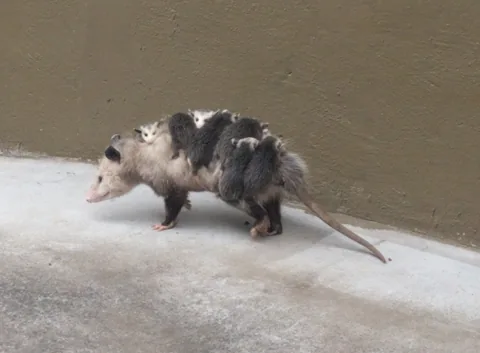 Virginia opossum
Didelphis virginiana
The Virginia opossum is North America's only marsupial, a cat-sized animal with a pointed face and a long, hairless tail. Around homes it raids pet food, garbage and fruit and dens under decks, sheds and houses.
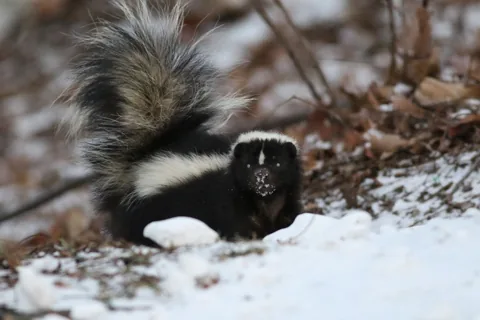 Striped skunk
Mephitis mephitis
The striped skunk is a cat-sized, black and white mammal that often lives under porches, decks and sheds. It digs lawns for grubs, sprays pets that corner it, and is one of the main wildlife carriers of rabies.
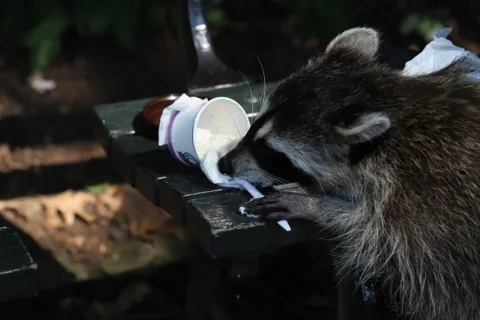 Raccoon
Procyon lotor
Raccoons are masked, ring-tailed mammals that adapt very well to towns and suburbs. They raid garbage and gardens, den in attics, chimneys and under decks, and can carry rabies and raccoon roundworm.
Is it an opossum?
The Virginia opossum is North America's only marsupial, a cat-sized animal with coarse grayish fur, a pointed face, hairless rounded ears and a long, nearly hairless tail. ICWDM notes that its fur ranges from snow-white to jet-black, and Missouri Department of Conservation describes a white or yellowish-white head and a pink nose.[1][2][6]
- Size: sources give slightly different figures. UC IPM says 2 to 3 feet long including the tail and up to 15 pounds, though most weigh 4 to 7 pounds. ICWDM says up to 40 inches long and as much as 14 pounds, averaging 4 to 12 pounds. Missouri gives 24 to 34 inches and 4 to 15 pounds. Males are usually larger.[1][2][6]
- Tracks: both front and hind prints look like small hands with widely spread fingers. The hind foot has a thumblike toe set at an angle that leaves no claw mark. ICWDM says a correctly identified hind-foot track is the definitive way to tell opossum damage from skunk or raccoon damage, which are often confused.[2][6][4][1]
- Night activity: opossums are mostly nocturnal, so you may never see one. UC IPM says barking dogs and pet food that disappears overnight may be the first signs. ICWDM says they don't hibernate and may forage by day in very cold weather.[1][3]
- Mess: UC IPM calls them messy feeders that leave remains of the night's meal, and droppings may turn up on garden paths, walkways and patios, though opossums usually go in leafy, protected spots.[1]
- Behavior when cornered: an opossum may hiss, growl, bare its 50 teeth, drool, or roll over and go limp (playing possum). Missouri and UC IPM describe this as a brief nervous-shock reaction; the animal recovers and slips away at the first chance.[1][2][6]
Why an opossum is under your deck or shed
Opossums don't dig their own burrows. They use dens other animals abandoned, tree cavities, brush piles and rock crevices, and around homes they den under steps, porches, decks, garden sheds and houses, and in attics and garages if they can get in. They build an untidy pile of sticks and whatever else is handy. ICWDM says they are not destructive or strong, so they usually enter places that already have an opening, while raccoons often make their own.[3][1][4]
- Under the house: ICWDM says opossums may climb into the insulation under trailer houses, move around in mobile-home ductwork, and commonly enter living areas through large gaps around pipes and drains under sinks.[4]
- Pet doors: UC IPM says opossums that have lost their fear of people will come through a pet door looking for food.[1]
- Food nearby: opossums eat almost anything. UC IPM and ICWDM list fruit, nuts, insects, snails, frogs, eggs, mice, rats, carrion, garden produce, garbage, compost and pet food. Missouri says they prefer animal matter and eat more fruit in fall and early winter.[1][3][6]
- Home range: ICWDM says opossums are usually solitary and nomadic, with a home range of 10 to 50 acres, and young wander until they find a range of their own. So a den under your deck may be one stop among several.[3]
Step 1: Take away the food and cover
Both UC IPM and ICWDM start here. UC IPM says making your yard less inviting will substantially reduce or eliminate opossum problems.[1][5]
- Pet food: bring bowls in by nightfall, per UC IPM. ICWDM also says to remove outdoor dishes of pet food.[1][5]
- Fruit: keep picking up fruit that falls from trees and shrubs.[1][5]
- Garbage: use cans with tight-fitting or locking lids.[1][5]
- Compost: don't put food scraps or table scraps in an open pile. ICWDM says to keep compost that gets food scraps in a container with a locking lid. See the compost guide for bin options.[1][5]
- Bird feeders: ICWDM says to remove feeders or change them so seed doesn't fall to the ground.[5]
- Cover: remove brush piles, stack firewood tightly with no den-sized gaps, and store lumber and other items neatly, UC IPM suggests about 18 inches off the ground.[1][5]
- Roof access: UC IPM says to cut back overgrown shrubs and trim branches back at least 5 feet from the roof edge.[1]
- Poultry: close the doors on coops and pens at night. ICWDM says opossums prey on chickens, ducks and pigeons and their eggs.[5][4]
Timing: opossum young and the pouch
Opossum babies are born tiny and spend weeks attached inside the mother's pouch. UC IPM says opossums normally live alone except when they have young, and since the young stay in the pouch, they leave with the mother.[1][3]
- Breeding: UC IPM says California has two mating seasons, January through February and June through July. Missouri says breeding starts in early February, most litters are born by the end of February, the first litter is usually weaned in May and second litters by the end of September. ICWDM says females raise 2, rarely 3, litters a year.[1][6][3]
- Pouch time: young are born about 13 days after mating, less than half an inch long. UC IPM says they stay attached for about 8 weeks; ICWDM says 7 to 8 weeks in the pouch. Litters average about 7 (UC IPM) or 7 to 8 (ICWDM).[1][3]
- Riding on the back: when the young get too big for all of them to fit in the pouch, some ride on the mother's back. UC IPM says they can leave the pouch for short periods at about 11 weeks and are weaned at about 14 weeks; ICWDM gives weaning at 96 to 108 days after birth.[1][6][3]
- What that means for you: the tracking-patch check and the one-way door below both depend on the animal walking out at night. Because pouch young leave with the mother, UC IPM's approach of confirming she has gone out before you close the hole applies to a mother with young as well.[1][5]
Step 2: Make sure it's out before you close the hole
UC IPM says that once an opossum has taken up residence under a building or deck, you have to be sure it has left before you block the opening.[1]
- Tracking patch: sprinkle a smooth layer of flour about 1/8 inch thick in front of the opening. Check it soon after dark. Footprints leading out mean the animal has left and you can close the hole, per UC IPM.[1]
- Seal every other gap first: before you rely on one opening, close the rest with hardware cloth so there's only one way in and out.[5][1]
- Don't grab it: if you meet an opossum in a crawl space or garage, back off. ICWDM says frightened opossums often play dead, hunker down or bare their teeth, and the right move is to remove people and pets from the area and give it time to leave.[4]
One-way doors
A one-way door lets the opossum walk out at night and stops it from getting back in. ICWDM lists a 6 x 6 x 10-inch one-way door for removing opossums from structures.[5]
- Close every other opening on the structure first, then mount the one-way door over the remaining hole.[5]
- ICWDM suggests propping the door partly open at first with crumpled newspaper, leaving a gap so the opossum can see out.[5]
- Once the animal is out, close the opening for good with hardware cloth as described below.[5][1]
Step 3: Seal it with hardware cloth
UC IPM calls screening or blocking access the best solution for an opossum under stairs, porches, decks or buildings. Close every opening under the house, shed, mobile home or deck. The two main sources give different specs:[1][5]
- UC IPM: 1/4-inch hardware cloth, which also keeps out rats and house mice. Where possible, bury it up to 6 inches deep to stop the opossum crawling or digging under.[1]
- ICWDM: 1 x 1/2-inch galvanized hardware cloth, buried at least 2 inches with a 12- to 18-inch skirt under the soil to discourage digging. ICWDM notes that some sources call for 12 to 24 inches deep with a 12-inch perpendicular skirt, but says that depth isn't needed for opossums.[5]
- Before digging, call the utility-locating service. ICWDM also suggests painting the mesh flat black and adding lattice so it doesn't show.[5]
- Indoors: seal gaps around pipes and drains under sinks, which ICWDM says opossums commonly use to get into living spaces.[4]
- Pet doors: UC IPM says opossums will come through a pet door in search of food, so a pet door is an entry point to deal with too.[1]
Keeping opossums out of gardens and off fences
- Floppy fence: UC IPM describes a 4-foot poultry-wire fence with the top 12 to 18 inches bent outward, away from the garden, and not attached to any support. The loose top bends under the opossum's weight, so it can't climb over.[1]
- Hot wire: UC IPM and ICWDM both say a tightly stretched electric wire near the top of an existing wire fence, 3 inches out from the mesh, stops opossums from climbing over. ICWDM also mentions strips of stainless steel porcupine wire.[1][5]
- Trees: UC IPM says the same electric-wire approach can keep opossums from climbing trees.[1]
Trapping: easy to catch, harder to dispose of
UC IPM says opossums are not wary of traps and are easy to catch in a box or cage live trap. The hard part is what comes next, because many states limit or forbid releasing the animal elsewhere (see state rules below). Read the live-trapping guide before you set one.[1][5]
- Trap size: UC IPM says at least 10 x 12 x 32 inches. ICWDM gives 10 x 12 x 32 inches for single-door traps and 7 x 7 x 24 inches for double-door traps.[1][5]
- Placement: set it along trails and travel routes, or where opossums have been seen.[1][5]
- Bait: fish-flavored canned cat food works but also catches cats. UC IPM suggests whole raw eggs, jam or peanut butter on bread, or overripe grapes, bananas or melons instead. ICWDM likewise advises fruit or sweet baits over fatty ones to cut the chance of catching cats and dogs, though skunks and raccoons like sweet baits too.[1][5]
- Put the bait behind the trap's trigger so the opossum has to walk all the way in.[5]
- Don't pick one up by the tail. If you catch a skunk or raccoon instead, note that Pennsylvania, for one, lists both as rabies vector species that should not be relocated.[5][9]
- Killing: UC IPM says shooting and a carbon dioxide chamber are the only acceptable ways to euthanize a trapped opossum, that firearms aren't allowed in most residential areas, and that drowning is illegal in California. It says people who don't want to deal with disposal may prefer to hire a professional wildlife control operator.[1]
State rules on trapping and relocating opossums
ICWDM says laws protecting opossums vary among states, most states have open hunting or trapping seasons for them, and you should contact local wildlife authorities before removing one. Here is what four state agencies say:[2]
- California: UC IPM says the Fish and Game Code classifies opossums as nongame mammals, so an owner or tenant whose property or crops are threatened may control them by any legal means. State rules prohibit relocating wildlife without written permission from the Department of Fish and Wildlife. UC IPM adds to check for city or county restrictions.[1]
- New York: the Department of Environmental Conservation's take table says you need a DEC permit to take an opossum that is only a nuisance, but not to take one that is damaging property; out of season, the animal must be buried or cremated immediately. DEC says it is illegal to move a live-trapped animal off your property, and says to contact a nuisance wildlife control operator if you need an animal removed.[8]
- Missouri: the Department of Conservation says you or someone acting for you may trap or shoot most damage-causing wildlife out of season without a permit, but it does not recommend relocation, because moving animals can spread disease and upset local populations.[7]
- Pennsylvania: the Game Commission lists skunks, raccoons, bats, groundhogs, foxes and coyotes as rabies vector species that should not be relocated; opossums aren't on that list. It says live wildlife may be relocated to a natural setting, may not be kept, sold or given away, traps must be checked daily, and anything killed must be reported to the Game Commission. Contact your regional office before trapping.[9]
What doesn't work
- Repellents: ICWDM says no repellents are registered for opossums, and UC IPM says none of the products marketed for wildlife give significant results on them.[5][1]
- Mothballs and ammonia: UC IPM says using mothballs, naphthalene or household ammonia as opossum repellents is not legal and not recommended, since the fumes can get into buildings and the chemicals can build up in soil.[1]
- Poison: no toxicants are registered for opossums. UC IPM says rodent baits should never be used on opossums, skunks or raccoons; the penalties for that misuse can be substantial, and it usually comes to light when someone's pet is poisoned.[5][1]
- Scare devices: ICWDM says no frightening devices are effective for opossums. UC IPM is a little more hopeful about motion-activated sprinklers, which sometimes scare opossums, but says the effect rarely lasts more than a few days once an animal is used to visiting.[5][1]
Opossums and rabies: the facts
A cornered opossum may drool, hiss and bare its teeth, and a frightened one may hunker down or play dead instead of running. Here is what health and wildlife agencies say about rabies itself.[6][4]
- Rarely rabid: ICWDM says opossums are more resistant to rabies than any other mammal, though not immune. The CDC lists bats, skunks, raccoons and foxes as the animals most often found with rabies in the US.[4][10]
- Not immune: the CDC says any mammal can get rabies. Treat a bite or scratch from an opossum like any other wild-animal bite.[11][4]
- If bitten or scratched: the CDC says rabies is preventable but you must get medical help right away; post-exposure prophylaxis is highly effective if given as soon as possible. Wash any wound right away with soap and water for 15 minutes, then call your doctor or health department, which can determine whether you need the vaccine.[11]
- An opossum out in daylight: ICWDM says opossums may forage by day in cold weather, and that one that doesn't move when approached may just be frightened. Move people and pets away and give it time. If it hasn't left within 24 hours, ICWDM says to assume it is sick or injured and have it removed, and to confirm that no person or animal touched it. The CDC advises not approaching wild animals that look sick, injured or dead and calling animal control.[3][4][11]
- Pets: the CDC says keeping pets' rabies vaccinations up to date lowers your household's risk.[11]
Other health issues
- Fleas and other parasites: UC IPM says opossums may carry fleas, ticks, mites and lice and are hosts for cat and dog fleas in urban areas, which matters for flea-borne typhus in Orange and Los Angeles Counties, California.[1]
- Diseases: UC IPM lists leptospirosis, tuberculosis, relapsing fever, tularemia, spotted fever, toxoplasmosis, coccidiosis, trichomoniasis and Chagas disease among diseases opossums carry.[1]
- Horses: ICWDM says opossums are the definitive host of the organism that causes equine protozoal myeloencephalitis (EPM), which is shed in their feces, so an opossum denning or feeding in a stable can contaminate horse feed and water.[4]
- Pets and fights: ICWDM says opossums generally avoid pets, but UC IPM says pet and opossum confrontations are fairly common and pets are often hurt by the opossum's sharp teeth.[4][1]
Do opossums eat ticks?
You'll often read that an opossum eats thousands of ticks a week. The research is mixed, and the popular version goes further than the evidence.[13][12]
- Lab result: in Keesing and colleagues' 2009 study, field-caught opossums and squirrels exposed to larval blacklegged ticks killed 83 to 96% of the ticks that tried to attach and feed, and the authors estimated some hosts can kill thousands of ticks per hectare.[12]
- Field check: Hennessy and Hild (2021) note that research on captive opossums estimated they eat an average of 5500 larval ticks a week. They then searched the stomachs of 32 wild opossums from central Illinois and found no ticks or tick parts, and none of 23 earlier opossum diet studies they reviewed found ticks. They concluded ticks are not a preferred food.[13]
- A 2026 lab study found blacklegged tick larvae and nymphs got onto opossums at about the same rate as onto white-footed mice, but the opossum was the least permissive host of the four tested for tick feeding.[14]
- Bottom line: lab work shows opossums kill most blacklegged ticks that try to feed on them, but the field evidence doesn't support the idea that they eat large numbers of ticks, and UC IPM notes opossums carry ticks and fleas themselves. Don't count on an opossum for tick control; see the yard tick control guide.[12][14][13][1]
Why you might let one stay
An opossum passing through isn't necessarily a problem. UC IPM says an occasional visit by an opossum, or a family of them, may not be cause for concern unless you have pets outdoors at night.[1]
- Pest eaters: ICWDM says opossums are often considered beneficial because they eat insects, mice and rats. Missouri says they feed on many insects farmers consider harmful.[3][6]
- Cleanup crew: Missouri says opossums perform an important ecosystem function by eating carrion.[6]
- Not aggressive: UC IPM and Missouri both say opossums are not aggressive unless cornered, and they don't dig or tear their way into buildings the way raccoons do.[1][6][4]
- Short-lived and on the move: most young die in their first year, ICWDM says wild opossums live 2 to 3 years (Missouri says about 2), and ICWDM describes them as solitary and nomadic.[3][6]
When to call a professional
- The opossum is inside the living space, the ductwork of a mobile home or the attic.[4][1]
- You've trapped one and your state doesn't allow you to release it elsewhere. UC IPM suggests a professional wildlife control operator, who can handle the animal legally and humanely, and New York DEC points to licensed nuisance wildlife control operators.[1][8]
- Someone has been bitten or scratched, or the animal seems sick: call your health department or animal control.[11][4]
Common questions
- Do opossums carry rabies?
- Rarely. ICWDM says opossums are more resistant to rabies than any other mammal but not immune, and the CDC lists bats, skunks, raccoons and foxes as the animals most often found rabid in the US. Any mammal can get rabies, so get medical advice right away after any bite or scratch.[4][10][11]
- How do I get an opossum out from under my deck?
- Remove pet food and other food, close every other gap, then wait for it to leave at night. Check a flour tracking patch after dark for footprints going out, or use a 6 x 6 x 10-inch one-way door, and close the opening with buried hardware cloth.[1][5]
- Will an opossum leave on its own?
- Sometimes. ICWDM describes opossums as nomadic, with home ranges of 10 to 50 acres. But UC IPM warns that once opossums have moved into a neighborhood they are probably there to stay as long as food, water and shelter are available, which is why removing food comes first.[3][1]
- Can I trap an opossum and release it somewhere else?
- It depends on your state. California requires written permission from its Department of Fish and Wildlife, New York makes it illegal to move the animal off your property, Missouri recommends against it, and Pennsylvania allows release in a natural setting. Check with your state wildlife agency first.[1][8][7][9]
- Is an opossum playing dead sick?
- Probably not. Playing possum is a brief shock reaction, and the animal recovers and leaves when it can. Keep people and pets away; ICWDM says if it hasn't moved on in 24 hours, assume it is sick or injured and have it removed.[6][1][4]
- Do opossums eat thousands of ticks a week?
- That figure comes from captive animals. A 2021 study of 32 wild opossums found no ticks in their stomachs, and none of 23 earlier diet studies found ticks either. In the lab, opossums do kill most ticks that try to feed on them.[13][12]
Photo credits
- Virginia opossum: (c) Millie Basden, some rights reserved (CC BY) — via iNaturalist, CC BY 4.0
- Striped skunk: (c) Richard Poort, some rights reserved (CC BY) — via iNaturalist, CC BY 4.0
- Raccoon: (c) Steven Bodzin, some rights reserved (CC BY) — via iNaturalist, CC BY 4.0
Sources
- University of California Statewide IPM Program, “Pest Notes: Opossum (Publication 74123).” ipm.ucanr.edu/home-and-landscape/opossum/ (accessed 2026-11-10)
- Internet Center for Wildlife Damage Management, “Opossums: Identification.” icwdm.org/species/other-mammals/opossums/ (accessed 2026-11-10)
- Internet Center for Wildlife Damage Management, “Opossum Biology.” icwdm.org/species/other-mammals/opossums/opossum-biology/ (accessed 2026-11-10)
- Internet Center for Wildlife Damage Management, “Opossum Damage Identification.” icwdm.org/species/other-mammals/opossums/opossum-damage-identification/ (accessed 2026-11-10)
- Internet Center for Wildlife Damage Management, “Opossum Damage Prevention and Control Methods.” icwdm.org/species/other-mammals/opossums/opossum-damage-prevention-and-control-methods/ (accessed 2026-11-10)
- Missouri Department of Conservation, “Virginia Opossum (field guide).” mdc.mo.gov/discover-nature/field-guide/virginia-opossum (accessed 2026-11-10)
- Missouri Department of Conservation, “Wildlife Control Guidelines.” mdc.mo.gov/wildlife/nuisance-problem-species/wildlife-control-guidelines (accessed 2026-11-10)
- New York State Department of Environmental Conservation, “Remove or "Take" Nuisance Animals Legally.” dec.ny.gov/nature/animals-fish-plants/nuisance-wildlife-species/remove-take-legally (accessed 2026-11-10)
- Pennsylvania Game Commission, “Nuisance Wildlife.” www.pgc.pa.gov/Wildlife/Pages/NuisanceWildlife.aspx (accessed 2026-11-10)
- Centers for Disease Control and Prevention, “About Rabies.” www.cdc.gov/rabies/about/index.html (accessed 2026-11-10)
- Centers for Disease Control and Prevention, “Rabies Prevention and Control.” www.cdc.gov/rabies/prevention/index.html (accessed 2026-11-10)
- Proceedings of the Royal Society B, abstract via PubMed (PMID 19692412), “Keesing et al. 2009, Hosts as ecological traps for the vector of Lyme disease (Proc Biol Sci 276:3911-9).” pubmed.ncbi.nlm.nih.gov/19692412/ (accessed 2026-11-10)
- Ticks and Tick-borne Diseases, abstract via PubMed (PMID 34298355), “Hennessy and Hild 2021, Are Virginia opossums really ecological traps for ticks? Groundtruthing laboratory observations.” pubmed.ncbi.nlm.nih.gov/34298355/ (accessed 2026-11-10)
- Acta Tropica, abstract via PubMed (PMID 41692365), “Burton, Ostfeld and Brunner 2026, A laboratory study estimating blacklegged tick adhesion rates to host species of varying permissiveness.” pubmed.ncbi.nlm.nih.gov/41692365/ (accessed 2026-11-10)