The short answer
- Treat the pets first. UC IPM says that if your dog or cat is on a spot-on or oral flea product, you'll rarely need to spray outdoors, and Kentucky says most flea problems end with treating the pet and, if needed, the inside of the home.[1][2]
- Find the hot spots. Walk the places your pets rest outdoors wearing white socks pulled up to the knee; adult fleas jump on and show up against the white. Check shade, crawl spaces, doghouses and the ground under decks and shrubs, not open, sunny lawn.[1][2][6][3]
- Make the yard dry and sunny where pets lie: mow often, rake out debris, don't overwater, and trim low branches so sun reaches resting spots. Sunlight dries out and kills young fleas.[7][6][1]
- Keep wildlife and strays out. Opossums, raccoons, feral cats, skunks and squirrels carry fleas into yards. Put away pet food, lid the trash, and close off spaces under decks, sheds and the house.[2][4][1][7]
- If you spray, spot-treat those shady resting areas with a product containing pyriproxyfen, an insect growth regulator that holds up outdoors. Treating the whole yard is seldom necessary.[2][1][3]
Flea profiles
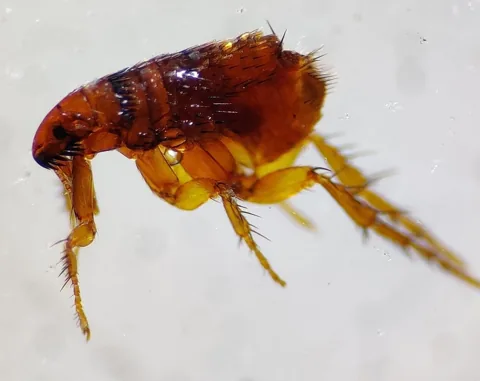 Cat Flea
Ctenocephalides felis
The cat flea is the most common external parasite of domestic cats and dogs, and the flea most often found on both. Adults spend most of their time on the pet, while eggs, larvae and pupae build up wherever the pet rests.
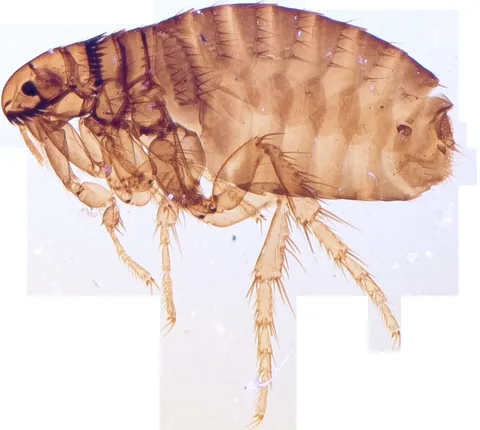 Dog Flea
Ctenocephalides canis
The dog flea looks very much like the cat flea but is the less common of the two on U.S. pets: UC IPM says the cat flea is the most common external parasite on domestic cats and dogs and calls the dog flea rare in California. In some countries, such as South Korea and Uzbekistan, surveys have found it to be the main flea on dogs.
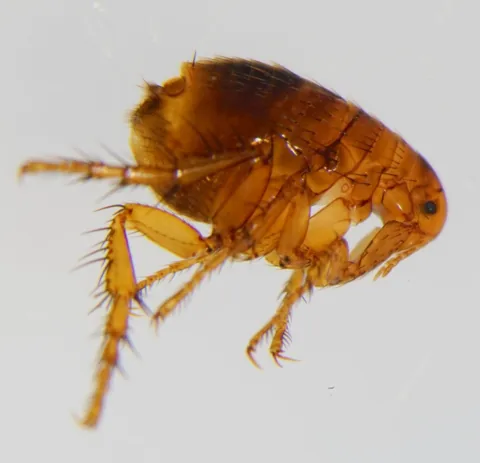 Human Flea
Pulex irritans
The human flea is a bloodsucking flea with a long association with people, one of its main hosts, though it also feeds on a wide range of wild and domestic animals.
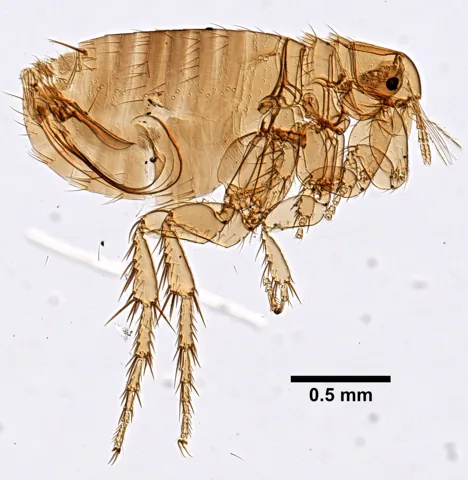 Oriental Rat Flea
Xenopsylla cheopis
The oriental rat flea is a parasite of rats and other small mammals and is best known for spreading two diseases to people: plague and flea-borne (murine) typhus. People are incidental hosts.
 Sticktight Flea
Echidnophaga gallinacea
The sticktight flea is a small, dark flea that embeds its mouthparts in its host's skin and stays put for days or weeks. Texas A&M's veterinary diagnostic lab calls it the main flea pest of poultry, and it also attaches to dogs, cats and people.
No photo yet
Ground squirrel flea
Oropsylla montana
This is the flea behind the handful of plague cases the western United States records each year. It lives in the nests of ground squirrels, west of the Rockies, and it only bothers people when squirrels are abundant or dying. Researchers call it a moderately effective vector, which is the useful part: a bite is unlikely to transmit anything, but a burrow full of dead squirrels and hungry fleas is a situation worth backing away from.
Where fleas live in a yard
Adult cat fleas stay on their host to feed, mate and lay eggs. The smooth eggs fall off the animal wherever it rests, and the larvae that hatch feed on the dried blood adult fleas pass as droppings. So outdoor flea stages pile up exactly where a pet, stray or wild animal spends time lying down.[1][4]
The larvae are fussy about where they live. UC IPM says they develop only in protected places with at least 75% relative humidity, and that immature fleas are unlikely to survive where they're exposed to sunlight or heavy foot traffic. CDC says yard fleas favor shade because they can't tolerate the sun for long, and NPIC notes that sunlight kills young fleas by drying them out.[1][7][6]
That points to a short list of places: doghouses and kennels, along fences, under decks and porches, next to the foundation, in crawl spaces where pets or feral animals sleep, and under shrubs and other vegetation beside buildings. Texas A&M says well-kept lawns in sunny sites are unlikely to harbor many fleas.[2][1][3]
UGA's cat flea fact sheet sums up the larval habitat as shaded areas with high humidity and limited air movement. Climate matters too: in California, UC IPM says outdoor fleas are most common along the coast and in other places with moderate daytime temperatures and fairly high humidity, while in the Central Valley they build up in shaded, protected spots.[4][1]
When yard fleas are worst
CDC says fleas prefer the warmer, more humid months but can survive year-round as long as there's an animal to feed on. UC IPM says flea numbers on pets tend to climb sharply in spring and early summer, when conditions favor the larvae.[7][1]
A field study in north-central Florida found cat flea larvae surviving outdoors in every season. Survival was best in fall (up to 84.6% from September to November), development was fastest in June and July (20-24 days), and January to March was hardest on them, with 91.7-100% of larvae dying during cold, dry fronts. Even then, larvae made it through light frosts in protected spots such as inside a doghouse and under a mobile home.[12]
Cocoons can also wait out bad conditions. UC IPM says fully formed fleas can stay in their cocoons for up to 12 months at cool temperatures, then emerge when warmth or pressure signals that a host is nearby.[1]
Where yard fleas come from: pets, strays and wildlife
Pets pick up fleas at kennels and groomers and from stray dogs, cats and wildlife passing through the yard; Kentucky singles out opossums and raccoons. Adult fleas can jump about 6 inches straight up, enough to land on a passing pet or on a person's shoes and pant legs. Kentucky adds that, contrary to popular belief, fleas seldom jump directly from one pet to another.[2]
Wild and stray animals can keep an outdoor flea population going even when your own pets are protected. UC IPM names feral cats, opossums, squirrels and coyotes; UGA names skunks, opossums, raccoons and cats; and CDC says wild and stray animals commonly carry fleas. Kentucky describes opossums, raccoons and other wildlife 'seeding' fleas into outdoor areas.[1][4][7][2]
If fleas show up in a house with no pets, Kentucky says raccoons, opossums, skunks or squirrels are often the source, for example a skunk or feral cat living under the house. NPIC suggests having the flea identified in that case, since the species can point to rodents or wildlife you didn't know were there.[2][6]
Step 1: Check before you treat
UC IPM says outdoor sprays aren't necessary unless you find significant numbers of adult fleas, and NPIC advises treating outside only where areas are heavily infested.[1][6]
The white-sock test is the standard check. Pull white socks up to the knee and walk slowly through pet resting areas: the doghouse, the shady spot under the deck, the strip along the fence or foundation. Fleas that jump on are easy to see against the white. Kentucky suggests the same test for any area you suspect.[1][2]
If the socks stay clean, you can skip outdoor sprays and keep the focus on the pets and the house. If fleas turn up only in one or two shady spots, those are the places to fix and, if needed, treat.[1][6]
Step 2: Keep every pet on a flea product
Pet treatment does most of the outdoor work. UC IPM says untreated infested areas outdoors can reinfest pets, but treating the pet with one of the preferred spot-on or oral products normally prevents that. Kentucky says keeping pets on a preventive product, seasonally or year-round depending on where you live, means stray fleas they pick up die before laying eggs.[1][2]
CDC recommends treating pets year-round and limiting their time outdoors and their contact with wild and stray animals. Talk with your veterinarian about the right product for each animal; NPIC warns that many dog products can't be used on cats. Product choices, cat safety and indoor clean-up are covered in our guides to fleas in the house and pet-safe pest control.[7][1][6]
Step 3: Make the yard less flea-friendly
Changing the habitat is the outdoor step that keeps working. CDC's list:[7]
- Mow often. Mowing lets sun reach the soil, which fleas avoid.[7]
- Don't overwater. Fleas thrive in humid conditions, so a drier yard is less inviting.[7]
- Rake out debris. Raking removes shaded, humid breeding spots and exposes fleas to any treatment.[7][6]
- Open up pet resting areas. UC IPM suggests removing low-hanging vegetation so sunlight reaches the places pets sleep, and NPIC says to keep yard vegetation low.[1][6]
- Restrict access to spots you can't treat. UGA suggests keeping pets out of hard-to-treat areas such as the space under a deck.[4]
Step 4: Keep wildlife and strays out
Cutting off the animals that bring fleas in matters as much as any spray. CDC and UGA recommend these steps:[7][4]
- Don't feed or pet stray or wild animals, and put pet food away so strays don't hang around.[7]
- Store food, including pet food, in tight-sealing containers, and keep tight lids on compost and trash cans.[7]
- Remove brush, rock piles, junk and cluttered firewood, which shelter rodents and other animals.[7]
- Seal holes in the house that rodents can use, and don't let wildlife nest under the house or in outbuildings.[7][4]
- UC IPM's advice for feral cats, opossums, squirrels and coyotes is to limit the food, water and shelter they find on your property.[1]
- If an animal is already living under a deck, shed or the house, Kentucky recommends having a nuisance wildlife or pest control professional remove it, then treating the flea problem. Our opossum and raccoon guides cover exclusion, one-way doors and state trapping rules.[2]
Step 5: Spot-treat only where fleas breed
Where: doghouse and kennel areas, along fences, under decks, next to the foundation, crawl spaces, pet bedding areas, under shrubs, and any shady spot where pets spend a lot of time. Kentucky says it's seldom necessary to treat the entire yard or areas in full sun, and UGA calls spraying the whole yard wasteful and irresponsible because larvae prefer shaded, humid, still areas.[2][1][3][4]
What: an insect growth regulator (IGR) that holds up in sunlight. Methoprene breaks down quickly in direct sun, so it's mainly an indoor product; pyriproxyfen sprays are more stable outdoors. Kentucky says pyriproxyfen formulations keep flea eggs and larvae from developing for several months, and UGA calls sunlight-stable IGRs the most effective outdoor treatments. They can be diluted in water and applied with a hose-end or pump-up sprayer.[3][2][4]
Adult-killing sprays are less certain. UC IPM says products for adult fleas outdoors are limited because many field populations of cat fleas are resistant to pyrethroids such as permethrin. Texas A&M and UGA still list pyrethroid sprays (Texas A&M names permethrin and esfenvalerate) for shaded areas pets use.[1][3][4]
Treat at the same time as the pets and the house. Texas A&M says premise treatments should ideally go on when the pet is treated, and UGA says sheds and doghouses should be treated the same way and at the same time as the home.[3][4]
Read the label before you buy and follow it exactly. Texas A&M notes that pyriproxyfen sprays are available through pest control operators, and NPIC suggests trying a lower-toxicity product first.[6][3]
Beneficial nematodes for yard fleas
The insect-killing nematode Steinernema carpocapsae is sold for yard fleas. Cornell's biocontrol fact sheet lists cat fleas in yards and turf among its targets, and UGA says the nematodes are sprayed onto soil, where they parasitize flea larvae, and may reduce flea numbers if label directions are followed carefully.[5][4]
The research behind this is mostly from controlled experiments. In a Louisiana State University study, S. carpocapsae applied to potting soil, sand or gravel containing flea eggs, larvae or pupae reduced the number of adult fleas that emerged, with effects on sand and gravel equal to or greater than on soil. Pupae were susceptible whether or not they were in a cocoon. In a 2024 laboratory study, Heterorhabditis bacteriophora killed more than 80% of cat flea larvae in its best-performing treatments and H. indica more than 70%.[11][13]
Conditions limit them outdoors. UGA says the nematodes work best in moist, sandy soils and may lose effectiveness elsewhere. Cornell says to apply them in early morning or evening to avoid sunlight, that S. carpocapsae is typically effective at soil temperatures of 70°F to 85°F, and that most commercial strains don't persist, so they need to be reapplied. Cornell also says beneficial nematodes don't harm plants or animals.[4][5]
Cornell stresses keeping nematodes out of sunlight and from drying out too quickly, which fits the shaded, humid spots where UC IPM says flea larvae live. Our beneficial nematodes guide covers handling, storage and application.[1][5]
What doesn't work well outdoors
Diatomaceous earth: Texas A&M's lab tests found it unlikely to give practical flea control outdoors, because it works only in dry conditions and mixing it with water and spraying it seems to cancel its effect. It may help as a dust in dry spots such as a pet house. UGA warns that it contains silica, which can cause lung disease if inhaled in excessive amounts.[3][4]
Light traps: UGA says traps near where pets rest may catch fleas as they leave their cocoons, but they won't draw fleas off the pet.[4]
Most home remedies: NPIC says most haven't been shown to control fleas, and UGA says the evidence for feeding pets vitamin B, brewer's yeast or garlic shows no value.[6][4]
Blanket lawn spraying: treating open, sunny turf misses where larvae actually live. Kentucky, UC IPM and UGA all limit outdoor sprays to the shaded areas pets and animals use.[2][1][4]
Yard fleas and health: typhus and plague
Flea-borne (murine) typhus is spread mainly by the Oriental rat flea and the cat flea, which become infected by biting infected animals such as rats, cats or opossums. CDC says most U.S. cases are reported from southern California, Hawaii and southern Texas, and lists time outdoors and contact with rats, opossums or free-roaming cats as risk factors. Deaths are rare, and almost all cases clear up with appropriate antibiotics.[9][8]
Studies from those areas show the backyard link. In a 2015 outbreak at a Los Angeles County mobile home community, fleas were everywhere in common areas because of flea-infested opossums and too many outdoor cats and dogs; flea control and removal of animals significantly cut the flea population within five months. In Galveston, Texas, researchers found Rickettsia typhi in fleas from feral cats, and a Texas review links rising cases to more opossums and stray cats and dogs in urban and suburban areas.[14][15][16]
Plague is spread mostly by the bites of infected rodent fleas or by handling infected animals. In areas where plague occurs, CDC advises reducing rodent habitat around the home, keeping pets on flea control, not letting free-roaming dogs or cats sleep on your bed, and wearing gloves when handling sick or dead animals.[10][7]
Protect yourself while working in a flea-infested yard: CDC suggests long pants and socks (bites are often on the lower legs and feet), an EPA-registered repellent such as DEET on skin, and clothing treated with 0.5% permethrin. CDC notes permethrin should not be used on cats.[7][9]
When to call for help
Talk to your veterinarian if your pets keep picking up fleas or react badly to bites; Kentucky notes that hypersensitive animals often need veterinary help. Call a nuisance wildlife or pest control professional if animals are living under the house, deck or shed, as Kentucky recommends.[2][7]
If you have fleas but no pets, your county extension office can help identify the flea, which NPIC says can reveal what animal is bringing them in.[6]
Common questions
- Do I need to treat my yard for fleas?
- Usually not. If your pets are on a spot-on or oral flea product, UC IPM says you'll rarely need to spray outdoors. Treat only if the white-sock test turns up fleas, and then only the shady spots where pets or wildlife rest.[1][2]
- What kills fleas in the yard naturally?
- Sun and dryness: mowing, raking, trimming low branches and not overwatering make the soil too dry and bright for larvae. Beneficial nematodes (Steinernema carpocapsae) are another option for moist, shaded soil, though UGA says results depend on conditions.[7][6][1][4][5]
- Can fleas live in grass?
- Not much in open, sunny grass. Texas A&M says well-maintained sunny lawns are unlikely to harbor many fleas, and UC IPM says larvae rarely survive sun exposure. They live in shaded, humid, sheltered spots instead.[3][1]
- Why does my yard have fleas if my pets are treated?
- Wildlife and strays. Opossums, raccoons, feral cats, skunks and squirrels can keep seeding fleas into the yard. Treated pets should kill the fleas they pick up, but removing food and shelter for those animals cuts the source.[2][1][4]
- Do fleas survive winter outdoors?
- In mild climates, yes. A Florida study found larvae surviving outdoors year-round, including light frosts in protected spots such as a doghouse. CDC says fleas can survive all year where there's an animal to feed on.[12][7]
- Does diatomaceous earth work for fleas in the yard?
- Not well. Texas A&M found it unlikely to give practical control outdoors because it works only in dry conditions.[3]
Photo credits
- Cat Flea: (c) Thomas Gyselinck, some rights reserved (CC BY) — via iNaturalist, CC BY 4.0
- Dog Flea: Ctenocephalides canis by Hallvard Elven, Naturhistorisk museum, Universitetet i Oslo — via Wikimedia Commons, CC BY 3.0
- Human Flea: (c) carnifex, some rights reserved (CC BY) — via iNaturalist, CC BY 4.0
- Oriental Rat Flea: Daniel J. Drew, public domain (CC0), via Wikimedia Commons
- Sticktight Flea: Tradimus, public domain (CC0), via Wikimedia Commons
Sources
- University of California Statewide IPM Program, “Fleas (Pest Notes, Home and Landscape).” ipm.ucanr.edu/home-and-landscape/fleas/ (accessed 2026-11-10)
- University of Kentucky Entomology, “Flea Control and Prevention, ENTFACT-602.” entomology.mgcafe.uky.edu/ef602 (accessed 2026-11-10)
- Texas A&M AgriLife Extension, Urban Entomology, “Fleas, ENT-3001.” citybugs.tamu.edu/factsheets/biting-stinging/others/ent-3001/ (accessed 2026-11-10)
- University of Georgia Center for Invasive Species and Ecosystem Health, IPM, “Cat Flea, Ctenocephalides felis (fact sheet, adapted from a University of Florida Featured Creatures publication).” ipm.uga.edu/files/2021/05/Cat-Flea.pdf (accessed 2026-11-10)
- Cornell University, New York State Integrated Pest Management, “Steinernema carpocapsae, Beneficial nematode (Sc), Biocontrol Fact Sheet.” cals.cornell.edu/integrated-pest-management/outreach-education/fact-sheets/steinernema-carpocapsae-beneficial-nematode-sc (accessed 2026-11-10)
- National Pesticide Information Center, “Fleas.” npic.orst.edu/pest/flea.html (accessed 2026-11-10)
- U.S. Centers for Disease Control and Prevention, “Preventing Flea Bites.” www.cdc.gov/fleas/prevention/index.html (accessed 2026-11-10)
- U.S. Centers for Disease Control and Prevention, “About Fleas.” www.cdc.gov/fleas/about/index.html (accessed 2026-11-10)
- U.S. Centers for Disease Control and Prevention, “About Flea-borne Typhus.” www.cdc.gov/typhus/about/murine.html (accessed 2026-11-10)
- U.S. Centers for Disease Control and Prevention, “Preventing Plague.” www.cdc.gov/plague/prevention/index.html (accessed 2026-11-10)
- Veterinary Dermatology, abstract via PubMed, “Henderson G et al. 1995. The effects of Steinernema carpocapsae application to different life stages on adult emergence of the cat flea Ctenocephalides felis. Veterinary Dermatology 6(3):159-163.” pubmed.ncbi.nlm.nih.gov/34644893/ (accessed 2026-11-10)
- Journal of Medical Entomology, abstract via PubMed, “Kern WH Jr et al. 1999. Outdoor survival and development of immature cat fleas (Siphonaptera: Pulicidae) in Florida. J Med Entomol 36(2):207-211.” pubmed.ncbi.nlm.nih.gov/10083759/ (accessed 2026-11-10)
- Revista Brasileira de Parasitologia Veterinaria, abstract via PubMed, “Souza ACF et al. 2024. Evaluation of the efficacy of entomopathogenic nematodes on Ctenocephalides felis felis larvae. Rev Bras Parasitol Vet 33(2):e019723.” pubmed.ncbi.nlm.nih.gov/38896756/ (accessed 2026-11-10)
- PLoS Neglected Tropical Diseases, abstract via PubMed, “Nelson K et al. 2018. A 2015 outbreak of flea-borne rickettsiosis in San Gabriel Valley, Los Angeles County, California. PLoS Negl Trop Dis 12(4):e0006385.” pubmed.ncbi.nlm.nih.gov/29677221/ (accessed 2026-11-10)
- Vector-Borne and Zoonotic Diseases, abstract via PubMed, “Blanton LS et al. 2019. Rickettsiae within the fleas of feral cats in Galveston, Texas. Vector Borne Zoonotic Dis 19(9):647-651.” pubmed.ncbi.nlm.nih.gov/30835649/ (accessed 2026-11-10)
- Pathogens, abstract via PubMed, “Anstead GM. 2025. A One Health perspective on the resurgence of flea-borne typhus in Texas in the 21st century, Part 1. Pathogens 14(2):154.” pubmed.ncbi.nlm.nih.gov/40005529/ (accessed 2026-11-10)