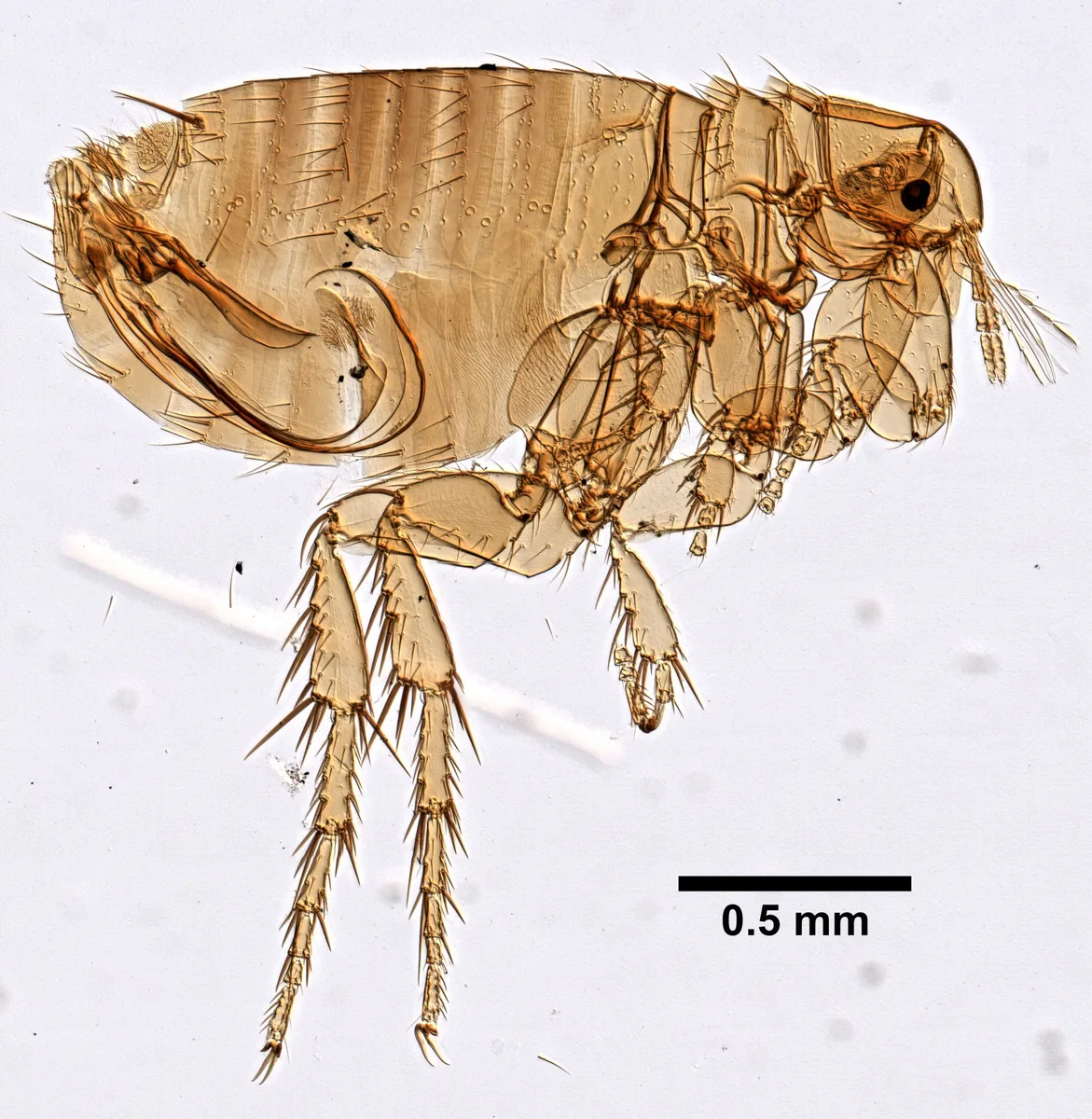
How to identify it
Look-alikes
Where it lives
It occurs worldwide wherever its hosts, rats and other small mammals, live; temperature and humidity limit it.[1]
Biology and life cycle
Females lay up to 300 to 400 eggs in a lifetime, mostly in the host's nest rather than on the host.[1]
It prefers rats but also feeds on cats, dogs and wild mammals; people are accidental hosts.[1]
Health risk
It carries plague bacteria and Rickettsia typhi, the cause of flea-borne typhus, and can transmit tapeworms.[1]
Control
Traps and physical control
Managing it means removing rats and other small host mammals, generally by trapping and poisoning.[1]
Pesticides
Insecticides in burrows and runways help, but resistance is making them less effective.[1]
Common questions
Sources
- University of Florida IFAS Extension (Featured Creatures), “Oriental Rat Flea, Xenopsylla cheopis (EENY-775).” edis.ifas.ufl.edu/publication/IN1330 (accessed 2026-10-06)
- iNaturalist, “Xenopsylla cheopis taxon page (order and family).” www.inaturalist.org/taxa/271312 (accessed 2026-10-06)