The short answer
- On lawns, most blacklegged ticks turn up within 9 feet of the edge next to woods, stone walls or ornamental plantings; the sunny, mowed middle has few.[1][6]
- Keep grass short, clear leaf litter and brush from the lawn edge, prune for sun, and move play sets away from the woods.[1][2][3][5]
- If you spray, treat the woodland edge and paths, not the whole lawn. In Connecticut the best time to hit blacklegged tick nymphs is mid-May to early June.[3][1][7]
- Yard treatment cuts tick numbers but hasn't been shown to prevent tick-borne disease, because people also pick up ticks elsewhere. Keep protecting yourself whenever you're outdoors.[2][5][8][9]
Ticks this applies to
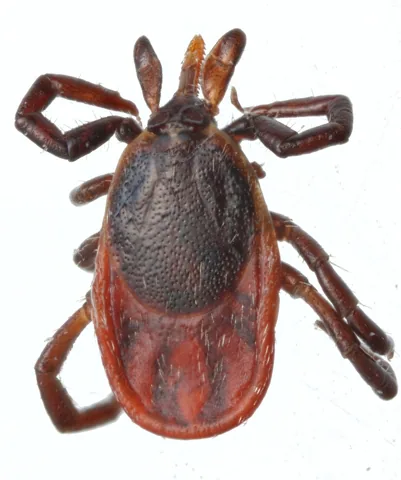 Blacklegged Tick
Ixodes scapularis
The blacklegged tick, often called the deer tick, is widely distributed across the eastern United States and transmits the bacteria that cause Lyme disease along with several other diseases.
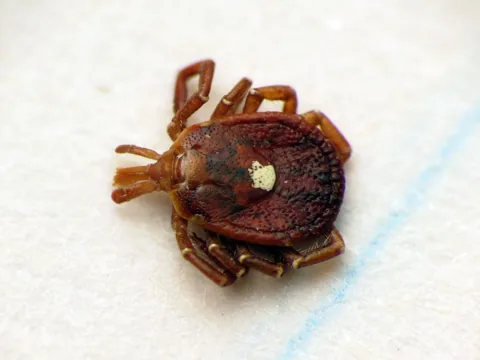 Lone Star Tick
Amblyomma americanum
The lone star tick is a very aggressive tick that readily bites people and pets across the Northeast, South and Midwest; its bite is linked to alpha-gal syndrome, a red meat allergy.
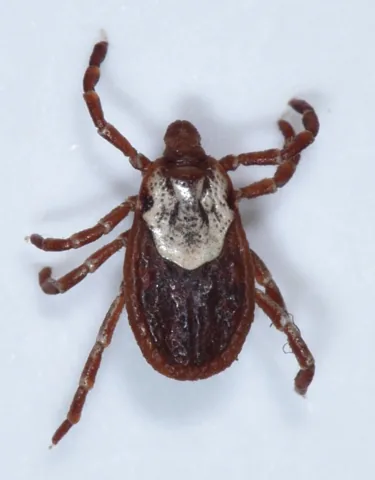 American Dog Tick
Dermacentor variabilis
The American dog tick, also called the wood tick, is widely distributed east of the Rocky Mountains. Adult females are the stage most likely to bite people, especially in spring and summer, and adults commonly climb to the crown of the head.
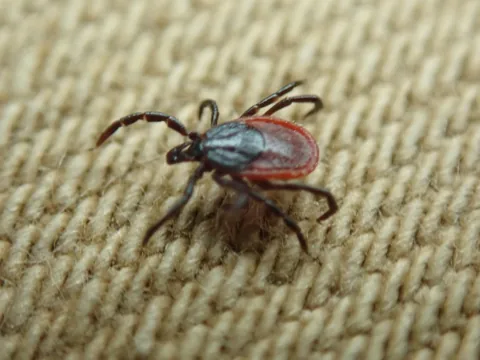 Western Blacklegged Tick
Ixodes pacificus
The western blacklegged tick is the West Coast relative of the eastern deer tick and the only tick that spreads Lyme disease bacteria to people in California. It bites people more often than any other tick in the state.
Where ticks live on a property
Blacklegged ticks are most abundant in woods, where their hosts thrive and humidity stays high. On lawns, 82% of deer ticks have been recovered within 9 feet of the lawn edge, especially next to woods, stone walls or ornamental plantings. Ticks also turn up in groundcover such as pachysandra.[1][6]
How many ticks a property has depends on how much brushy, grassy habitat it has and how many white-tailed deer and white-footed mice visit.[3]
Animals bring ticks in. Mice, chipmunks, birds and deer all carry them, and ticks drop off after feeding wherever those animals roam.[2][6]
Species differ. The University of Rhode Island's TickEncounter center says blacklegged ticks stay where it is shaded, leafy and humid, American dog ticks don't mind sunnier spots such as a patio or deck, and lone star ticks wander between shade and sun.[6]
Habitat changes are most helpful against blacklegged ticks and may be less effective against lone star ticks.[2]
Check the yard with a tick drag
- Fasten a 1-yard or 1-meter square of flannel or corduroy to a piece of wood, and pull it behind you on a string through different parts of the yard.[2]
- Hang the cloth on a branch, railing or fence and look it over. Pick ticks off with tweezers into a vial of alcohol, which kills and preserves them for identification. Try not to hold the cloth, so ticks don't crawl onto you.[2]
- Drag on several days at different times and write down what you find; that shows where and when ticks are active.[2]
- A drag picks up only about 10 to 15% of the ticks present, so finding none doesn't mean the yard is tick-free.[2]
- Check yourself during and after dragging. Cornell IPM says to put your clothes in a hot dryer for 20 minutes and take a shower when you're done. CDC says 10 minutes on high heat kills ticks on dry clothing and damp clothes may need longer, and that showering within two hours of coming indoors has been shown to reduce the risk of Lyme disease.[2][5]
Make the yard less tick-friendly
CDC points homeowners to these same landscaping steps for reducing blacklegged ticks: remove leaf litter, clear tall grass and brush around the house and at the lawn edge, and mow often.[5]
- Keep the grass mowed; Cornell suggests about three inches for turf health. Ticks are less likely to survive in short grass.[2][3][5]
- Remove leaf litter and brush, especially along the edges of the lawn, stone walls and driveways, and prune trees and shrubs to let in sunlight; ticks are more common in shade.[1][3][5][6]
- Limit groundcover where the family spends time, keep swing sets, gazebos and other yard attractions away from the wood's edge, and make the areas you use as open and sunny as possible.[1][2][5]
- Gravel paths, mulch, decking, stone, tile and other hardscape around high-use areas help create a tick-safe zone. Wildflower meadows and herb gardens have very few ticks and can replace grass in some areas.[1]
- A dry strip of wood chips, bark, mulch or gravel between woods and lawn can reduce the number of ticks moving into the lawn, according to CAES, and CDC suggests a 3-foot-wide barrier of wood chips or gravel to restrict ticks moving into play and sitting areas. Cornell and the University of Rhode Island describe the border mainly as a visible line that people, especially children, shouldn't cross; Cornell says it isn't designed to kill ticks.[1][5][2][6]
- Remove old furniture, mattresses and trash that give ticks a place to hide, and stack firewood neatly in a dry spot, which discourages rodents.[5]
- Cut back Japanese barberry, an invasive shrub that shelters ticks and the rodents they feed on. In one study, reducing barberry cover from 62% to 3% meant fewer larval ticks on mice and brought the density of Lyme-infected adult ticks down to nearly 60% of the level in unmanaged barberry.[1]
Keep tick hosts away
Deer bring in the adult ticks that lay eggs, and the young ticks can pick up infections by feeding on mice, chipmunks and birds. Mice live in stone walls, around sheds and in woodpiles, so the University of Rhode Island suggests clearing leaves from stone walls and moving woodpiles away from where people spend time. CAES also advises cleaning up stone walls near the house that shelter mice and chipmunks.[6][1]
- Keep bird feeders, garbage cans, stacked firewood and other things that attract wildlife well away from the house. Cornell notes this advice rests on tick biology and pest management practice rather than research.[2][6]
- Don't feed deer. To keep them out, a fence has to be about 8 to 10 feet high.[3]
- In one study, ticks inside an area surrounded by an electric deer fence dropped by 100% for larvae, 85% for nymphs and 74% for adults. Fencing small areas probably works less well, and deer fences don't keep out mice and other small hosts that carry ticks.[1][2]
- Planting landscape plants deer find less palatable, especially along the edge of the property, can discourage them from browsing.[1][3][6]
Acaricide sprays: where and when
Acaricides (pesticides that kill ticks) can be applied to lawn edges and woodland borders. Use enough spray volume and pressure to get through the vegetation and leaf litter, and treat wooded areas next to the home for the best effect.[1][7]
Minnesota Extension says treating the lawn itself is unnecessary, because ticks rarely infest maintained yards, and treating large areas of woods, brush or grass doesn't work well, because sprays don't always reach the leaf litter and animals carry new ticks in. Treating the edges of wooded or brushy areas and paths can help.[3][7]
Timing in Connecticut: the best time to control blacklegged tick nymphs is mid-May to early June, and one application of most acaricides is enough for the summer. A fall application can target adults, with an early spring application if none was made in the fall.[1]
The University of Rhode Island gives a different schedule: two applications, in mid-May and again in mid-June, across the Northeast and upper Midwest, with an optional fall application in mid-October after adult blacklegged ticks emerge. It recommends hiring a licensed applicator with high-pressure equipment. CDC says to check with local health or agricultural officials on the best time and type of pesticide for your area and the rules for spraying residential property.[7][5]
Residential tick products contain active ingredients such as bifenthrin, carbaryl, cyfluthrin, permethrin or pyrethrins. Many tick products are restricted to licensed commercial applicators, and deltamethrin and lambda-cyhalothrin are restricted-use products for licensed applicators, though low concentrations appear in some non-restricted products. Whatever you use, the label must list ticks and the area you plan to treat.[1][3][7]
Pyrethrins have little residual activity, so they need thorough coverage and may need repeat applications.[1]
A biopesticide made from spores of the fungus Metarhizium anisopliae strain F52 reduced blacklegged ticks around homes by 53 to 74% in trials, applied every 4 to 8 weeks through the tick season.[1]
Minimum-risk products with oils such as cedar, rosemary, peppermint or garlic are exempt from EPA registration, so EPA hasn't reviewed their efficacy. Tests are limited, though a few have suppressed ticks for 2 to 3 weeks.[1]
Permethrin, a common tick spray ingredient, is highly toxic to fish and other aquatic animals and to bees and other beneficial insects, so keep sprays away from water and blooming plants. CAES says most acaricides are highly toxic to fish, and the University of Rhode Island says pyrethroids shouldn't be applied around ponds or streams with fish.[4][1][7]
Rodent- and deer-targeted products
Bait boxes lure mice and chipmunks inside and treat them with fipronil as they feed. CAES reports that they dramatically reduced ticks in a large community trial; Cornell describes a short-term study showing fewer host-seeking nymphs, with larger studies under way. The boxes are available through certain licensed applicators, go every 30 to 60 feet along the lawn-woods edge and near likely mouse nests, and work best when several neighbors use them.[1][2]
One of those larger studies, The Tick Project, compared treatments across 24 New York neighborhoods, with every participating property in a neighborhood getting the same treatment. Bait boxes were linked to fewer host-seeking ticks and fewer ticks feeding on rodents.[2][9]
Tick tubes hold permethrin-treated cotton that mice carry off for nesting. Results are mixed: several Connecticut and New York trials on properties of about 4 acres or less found no drop in infected host-seeking nymphs, while a Massachusetts study on an 18-acre site and some sites on Fire Island saw fewer nymphs. Chipmunks, another important host, don't collect the cotton.[1]
Don't make your own tick tubes from permethrin clothing spray. The label has no directions for that use, so doing it is illegal.[2]
Deer feeding stations that rub permethrin onto deer as they feed are labeled in a number of states, but they are a community-scale tool and tend to be too expensive for many communities.[1][2]
What yard control can't do
A study of residential acaricide spraying found it reduced host-seeking ticks on treated properties but didn't reduce tick encounters or tick-borne disease, probably because people met ticks in untreated parts of the property or away from home.[2][8][5]
That study was a CDC-led trial in 2,727 households in three northeastern states. Each yard got a single spring barrier spray of bifenthrin or water. Treated properties had 63% fewer host-seeking ticks, yet there was no difference between the groups in tick encounters or in tick-borne disease confirmed from medical records.[8]
Cornell IPM lists three neighborhood-scale projects set up to test whether area-wide treatment can reduce disease. Many towns that run mosquito programs have no comprehensive plan for ticks, so tick control often falls to homeowners.[2]
The Tick Project, one of those three, found the same for people: bait boxes and a fungal spray, alone or together, didn't make a significant difference in tick-borne disease in people, though they did reduce it in pets. CDC's advice is that pesticides can reduce ticks in the treated parts of a yard, but you shouldn't rely on spraying to reduce your risk of infection.[9][5]
Whatever you do in the yard, act as if ticks are present whenever you're outdoors, including in your own backyard: CDC advises an EPA-registered repellent, clothing and gear treated with 0.5% permethrin, and a full-body tick check after you come in.[5][2][1]
Common questions
- Should I spray my whole lawn for ticks?
- No. Ticks rarely infest maintained lawns. Treat the edges of woods, brush and paths, where ticks actually live.[3][1][7]
- Do wood chip borders kill ticks?
- No. A dry wood chip, bark or gravel strip can reduce ticks moving from woods into the lawn, and it marks where children shouldn't wander, but it isn't designed to kill ticks.[1][2][5]
- When is the best time to spray for ticks?
- For blacklegged tick nymphs, CAES gives mid-May to early June and says one application of most products covers the summer; the University of Rhode Island recommends two, in mid-May and mid-June. Both say a fall treatment can target adults. Check with local health or agricultural officials for your area.[1][7][5]
- Will spraying my yard keep my family from getting Lyme disease?
- Not on its own. In a CDC-led trial, one spring spray cut host-seeking ticks on treated properties by 63% but didn't reduce tick encounters or tick-borne disease. CDC says not to rely on spraying and to keep using repellent, treated clothing, tick checks and a shower after time outdoors.[8][5]
Photo credits
- Blacklegged Tick: (c) Christian Back, some rights reserved (CC BY) — via iNaturalist, CC BY 4.0
- Lone Star Tick: (c) Katja Schulz, some rights reserved (CC BY) — via iNaturalist, CC BY 4.0
- American Dog Tick: (c) Don Loarie, some rights reserved (CC BY) — via iNaturalist, CC BY 4.0
- Western Blacklegged Tick: Randal, public domain (CC0), via iNaturalist
Sources
- Connecticut Agricultural Experiment Station, “Managing Exposure to Ticks on Your Property (Kirby C. Stafford III, 2014).” portal.ct.gov/-/media/caes/documents/publications/fact_sheets/entomology/tickcontrolfspdf.pdf (accessed 2026-11-10)
- New York State Integrated Pest Management Program, Cornell University, “Managing Ticks in the Landscape.” cals.cornell.edu/integrated-pest-management/outreach-education/whats-bugging-you/ticks/managing-ticks-landscape (accessed 2026-11-10)
- University of Minnesota Extension, “Ticks (Jeffrey Hahn; reviewed 2025).” extension.umn.edu/garden-and-home/yard-and-garden/yard-and-garden-insects/ticks (accessed 2026-11-10)
- National Pesticide Information Center, “Permethrin General Fact Sheet.” npic.orst.edu/factsheets/PermGen.html (accessed 2026-11-10)
- Centers for Disease Control and Prevention, “Preventing Tick Bites.” www.cdc.gov/ticks/prevention/index.html (accessed 2026-11-10)
- TickEncounter Resource Center, University of Rhode Island, “Protect your yard.” web.uri.edu/tickencounter/prevention/protect-your-yard/ (accessed 2026-11-10)
- TickEncounter Resource Center, University of Rhode Island, “Perimeter treatments.” web.uri.edu/tickencounter/prevention/protect-your-yard/perimeter-treatments/ (accessed 2026-11-10)
- Journal of Infectious Diseases, abstract via PubMed, “Hinckley and others 2016, Effectiveness of Residential Acaricides to Prevent Lyme and Other Tick-borne Diseases in Humans (CDC Division of Vector-Borne Diseases).” pubmed.ncbi.nlm.nih.gov/26740276/ (accessed 2026-11-10)
- Emerging Infectious Diseases (CDC), abstract via PubMed, “Keesing and others 2022, Effects of Tick-Control Interventions on Tick Abundance, Human Encounters with Ticks, and Incidence of Tickborne Diseases in Residential Neighborhoods, New York, USA.” pubmed.ncbi.nlm.nih.gov/35447066/ (accessed 2026-11-10)