The short answer
- If ticks keep turning up on your dog and crawling on baseboards or walls indoors, it is very likely the brown dog tick, the tick that Ohio State and Connecticut say becomes established inside homes with dogs.[3][2][4][5]
- Treat every dog in the household, ideally through your veterinarian, at the same time the house is treated. The ticks live both on the dog and in the building, so both need control.[3][4][5]
- Vacuum and clean first, then treat cracks and crevices near floor level, baseboards, door and window frames, carpet edges and above all the places the dog sleeps and rests, with a product whose label lists ticks and those indoor sites.[3][4][2]
- Broadcast yard spraying for woodland ticks won't fix an indoor infestation. Outdoors, limit treatment to where the dog rests: kennels, doghouses and around outbuildings.[4][3][5]
- Expect several rounds over several months. Rhode Island's TickEncounter center describes a four-step process (pets, house, yard, vacuuming) that may take several treatments and several months.[1]
- In parts of the southwestern U.S. and Mexico, brown dog ticks spread Rocky Mountain spotted fever, which can be deadly if not treated early with doxycycline. See a doctor if you get sick after a tick bite.[8][10][3]
Related profiles
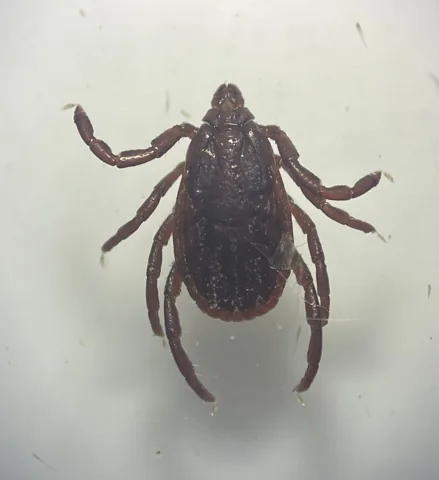 Brown Dog Tick
Rhipicephalus sanguineus
The brown dog tick is unusual: unlike most ticks, it can complete its entire life cycle indoors. It occurs across the United States, is met more often in the southern states, and can build up to high numbers on dogs and in homes and kennels.
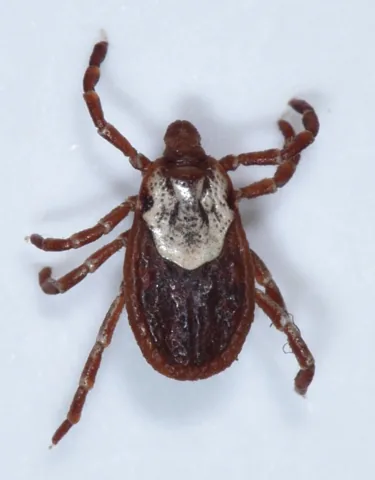 American Dog Tick
Dermacentor variabilis
The American dog tick, also called the wood tick, is widely distributed east of the Rocky Mountains. Adult females are the stage most likely to bite people, especially in spring and summer, and adults commonly climb to the crown of the head.
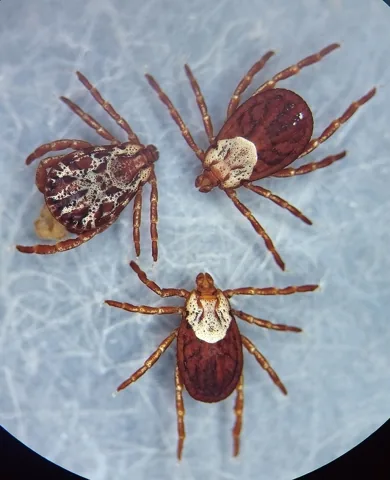 Rocky Mountain Wood Tick
Dermacentor andersoni
The Rocky Mountain wood tick is the tick most often found on people and pets in Colorado and Utah. It is most active in spring, then goes dormant as the weather turns hot and dry, and it is the vector of Colorado tick fever.
Is it really a brown dog tick?
Sources agree that the brown dog tick is the species behind household tick infestations. Other ticks, such as American dog ticks, can be carried in and survive for a while, but they don't establish themselves indoors.[2][4][3][6]
- Look: reddish brown with no markings on the back, teardrop-shaped, with short mouthparts. Ohio State gives about 1/8 inch for unfed adults; the University of Saskatchewan veterinary college gives 4 to 5 mm for unfed adult females. A fed female swells to about 1/2 inch and turns bluish gray.[3][6][5]
- Where ticks are on the dog: adults mainly inside the ears, on the head and neck and between the toes; larvae and nymphs along the back in the long hair, or on the legs, chest and belly. Connecticut's handbook says the immature stages feed almost anywhere.[2][4][3][5]
- Where ticks are in the house: crawling along baseboards and up walls and other vertical surfaces, looking for cracks, gaps behind baseboards and loose wallpaper where they molt and lay eggs. The veterinary college notes many owners don't realize the house is infested until they see ticks crawling up the walls.[2][4][5]
- All three life stages (six-legged larvae, eight-legged nymphs and adults) can turn up on the same dog, a sign the ticks are breeding where the dog lives.[5][2]
- Not sure? The University of Saskatchewan says a diagnostic laboratory can identify ticks found in a household, and our types of ticks guide shows how the brown dog tick differs from the American dog tick and deer tick.[5]
Why this tick takes over houses and kennels
Dogs are the main host for all three life stages, and each stage drops off the dog to digest and molt nearby, so where the dog sleeps the ticks collect. Ohio State says it is well adapted to the warm, dry conditions inside homes and doesn't thrive in woods.[2][7][5][3]
- It travels with dogs. Dogs pick it up in infested homes, kennels, veterinary offices and outdoor spots used by an infested dog. Direct contact between dogs is less of a problem than contact with an infested place, according to the veterinary college.[4][5]
- Females lay big batches in hidden spots. Sources give different counts: 360 to 3,000 eggs (Connecticut), up to 4,000 (Rhode Island) and as many as 5,000 (Clemson). Eggs go in cracks and crevices, on top of kennels and on ledges, and hatch in 2 to 5 weeks.[2][1][4]
- It can cycle quickly. A generation can take about 60 days under good conditions (Ohio State) or about two months (Connecticut); Rhode Island says as few as three months. The veterinary college says it usually takes longer, 4 to 5 months, when ticks can't find a dog right away.[3][2][1][5]
- It can wait a long time without food. Rhode Island says adults can survive 18 months without feeding; the veterinary college lists about 253 days for unfed larvae, 97 days for nymphs and 568 days for adults.[1][5]
- It's worse in warm regions but not limited to them. It is more common in the southern states. In the North and in Canada it lives almost entirely indoors, often arriving on dogs that traveled from warmer places.[2][1][5]
- A single tick can start it. A study in Israel watched single females feed on indoor dogs and then lay eggs inside apartments, followed by new young ticks.[13]
Step 1: Treat every dog, with your veterinarian
The dog is both the food source and the transport. Ohio State says the dog should be treated, preferably by a veterinarian, at the same time as the house and yard, and Clemson says to treat the animal with an approved product whenever the home is treated.[3][4]
The University of Saskatchewan veterinary college says all dogs in contact must be treated, ideally with an isoxazoline or a newer macrocyclic lactone whose label claims this tick. Older collars, powders, shampoos and sprays exist too.[5]
- Use a tick preventive on each dog and ask your veterinarian which product fits your dogs and your local tick diseases. CDC notes vaccines don't exist for most tickborne diseases of dogs.[9]
- Isoxazolines: CDC's pet page links an FDA notice about possible adverse events with isoxazoline flea and tick products, another reason to choose with your veterinarian.[9]
- Collars worked at community scale. In an Arizona community with high RMSF rates, long-acting tick collars on all dogs plus monthly yard treatments dropped visible infestations to under 1% of dogs within five months, compared with 64% in communities outside the project; in year two, collars alone kept it under 3%.[11]
- Cats: CDC says cats are extremely sensitive to many chemicals; don't put any tick product on a cat without asking a veterinarian first. The veterinary college adds that some dog and house products contain pesticides unsafe for cats and children. Our flea guide covers products to keep away from cats.[9][5]
- Check dogs daily and remove ticks right away. Ticks can be hard to spot on long or dark fur.[9]
- Watch for illness. CDC says signs of tickborne disease in pets may not appear for 7 to 21 days or longer after a bite. Ohio State lists lethargy, anemia, not eating, weight loss and lameness; take a pet with those signs to a veterinarian. Brown dog ticks carry canine ehrlichiosis and canine babesiosis to dogs.[9][3][2][6]
Step 2: Vacuum and clean before you treat
Ohio State says any pesticide treatment should follow vacuuming and cleaning, which removes debris and as many ticks as possible and lets the treatment reach deeper into cracks and crevices. Rhode Island lists vacuuming as one of the four steps in clearing an infestation.[3][1]
- Vacuum along baseboards, carpet edges, door and window frames, and every spot the dog sleeps or rests.[3][4]
- Pay most attention to pet bedding and sleeping areas, where ticks drop off after feeding.[4][3][2]
- Check kennels and crates, including the tops and ledges where Rhode Island says eggs are often laid.[1]
Step 3: Treat the cracks, not the whole room
Indoor tick treatment is generally not advised for other ticks, because they don't establish inside. The brown dog tick is the exception, and both Clemson and Ohio State describe targeted, low-level treatment rather than spraying rooms.[4][3]
- Where to treat: the dog's sleeping and resting sites, and the cracks and crevices in floors and walls, baseboards, window and door frames, around wall molding and hangings and under carpet edges, where ticks hide to molt.[3][4]
- How high? Clemson says brown dog ticks won't be found in high places and to think of them as being at the level of the dog. Connecticut and the veterinary college describe ticks crawling up walls, and Connecticut mentions gaps between walls and wallpaper. Treat low first, and follow the ticks if you see them climbing.[4][2][5]
- What product: Clemson says many of the same spray or dust products used for cockroaches work, if the label lists the sites you need to treat. Connecticut notes some products are labeled only for brown dog ticks or only for indoor surfaces. Always read and follow the label.[4][2]
- Pyrethroid resistance: brown dog tick populations have been reported with reduced sensitivity to permethrin and etofenprox, likely from long use of pyrethroids around homes, and a review warns that indiscriminate acaricide use has selected for resistant tick strains.[15][14]
- Hiring help: Clemson says a professional may be worth it for a severe infestation, since professionals can use products not sold to consumers. The veterinary college also says treating the building may involve a professional.[4][5]
Step 4: The yard, and why spraying it isn't the fix
Woodland ticks are found in wooded and brushy areas, while brown dog ticks don't thrive in woods and live with the dog, in and around the home. A general yard treatment misses the ticks hiding indoors. Clemson says general outdoor tick treatments often aren't very effective and should be limited to where pets spend the most time.[4][3][2]
- Treat where the dog rests: Ohio State lists sites where the dog rests, under doghouses, and grassy or brushy areas around outbuildings and kennels. Its close link to the house is why Ohio State calls the brown dog tick an exception to the rule that outdoor chemical control is mostly ineffective.[3]
- Crawlspaces, outside walls and cracks: Clemson says to treat these only if you actually see ticks there.[4]
- In northern areas the yard may not matter. The veterinary college says in Canada the outdoor environment isn't a source and control should focus indoors.[5]
- Free-roaming dogs keep bringing them back. In eastern Arizona, homes with more nearby structures had more ticks, which researchers tied to free-roaming dogs, and fencing appeared protective. The Arizona RMSF Rodeo project also encouraged spay and neuter and proper tethering.[12][11]
- For woodland ticks outside, see our yard tick control guide; those steps target different species.[4]
How long it takes
Plan on months, not a weekend. Rhode Island says clearing an infestation may take several treatments over several months. Because unfed adults can survive many months and eggs hide in cracks, keep treating the dogs and keep checking the house well after the last tick is seen.[1][5]
- Keep every dog on a tick preventive through the whole period. In the Arizona project, collars alone sustained control in the second year.[11][5]
- Recheck baseboards, kennels and bedding regularly, and look for ticks on the dogs daily.[9][4]
- Prevent the next one: the veterinary college advises tick preventives for dogs traveling to warm regions and checking dogs that come back.[5]
Do brown dog ticks bite people? RMSF risk
They prefer dogs and rarely feed on people, but they can bite humans and other mammals, and the veterinary college notes people may be bitten when no dogs are around.[3][7][5][4]
Rocky Mountain spotted fever (RMSF): CDC lists the brown dog tick as a vector in parts of the southwestern United States and Mexico. In eastern Arizona, a 2002 to 2004 investigation found 16 patients, 15 hospitalized and 2 deaths, all confirmed patients having contact with tick-infested dogs; dense brown dog tick populations were on dogs and in yards.[8][10][3]
- Scale: from 2003 to 2012 more than 250 RMSF cases and 19 deaths were documented among Arizona's American Indian population; a later CDC-led study reports nearly 500 cases and 28 deaths in Arizona tribal communities since 2003.[11][12]
- Elsewhere: Ohio State says it isn't known whether the brown dog tick spreads RMSF to people in other parts of the U.S., and in Ohio it hasn't been implicated in human disease.[3]
- Symptoms: CDC lists fever, headache, rash, nausea or vomiting, stomach pain, muscle pain and lack of appetite. The rash usually appears 2 to 4 days after fever begins.[8]
- Treatment: RMSF can be deadly if not treated early with the antibiotic doxycycline, which CDC says is approved for adults and children of all ages. There is no vaccine. If you become ill after a tick bite, see your healthcare provider; CDC says they should start treatment before test results come back if they suspect RMSF.[8]
- If one bites you: remove it promptly and watch for symptoms. Our guide on what to do after a tick bite covers removal, saving the tick and when to see a doctor.[8][4]
Common questions
- Can ticks live in your house?
- Most can't. The brown dog tick is the exception: it can complete its whole life cycle indoors in homes with dogs and in kennels. Other ticks brought inside don't establish.[3][2][4]
- Why do I keep finding ticks on my walls?
- Brown dog ticks that drop off the dog crawl along baseboards and up walls looking for cracks and gaps to molt and lay eggs. Seeing them on walls usually means the house is infested.[2][5]
- Do I need to treat the house if I treat my dog?
- Yes. Sources say to treat the dog and the infested home at the same time, since eggs, larvae and molting ticks are off the dog in the house.[3][4][5][2]
- Will spraying the yard get rid of brown dog ticks?
- Not by itself. Outdoor treatment should be limited to where the dog rests, such as kennels and doghouses, while the main work is on the dogs and inside.[4][3][5]
- How many eggs does a brown dog tick lay?
- Sources differ: 360 to 3,000 (Connecticut), up to 4,000 (Rhode Island) and as many as 5,000 (Clemson).[2][1][4]
- Are brown dog ticks dangerous to people?
- They rarely bite people, but in parts of the southwestern U.S. and Mexico they spread Rocky Mountain spotted fever, which needs prompt treatment with doxycycline.[8][3][10]
Photo credits
- Brown Dog Tick: (c) NoahM, some rights reserved (CC BY) — via iNaturalist, CC BY 4.0
- American Dog Tick: (c) Don Loarie, some rights reserved (CC BY) — via iNaturalist, CC BY 4.0
- Rocky Mountain Wood Tick: (c) Toby, some rights reserved (CC BY) — via iNaturalist, CC BY 4.0
Sources
- University of Rhode Island TickEncounter Resource Center, “Brown Dog Tick.” web.uri.edu/tickencounter/species/brown-dog-tick/ (accessed 2026-11-10)
- Connecticut Agricultural Experiment Station, “Tick Management Handbook, revised edition (Bulletin No. 1010; K. C. Stafford III, 2007).” portal.ct.gov/-/media/CAES/DOCUMENTS/Publications/Bulletins/b1010pdf.pdf (accessed 2026-11-10)
- Ohio State University Extension, “Ticks and Tick-Borne Diseases, HYG-2073 (2013).” ohioline.osu.edu/factsheet/HYG-2073 (accessed 2026-11-10)
- Clemson Cooperative Extension Home & Garden Information Center, “Ticks Around Your Home, HGIC 2484 (J. M. Sargent, P. A. Zungoli, E. P. Benson).” hgic.clemson.edu/factsheet/ticks/ (accessed 2026-11-10)
- Western College of Veterinary Medicine, University of Saskatchewan, “Rhipicephalus sanguineus: brown dog tick (Learn About Parasites, 2021).” wcvm.usask.ca/learnaboutparasites/parasites/rhipicephalus-sanguineus-brown-dog-tick.php (accessed 2026-11-10)
- University of Kentucky Entomology, “Ticks and Disease in Kentucky (ENTFACT-618; A. Pasternak, J. Larson, M. Cipriani).” entomology.mgcafe.uky.edu/ef618 (accessed 2026-11-10)
- Centers for Disease Control and Prevention, “Where Ticks Live.” www.cdc.gov/ticks/about/where-ticks-live.html (accessed 2026-11-10)
- Centers for Disease Control and Prevention, “About Rocky Mountain Spotted Fever.” www.cdc.gov/rocky-mountain-spotted-fever/about/index.html (accessed 2026-11-10)
- Centers for Disease Control and Prevention, “Preventing Ticks on Pets.” www.cdc.gov/ticks/prevention/preventing-ticks-on-pets.html (accessed 2026-11-10)
- New England Journal of Medicine (PubMed 16093467), “Demma LJ et al. Rocky Mountain spotted fever from an unexpected tick vector in Arizona. N Engl J Med 2005;353(6):587-94.” pubmed.ncbi.nlm.nih.gov/16093467/ (accessed 2026-11-10)
- PLoS One (PubMed 25479289), “Drexler N et al. Community-based control of the brown dog tick in a region with high rates of Rocky Mountain spotted fever, 2012-2013. PLoS One 2014;9(12):e112368.” pubmed.ncbi.nlm.nih.gov/25479289/ (accessed 2026-11-10)
- American Journal of Tropical Medicine and Hygiene (PubMed 40328244), “Brophy MK et al. Ecologic risk factors for infestation of Rhipicephalus sanguineus s.l. in a Rocky Mountain spotted fever-endemic area of eastern Arizona. Am J Trop Med Hyg 2025;113(1):156-162.” pubmed.ncbi.nlm.nih.gov/40328244/ (accessed 2026-11-10)
- International Journal of Medical Microbiology (PubMed 12141741), “Uspensky I, Ioffe-Uspensky I. The dog factor in brown dog tick Rhipicephalus sanguineus infestations in and near human dwellings. Int J Med Microbiol 2002;291 Suppl 33:156-63.” pubmed.ncbi.nlm.nih.gov/12141741/ (accessed 2026-11-10)
- Veterinary Parasitology (PubMed 18280045), “Dantas-Torres F. The brown dog tick, Rhipicephalus sanguineus (Latreille, 1806): from taxonomy to control. Vet Parasitol 2008;152(3-4):173-85.” pubmed.ncbi.nlm.nih.gov/18280045/ (accessed 2026-11-10)
- Medical and Veterinary Entomology (PubMed 32918501), “Tucker NSG et al. Prevalence and distribution of pathogen infection and permethrin resistance in tropical and temperate populations of Rhipicephalus sanguineus s.l. collected worldwide. Med Vet Entomol 2021;35(2):147-157.” pubmed.ncbi.nlm.nih.gov/32918501/ (accessed 2026-11-10)