The short answer
- Blacklegged (deer) tick: small, with a dark plate and black legs; the unfed female has a reddish-orange body. Eastern U.S. Spreads Lyme disease, anaplasmosis, babesiosis and Powassan virus.[1][4][8]
- Western blacklegged tick: looks like the deer tick and only a specialist can tell them apart. Pacific Coast, especially northern California. Spreads Lyme disease and anaplasmosis.[1][6][7]
- Lone star tick: reddish-brown; the female has a single white spot on her back. Northeast, South and Midwest. A very aggressive biter linked to ehrlichiosis, tularemia, Heartland and Bourbon viruses, STARI and alpha-gal syndrome (red meat allergy), but not Lyme disease.[1][4][19]
- American dog tick: larger, about 1/4 inch, brown with whitish or silvery markings and short mouthparts. East of the Rockies plus limited areas in the West. Spreads Rocky Mountain spotted fever and tularemia.[1][6][4]
- Rocky Mountain wood tick: looks like the American dog tick; found in the Rocky Mountain states at 4,000 to 10,500 feet. Spreads Rocky Mountain spotted fever, Colorado tick fever and tularemia.[1][12]
- Brown dog tick: plain brown and teardrop-shaped; the one tick that can infest a house, living around dogs. Found worldwide; spreads Rocky Mountain spotted fever in the southwestern U.S. and along the U.S.-Mexico border.[1][4][13][6]
- Gulf Coast tick: patterned like a dog tick but with long, slender mouthparts. Mainly the Southeast. Spreads Rickettsia parkeri rickettsiosis.[1][14][4]
- Asian longhorned tick: small, plain brown, invasive since 2017 in the East, and much more a livestock pest than a human biter so far.[1][16][17]
- If one has bitten you, remove it with fine-tipped tweezers, save it in a sealed bag with the date and place, and tell a doctor if you get a fever or rash.[4]
Tick profiles
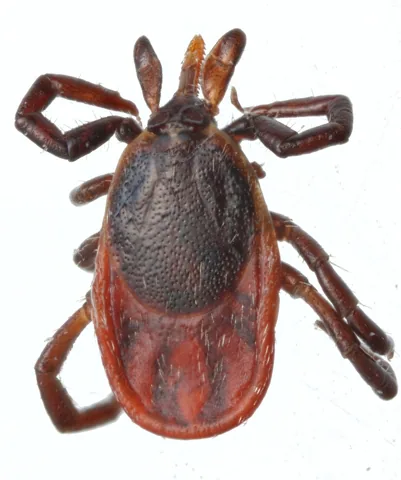 Blacklegged Tick
Ixodes scapularis
The blacklegged tick, often called the deer tick, is widely distributed across the eastern United States and transmits the bacteria that cause Lyme disease along with several other diseases.
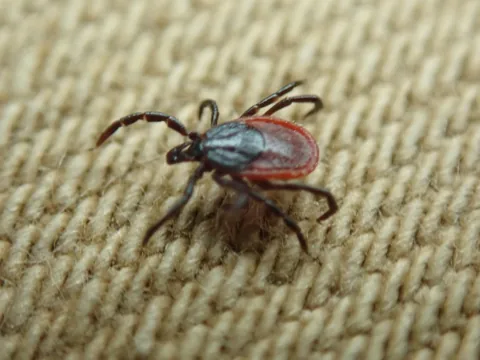 Western Blacklegged Tick
Ixodes pacificus
The western blacklegged tick is the West Coast relative of the eastern deer tick and the only tick that spreads Lyme disease bacteria to people in California. It bites people more often than any other tick in the state.
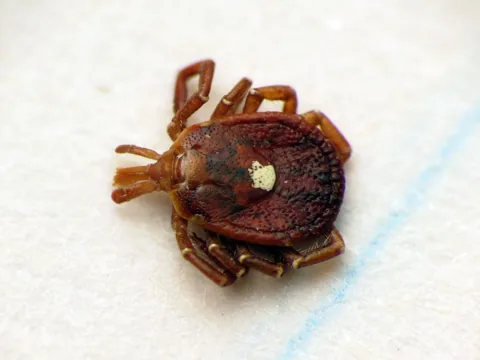 Lone Star Tick
Amblyomma americanum
The lone star tick is a very aggressive tick that readily bites people and pets across the Northeast, South and Midwest; its bite is linked to alpha-gal syndrome, a red meat allergy.
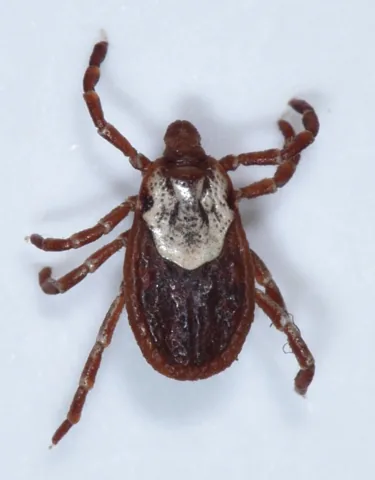 American Dog Tick
Dermacentor variabilis
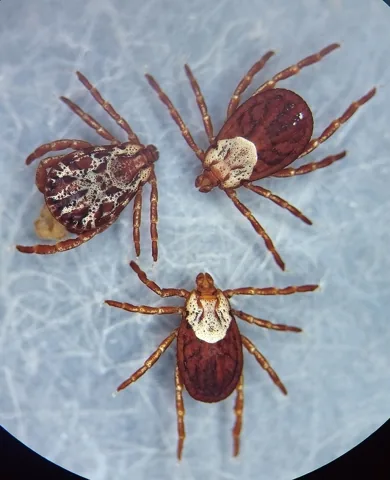
The American dog tick, also called the wood tick, is widely distributed east of the Rocky Mountains. Adult females are the stage most likely to bite people, especially in spring and summer, and adults commonly climb to the crown of the head.
 Rocky Mountain Wood Tick
Dermacentor andersoni
The Rocky Mountain wood tick is the tick most often found on people and pets in Colorado and Utah. It is most active in spring, then goes dormant as the weather turns hot and dry, and it is the vector of Colorado tick fever.
 Brown Dog Tick
Rhipicephalus sanguineus
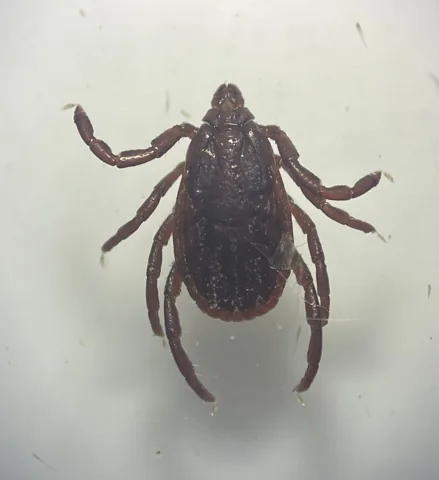
The brown dog tick is unusual: unlike most ticks, it can complete its entire life cycle indoors. It occurs across the United States, is met more often in the southern states, and can build up to high numbers on dogs and in homes and kennels.
 Gulf Coast Tick
Amblyomma maculatum
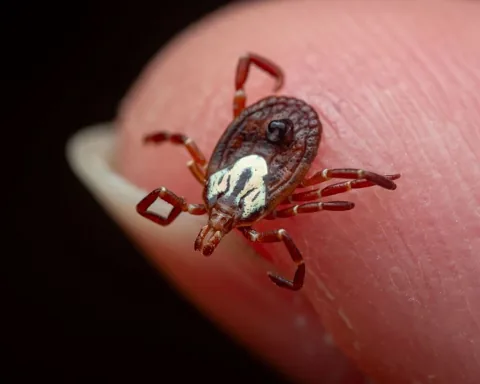
The Gulf Coast tick is a hard tick of grass prairies, coastal uplands and shrubby, recently disturbed ground with little or no tree cover. Adults bite people, and it is the principal carrier of Rickettsia parkeri, which causes a form of spotted fever, and of the parasite behind American canine hepatozoonosis in dogs.
 Asian Longhorned Tick
Haemaphysalis longicornis
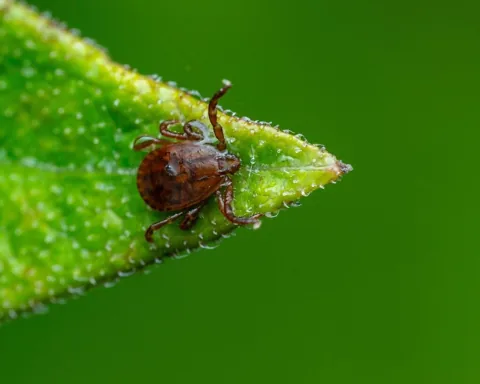
The Asian longhorned tick is an invasive tick first reported in the United States in 2017. U.S. females lay eggs without mating, which APHIS describes as essentially cloning themselves, so huge numbers can build up on livestock, pets and wildlife and in grass.
 Pacific Coast Tick
Dermacentor occidentalis
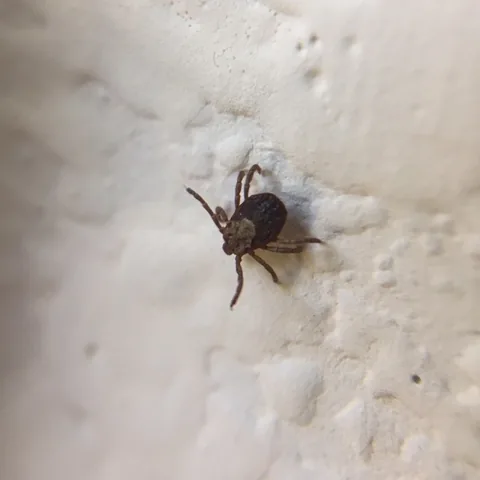
The Pacific Coast tick is one of the most widespread ticks in California and one of a handful that regularly bite people. It is the only tick known to spread Pacific Coast tick fever, and it can also carry spotted fever and tularemia.
 Winter tick
Dermacentor albipictus
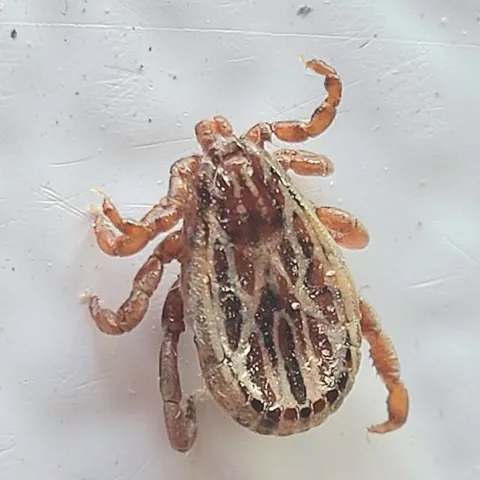
The winter tick, also called the moose tick, is a hard tick that spends its whole life on a single animal and feeds through the fall and winter, when most ticks are inactive. Moose suffer most, but it also turns up on deer, elk, horses and cattle.
 Groundhog tick
Ixodes cookei
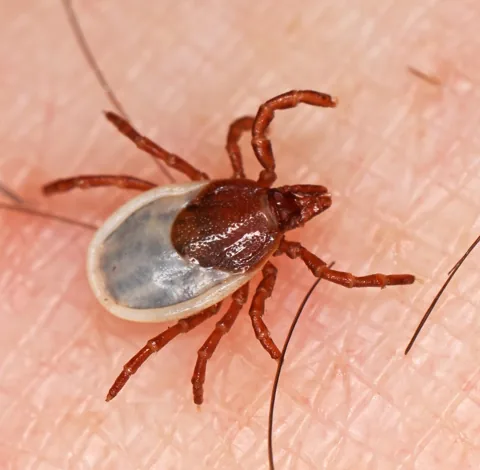
The groundhog tick, also called the woodchuck tick, is a hard tick of eastern North America that lives in the dens and nests of groundhogs and other mammals. It bites people far less readily than the blacklegged tick, but it is the tick that keeps lineage I of Powassan virus circulating among groundhogs and weasel-family mammals.
 Soft Ticks (relapsing fever ticks)
Ornithodoros species (mainly O. hermsi and O. turicata in the U.S.)
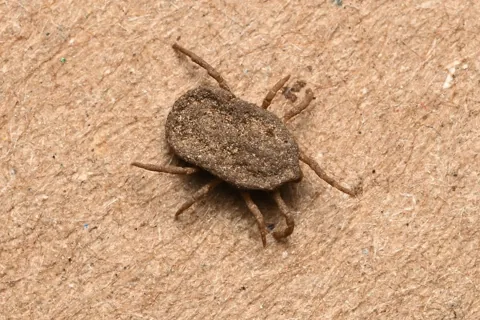
Soft ticks live in rodent nests, often inside the walls and floors of rustic cabins, and come out at night to feed briefly on sleeping people. In the U.S., infected Ornithodoros soft ticks spread soft tick relapsing fever.
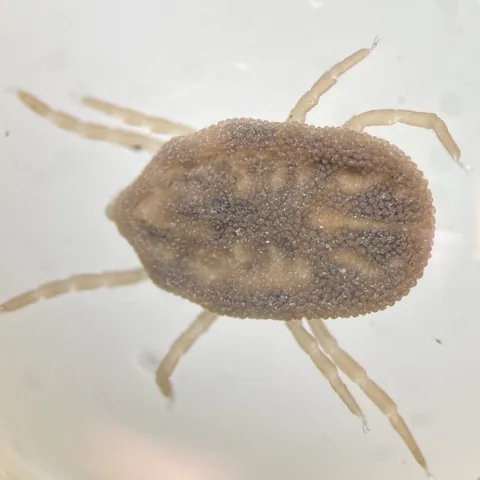 Bat tick
Carios kelleyi (formerly Ornithodoros kelleyi; iNaturalist: Alectorobius kelleyi)
The bat tick, Carios kelleyi, is a soft tick that lives in the cracks and crevices of bat roosts in houses and other buildings. It feeds on bats, and people usually meet it only after the bats leave or are evicted and the hungry ticks start to wander in search of another meal.
Tick basics: hard vs. soft, females vs. males, nymphs
A tick's life has four stages: egg, larva, nymph and adult. Larvae, nymphs and adult females each take one blood meal, so most of the ticks that bite people are three-host ticks that feed on a different animal at each stage.[4][6]
Nearly every tick in this guide is a hard tick (family Ixodidae). Hard ticks have a hard shield, the scutum, on the back. On an adult female the scutum covers only about the front half of the body, while on a male it covers the whole back, so the sexes are easy to tell apart. Soft ticks (Argasidae) are leathery, wrinkled and grayish, with mouthparts underneath the body that can't be seen from above.[4][6]
- Where to look: the shape and color of the scutum, any white or silvery pattern on it, and the length of the mouthparts. Lone star, Gulf Coast and blacklegged ticks have long mouthparts; dog ticks, Rocky Mountain wood ticks, brown dog ticks and Asian longhorned ticks have short ones.[4][6]
- Ixodes ticks (the blacklegged ticks) have a semicircular groove that curves around the front of the anal opening on the underside. Many other ticks, but not Ixodes, have festoons: small rectangular areas separated by grooves along the rear edge of the body.[6]
- Feeding changes everything. The scutum doesn't grow, but a female's body swells enormously; a western blacklegged female increases her weight 100-fold or more. Engorged females of different species can look alike, and fully fed blacklegged females are sometimes confused with engorged American dog ticks.[7][6]
- Males feed only briefly and don't engorge. Blacklegged males are not involved in passing on infections.[4][8]
How big are ticks? Nymph vs. adult sizes
Size is the reason nymphs cause so much trouble. Before feeding, a blacklegged nymph is 1.3 to 1.7 mm long, about the size of a poppy seed, and URI's TickEncounter group calls the nymph and adult female the stages responsible for spreading Lyme disease, babesiosis and anaplasmosis. In a study of photos sent to URI's TickSpotters service, people identified their tick incorrectly 83% of the time, and they were significantly more likely to misidentify nymphs than adults.[6][8][7][18]
- Blacklegged tick: unfed female about 3 to 3.7 mm (about 1/10 inch) including the mouthparts; male 2 to 2.7 mm; nymph 1.3 to 1.7 mm; larva only 0.7 to 0.8 mm.[6]
- Western blacklegged tick: unfed nymph about 1/25 inch; unfed female about 1/8 inch, swelling to 3/8 inch or longer while feeding; male about 1/10 inch and barely grows when it feeds. The pinhead-sized larvae have only six legs.[7]
- Lone star tick: adults about 3 to 4 mm long. Nymphs are rounder than blacklegged nymphs and reddish.[6]
- American dog tick: adults almost 6.4 mm (1/4 inch). Fully engorged females may reach 1/2 inch long and look like a dark pinto bean.[6]
- Asian longhorned tick: adults about 0.1 inch. Other unfed stages are about the size of a sesame seed or smaller, and engorged females are about the size of a pea.[16][17]
- Larvae: Kentucky puts newly hatched larvae at smaller than 2 mm. Lone star larvae often latch on by the hundreds, and URI suggests sticky duct tape to lift them off before they attach.[4][10]
Blacklegged tick (deer tick), Ixodes scapularis
The tick behind most Lyme disease in the East. CDC lists it as widely distributed across the eastern United States. The Connecticut Agricultural Experiment Station's handbook adds the upper Midwest (especially Wisconsin and Minnesota) and the Southeast west to south-central Texas, but notes few southeastern ticks have been found carrying the Lyme bacterium, so Lyme risk from this tick there is considered relatively low.[1][6]
- Adult female: reddish or orange-red body around a black scutum, with black legs and long mouthparts. URI says the unfed female is easily told from other ticks by that orange-red body around the black shield.[4][8][6]
- Adult male: smaller and completely dark brown.[6]
- Nymph: translucent body with a black scutum and black legs.[4]
- Habitat: woods and forest with dense leaf litter, and tall grass and shrubs along forest edges. Adults quest about knee-high on the tips of low shrubs.[4][8]
- Bites people: nymphs and adult females.[1][8]
- Diseases (CDC): anaplasmosis, babesiosis, Lyme disease (Borrelia burgdorferi and B. mayonii), hard tick relapsing fever (B. miyamotoi), ehrlichiosis (Ehrlichia muris eauclairensis) and Powassan virus disease.[1]
- Season: bites are most likely in spring, summer and fall, but adults hunt for hosts any time winter temperatures are above freezing. In Kentucky adults are active October to June and nymphs May to August; in the Northeast nymphs peak in May, June and July.[1][4][6]
- Timing: Kentucky notes the tick must feed for about 36 hours before the Lyme bacterium is passed on, though some other germs can be transmitted much faster.[4]
Western blacklegged tick, Ixodes pacificus
The West Coast's Lyme disease tick. It looks just like the eastern blacklegged tick and only a specialist could tell them apart; URI notes the eastern species isn't reported on the West Coast without a recent travel history. CDC places it along the Pacific coast, particularly northern California, and URI and the Connecticut handbook mention pockets in Utah, Nevada and Arizona.[6][9][1]
- Adult female: about 1/8 inch, with long forward-pointing mouthparts, brownish-black legs, a brownish-black plate over the front half of the back, and a reddish-orange abdomen.[7]
- Adult male: about 1/10 inch, oval and brownish-black. Males attach to people far less often than females.[7]
- Nymph: about 1/25 inch, the size of a poppy seed, with a dark brownish-black plate and a light, translucent abdomen. Attached nymphs are easy to overlook.[7]
- Habitat: nymphs live in the leaf litter, fir needles, logs and the base of tree trunks in dense woodland such as oak, Pacific madrone or Douglas fir. Adults are met in open grassland, chaparral and the edges of trails, especially where grass meets brush or forest.[7]
- Bites people: all stages can, but nymphs and adult females are reported on people more often.[1][7]
- Diseases (CDC): anaplasmosis, Lyme disease and hard tick relapsing fever (Borrelia miyamotoi). Nymphs feed heavily on lizards, which are not good reservoirs for the Lyme bacterium, and URI says usually fewer than 5% of these ticks are infected.[1][9][7]
- Season: adults are active from late fall through spring (in central and southern California, late November to late April or early May). Nymphs peak from April to June, and Lyme disease cases in California peak from May to July.[7][9]
Lone star tick, Amblyomma americanum
CDC calls it a very aggressive tick that bites humans, and Kentucky notes it actively chases its hosts. It is widely distributed in the Northeast, South and Midwest; the Connecticut handbook describes a range through the Southeast west to Texas and north to New Jersey and Long Island along the coast.[1][4][6]
- Adult female: reddish-brown with a single white dot, the lone star, at the rear of her scutum.[1][4][6]
- Adult male: smaller white spots or streaks around the rear edge of the body.[4][10][6]
- Nymph and larva: reddish-brown and round. Mouthparts are long at every stage.[4][6]
- Habitat: woods and forest, open areas with dense vegetation, and around places where animals rest.[4][10]
- Bites people: nymphs and adult females most often, but all stages will feed on people. URI says larvae don't carry disease germs, though their bites can still cause a reaction.[1][6][10]
- Diseases (CDC): Bourbon virus, ehrlichiosis (Ehrlichia chaffeensis and E. ewingii), Heartland virus and tularemia. A circular rash of unknown cause called STARI sometimes follows a bite, and growing evidence links lone star bites to alpha-gal syndrome, an allergy to red meat.[1]
- Not Lyme: a 2018 review of 54 surveys and at least nine transmission experiments concluded the lone star tick is not a vector of the Lyme disease bacterium.[19][4]
- Bite reaction: the saliva can be irritating, so redness and discomfort at the bite do not necessarily mean infection.[1]
- Season: in Kentucky adults and nymphs are active March through September and larvae in late summer and fall; URI gives April to late August for adults.[4][10]
American dog tick, Dermacentor variabilis
The big, patterned tick people often pick off themselves or their dogs after walking through tall grass, and the main carrier of Rocky Mountain spotted fever in the East. CDC says it is widely distributed east of the Rocky Mountains, with limited areas west of them. A newly described look-alike, Dermacentor similis, lives west of the Rockies.[1][6][11]
- Adult female: reddish-brown, almost 1/4 inch, with whitish or silvery markings on an oval scutum and short mouthparts.[6][4]
- Adult male: the same pattern spread over the entire back.[6]
- Nymph and larva: brown or tan. They feed on rodents and rarely attach to people or pets.[4][11][6]
- Habitat: grassy fields, meadows, scrubland and the edges of forests, trails, roadsides and paths. Adults commonly climb to the top of a person's head.[11][4][6]
- Bites people: adults, especially adult females.[1][6]
- Diseases (CDC): Rocky Mountain spotted fever and tularemia. It does not transmit Lyme disease.[1][6]
- Season: bites are most likely in spring and summer; URI gives April to early August for adults, and Kentucky March through September.[1][11][4]
- Indoors: dogs and people carry them into homes, where they can survive for many days, but this tick does not become established indoors.[6]
- Toughness: adults can survive up to two years without feeding.[4][11]
Rocky Mountain wood tick, Dermacentor andersoni
The western mountain counterpart of the American dog tick. CDC places it in the Rocky Mountain states and southwestern Canada at elevations of 4,000 to 10,500 feet. URI says a microscope is generally needed to separate it from the American dog tick, but wood ticks are far more common in the mountain region.[1][12][6]
- Looks: patterned like an American dog tick, with short mouthparts.[12][6]
- Habitat: shrublands, lightly wooded areas, open grasslands and trails. Adults quest about knee-high on the tips of vegetation.[12]
- Bites people: mainly adults. Nymphs and larvae feed on small mammals and are rarely found on people or pets.[1][12][6]
- Diseases (CDC): Rocky Mountain spotted fever, Colorado tick fever and tularemia.[1]
- Tick paralysis: its saliva contains a toxin that occasionally causes an ascending paralysis in people and pets, usually from an adult female; URI says it fades within 24 to 72 hours after the tick is removed.[12]
- Season: adults can be active from January through November but are met most from April through July, with activity dropping off in hot, dry midsummer.[12][6]
Brown dog tick, Rhipicephalus sanguineus
Unlike the other ticks here, the brown dog tick can live its whole life indoors and build up an infestation in a house or kennel. Dogs are its main host at every stage, though it may also bite people. It is found worldwide (CDC notes it occurs in Hawaii) and is more abundant in the southern states; in the North it is found almost exclusively indoors.[4][1][6][13]
- Looks: a brown, teardrop-shaped body with short mouthparts. The base of the mouthparts behind them is hexagonal.[4]
- Where you see it: on dogs, adults feed mainly in the ears, on the head and neck and between the toes. In infested homes ticks crawl along baseboards and up walls looking for cracks to molt or lay eggs in.[6]
- Bites people: occasionally; it prefers dogs.[1][13][6]
- Diseases (CDC): Rocky Mountain spotted fever in the southwestern U.S. and along the U.S.-Mexico border. In dogs it also spreads canine ehrlichiosis and canine babesiosis.[1][4][6]
- Season: adults are found all year indoors.[13][4]
- Why infestations last: a female can lay hundreds to a few thousand eggs (the Connecticut handbook gives 360 to 3,000; URI says up to 4,000), the life cycle can finish in about two months, and adults can survive 18 months without feeding. URI says control usually means treating the pets, the house and the yard plus thorough vacuuming, and may take several months.[6][13]
Gulf Coast tick, Amblyomma maculatum
A tick of grassy places in the South. CDC says it lives mainly in the southeastern United States, with scattered populations in the Northeast, Midwest and Southwest; URI describes coastal areas from New Jersey to Texas, extending into Oklahoma and Kansas.[1][14]
- Looks: brown body and legs with a complex white pattern and long mouthparts. People sometimes take it for an American dog tick; the long, slender mouthparts and more angular scutum tell it apart.[4][14]
- Habitat: prairie grass meadows and shady wooded edges, coastal grasslands, and in Kentucky tall grass and meadows.[14][4]
- Bites people: adults are the stage associated with spreading Rickettsia parkeri to people. Immature stages feed on small mammals and ground birds.[1][14]
- Diseases (CDC): Rickettsia parkeri rickettsiosis, a form of spotted fever.[1]
- Season: URI gives April to October for adults, peaking in July and August.[14][4]
Asian longhorned tick, Haemaphysalis longicornis
An invasive tick first reported in the United States in 2017. As of April 12, 2024, CDC listed it in Arkansas, Connecticut, Delaware, Georgia, Illinois, Indiana, Kentucky, Maryland, Massachusetts, Missouri, New Jersey, New York, North Carolina, Ohio, Pennsylvania, Rhode Island, South Carolina, Tennessee, Virginia and West Virginia. U.S. populations are all female and reproduce without mating, so thousands can turn up at once on grass, shrubs or an animal.[1][16][17]
- Looks: small and brown, about 0.1 inch as an adult, with short mouthparts and no distinct markings. APHIS describes unfed ticks as light reddish-tan to dark reddish. Engorged females turn gray-green. Males are rare.[16][4][17]
- Confusion: if found on hosts like cattle or deer, Penn State says it is very likely this species; young ones can be mistaken for immature lone star ticks, which have different mouthparts.[16]
- Habitat and hosts: woods and fields, pastures and lawns. It has been found on pets, livestock, wildlife and people.[4][1][16]
- People: CDC says it appears less attracted to humans than native ticks such as the blacklegged, lone star and American dog ticks, and it isn't yet known whether, or how often, it passes germs to people in the U.S. A lab study found it can carry and spread the Rocky Mountain spotted fever bacterium, which hasn't been found in these ticks in nature, and another found it is not likely to spread Lyme disease bacteria.[1]
- Animals: Penn State says it is confirmed to transmit bovine theileriosis and Babesia in animals, and heavy infestations can cause anemia.[16]
- Season: APHIS says generally March to November, varying by year.[17][4]
- If you think you've found one, APHIS suggests sealing it in a zip-top bag and giving it to a veterinarian for identification.[17]
Soft ticks (relapsing fever ticks)
Soft ticks live in the nests of rodents, birds or bats rather than in grass, and the ones that bite people in the U.S. are mainly a western problem. Their bites are brief, usually under half an hour, and painless, so most people never know they were bitten. Ornithodoros soft ticks spread soft tick relapsing fever, with fevers lasting about 3 days that return after roughly a week.[6][2]
- Looks: leathery, wrinkled and grayish, with the mouthparts hidden underneath.[6]
- Where people meet them: most U.S. infections come from overnight stays in rodent-infested cabins in the mountains of western states, where Ornithodoros hermsi ticks come out at night. Less often, people are bitten in caves in parts of Texas by O. turicata.[2]
- Season: exposure is most common in summer, but lighting a fire to warm a cabin in winter can wake ticks resting in the walls.[2]
- Soft ticks can live for decades, so CDC advises removing rodent nests and keeping rodents out of cabins; beds should be moved away from walls and sheets kept off the floor.[2]
- A bat tick, Carios (Ornithodoros) kelleyi, has also been found in northeastern states.[6]
Is it a tick or something else?
About one in 20 photos sent to URI's TickSpotters is not a tick at all. The quickest check is legs and antennae: adult and nymph ticks have eight legs and no antennae, while insects have six legs and usually visible antennae. The exception is tick larvae, which have only six legs, so a tiny six-legged speck found after a walk can still be a tick.[15][7][4]
- Spider beetles: one of the most common tick look-alikes URI sees. Count six legs and two long antennae.[15]
- Weevils: six legs, three body regions and clubbed antennae; adult ticks have eight legs, two body regions and no antennae.[15]
- Bed bugs: Kentucky notes bed bugs are sometimes mistaken for ticks. Adults are about 3/16 inch, reddish-brown, oval and flat, the color of an apple seed. Unlike ticks they have antennae, eyes and a segmented abdomen.[5][15]
- Carpet beetles: usually indoor pests that feed on wool, fur, feathers and pet hair.[15]
- Stink bugs and their nymphs: look for wing tips folded over the body on adults; ticks don't have wings.[15]
- Deer keds (louse flies): flat, tick-like flies with six legs that hunters often see on deer. They lose their wings once they find a host and occasionally bite people.[6]
- Others URI often sees: clover mites, bird mites, head and crab lice, pseudoscorpions and crab spiders.[15]
Found a tick? What to do next
If it is attached, remove it right away with fine-tipped tweezers: grasp it as close to the skin as possible and pull up with steady, even pressure, without twisting or jerking. Clean the bite and your hands with rubbing alcohol, iodine soap or soap and water.[4]
Keep the tick in a sealed plastic bag with the date and place it was found. Your county Cooperative Extension office can identify it, and the species tells your doctor which diseases to think about if you later get a fever, rash or flu-like symptoms. Rocky Mountain spotted fever can be deadly if not treated early with doxycycline.[4][3]
For the yard, the Connecticut handbook's steps include keeping grass mowed, clearing leaf litter and brush at the lawn edge, discouraging rodents and deer, and putting a 3-foot or wider wood chip, mulch or gravel border between lawn and woods. Our yard tick control guide covers landscaping, borders and spray timing.[6]
Common questions
- What is the difference between a deer tick and a dog tick?
- A deer (blacklegged) tick is smaller, about 1/10 inch as an adult female, with black legs, a black shield and a reddish-orange body. An American dog tick is about 1/4 inch, brown, with whitish or silvery markings on its back and short mouthparts. Deer ticks spread Lyme disease; dog ticks spread Rocky Mountain spotted fever and tularemia but not Lyme.[6][4][1]
- How big is a tick nymph?
- About the size of a poppy seed. Blacklegged nymphs are 1.3 to 1.7 mm long and western blacklegged nymphs about 1/25 inch before feeding.[6][7]
- Which ticks carry Lyme disease?
- In the U.S., the blacklegged tick in the East and the western blacklegged tick on the Pacific Coast. Lone star ticks and American dog ticks do not spread it.[1][4][6][19]
- Can ticks live in your house?
- The brown dog tick can complete its whole life indoors and infest a home with dogs. American dog ticks carried inside can survive for days but don't become established. Soft ticks can live in the walls of rodent-infested cabins.[4][6][2]
- What tick has a white dot on its back?
- The adult female lone star tick. Males have smaller white marks around the rear edge instead.[1][4]
- Are Asian longhorned ticks dangerous to people?
- So far they appear less attracted to people than native ticks, and CDC says it isn't yet known whether or how often they pass germs to people in the U.S. They are a serious livestock pest.[1][17]
Photo credits
- Blacklegged Tick: (c) Christian Back, some rights reserved (CC BY) — via iNaturalist, CC BY 4.0
- Western Blacklegged Tick: Randal, public domain (CC0), via iNaturalist
- Lone Star Tick: (c) Katja Schulz, some rights reserved (CC BY) — via iNaturalist, CC BY 4.0
- American Dog Tick: (c) Don Loarie, some rights reserved (CC BY) — via iNaturalist, CC BY 4.0
- Rocky Mountain Wood Tick: (c) Toby, some rights reserved (CC BY) — via iNaturalist, CC BY 4.0
- Brown Dog Tick: (c) NoahM, some rights reserved (CC BY) — via iNaturalist, CC BY 4.0
- Gulf Coast Tick: (c) Zachary Dankowicz, some rights reserved (CC BY) — via iNaturalist, CC BY 4.0
- Asian Longhorned Tick: (c) Zachary Dankowicz, some rights reserved (CC BY) — via iNaturalist, CC BY 4.0
- Pacific Coast Tick: Stanley, public domain (CC0), via iNaturalist
- Winter tick: (c) Megan Dark, some rights reserved (CC BY) — via iNaturalist, CC BY 4.0
- Groundhog tick: (c) Chris Baer, some rights reserved (CC BY) — via iNaturalist, CC BY 4.0
- Soft Ticks (relapsing fever ticks): (c) Trevor Van Loon, some rights reserved (CC BY) — via iNaturalist, CC BY 4.0
- Bat tick: (c) Jody, some rights reserved (CC BY) — via iNaturalist, CC BY 4.0
Sources
- Centers for Disease Control and Prevention, “Where Ticks Live.” www.cdc.gov/ticks/about/where-ticks-live.html (accessed 2026-11-10)
- Centers for Disease Control and Prevention, “About Soft Tick Relapsing Fever (STRF).” www.cdc.gov/relapsing-fever/about/about-strf.html (accessed 2026-11-10)
- Centers for Disease Control and Prevention, “About Rocky Mountain Spotted Fever.” www.cdc.gov/rocky-mountain-spotted-fever/about/index.html (accessed 2026-11-10)
- University of Kentucky Entomology, “Ticks and Disease in Kentucky (ENTFACT-618; A. Pasternak, J. Larson, M. Cipriani).” entomology.mgcafe.uky.edu/ef618 (accessed 2026-11-10)
- University of Kentucky Entomology, “Bed Bugs (ENTFACT-636).” entomology.mgcafe.uky.edu/ef636 (accessed 2026-11-10)
- Connecticut Agricultural Experiment Station, “Tick Management Handbook, revised edition (Bulletin No. 1010; K. C. Stafford III).” portal.ct.gov/-/media/CAES/DOCUMENTS/Publications/Bulletins/b1010pdf.pdf (accessed 2026-11-10)
- University of California Statewide IPM Program, “Pest Notes: Lyme Disease in California.” ipm.ucanr.edu/legacy_assets/PDF/PESTNOTES/pnlymedisease.pdf (accessed 2026-11-10)
- University of Rhode Island TickEncounter Resource Center, “Blacklegged (Deer) Tick.” web.uri.edu/tickencounter/species/blacklegged-tick/ (accessed 2026-11-10)
- University of Rhode Island TickEncounter Resource Center, “Western Blacklegged Tick.” web.uri.edu/tickencounter/species/western-blacklegged-tick/ (accessed 2026-11-10)
- University of Rhode Island TickEncounter Resource Center, “Lone Star Tick.” web.uri.edu/tickencounter/species/lone-star-tick/ (accessed 2026-11-10)
- University of Rhode Island TickEncounter Resource Center, “American Dog Tick.” web.uri.edu/tickencounter/species/dog-tick/ (accessed 2026-11-10)
- University of Rhode Island TickEncounter Resource Center, “Rocky Mountain Wood Tick.” web.uri.edu/tickencounter/species/rocky-mountain-wood-tick/ (accessed 2026-11-10)
- University of Rhode Island TickEncounter Resource Center, “Brown Dog Tick.” web.uri.edu/tickencounter/species/brown-dog-tick/ (accessed 2026-11-10)
- University of Rhode Island TickEncounter Resource Center, “Gulf Coast Tick.” web.uri.edu/tickencounter/species/gulf-coast-tick/ (accessed 2026-11-10)
- University of Rhode Island TickEncounter Resource Center, “Bugs that look like ticks (Tick look-alikes).” web.uri.edu/tickencounter/is-it-a-tick/ (accessed 2026-11-10)
- Penn State Extension, “Asian Longhorned Tick, Haemaphysalis longicornis.” extension.psu.edu/asian-longhorned-tick (accessed 2026-11-10)
- USDA Animal and Plant Health Inspection Service, “Pest Alert: Asian Longhorned Ticks.” www.aphis.usda.gov/livestock-poultry-disease/cattle/ticks/asian-longhorned (accessed 2026-11-10)
- Journal of Medical Entomology, via PubMed, “Kopsco, Duhaime and Mather (2021), Assessing public tick identification ability and tick bite riskiness using passive photograph-based crowdsourced tick surveillance, J. Med. Entomol. 58(2):837-846.” pubmed.ncbi.nlm.nih.gov/33146378/ (accessed 2026-11-10)
- Journal of Medical Entomology, via PubMed, “Stromdahl et al. (2018), Amblyomma americanum ticks are not vectors of the Lyme disease agent, Borrelia burgdorferi: a review of the evidence, J. Med. Entomol. 55(3):501-514.” pubmed.ncbi.nlm.nih.gov/29394366/ (accessed 2026-11-10)