On this page
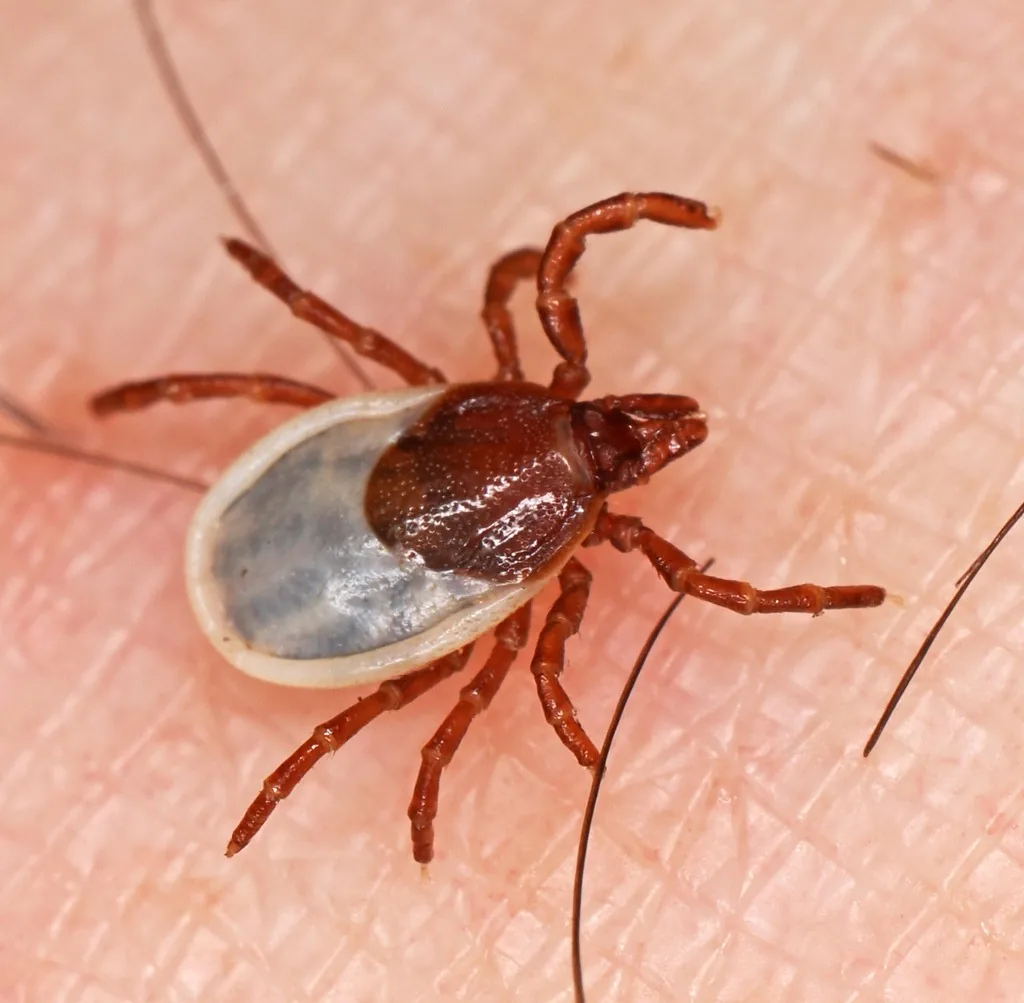
How to identify it
- A hard tick in the genus Ixodes, the same genus as the blacklegged (deer) tick.[8][4]
- Most groundhog ticks found on people are nymphs. Of the human records with a known life stage in a national review, 75 percent were nymphs, 19 percent adults and 6 percent larvae.[3]
- Where it turns up is the best clue. It is typically found in and around the dens and nests of woodchucks and its other hosts, and on pets: one national survey of ticks from dogs and cats found it on dogs in the Southeast and in Ohio and on a ferret in Illinois.[1][5]
Look-alikes
| Look-alike | How to tell them apart |
|---|---|
| Blacklegged (deer) tick | A close relative that is not tied to one host's burrow. Blacklegged ticks wait in leaf litter and on vegetation and readily bite white-footed mice, white-tailed deer and people, while the groundhog tick stays with its host in the burrow and is not known to quest.[4][1] |
Where it lives
Eastern North America. A national review lists its US distribution as eastern, it is often reported from dogs and cats throughout eastern North America, and Vermont lists it among its commonly encountered ticks. Illinois recorded its first groundhog tick taken from a person through recent statewide tick surveillance.[3][5][1][2]
Biology and life cycle
The groundhog tick is a burrow and nest tick. Its hosts are mainly groundhogs (woodchucks), other small mammals and members of the weasel family (mustelids), with birds also listed; a national review summarizes its host preference as rodents and carnivores.[1][4][3]
It is believed not to quest, that is, not to wait on vegetation for a passing host. Generations of ticks stay closely tied to a single host in its burrow.[4]
In Vermont it is active in the summer months, with numbers peaking in July.[1]
In nature it keeps lineage I of Powassan virus circulating among groundhogs and mustelids. Researchers found groundhogs often infested with this tick and carrying relatively high rates of antibodies to the virus.[4]
Damage and signs
Health risk
Groundhog ticks do bite people. A national review counted 2,494 specimens recorded from people in the US, about 1 percent of all tick records from humans, and lists Powassan virus as the human pathogen associated with this tick. The Illinois Natural History Survey notes that the species plays a role in transmitting Powassan virus, a tick-borne virus of growing concern. Because the tick stays in host burrows, people are less likely to meet infected ones, except in parts of Maine, where it bites people more readily than elsewhere.[3][2][4]
Control
Prevention
General tick precautions apply. Ohio State and Kentucky Extension advise a tick repellent containing DEET on exposed skin, used according to the label, and permethrin products on clothing and gear only, never on skin.[6][7]
Wear light-colored clothing so crawling ticks are easier to see, tuck pants into socks and shirt into pants, and check yourself, children and other family members often while outdoors and again on returning home.[6][7]
Check pets often if they go outdoors, and protect them with an anti-tick product; Ohio State recommends consulting your veterinarian before using over-the-counter products.[7][6]
Sanitation
Remove brush, tall weeds and grass to take away cover for rodents and other small mammals that host ticks.[6]
Traps and physical control
Remove attached ticks right away with fine-tipped tweezers: grasp the tick as close to the skin as possible and pull out the whole tick without twisting or jerking. Kentucky suggests keeping it in a sealed plastic bag labeled with the date and place.[7][6]
Common questions
- Can the groundhog tick give people Powassan virus?
- It can carry the virus. It keeps lineage I of Powassan virus circulating among groundhogs and mustelids, and the Illinois Natural History Survey notes it plays a role in transmitting this virus of growing concern. Because it lives in host burrows, people are less likely to come in contact with infected ticks.[4][2]
- Will my dog or cat pick up groundhog ticks?
- It happens. Researchers note it is often reported from dogs and cats throughout eastern North America, and Kentucky Extension advises checking pets often if they go outdoors.[5][7]
- When are groundhog ticks active?
- In Vermont, during the summer months, with numbers peaking in July.[1]
Sources
- Vermont Agency of Agriculture, Food and Markets, “Commonly Encountered Tick Species in Vermont.” agriculture.vermont.gov/sites/agriculture/files/MosquitoTick/Vermont%20Tick%20Species.pdf (accessed 2026-11-08)
- Illinois Natural History Survey, Prairie Research Institute, University of Illinois, “Statewide Tick Surveillance Highlights Widespread Establishment of Ticks and Pathogens (2024).” static1.squarespace.com/static/5f6a55cc288a4713e5464577/t/668dc6b26110e678894b5d43/1720567478247/INHS_tick-disease-factsheet-FINAL.pdf (accessed 2026-11-08)
- Ticks and Tick-borne Diseases (Elsevier), full text in PubMed Central PMC10862467, “Tick species infesting humans in the United States (L. Eisen), Ticks and Tick-borne Diseases 13(6):102025, 2022.” pmc.ncbi.nlm.nih.gov/articles/PMC10862467/ (accessed 2026-11-08)
- Vector-Borne and Zoonotic Diseases (Mary Ann Liebert), full text in PubMed Central PMC5512300, “Powassan Virus: An Emerging Arbovirus of Public Health Concern in North America (M.E. Hermance, S. Thangamani), Vector-Borne and Zoonotic Diseases 17(7):453-462, 2017.” pmc.ncbi.nlm.nih.gov/articles/PMC5512300/ (accessed 2026-11-08)
- Vector-Borne and Zoonotic Diseases (Mary Ann Liebert), full text in PubMed Central PMC9469741, “Ixodes spp. from Dogs and Cats in the United States: Diversity, Seasonality, and Prevalence of Borrelia burgdorferi and Anaplasma phagocytophilum (P. Ghosh et al.), Vector-Borne and Zoonotic Diseases 21(1):11-19, 2021.” pmc.ncbi.nlm.nih.gov/articles/PMC9469741/ (accessed 2026-11-08)
- Ohio State University Extension (Ohioline), “Ticks and Tick-Borne Diseases, HYG-2073.” ohioline.osu.edu/factsheet/HYG-2073 (accessed 2026-11-08)
- University of Kentucky Entomology Extension, “Ticks and Disease in Kentucky, ENTFACT-618.” entomology.ca.uky.edu/ef618 (accessed 2026-11-08)
- iNaturalist, “Ixodes cookei taxon page (order and family).” www.inaturalist.org/taxa/864819 (accessed 2026-11-08)