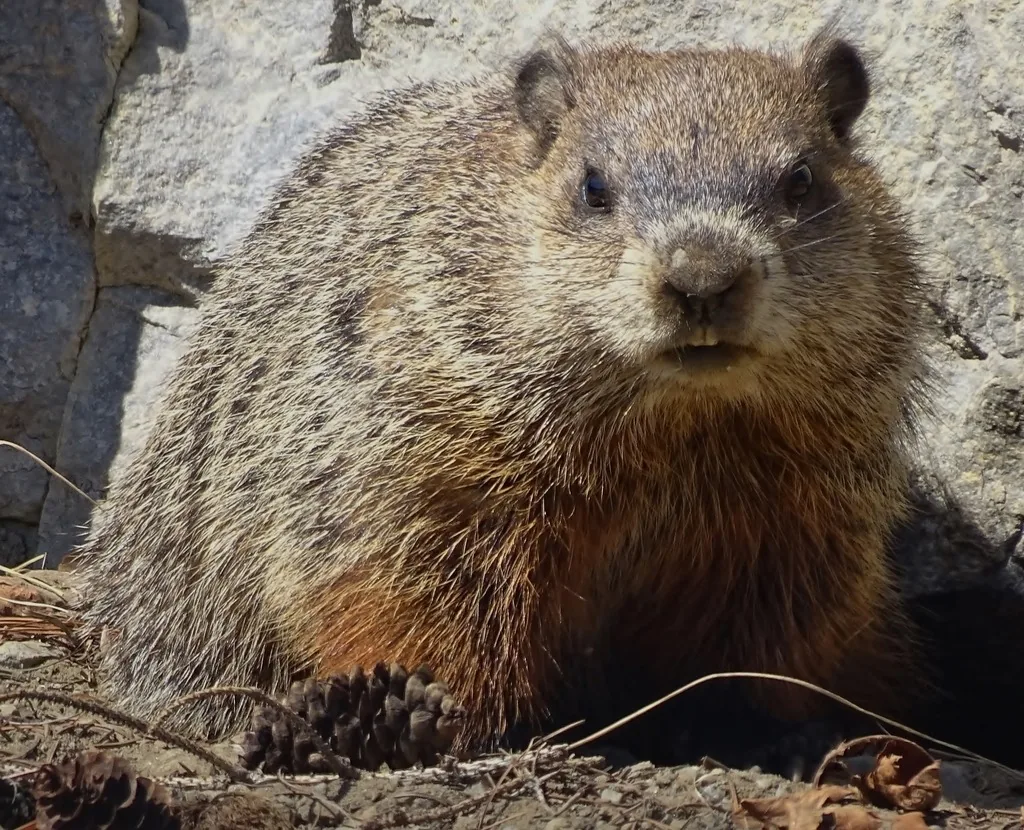
How to identify it
- A compact, chunky body on short, strong legs, usually grizzled gray-brown, with a short, furry dark brown tail.[2][1]
- Adults weigh 5 to 10 pounds, with a head and body 16 to 20 inches long and a tail of 4 to 7 inches.[2][1]
- Long curved claws on the front feet for digging, and yellow-white, chisel-like front teeth.[2][1]
- The main burrow entrance is 10 to 12 inches across with a large mound of dug-out soil in front; hidden secondary holes have no mound.[3][1]
- A shrill whistle when startled, which gives the animal its nickname whistle pig.[2]
Look-alikes
| Look-alike | How to tell them apart |
|---|---|
| Raccoon (fruit tree damage) | Woodchucks climb cherry and apple trees and break limbs, damage that can be mistaken for raccoons; a nearby burrow with a dirt mound points to a woodchuck.[4][3] |
| Pocket gopher | Pocket gophers spend almost all their time underground and leave half-circle dirt mounds with a plugged hole; woodchucks feed above ground in daylight and leave an open burrow entrance 10 to 12 inches wide.[6][3] |
Where it lives
Found throughout eastern and central North America, including parts of Alaska and Canada, and west to northern Idaho, eastern Kansas and northern Alabama.[2]
Biology and life cycle
Woodchucks breed in March and April and have one litter a year of 2 to 6 young, usually 4, born after about 32 days.[3][1]
Young are weaned by late June or early July and soon leave; complaints often rise in July as they disperse.[3][5]
They are true hibernators, usually sleeping from late October or November until late February or March.[3][1]
Active in daylight, they feed in early morning and evening, mostly staying within 50 to 150 feet of the den.[3][1]
They are plant eaters that favor beans, peas, carrot tops, alfalfa, clover and grasses, and they can climb into low tree branches.[3][1]
Burrows can run 5 feet deep and up to 66 feet long and may be used for several seasons.[3]
Damage and signs
- They can wipe out garden crops such as beans, peas, squash and tomatoes, and damage orchards and nurseries.[1][4]
- Burrows can undermine building foundations, pools, sidewalks and dikes.[4][1]
- They gnaw and mark trees and shrubs, which can severely damage or kill them, and may chew wood, pipes and wires.[4][1]
- Burrow holes and dirt mounds are hazards for mowers, farm equipment, horses and riders.[1][4]
Health risk
Healthy woodchucks flee from people but will defend themselves when cornered; though rare, they can carry rabies and tularemia and host disease-carrying ticks, so keep pets and children away.[4]
Control
Prevention
Scarecrows and similar devices give only temporary relief; move them often. Territorial dogs kept behind fences can help keep woodchucks away.[1][5]
Keep them out
Fencing is the most permanent fix for gardens: use heavy poultry wire or 2-inch woven wire at least 3 feet high.[1][5]
Stop digging under the fence by burying the bottom edge with an L-shaped outward bend, and stop climbing with an outward-bent top or an electric wire 4 to 5 inches off the ground.[1][5]
Traps and physical control
Cage traps baited with apple slices, carrots or lettuce work at burrow entrances or travel lanes; refresh bait daily and check traps often.[1][5]
Pesticides
Gas cartridges, a general-use pesticide, can fumigate active burrows; never use them under sheds, decks or buildings because of fire risk, and follow the label exactly.[1][5]
When to call a professional
Aluminum phosphide is a restricted-use fumigant that only certified applicators may apply, with strict distance limits from occupied buildings.[1][5]
Legal status and relocation
Woodchucks are game or unprotected animals depending on the state, so check your state's rules before trapping or shooting.[2]
In Pennsylvania they are game animals, but landowners may control those damaging property; because they are a potential rabies carrier, trapped woodchucks may not be moved to other properties there.[1]
Common questions
- What's the best way to keep a groundhog out of my garden?
- A buried, 3-foot wire fence with an outward-bent bottom and an electric wire or bent top to stop climbing; it also keeps rabbits out.[1][5]
- When are groundhogs most active?
- They are out in daylight from late winter to fall, feeding mainly in early morning and evening, then hibernate through the cold months.[3][1]
- Can I just trap a groundhog and let it go somewhere else?
- Check state law first. Some states, including Pennsylvania, do not allow trapped woodchucks to be released on other properties because of rabies concerns.[1][2]
Sources
- Penn State Extension, “Woodchucks (wildlife damage control fact sheet).” extension.psu.edu/woodchucks (accessed 2026-10-06)
- Internet Center for Wildlife Damage Management, “Woodchucks: Identification.” icwdm.org/species/rodents/woodchucks/ (accessed 2026-10-06). Run by university wildlife damage specialists (maintained at the University of Wisconsin-Stevens Point); species modules are based on Prevention and Control of Wildlife Damage (University of Nebraska Cooperative Extension, 1994).
- Internet Center for Wildlife Damage Management, “Woodchuck Biology.” icwdm.org/species/rodents/woodchucks/woodchuck-biology/ (accessed 2026-10-06). Run by university wildlife damage specialists (maintained at the University of Wisconsin-Stevens Point); species modules are based on Prevention and Control of Wildlife Damage (University of Nebraska Cooperative Extension, 1994).
- Internet Center for Wildlife Damage Management, “Woodchuck Damage Identification.” icwdm.org/species/rodents/woodchucks/woodchuck-damage-identification/ (accessed 2026-10-06). Run by university wildlife damage specialists (maintained at the University of Wisconsin-Stevens Point); species modules are based on Prevention and Control of Wildlife Damage (University of Nebraska Cooperative Extension, 1994).
- Internet Center for Wildlife Damage Management, “Woodchuck Damage Prevention and Control Methods.” icwdm.org/species/rodents/woodchucks/woodchuck-damage-prevention-and-control-methods/ (accessed 2026-10-06). Run by university wildlife damage specialists (maintained at the University of Wisconsin-Stevens Point); species modules are based on Prevention and Control of Wildlife Damage (University of Nebraska Cooperative Extension, 1994).
- University of California Statewide IPM Program, “Pocket Gophers (Pest Notes, Home and Landscape).” ipm.ucanr.edu/home-and-landscape/pocket-gophers/ (accessed 2026-10-06)
- iNaturalist, “Marmota monax taxon page (order and family).” www.inaturalist.org/taxa/46095 (accessed 2026-10-06)