How to identify it
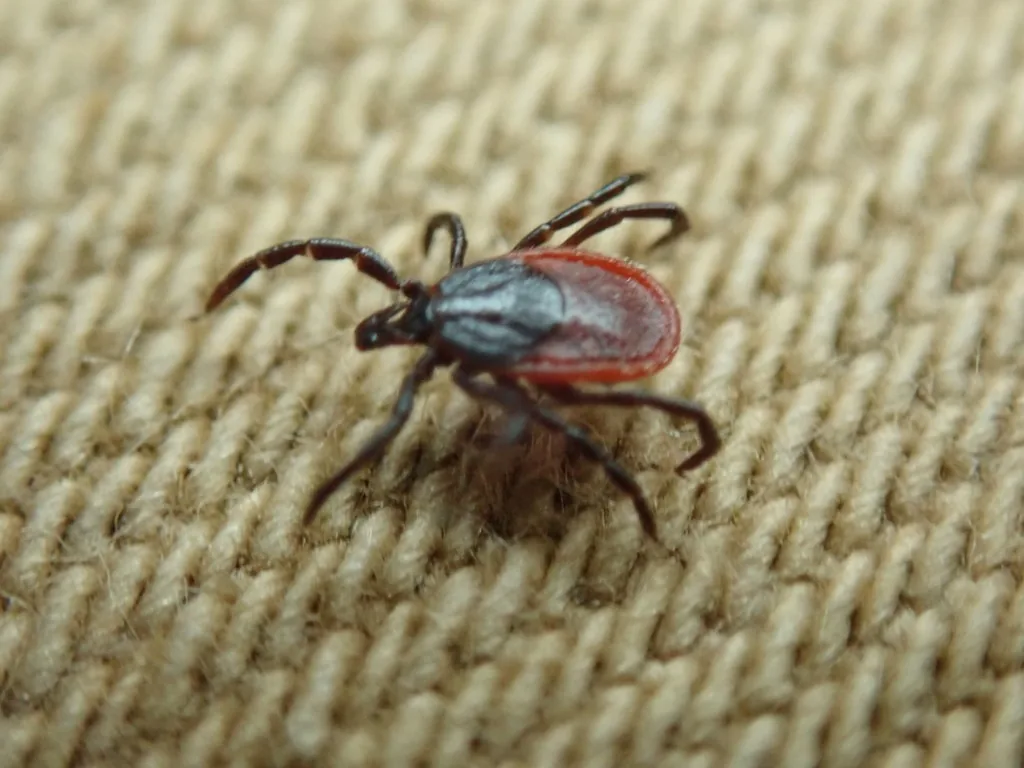
- The unfed nymph is about the size of a poppy seed, roughly 1/25 inch long, with eight legs, a dark brownish-black plate on its back and a pale, see-through abdomen.[1]
- The unfed adult female is about 1/8 inch long, with long forward-pointing mouthparts, brownish-black legs, a dark plate covering the front half of the back and a reddish-orange abdomen.[1]
- Adult males are smaller, about 1/10 inch, oval and brownish-black all over; they rarely attach to people.[1]
- A feeding female swells to 3/8 inch or longer, while larvae are pinhead-sized, have only six legs and seldom bite people.[1]
Look-alikes
| Look-alike | How to tell them apart |
|---|---|
| Blacklegged (deer) tick | A close relative that carries Lyme disease bacteria in eastern North America; it does not occur in California.[1] |
| Pacific Coast tick | Found in the same coast and foothill areas, but it spreads Pacific Coast tick fever and spotted fever rather than Lyme disease.[4] |
| American dog tick | Found throughout California and linked to spotted fever and tularemia, not Lyme disease or anaplasmosis.[4] |
Where it lives
Lives along the Pacific coast of the U.S., especially northern California, where it has been found in 56 of the state's 58 counties. Risk is highest on the north coast, in the northern Sierra Nevada foothills, the Bay Area and the Central Coast.[5][1][2]
Biology and life cycle
Larvae and nymphs feed on lizards, birds and small mammals for several days; adult females feed for about a week on medium and large mammals, then lay 900 to 1,000 eggs in soil or litter.[1]
In northwestern California the full life cycle takes about three years.[1]
Nymphs live in shady woodlands with oak, madrone or Douglas fir, in leaf litter and on logs, rocks and tree trunks up to 3 or 4 feet high.[1][2]
Adults climb grass and shrub tips, often along trail edges, and wait for deer, coyotes and other passing animals.[1][2]
Nymphs are most active in spring and early summer, while adults are most active from late fall through early spring.[2][3]
Nymphs strongly prefer lizards: in some woodlands, more than 90% of them attach to lizards rather than birds or mammals.[1]
Damage and signs
- Dogs can get Lyme disease and may show lameness, tiredness, poor appetite or swollen lymph nodes; cats, horses and livestock can be infected but rarely get sick.[1]
Health risk
The CDC lists it as a carrier of Lyme disease, anaplasmosis and Borrelia miyamotoi disease. Only nymphs and adult females spread Lyme bacteria, and CDPH says the tick must feed at least 24 hours to do so. Lyme disease is treated with antibiotics.[5][1][2]
Control
Prevention
Wear long pants tucked into socks and a long-sleeved shirt; stay in the center of trails and avoid brushing against grass and brush.[1]
Use an EPA-registered repellent with at least 20% DEET on skin or clothing, and treat clothing and gear, never skin, with 0.5% permethrin.[2]
Check your body and your pets during and after time outdoors, shower soon after coming in, and put outdoor clothes in a hot dryer.[2][1]
Keep them out
Discourage the rodents and deer that carry ticks: fence out deer, keep trash closed and woodpiles away from the house, and avoid overfilling bird feeders.[3]
Sanitation
Keep lawns and plants trimmed, clear leaf litter, and put a 3-foot gravel or wood-chip strip between the yard and brushy or wooded land.[3]
Traps and physical control
Remove an attached tick right away with tweezers, gripping close to the skin and pulling slowly straight out without twisting or crushing it, then wash the bite.[1]
Pesticides
Yard products for ticks may contain permethrin, bifenthrin or pyrethrin; apply only where ticks are common, follow the label and avoid areas used by bees, pets and people.[3]
Common questions
- When is Lyme disease risk highest in California?
- CDPH says risk is highest from late fall through early summer and low in mid-summer. Cases from local bites peak from May to July, after nymphs reach peak numbers.[2][1]
- Why are nymphs the bigger worry?
- Nymphs are tiny and easy to miss, so they often stay attached long enough to spread infection. In northern California, a higher share of nymphs than adults carry Lyme bacteria.[2][1]
- Should I get the tick that bit me tested?
- UC IPM says tick testing is not recommended for medical decisions; see a doctor if you get a rash or flu-like illness after time in tick habitat.[1]
Sources
- University of California Statewide IPM Program, “Pest Notes: Lyme Disease in California, Publication 7485 (May 2016).” ipm.ucanr.edu/legacy_assets/PDF/PESTNOTES/pnlymedisease.pdf (accessed 2026-10-06)
- California Department of Public Health, “Lyme Disease.” www.cdph.ca.gov/Programs/CID/DCDC/Pages/LymeDisease.aspx (accessed 2026-10-06)
- California Department of Public Health, Vector-Borne Disease Section, “Controlling Ticks Around Your Home (April 2021).” www.cdph.ca.gov/Programs/CID/DCDC/CDPH%20Document%20Library/ControllingTicksAroundHome.pdf (accessed 2026-10-06)
- California Department of Public Health, Vector-Borne Disease Section, “Guide to Common Ticks in California and Diseases They Transmit.” www.cdph.ca.gov/Programs/CID/DCDC/CDPH%20Document%20Library/GuidetoTicksandDiseasesTheyTransmit.pdf (accessed 2026-10-06)
- Centers for Disease Control and Prevention, “Where Ticks Live.” www.cdc.gov/ticks/about/where-ticks-live.html (accessed 2026-10-06)
- iNaturalist, “Ixodes pacificus taxon page (order and family).” www.inaturalist.org/taxa/60599 (accessed 2026-10-06)