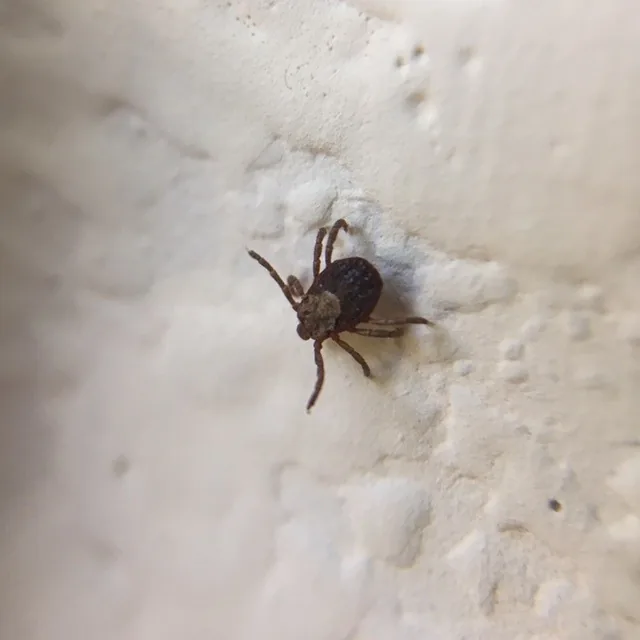
How to identify it
- The body is flat, oval and dark brown with whitish-gray markings; females have a mottled off-white shield behind the head, and males look mottled and spotty all over.[1]
- Larvae have six legs, while nymphs and adults have eight.[1]
- Size runs from about 3 mm to 15 mm, roughly 1/8 to 5/8 inch, depending on how much blood the tick has taken.[1]
Look-alikes
| Look-alike | How to tell them apart |
|---|---|
| American dog tick | Another Dermacentor tick that also carries spotted fever and tularemia, but it does not spread Pacific Coast tick fever and occurs throughout California.[2][3] |
| Western blacklegged tick | Has a plain dark brownish-black shield, and the female has a reddish-orange abdomen, with no whitish mottling; it is the tick that spreads Lyme disease.[4][3] |
Where it lives
Found across most of California except the driest parts of the Central Valley and the southeastern deserts, especially along the coast and in the foothills. It also occurs in Oregon and Baja California.[1][3]
Biology and life cycle
It is a three-host tick: the larva, nymph and adult each feed, often on a different animal, then drop off before the next stage.[1][6]
It shares dense woodlands and nearby chaparral with the western blacklegged tick in northwestern California.[5]
The CDPH notes that Pacific Coast ticks don't live very long in homes and suburban yards, unlike the brown dog tick.[2]
Damage and signs
- It can pass spotted fever and tularemia to cats and dogs, spreads bovine anaplasmosis to cattle, and has been implicated in tick paralysis in cattle, deer and ponies.[1]
Health risk
It spreads Pacific Coast tick fever, caused by Rickettsia philipii, which usually leaves a small dark scab called an eschar at the bite. It can also carry Rocky Mountain spotted fever and tularemia. CDPH says treatment is the same as for Rocky Mountain spotted fever, usually doxycycline.[2][3][4]
Control
Prevention
In tick habitat, stay in the middle of trails and avoid grassy areas, leafy ground under trees, logs and fallen branches.[2]
Use an EPA-registered repellent with at least 20% DEET, treat clothing only with permethrin, and keep pets on vet-recommended tick prevention.[2]
Shower soon after coming indoors, check yourself and others for up to three days, and run outdoor clothes in a hot dryer for 10 minutes.[2]
Traps and physical control
Remove an attached tick promptly with tweezers, gripping the mouthparts close to the skin and pulling straight out with steady pressure, then wash and disinfect the bite.[2]
Common questions
- What is Pacific Coast tick fever?
- An infection with Rickettsia philipii spread only by the Pacific Coast tick. It most often causes a small open sore about the size of a pencil eraser that turns into a dark scab, and it is treated like Rocky Mountain spotted fever.[2][4]
- Does the Pacific Coast tick spread Lyme disease?
- CDPH does not list it as a Lyme disease tick. Wild Pacific Coast ticks are only rarely infected with Lyme bacteria, and lab studies found it an inefficient carrier.[3][5]
- How soon after a bite can spotted fever spread?
- CDPH says a tick must be attached for at least 4 to 6 hours to pass Rocky Mountain spotted fever bacteria, so prompt tick checks matter.[2]
Sources
- Columbia Drainage Vector Control District (Oregon), “Pacific Coast Tick (Dermacentor occidentalis).” cdvcd.specialdistrict.org/pacific-coast-tick-dermacentor-occidentalis (accessed 2026-10-06)
- California Department of Public Health, Division of Communicable Disease Control, “Spotted Fever Group Rickettsia in California: Rocky Mountain Spotted Fever and Pacific Coast Tick Fever (September 2020).” www.cdph.ca.gov/Programs/CID/DCDC/CDPH%20Document%20Library/SpottedFeverRickettsiaFactSheet.pdf (accessed 2026-10-06)
- California Department of Public Health, Vector-Borne Disease Section, “Guide to Common Ticks in California and Diseases They Transmit.” www.cdph.ca.gov/Programs/CID/DCDC/CDPH%20Document%20Library/GuidetoTicksandDiseasesTheyTransmit.pdf (accessed 2026-10-06)
- University of California Statewide IPM Program, “Pest Notes: Lyme Disease in California, Publication 7485 (May 2016).” ipm.ucanr.edu/legacy_assets/PDF/PESTNOTES/pnlymedisease.pdf (accessed 2026-10-06)
- Lane RS, Mun J, Peribáñez MA, Fedorova N (University of California, Berkeley), via PubMed Central, “Differences in prevalence of Borrelia burgdorferi and Anaplasma spp. infection among host-seeking Dermacentor occidentalis, Ixodes pacificus, and Ornithodoros coriaceus ticks in northwestern California (Ticks and Tick-borne Diseases 1:159-167, 2010).” pmc.ncbi.nlm.nih.gov/articles/PMC3044915/ (accessed 2026-10-06)
- Colorado State University Extension, “Colorado Ticks and Tick-Borne Diseases.” extension.colostate.edu/resource/colorado-ticks-and-tick-borne-diseases/ (accessed 2026-10-06)
- iNaturalist, “Dermacentor occidentalis taxon page (order and family).” www.inaturalist.org/taxa/83016 (accessed 2026-10-06)