The short answer
- A bed bug is wingless, flat and oval, reddish brown, about the size of an apple seed (3/16 to 1/4 inch), and found in mattress seams, bed frames and sofas.[4][2][1]
- A bug that looks exactly like a bed bug but turns up near an attic, chimney or a swallow nest is likely a bat bug or swallow bug. Telling them apart takes a hand lens: the hairs behind the head are longer than the eye is wide on bat bugs and swallow bugs, shorter on bed bugs.[5][1]
- A tiny round beetle on a windowsill, or a fuzzy brown larva with shed skins in a closet, is a carpet beetle. A pale, soft insect about 1 to 2 mm long in a damp spot is a booklouse.[6][7][10]
- A thin bug that jumps is a flea. Anything with eight legs, or one that stays attached to the skin, is a tick.[2][19][17][18]
- Bites alone can't tell you which bug you have. The only way to confirm bed bugs is to find the bugs themselves or their signs.[1][3]
Profiles of bed bugs and look-alikes
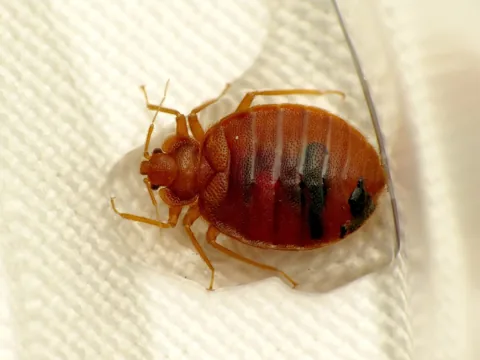 Bed Bug
Cimex lectularius
Bed bugs are wingless, blood-feeding insects that feed on sleeping or resting people, mostly at night; they have resurged worldwide and now turn up even in the finest hotels. CDC says they turn up in five-star hotels and resorts, and how clean a place is does not determine whether bed bugs are present.
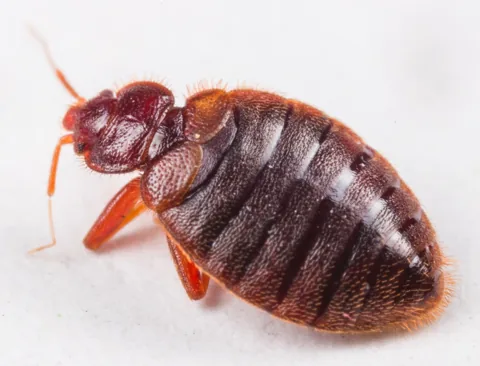 Tropical Bed Bug
Cimex hemipterus
The tropical bed bug is one of two bed bug species that feed on people. UC IPM says it is the dominant species in the tropics, and a 2021 study describes it spreading to new areas, including the United States, northern Australia, the Middle East, Russia and Central Europe.
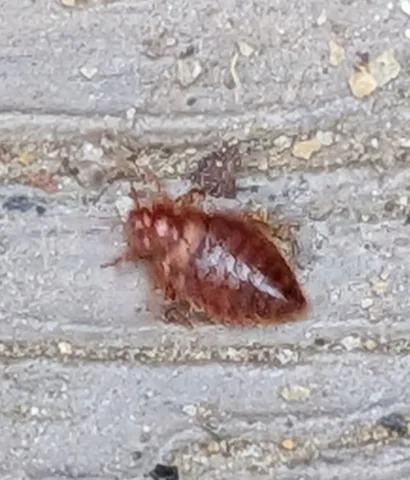 Bat Bugs
Cimex adjunctus (eastern bat bug) and Cimex pilosellus (western bat bug)
Bat bugs are close relatives of bed bugs that feed on the blood of roosting bats. They turn up in homes that have bats in the attic or walls, and they may bite people when the bats leave or are shut out.
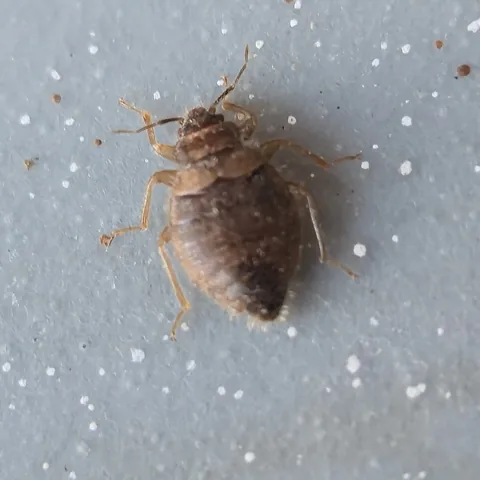 Swallow Bug
Oeciacus vicarius
Swallow bugs are close relatives of bed bugs that feed on the blood of swallows, mainly cliff swallows and sometimes barn swallows. They live in and around mud nests on buildings and bite people mainly when their birds are away.
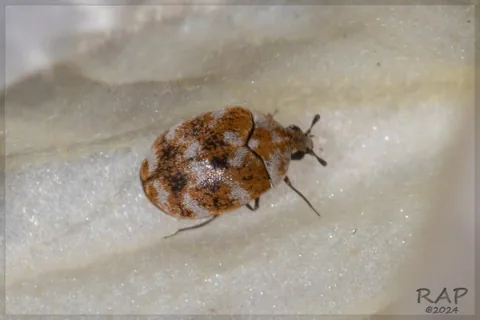 Varied Carpet Beetle
Anthrenus verbasci
Carpet beetles are small beetles whose larvae damage wool, silk, fur, feathers, leather and other animal products; the adults feed on pollen outdoors and often fly in through windows.
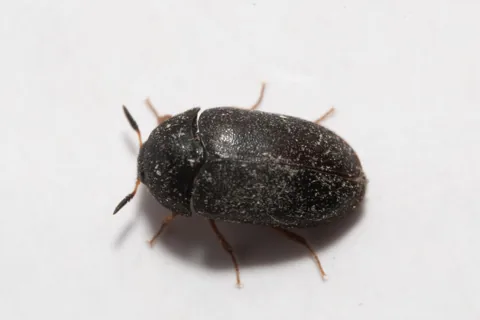 Black Carpet Beetle
Attagenus unicolor
The black carpet beetle is a shiny black carpet beetle whose larvae feed on wool, fur, feathers and other animal products, plus grains and other stored foods. In dry areas such as California, it is more often a pantry pest than a fabric pest. Colorado State Extension calls it one of the most common dermestid beetles.
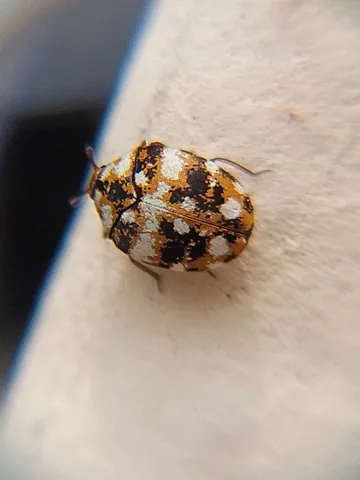 Furniture Carpet Beetle
Anthrenus flavipes
The furniture carpet beetle is a small, round dermestid beetle whose hairy larvae chew upholstery, carpets, fur and other animal-fiber items.
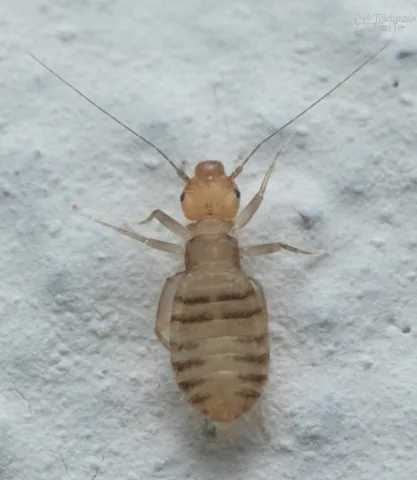 Booklice
Liposcelis species and other psocids (family Liposcelididae)
Booklice, also called psocids, are tiny insects that feed on mold and fungi. Finding them indoors usually means high humidity or a moisture problem, and drying things out is the most effective control.
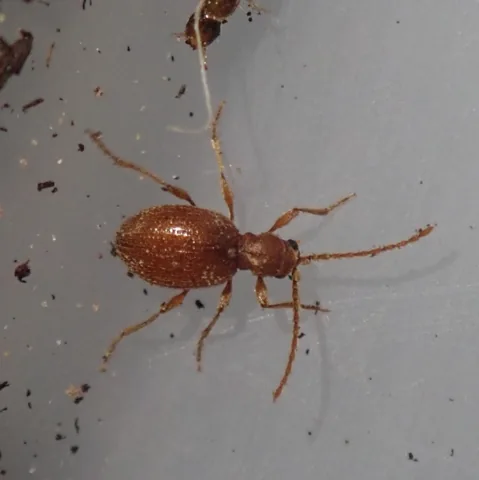 Spider Beetles
Ptinus fur
Spider beetles are small scavenging beetles in the family Ptinidae, named for their long legs and rounded, spider-like bodies; the whitemarked spider beetle is shown here. USDA's stored-grain handbook says several species turn up in grain and cereal products but are rarely abundant enough in the U.S. to cause serious damage, and Washington State University says they are usually a problem only where sanitation is very poor.
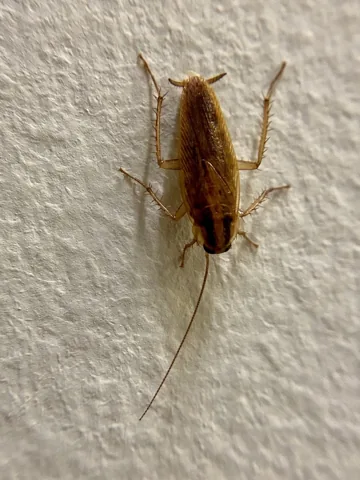 German Cockroach
Blattella germanica
The German cockroach is the most common cockroach living indoors in California and perhaps worldwide, especially in apartment buildings, and it has the fastest reproductive cycle of the common pest cockroaches. Penn State and Kentucky call it the most common cockroach in homes, apartments and other buildings, and Kentucky says it does not live outdoors.
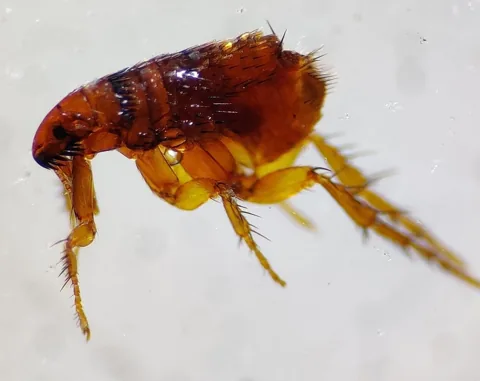 Cat Flea
Ctenocephalides felis
The cat flea is the most common external parasite of domestic cats and dogs, and the flea most often found on both. Adults spend most of their time on the pet, while eggs, larvae and pupae build up wherever the pet rests.
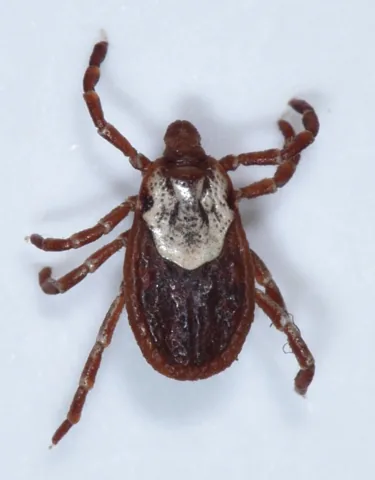 American Dog Tick
Dermacentor variabilis
The American dog tick, also called the wood tick, is widely distributed east of the Rocky Mountains. Adult females are the stage most likely to bite people, especially in spring and summer, and adults commonly climb to the crown of the head.
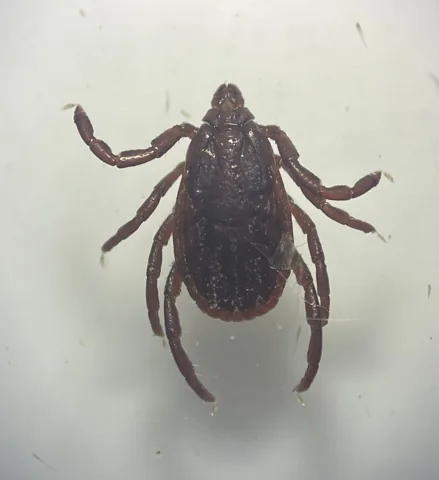 Brown Dog Tick
Rhipicephalus sanguineus
The brown dog tick is unusual: unlike most ticks, it can complete its entire life cycle indoors. It occurs across the United States, is met more often in the southern states, and can build up to high numbers on dogs and in homes and kennels.
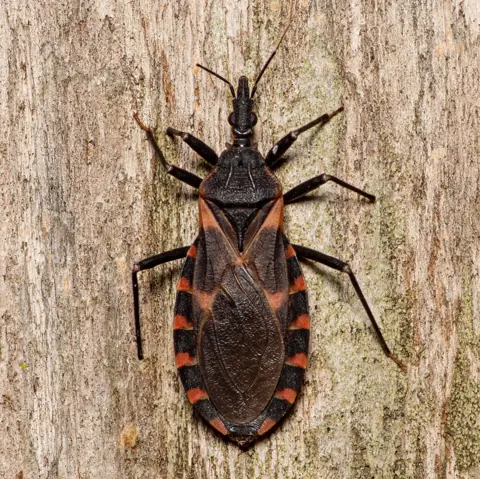 Eastern Bloodsucking Conenose
Triatoma spp. (shown: T. sanguisuga)
Kissing bugs are blood-feeding insects, active mostly at night, that can carry Trypanosoma cruzi, the parasite that causes Chagas disease. They have been found in 29 U.S. states, and studies of bugs collected in the United States have found the parasite in roughly one in six to nearly two in three of those tested, depending on the place.
What a bed bug looks like
Start with the real thing, so you have something to compare against.[4]
- Adults: wingless, oval and flattened, rusty red to mahogany. UC IPM gives about 1/5 inch, Kentucky 3/16 inch, and EPA 5 to 7 mm (3/16 to 1/4 inch). Kentucky says the color is like an apple seed and the size closer to a lentil.[1][2][4]
- After feeding: balloon-like, more reddish and more elongated.[4]
- Nymphs: shaped like the adults but smaller and lighter, translucent or whitish yellow. EPA lists five nymph stages from about 1.5 mm to 4.5 mm.[4][2][1]
- Eggs: white, about 1 mm (UC IPM: 1/20 inch), glued to rough surfaces near where people sleep.[1][3][4]
- Movement: bed bugs don't fly and don't jump like fleas, but they crawl quickly over floors, walls and ceilings.[2]
- Signs: dark fecal spots on sheets and mattress seams, rusty stains from crushed bugs, light brown shed skins, and a musty-sweetish odor.[1][3][4]
Bat bugs and swallow bugs
These are the closest look-alikes, close relatives of the bed bug in the same family. They are similar in size and color, also wingless and flat, and also feed on blood. The eastern and western bat bugs feed on roosting bats, and the swallow bug feeds mainly on cliff swallows.[5][1]
Kentucky notes that species living on bats and birds such as swallows or chimney swifts may bite people, especially when the wild hosts are gone. But Colorado State says they cannot reproduce on human blood.[2][5]
- The hair test: look at the fringe of hairs on the shield behind the head (the pronotum) with a hand lens or microscope. On bat bugs and swallow bugs these hairs are longer than the eye is wide; on bed bugs they are shorter.[5][1]
- The antenna test for swallow bugs: the last two antenna segments are nearly equal in length. On a bed bug the last segment is only about half as long as the one before it.[5]
- Where you find them: bat bugs turn up on upper floors near roosts in attics, walls, chimneys and under shingles, and usually one at a time. Bed bugs gather in groups near beds, chairs and sofas.[5]
- When they bite: bat bugs move into living areas after the bats are excluded or die. Swallow bugs are most likely to bite people in spring before the swallows return, or in autumn after the nest is abandoned.[5]
- Why it matters: treatment focuses on the bats or birds. Kentucky says roosting and nesting sites should be the target, along with excluding the wild hosts, and UC IPM says managing these relatives means managing their hosts.[2][1]
- A third bird-feeding relative, Hesperocimex coloradensis, lives in woodpecker, purple martin and owl nests. Colorado State says it is rarely reported in homes and there are no conclusive reports that it bites people.[5]
Carpet beetles (adults and larvae)
EPA names carpet beetles as an insect easily mistaken for bed bugs, and Kentucky lists them among the household insects people confuse with bed bugs.[3][2]
- Adults: small round beetles, about 1/16 to 1/8 inch, with short antennae, black or mottled with white, brown and yellow scales. Unlike bed bugs, they can fly.[7][6]
- Where adults show up: on windowsills, since they are attracted to light. They feed on pollen and nectar outdoors and fly in through open windows and doors or ride in on cut flowers.[6]
- Larvae: about 1/8 to 1/4 inch, tan to brown, slow-moving and covered with hairs or bristles. Varied carpet beetle larvae have alternating light and dark stripes and raise a plume of hair tufts when disturbed.[7][6]
- Signs: brown, bristly shed skins and fecal pellets about the size of a grain of salt, with damage to wool, fur, silk, feathers or leather. Cotton and synthetics are rarely attacked unless blended with wool or soiled.[6][7]
- The rash problem: hairs of carpet beetle larvae can cause an allergic skin reaction that people describe as being bitten, with intense itching and a rash. Penn State says only people with long-term exposure seem to become sensitized.[8]
- A 2021 report in a CDC journal describes 11 patients in France whose skin lesions, mostly under clothing, came from carpet beetle larva hairs. The authors say this dermatitis is underdiagnosed or confused with bed bug or flea bites.[9]
Booklice (psocids)
Penn State says booklice are sometimes confused for bed bugs because they are flattened.[10]
- Size and color: 1 to 2 mm, soft-bodied, usually light to dark tan, but they can be grey, brown or nearly clear. WSU gives 1/16 to 1/8 inch and describes them as white, cream, or light or dark gray.[10][11]
- The tell: an adult bed bug is about three times as long as an adult booklouse, and a newly hatched bed bug is about the size of an adult booklouse. A booklouse's head is wider than its thorax and nearly as wide as its body; a bed bug's head is narrower than its thorax.[10]
- Where: humid, damp, dark places, on moldy paper, books, wallpaper and stored grain. They feed on mold and fungi.[10][11]
- Bites: none. Penn State says booklice do not bite and do not carry disease.[10]
Spider beetles
Small, round beetles with long legs that give them a spider-like look. They infest stored food.[12][13]
- Where: grain products and other stored foods, feathers and rodent droppings. WSU says they are among the most common beetles in moldy, old food.[12][13]
- Larvae: C-shaped grubs that feed in the same food as the adults. Development from egg to adult takes about three and a half months.[13]
- Fix: sanitation. WSU says spider beetles are usually a pest only where sanitation is very poor.[12]
Baby cockroaches
Cockroaches are flattened, brownish insects, and Kentucky lists cockroaches among the insects mistaken for bed bugs.[2][15][14]
- Shape: cockroaches are fast runners with long, slender antennae. German cockroach nymphs are smaller and darker than adults; Kentucky describes a tan stripe down the middle of the back and Texas A&M two dark stripes running down the thorax and abdomen.[15][16]
- Where: kitchens and bathrooms. Kentucky notes cockroaches seldom gather on beds the way bed bugs do.[15]
- Droppings: pepper-like specks that look like bed bug spotting but can usually be told apart by where they are and by other signs.[15]
- Bites: Kentucky contrasts cockroaches, which feed on filth, with bed bugs, which feed solely on blood.[2]
- See the types of cockroaches guide to work out which species you have.[14][15]
Ticks
Kentucky lists ticks among the bugs mistaken for bed bugs. A few checks separate them.[2][17]
- Legs: count them. Tick nymphs and adults have eight legs; only tick larvae have six.[17]
- Feeding: a tick climbs onto a host from grass or brush, inserts its feeding tube and often cements itself in place, so you find it still attached. Bed bugs feed for 3 to 10 minutes and then leave.[18][1]
- Engorged ticks: their size and color change a lot after feeding, which makes them hard to identify.[17]
- Health: ticks can spread disease, and an attached tick can go unnoticed because its saliva has anesthetic properties.[18]
Fleas
- Shape: adults are no more than 1/8 inch, reddish brown and wingless, but flattened side to side so they look as if they walk on edge. Bed bugs are flat and oval.[19][4]
- Movement: fleas jump onto pets and people; bed bugs don't jump.[20][2]
- Where: on dogs and cats and where pets rest. Flea larvae live in carpet and furniture, and flea droppings show up as dark, pepper-like specks in a pet's coat.[20][19]
- Bites: fleas bite pets and people, and the bites itch. UC IPM says bed bug bites can't reliably be told apart from flea bites.[20][1]
Kissing bugs (conenose bugs)
Kissing bugs are bloodsuckers in the same insect order as bed bugs, and they sometimes hide between mattresses. UC IPM separates them from bed bugs by size, shape and wings: bed bugs are smaller, more rounded and wingless as adults.[22][1]
- Size: about 1/2 to over 1 inch as adults (UC IPM: up to 3/4 inch for western species), with wings held flat over the back.[22][1][21]
- Where: outdoors in pack rat nests and other wildlife nests. Adults fly to porch lights at night and can come indoors.[22][21]
- Bites: at night, often several grouped on the face, neck or arms. Bites are painless at first but can itch and swell into a welt lasting several days.[21][22]
Which look-alikes bite?
- Bite people: bed bugs, bat bugs and swallow bugs (mostly when their bats or birds are gone), fleas, ticks and kissing bugs.[1][5][2][20][18][21]
- Don't bite: booklice. Cockroaches feed on filth, not blood.[10][2]
- Look like bites but aren't: carpet beetle larva hairs can cause an itchy rash that people describe as bites.[8][9]
- Don't diagnose from bites: UC IPM says raised welts, blisters or rashes should never be used to identify the pest, because several household pests bite and people react differently. EPA adds that bed bug bites can look like mosquito or chigger bites, rashes or hives, and some people don't react at all.[1][3]
Next steps
- Catch one: use a flashlight and magnifying glass to check mattress seams and bed frames for live bugs, dark fecal spots and shed skins.[1][3]
- Get it identified: EPA says your state cooperative extension office may be able to help with identification. Kentucky says entomologists and pest professionals can separate bed bugs from bat and bird bugs.[4][2]
- If it is a bed bug: see the guides below on encasements, preparing for treatment and heat treatment. Kentucky recommends a professional when resources allow.[2][1]
- If it is a bat bug or swallow bug: exclude the bats or birds. Colorado State says to seal entry points between October and early April when the hosts are away, and to get professional help because bats are federally protected and can carry rabies. Leftover bugs can wander for months, so seal cracks and gaps in walls too.[5]
- If it is a carpet beetle: find the source (an old wool item, a stored rug, a bird or rodent nest), then launder, dry-clean or discard infested items and vacuum up lint and hair.[7][6]
- If it is a booklouse: fix the moisture. Penn State says keeping relative humidity below 50% prevents mold growth and booklouse development, and pesticides usually aren't needed.[10]
- If it is a flea: treat the pet first, since adult fleas spend most of their time on the animal, then vacuum and wash pet bedding.[20][19]
Common questions
- What bug looks exactly like a bed bug?
- Bat bugs and swallow bugs. They are close relatives with the same size, color and shape. You need a hand lens to compare the hairs behind the head with the width of the eye.[5][1]
- Can carpet beetles be mistaken for bed bugs?
- Yes. EPA names carpet beetles as an easy mistake. Adults are round beetles that fly and gather on windowsills. Larvae are fuzzy and leave bristly shed skins.[3][6][7]
- Do booklice bite?
- No. Penn State says booklice do not bite and do not carry disease; they feed on mold in damp places.[10]
- Can bat bugs live on human blood?
- They may bite people when bats are gone, but Colorado State says bat bugs and bird-feeding bugs cannot reproduce on human blood. Remove the bats and the infestation eventually dies out.[5][2]
- How can I tell a bed bug from a tick?
- Count the legs. Tick nymphs and adults have eight. A tick also usually stays attached while it feeds, but a bed bug feeds for a few minutes and leaves.[17][18][1]
Photo credits
- Bed Bug: (c) Katja Schulz, some rights reserved (CC BY) — via iNaturalist, CC BY 4.0
- Tropical Bed Bug: (c) portioid, some rights reserved (CC BY) — via iNaturalist, CC BY 4.0
- Bat Bugs: (c) Jason Hill, some rights reserved (CC BY) — via iNaturalist, CC BY 4.0
- Swallow Bug: (c) John Clonce, some rights reserved (CC BY) — via iNaturalist, CC BY 4.0
- Varied Carpet Beetle: (c) RAP, some rights reserved (CC BY) — via iNaturalist, CC BY 4.0
- Black Carpet Beetle: (c) Поляков Александр, some rights reserved (CC BY) — via iNaturalist, CC BY 4.0
- Furniture Carpet Beetle: (c) Rodolfo Salinas Villarreal, some rights reserved (CC BY) — via iNaturalist, CC BY 4.0
- Booklice: (c) Luis Fernando Valdez Ojeda, some rights reserved (CC BY) — via iNaturalist, CC BY 4.0
- Spider Beetles: (c) agujaceratops, some rights reserved (CC BY) — via iNaturalist, CC BY 4.0
- German Cockroach: (c) Sandra H Statner, some rights reserved (CC BY) — via iNaturalist, CC BY 4.0
- Cat Flea: (c) Thomas Gyselinck, some rights reserved (CC BY) — via iNaturalist, CC BY 4.0
- American Dog Tick: (c) Don Loarie, some rights reserved (CC BY) — via iNaturalist, CC BY 4.0
- Brown Dog Tick: (c) NoahM, some rights reserved (CC BY) — via iNaturalist, CC BY 4.0
- Eastern Bloodsucking Conenose: (c) Justin Williams, some rights reserved (CC BY) — via iNaturalist, CC BY 4.0
Sources
- University of California Statewide IPM Program, “Pest Notes: Bed Bugs (Home and Landscape).” ipm.ucanr.edu/home-and-landscape/bed-bugs/ (accessed 2026-11-10)
- University of Kentucky Entomology, “ENTFACT-636: Bed Bugs.” entomology.mgcafe.uky.edu/ef636 (accessed 2026-11-10)
- U.S. Environmental Protection Agency, “How to Find Bed Bugs.” www.epa.gov/bedbugs/how-find-bed-bugs (accessed 2026-11-10)
- U.S. Environmental Protection Agency, “Bed Bugs Appearance and Life Cycle.” www.epa.gov/bedbugs/bed-bugs-appearance-and-life-cycle (accessed 2026-11-10)
- Colorado State University, Agricultural Biology, “Bed bug look-alikes.” agsci.colostate.edu/agbio/ipm-pests/bed-bug-look-alikes/ (accessed 2026-11-10)
- University of California Statewide IPM Program, “Pest Notes: Carpet Beetles (Home and Landscape).” ipm.ucanr.edu/home-and-landscape/carpet-beetles/ (accessed 2026-11-10)
- University of Kentucky Entomology, “ENTFACT-601: Carpet Beetles.” entomology.mgcafe.uky.edu/ef601 (accessed 2026-11-10)
- Penn State Extension, “Carpet Beetle Dermatitis.” extension.psu.edu/carpet-beetle-dermatitis (accessed 2026-11-10)
- Centers for Disease Control and Prevention (Emerging Infectious Diseases journal), “Simon et al. 2021, Anthrenus sp. and an Uncommon Cluster of Dermatitis, Emerging Infectious Diseases 27(7):1940-1943.” wwwnc.cdc.gov/eid/article/27/7/20-3245_article (accessed 2026-11-10)
- Penn State Extension, “Booklice.” extension.psu.edu/booklice (accessed 2026-11-10)
- Washington State University Pestsense, “Psocids (booklice or barklice).” pestsense.cahnrs.wsu.edu/fact-sheet/psocids-booklice-or-barklice/ (accessed 2026-11-10)
- Washington State University Pestsense, “Spider beetle.” pestsense.cahnrs.wsu.edu/fact-sheet/spider-beetle/ (accessed 2026-11-10)
- University of Missouri Extension, “G7370: Insect Pests of Stored Products.” extension.missouri.edu/publications/g7370 (accessed 2026-11-10)
- University of California Statewide IPM Program, “Pest Notes: Cockroaches, UC ANR Publication 7467 (Home and Landscape).” ipm.ucanr.edu/home-and-landscape/cockroaches/ (accessed 2026-11-10)
- University of Kentucky Entomology, “ENTFACT-614: Cockroach Elimination in Homes and Apartments.” entomology.mgcafe.uky.edu/ef614 (accessed 2026-11-10)
- Texas A&M AgriLife Extension, “ENTO-037: Cockroach Biology and Management (2017).” extensionentomology.tamu.edu/wp-content/uploads/sites/3/2017/12/Cockroach-Biol-and-Mngmt_ENTO-037_2017.pdf (accessed 2026-11-10)
- University of Minnesota Extension, “Ticks.” extension.umn.edu/garden-and-home/yard-and-garden/yard-and-garden-insects/ticks (accessed 2026-11-10)
- Centers for Disease Control and Prevention, “About Ticks and Tickborne Disease.” www.cdc.gov/ticks/about/index.html (accessed 2026-11-10)
- University of California Statewide IPM Program, “Pest Notes: Fleas (Home and Landscape).” ipm.ucanr.edu/home-and-landscape/fleas/ (accessed 2026-11-10)
- University of Kentucky Entomology, “ENTFACT-602: Flea Control and Prevention.” entomology.mgcafe.uky.edu/ef602 (accessed 2026-11-10)
- University of California Statewide IPM Program, “Pest Notes: Conenose Bugs, UC ANR Publication 7455.” ipm.ucanr.edu/home-and-landscape/conenose-bugs/ (accessed 2026-11-10)
- University of Arizona Cooperative Extension, “What You Should Know About Kissing Bugs, az1992 (Li, Gouge, Ruberto, Nair, Fournier and Hall, March 2022).” extension.arizona.edu/sites/default/files/pubs/az1992-2022.pdf (accessed 2026-11-10)