The short answer
- A flat, oval, reddish-brown, wingless bug about 3/16 inch long, hiding in mattress seams or the bed frame, is most likely a bed bug. Look for dark fecal spots, pale shed skins and rusty smears on sheets to confirm it.[1][2][4]
- A tiny round beetle on the windowsill, or a slow, bristly, tan to brown larva in a closet or under the bed, is a carpet beetle. The larvae eat wool and other animal fibers, and their hairs can cause a rash that looks like bites, though the beetles don't bite.[7][8][10]
- Small golden moths fluttering in a dark closet are clothes moths; food-infesting moths fly in a more direct, steady way.[11]
- Tiny dark insects that jump, with itchy bites on people and pets, point to fleas. Control starts with the pet, not the bed.[13][12][14]
- Tiny, soft-bodied, mostly tan crawlers on damp books, papers or walls are booklice. They feed on mold and don't bite.[18][19]
- Spiders in the bedroom rarely bite. Kentucky Extension says bites happen when a spider that has crawled into bedding or clothing gets trapped against the skin.[17][16][15]
- Bites with no bug in sight have many causes. Collect any specimen you can, check for bird or rodent nests close to the room, and see a doctor about a rash that won't clear up.[22][25][1]
Bugs most often found in bedrooms
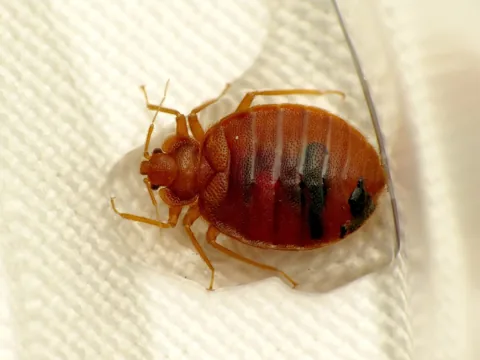 Bed Bug
Cimex lectularius
Bed bugs are wingless, blood-feeding insects that feed on sleeping or resting people, mostly at night; they have resurged worldwide and now turn up even in the finest hotels. CDC says they turn up in five-star hotels and resorts, and how clean a place is does not determine whether bed bugs are present.
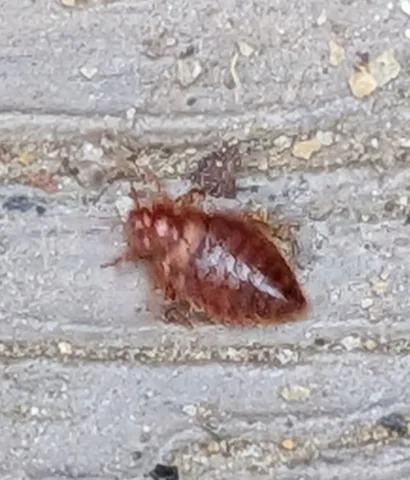 Bat Bugs
Cimex adjunctus (eastern bat bug) and Cimex pilosellus (western bat bug)
Bat bugs are close relatives of bed bugs that feed on the blood of roosting bats. They turn up in homes that have bats in the attic or walls, and they may bite people when the bats leave or are shut out.
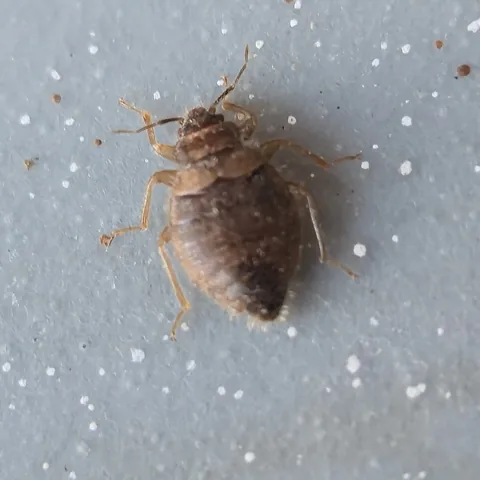 Swallow Bug
Oeciacus vicarius
Swallow bugs are close relatives of bed bugs that feed on the blood of swallows, mainly cliff swallows and sometimes barn swallows. They live in and around mud nests on buildings and bite people mainly when their birds are away.
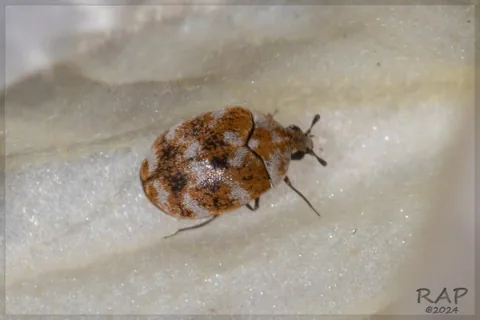 Varied Carpet Beetle
Anthrenus verbasci
Carpet beetles are small beetles whose larvae damage wool, silk, fur, feathers, leather and other animal products; the adults feed on pollen outdoors and often fly in through windows.
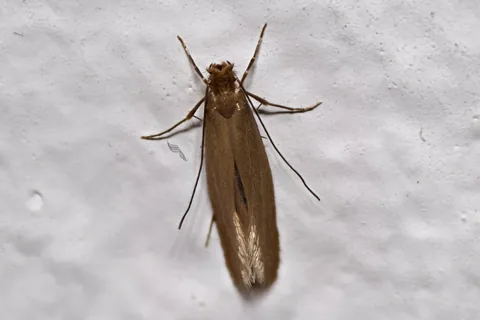 Webbing Clothes Moth
Tineola bisselliella
The webbing clothes moth is probably the most commonly encountered clothes moth in the United States. Its larvae feed on wool, fur, feathers and other animal fibers in hidden spots, and the moths are seldom seen because they avoid light.
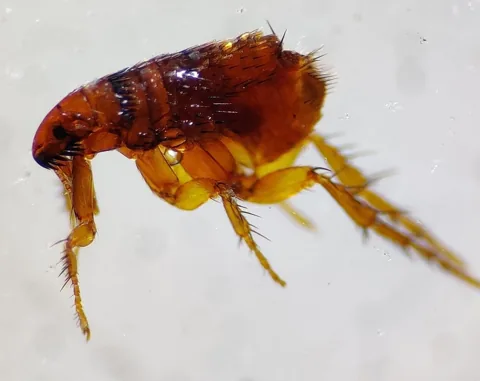 Cat Flea
Ctenocephalides felis
The cat flea is the most common external parasite of domestic cats and dogs, and the flea most often found on both. Adults spend most of their time on the pet, while eggs, larvae and pupae build up wherever the pet rests.
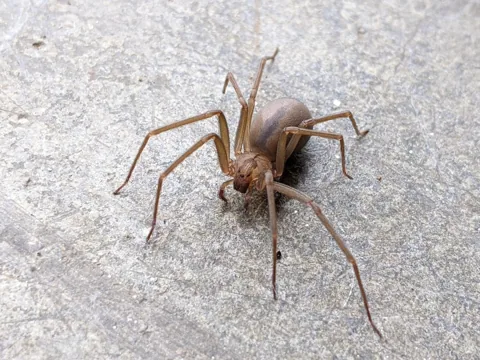 Brown Recluse
Loxosceles reclusa
The brown recluse is a secretive spider of the south-central and Midwestern United States whose bite can occasionally cause serious wounds; it is widely over-reported outside its range. The Illinois Department of Public Health says it occurs in roughly the southeastern quarter of the country and that bites are uncommon even where the spider is common.
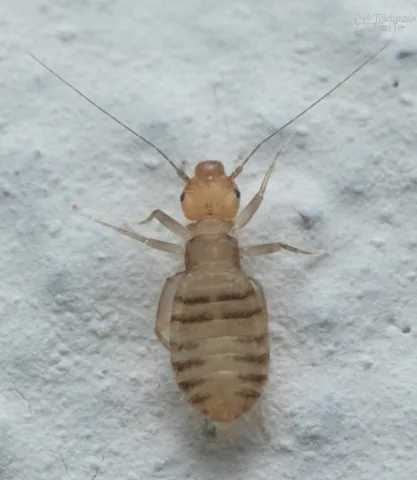 Booklice
Liposcelis species and other psocids (family Liposcelididae)
Booklice, also called psocids, are tiny insects that feed on mold and fungi. Finding them indoors usually means high humidity or a moisture problem, and drying things out is the most effective control.
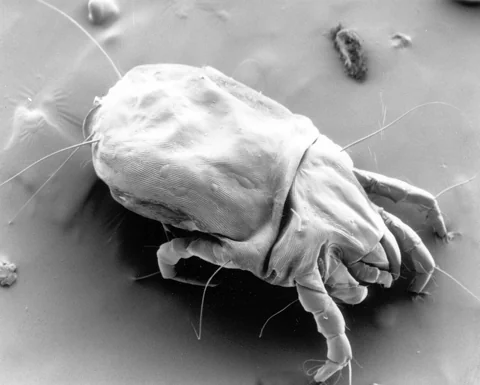 House Dust Mites
Dermatophagoides farinae (American house dust mite) and D. pteronyssinus (European house dust mite)
House dust mites are microscopic relatives of ticks and spiders that live in house dust and feed on skin flakes shed by people and pets. They don't bite, but their body parts and droppings are a major indoor allergen and the main cause of dust allergy.
No photo yet
Tropical rat mite
Ornithonyssus bacoti
The tropical rat mite is a tiny blood-feeding mite that lives in the nests of rats and mice. It isn't a true parasite of people, but when its hosts die, leave or are exterminated, the hungry mites wander through the house and bite readily, causing itchy red bumps.
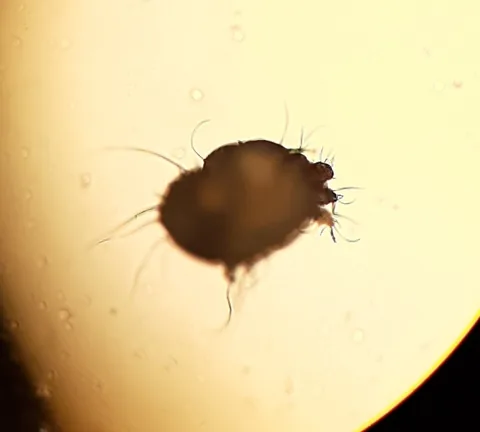 Scabies mite
Sarcoptes scabiei
Scabies is a skin infestation caused by a microscopic mite, Sarcoptes scabiei, that burrows into the upper layer of the skin of people and many other mammals. Its hallmark is intense itching, especially at night, and it spreads mainly through direct, prolonged skin-to-skin contact.
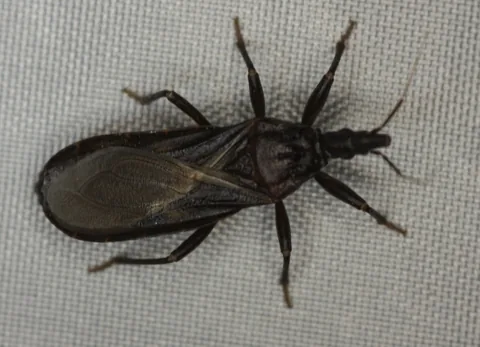 Western bloodsucking conenose
Hospesneotomae protracta
The western bloodsucking conenose (Hospesneotomae protracta, formerly Triatoma protracta) is the most important kissing bug in California and one of the three species most often found around homes in Arizona. It normally lives in the nests of wood rats (pack rats) and other wildlife, but adults fly to lights at night, get into houses and may feed on sleeping people. The bite is painless, yet it can leave itchy, swollen welts, and in people who become allergic it can trigger anaphylaxis.
Which bedroom bug is it?
Match what you found, then use that bug's own guide for control. Sizes are for adults unless noted.[1][8]
- Bed bug: oval, flattened and reddish brown, about 3/16 inch long according to Kentucky Extension; CDC gives a range of 1 mm to 7 mm, which covers young nymphs up to adults. Kentucky compares the color to an apple seed. Adults have no wings. Full guides: signs of bed bugs and how to get rid of bed bugs.[1][3][2]
- Bat bugs and swallow bugs: close relatives of bed bugs, similar in size and color, separated only with a hand lens or microscope. They turn up near bat roosts or bird nests on or in the building, and they can bite people but can't reproduce on human blood. Full guide: bed bug look-alikes.[6]
- Carpet beetle: adults are small round beetles, 1/16 to 1/8 inch (UC IPM gives 1/8 to 1/10 inch), black or mottled white, brown, yellow and orange. The larvae, about 1/8 to 1/4 inch, are tan to brown, slow and covered with bristly hairs. Full guide: clothes moths and carpet beetles.[8][7]
- Webbing clothes moth: a small gold moth with reddish-golden hairs on its head and a wingspan of about 1/2 inch. It isn't drawn to lights, so you'll usually find it near the infested items in a dark part of a closet.[11]
- Flea: no more than 1/8 inch long, brown to black, with strong jumping legs. Kentucky says adults can jump up to about 6 inches straight up. Full guide: how to get rid of fleas in the house.[12][14][13]
- Booklouse (psocid): soft-bodied, wingless and about 1 to 2 mm, mostly light to dark tan but sometimes gray or nearly clear. Penn State says booklice are sometimes taken for bed bugs, but an adult bed bug is about three times as long, and the booklouse's head is wider than its thorax. Full guide: booklice and psocids.[18][19]
- Bird mites: very small, about 1/32 inch, but visible to the naked eye. They live in bird nests and wander indoors when the nest is abandoned or a bird dies. Rat mites come from wild rodent nests in the same way. Full guide: mites that bite people.[23][22]
- House dust mites: microscopic, so you won't see them. They live in mattresses, bedding, upholstered furniture and carpet. Kentucky Extension says they don't bite or sting; they matter because of allergies.[21][20]
- Conenose (kissing) bug: larger than a bed bug, darker, with wings as an adult and a pointed, cone-shaped head. Adults fly and are drawn to lights at night. Full guide: kissing bugs and Chagas disease.[26][27]
Bites in bed: what the clues can and can't tell you
A bite alone can't tell you which bug did it. Kentucky Extension says studies in infested apartments suggest about 30 percent of people don't react to bed bug bites even when bitten repeatedly, that reactions can be delayed days or even weeks, and that not all bite-like reactions are due to bed bugs. The signs of bed bugs guide covers what to look for instead.[1]
CDC says bed bugs bite at night while people sleep and are not known to spread diseases, though bites can cause itching, lost sleep and, rarely, allergic reactions. Scratching can lead to a skin infection.[3][2]
- Fleas: UC IPM describes a flea bite as a small red spot with a red halo, usually without much swelling. People get bitten especially when flea numbers are high, but fleas don't live and breed on humans.[12][14]
- Bird and rodent mites: Texas A&M says bites are usually noticed only in certain rooms, presumably close to the nest. Unlike bed bugs, these mites don't hitchhike on people or belongings to other places.[22]
- Carpet beetle larvae: Penn State describes an allergic rash from contact with the larval hairs, with complaints of being bitten by something and intense itching, apparently only in people exposed for years. A 2021 report in CDC's Emerging Infectious Diseases journal describes these lesions as allergic reactions to larval hairs, not bites, and says they should be told apart from bed bug and flea bites.[9][10]
- Spiders: Kentucky Extension says some people are bitten when they roll over a brown recluse in bed, and another Kentucky fact sheet says bites may happen when a sleeping person contacts a spider that has crawled onto the bed. UC IPM adds that most spiders' jaws are too small to bite people and that a spider trapped in bedding usually causes no more than itching or a bee-sting-like reaction. Brown recluses are rare outside their native range in the south-central and Midwestern U.S.[17][16][15]
- Conenose bugs: UC IPM says their bites usually happen at night and come as several bites on the face, neck, arms or legs, and in sensitive people they can cause dangerous allergic reactions.[26]
- Scabies: not a bedroom pest at all but a mite that burrows into human skin. CDC lists intense itching, especially at night, and a pimple-like rash as the most common symptoms, and spread is mostly by prolonged skin-to-skin contact. A healthcare professional diagnoses it and treatment requires a prescription.[24]
- No bug found: Cornell's New York State IPM program says there are many causes of itching and biting sensations, an entomologist can only say whether a sample contains an identifiable arthropod, and a dermatologist or other medical provider is often needed. If nothing is found, no pest control should be recommended.[25]
Check the bed first
Because bed bugs are the one bedroom pest that spreads by hitchhiking and gets harder to clear the longer it goes, rule them in or out before anything else. UC IPM says common hiding spots are within about 6 feet of where people sleep or rest: mattress seams and tufts, box spring joints, bed frame cracks, and behind baseboards and headboards. Kentucky adds sofas and recliners, especially ones used for sleeping.[2][1][22]
Use a flashlight and magnifier and look for live bugs, dark fecal spots and light-brown shed skins, as UC IPM advises. EPA adds rusty or reddish stains on sheets from crushed bugs and tiny pale-yellow eggs about 1 mm long. Kentucky notes the often-mentioned smell is seldom noticeable except in extreme infestations and shouldn't be relied on.[2][4][1]
Save any bug you catch so it can be identified; UC IPM notes that people bitten without a specimen are harder to diagnose, and extension entomologists can examine samples. The signs of bed bugs guide walks through a full inspection and interceptor monitors; if you find bed bugs, the treatment guide sets out the whole plan.[2][25]
Make the bed an island
Two very different pests call for the same simple step. For bed bugs, EPA suggests moving furniture a few inches from walls with only the legs touching the floor and an interceptor trap under each leg. For brown recluse spiders, Kentucky Extension says to move beds away from walls and remove bed skirts and dust ruffles to break contact with the floor, and to shake out shoes and clothing kept on the floor before wearing them.[5][17]
Kentucky's bed bug fact sheet describes the result as a bug-free island: an encased bed pulled away from the wall with no blankets or dust ruffle bridging to the floor, so bugs climbing up the legs end up in the traps.[1]
Closets, rugs and stored clothes
Holes in wool sweaters or bare patches in a wool rug point to clothes moths or carpet beetles. Kentucky Extension says carpet beetle damage is often mistaken for clothes moth damage, and that clothing and blankets in regular use, and rugs that are vacuumed routinely, are seldom attacked. The worst spots are items stored for a long time in closets, chests and boxes, and the lint, hair and debris under baseboards and in floor vents.[8]
Carpet beetle adults feed on pollen and often come in on cut flowers or through open windows. In spring they show up on windowsills, which Kentucky says can suggest an infestation inside the home. UC IPM advises checking window screens and inspecting cut flowers before bringing them in.[7][8]
The clothes moth and carpet beetle guide covers finding every infested item, washing, freezing or heating, and storage. If you use mothballs, flakes or crystals, Kentucky says to follow the label and never scatter them in open closets or anywhere children or pets can reach.[8][11]
If a pet sleeps on the bed
Fleas in a bedroom are a pet problem first. UC IPM says that to keep fleas out of the home you control them on the pet and regularly vacuum and launder the places the pet rests, which includes your bed if that's where it sleeps. The flea guide covers treating pets with your veterinarian and the home with an insect growth regulator when needed.[12][13]
Bites with no pets in the house can come from wildlife: Kentucky Extension describes fleas from feral animals living under or around the home, and Texas A&M and Minnesota Extension trace biting mites to rodent and bird nests in the building.[13][22][23]
Nests in the walls, attic or eaves
Several bedroom biters really come from animals living in the building. Texas A&M says rat and bird mite infestations happen where rodent or bird nests are located, the mites can crawl several yards from a nest, bird problems are most common in spring and summer, and the host animal has to be dealt with before mite control can work. Colorado State says the same for bat bugs and swallow bugs: keeping bats and swallows out of the building prevents or ends those infestations.[22][6]
Minnesota Extension says bird mites hatch in two to three days and adults appear about five days later if birds are present, and they go looking for other hosts when a nest is abandoned. Try to collect some of the mites for identification, as Texas A&M advises; the mites guide covers sampling and treatment.[23][22]
Booklice and a damp room
Booklice in a bedroom mean moisture: Penn State calls them indicators of high humidity and says they feed on mold in humid, damp, generally dark areas. Lowering relative humidity below 50% prevents mold growth and booklouse development, so a dehumidifier or fixing the water problem is usually the answer, not an insecticide. The booklice guide covers books, boxes and keepsakes.[18][19]
Dust mites, bedding and allergies
If allergies or asthma, not bites, are the problem, house dust mites are the usual bedroom suspect. Kentucky Extension says an infested mattress can contain millions of them, that the allergens are in the mites, their shed skins and especially their feces, and that bedrooms deserve the most attention because people perspire and exhale moisture where they sleep. An allergist can confirm a dust mite allergy with a skin or blood test.[20]
Kentucky says dust mites do best at about 75 to 80°F and 70 to 80 percent relative humidity, though some species survive at 50 to 60 percent. NIEHS advises keeping humidity at or below 50 percent with a dehumidifier or air conditioner.[20][21]
- Encase the mattress, box spring and pillows in allergen-impermeable covers (NIEHS and Kentucky).[21][20]
- Wash bedding and blankets once a week in hot water, 130 to 140°F, as NIEHS advises; non-washable bedding can be frozen overnight.[21][20]
- Vacuum with a HEPA-filtered machine so the allergens stay in the bag (Kentucky). NIEHS suggests wearing a mask while vacuuming and staying out of the room for 20 minutes afterward.[20][21]
- Where you can, NIEHS suggests bare floors instead of wall-to-wall carpet in bedrooms and fewer fabric curtains and upholstered pieces.[21]
Common questions
- How do I know if it's bed bugs or something else?
- Find the bug or its signs. Bed bugs leave dark fecal spots, pale shed skins and rusty smears along mattress seams and bed frames. Bites alone don't confirm them, since many people don't react and other causes look similar.[2][4][1]
- Do carpet beetles bite?
- No. Adults eat pollen and larvae eat animal fibers, but contact with larval hairs can cause an allergic rash that mimics bites, which Penn State links to long-term exposure.[8][10][9]
- Why do I find tiny beetles on my bedroom windowsill?
- Often carpet beetle adults, which are drawn to light. Kentucky says seeing them on windowsills in spring can mean larvae are feeding somewhere inside, so check closets, rugs and stored woolens.[7][8]
- Can spiders bite me in my sleep?
- It happens but isn't common. Kentucky Extension says bites occur when a spider that has crawled onto the bed is pressed against a sleeper, and UC IPM says the effect is usually no worse than itching or a bee-sting-like reaction.[16][17][15]
- What's biting me at night if I can't find any bugs?
- Check for bird or rodent nests near the room, and save any specimen you can. If nothing turns up, Cornell's IPM program says a dermatologist or other medical provider is often needed, since many conditions cause itching.[22][25]
Photo credits
- Bed Bug: (c) Katja Schulz, some rights reserved (CC BY) — via iNaturalist, CC BY 4.0
- Bat Bugs: (c) Jason Hill, some rights reserved (CC BY) — via iNaturalist, CC BY 4.0
- Swallow Bug: (c) John Clonce, some rights reserved (CC BY) — via iNaturalist, CC BY 4.0
- Varied Carpet Beetle: (c) RAP, some rights reserved (CC BY) — via iNaturalist, CC BY 4.0
- Webbing Clothes Moth: (c) David Kleuker, some rights reserved (CC BY) — via iNaturalist, CC BY 4.0
- Cat Flea: (c) Thomas Gyselinck, some rights reserved (CC BY) — via iNaturalist, CC BY 4.0
- Brown Recluse: iamfindingplants, public domain (CC0), via iNaturalist
- Booklice: (c) Luis Fernando Valdez Ojeda, some rights reserved (CC BY) — via iNaturalist, CC BY 4.0
- House Dust Mites: Matt Colloff, CSIRO — CSIRO ScienceImage 11085 (CC BY 3.0) — via Wikimedia Commons, CC BY 3.0
- Scabies mite: Tero Linjama, public domain (CC0), via iNaturalist
- Western bloodsucking conenose: (c) Andrew Meeds, some rights reserved (CC BY) — via iNaturalist, CC BY 4.0
Sources
- University of Kentucky Entomology, “ENTFACT-636: Bed Bugs.” entomology.mgcafe.uky.edu/ef636 (accessed 2026-11-10)
- University of California Statewide IPM Program, “Pest Notes: Bed Bugs, Publication 7454 (May 2013).” ipm.ucanr.edu/legacy_assets/PDF/PESTNOTES/pnbedbugs.pdf (accessed 2026-11-10)
- Centers for Disease Control and Prevention, “About Bed Bugs.” www.cdc.gov/bed-bugs/about/index.html (accessed 2026-11-10)
- U.S. Environmental Protection Agency, “How to Find Bed Bugs.” www.epa.gov/bedbugs/how-find-bed-bugs (accessed 2026-11-10)
- U.S. Environmental Protection Agency, “Do-it-yourself Bed Bug Control.” www.epa.gov/bedbugs/do-it-yourself-bed-bug-control (accessed 2026-11-10)
- Colorado State University, Agricultural Biology, “Bed bug look-alikes.” agsci.colostate.edu/agbio/ipm-pests/bed-bug-look-alikes/ (accessed 2026-11-10)
- University of California Statewide IPM Program, “Pest Notes: Carpet Beetles (Home and Landscape).” ipm.ucanr.edu/home-and-landscape/carpet-beetles/ (accessed 2026-11-10)
- University of Kentucky Entomology, “ENTFACT-601: Carpet Beetles.” entomology.mgcafe.uky.edu/ef601 (accessed 2026-11-10)
- Penn State Extension, “Carpet Beetle Dermatitis.” extension.psu.edu/carpet-beetle-dermatitis (accessed 2026-11-10)
- Centers for Disease Control and Prevention (Emerging Infectious Diseases journal), “Simon et al. 2021, Anthrenus sp. and an Uncommon Cluster of Dermatitis, Emerging Infectious Diseases 27(7):1940-1943.” wwwnc.cdc.gov/eid/article/27/7/20-3245_article (accessed 2026-11-10)
- University of California Statewide IPM Program, “Pest Notes: Clothes Moths, Publication 7435 (March 2013).” ipm.ucanr.edu/legacy_assets/PDF/PESTNOTES/pnclothesmoths.pdf (accessed 2026-11-10)
- University of California Statewide IPM Program, “Pest Notes: Fleas (Home and Landscape).” ipm.ucanr.edu/home-and-landscape/fleas/ (accessed 2026-11-10)
- University of Kentucky Entomology, “ENTFACT-602: Flea Control and Prevention.” entomology.mgcafe.uky.edu/ef602 (accessed 2026-11-10)
- Texas A&M AgriLife Extension, Urban Entomology, “Fleas, ENT-3001.” citybugs.tamu.edu/factsheets/biting-stinging/others/ent-3001/ (accessed 2026-11-10)
- University of California Statewide IPM Program, “Pest Notes: Spiders, UC ANR Publication 7442.” ipm.ucanr.edu/home-and-landscape/spiders/ (accessed 2026-11-10)
- University of Kentucky Entomology, “Eliminating Spiders Around Homes and Buildings (ENTFACT-623).” entomology.mgcafe.uky.edu/ef623 (accessed 2026-11-10)
- University of Kentucky Entomology, “ENTFACT-631: Brown Recluse Spider.” entomology.mgcafe.uky.edu/ef631 (accessed 2026-11-10)
- Penn State Extension, “Booklice (S. Jacobs; revised July 2024 by M. Skvarla).” extension.psu.edu/booklice (accessed 2026-11-10)
- Washington State University Pestsense, “Psocids (booklice or barklice).” pestsense.cahnrs.wsu.edu/fact-sheet/psocids-booklice-or-barklice/ (accessed 2026-11-10)
- University of Kentucky Entomology, “ENTFACT-646: House Dust Mites (revised March 2026).” entomology.ca.uky.edu/ef646 (accessed 2026-11-10)
- National Institute of Environmental Health Sciences, NIH, “Dust Mites and Cockroaches (Allergens).” www.niehs.nih.gov/health/topics/agents/allergens/dustmites (accessed 2026-11-10)
- Texas A&M AgriLife Extension, Insects in the City, “Rat and Bird Mites (ENT-3009).” citybugs.tamu.edu/factsheets/biting-stinging/others/ent-3009/ (accessed 2026-11-10)
- University of Minnesota Extension, “Bird and Rodent Mites.” extension.umn.edu/insect-relatives/bird-and-rodent-mites (accessed 2026-11-10)
- Centers for Disease Control and Prevention, “About Scabies (2024).” www.cdc.gov/scabies/about/index.html (accessed 2026-11-10)
- Cornell University, New York State Integrated Pest Management, “Mystery Bites.” cals.cornell.edu/integrated-pest-management/mystery-bites (accessed 2026-11-10)
- University of California Statewide IPM Program, “Pest Notes: Conenose Bugs, UC ANR Publication 7455.” ipm.ucanr.edu/home-and-landscape/conenose-bugs/ (accessed 2026-11-10)
- University of Arizona Cooperative Extension, “What You Should Know About Kissing Bugs, az1992 (2022).” extension.arizona.edu/sites/default/files/pubs/az1992-2022.pdf (accessed 2026-11-10)