The short answer
- Most basement bugs are moisture pests. Kentucky says most millipedes and centipedes die shortly after entering a building because of the lack of moisture, and pillbugs and sowbugs find it almost impossible to survive indoors without high moisture.[3][4]
- Lower the humidity. EPA says to keep indoor humidity below 60 percent, ideally 30 to 50 percent. Penn State says getting it under 50% prevents mold growth and booklouse development. A dehumidifier or fan is the usual tool.[19][15][6]
- Fix the water at the source too. Minnesota Extension says a dehumidifier reduces the humidity and odor but isn't a permanent solution; grading, gutters and downspouts handle a great many basement water problems.[20]
- Seal the ways in: cracks in slabs and block walls, sump covers, floor drains, and gaps around pipes. Mice fit through a hole the width of a pencil.[1][18][9]
- Spraying inside is rarely the answer. Kentucky says indoor pesticides are rarely necessary for millipedes and centipedes, and UC IPM says insecticides won't work on silverfish unless you also remove the moisture, food and hiding places.[3][5]
Basement pest profiles
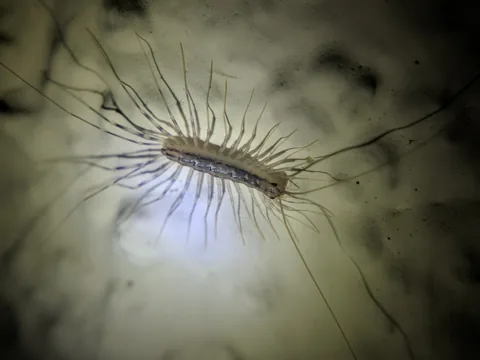 House Centipede
Scutigera coleoptrata
House centipedes are fast, long-legged predators that live in damp parts of buildings and feed on silverfish, cockroaches, carpet beetle larvae and other small arthropods; they are largely harmless.
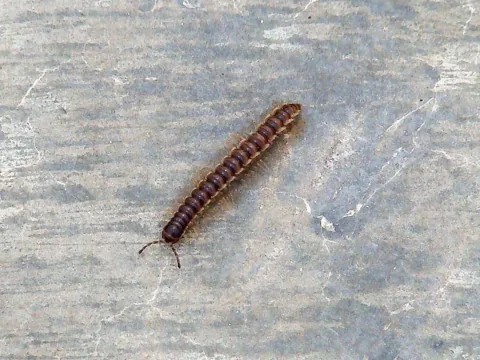 Greenhouse Millipede
Oxidus gracilis
Millipedes live in cool, damp places under leaves, mulch and stones; occasionally they migrate into buildings in large numbers but do no damage and soon die indoors. Clemson says the garden millipede (Oxidus gracilis) is the species that most often invades homes in large numbers.
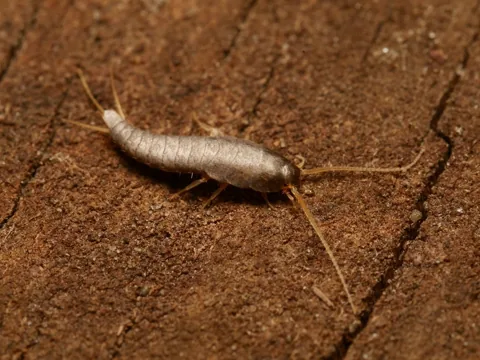 Silverfish
Lepisma saccharinum
Silverfish are nocturnal, wingless insects that hide by day and graze at night on paper, book bindings, starch in clothing and dry foods, preferring damp, warm places such as laundry rooms.
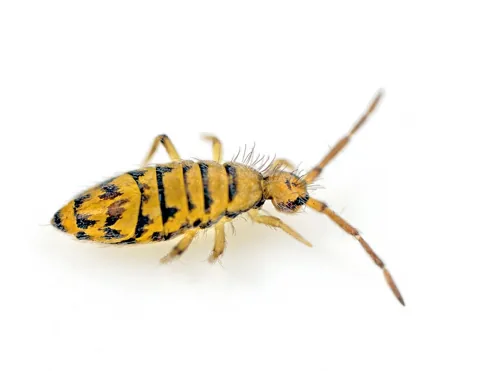 Springtail
Collembola (shown: Entomobrya sp.)
Springtails are tiny jumping creatures that sometimes appear in large numbers in moist spots indoors. They don't bite or sting and don't damage furniture or food; their presence indoors points to a moisture problem.
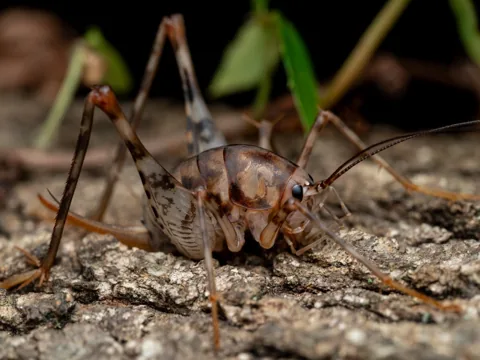 Camel Cricket
Rhaphidophoridae (shown: Tachycines asynamorus)
Camel crickets, also called cave crickets, are humpbacked, wingless crickets that live in cool, damp, dark places and often turn up in basements, crawl spaces and garages. They are a nuisance, not a danger.
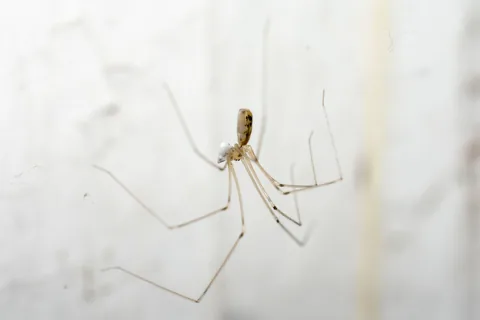 Longbodied Cellar Spider
Pholcus phalangioides
The longbodied cellar spider is the most common cellar spider in the United States: a small, pale spider with extremely long legs that lives in buildings all year. Penn State says it isn't known to be harmful in any way; its main offense is messy webbing.
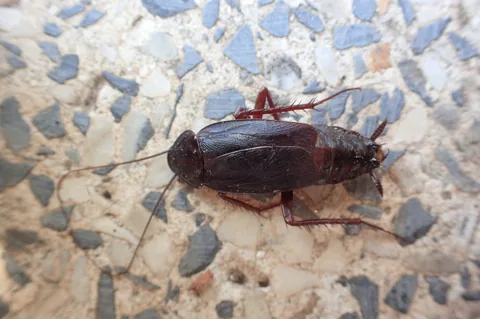 Oriental Cockroach
Blatta orientalis
The oriental cockroach, often called a water bug and sometimes a black beetle, lives in cool, dark, damp places such as basements, crawl spaces, drains and water meter boxes. It usually lives outdoors or in those damp spots and wanders into buildings at night, mostly staying at ground level.
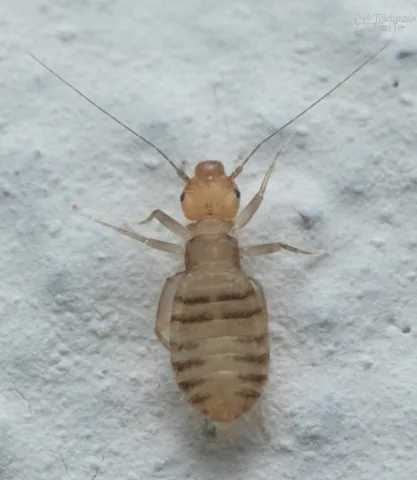 Booklice
Liposcelis species and other psocids (family Liposcelididae)
Booklice, also called psocids, are tiny insects that feed on mold and fungi. Finding them indoors usually means high humidity or a moisture problem, and drying things out is the most effective control.
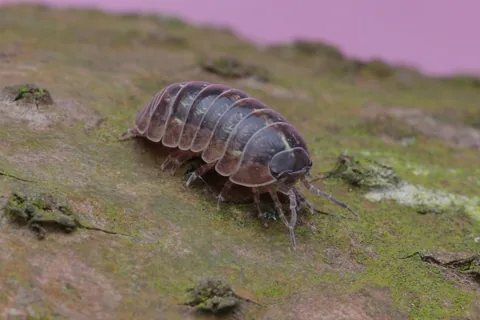 Common Pillbug
Armadillidium vulgare
Sowbugs and pillbugs are land-living crustaceans, more closely related to shrimp and crayfish than to insects, that feed mostly on decaying plant matter. They are harmless indoors, and finding many inside usually points to dampness, a large population outdoors or a gap at a door or window.
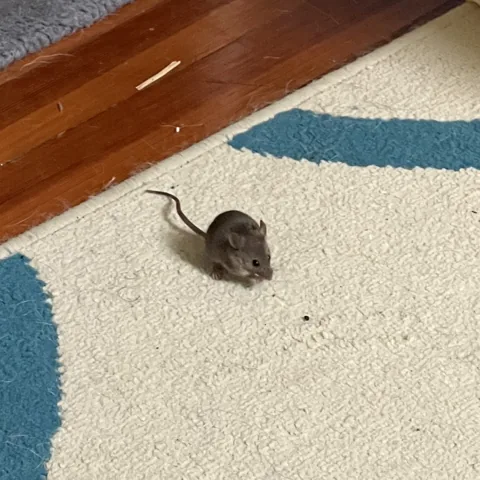 House Mouse
Mus musculus
The house mouse is a small, adaptable rodent that lives close to people in homes, schools and food businesses, eating and contaminating food, gnawing wiring and carrying disease.
Which bug is it? Match it, then go to its guide
The descriptions below are only enough to tell these pests apart. Each one has its own guide, linked at the bottom of this page, with the full identification and control steps.[1]
- House centipede: 1 to 1-1/2 inches long with 15 pairs of long legs, fast-moving. Penn State says it lives in dark, damp places such as floor drains and crawl spaces, and that it feeds on small arthropods, including pest insects, and is harmless. See the centipede and millipede guide.[1]
- Millipede: wormlike with many segments, usually dark brown and about an inch long. Millipedes live outdoors in damp leaf litter and mulch and show up in basements, window wells and garages, often after cooler weather or heavy rain. See the centipede and millipede guide.[2][3]
- Silverfish: shiny, silver or pearl gray, about 1/2 inch long. UC IPM says silverfish need a lot of moisture; NC State says they prefer cool, damp areas such as bathrooms, basements and bookshelves where rarely used items are stored. See the silverfish guide.[5][6]
- Springtail: about 1/16 inch long and jumps when disturbed. UC IPM says springtails gather around floor drains and in damp basements, crawl spaces and wall voids, and that their continued presence indoors is a sign of moisture. See the springtail guide.[7]
- Camel (cave) cricket: humpbacked, long-legged and wingless, which gives it a spider-like look. NC State says these crickets invade crawl spaces, basements and garages where moisture is a problem. See the cricket guide.[9][10]
- Spiders: UC IPM says the long-legged cellar spiders and the common house spider are among those often found indoors; the hobo spider of the Northwest builds webs in dark, moist areas including basements and window wells. Kentucky says brown recluses survive winters in unheated basements and are found along joists, sills and rafters and under rolled insulation. See the house spider and brown recluse guides.[11][12]
- Oriental cockroach: about an inch long, very dark brown to nearly black, sluggish. Penn State says it prefers dark, damp, cool places such as damp basements, floor drains and crawl spaces. See the American and Oriental cockroach guide.[14][13]
- Booklice: small, wingless insects that feed on mold and fungi on damp paper, books, boxes and wallpaper. Penn State calls them indicators of high humidity or moisture. See the booklice guide.[15]
- Pillbugs and sowbugs: gray to brown, 1/4 to 5/8 inch, with armor-like plates and seven pairs of legs. Clemson says they often turn up in damp basements, crawl spaces and ground floors. See the pillbug and sowbug guide.[17]
- Mice: CDC lists the basement or crawl space, floor drains and crawl space vents among the places to check for openings. See the guide to mice in the house.[18]
What the bugs are telling you about moisture
Several of these pests are close to a humidity meter on legs. UC IPM says springtails soon die after entering a home unless they find moisture. Penn State says springtails can keep a population going indoors in homes with high humidity and mold growth, more often in bathrooms and basements. Booklice feed on mold, and Minnesota Extension says they don't survive when humidity falls below 45% to 50%.[7][8][16]
Others are wandering in from damp soil outside. Kentucky says the need for moisture can drive pillbugs and sowbugs into crawl spaces, basements and ground floors, and that centipedes and millipedes are very sensitive to moisture loss. Penn State says Oriental cockroaches mostly live outdoors in warm weather, but in a drought they may move into buildings, apparently looking for higher humidity. NC State says camel crickets often become a problem during extremes of weather, either heavy rain or long hot, dry spells.[4][3][14][9]
Spiders and house centipedes are partly a sign of the other bugs. Penn State says house centipedes feed on other arthropods, and Kentucky says cobweb and cellar spiders prey on other pests. If you dry the basement out and the small insects decline, there's less for them to eat.[1][12]
How dry is dry enough?
A humidity meter (hygrometer) tells you where you stand; EPA notes they're small and sold at many hardware stores. Condensation on walls, floors or cold pipes is another sign the air is too humid.[19]
The targets differ a little by source:[19][21][15][16]
- EPA: keep indoor relative humidity below 60 percent, ideally between 30 and 50 percent.[19]
- Minnesota Extension (moisture in homes): moisture problems may occur when relative humidity is more than 50%; 25% in winter to 50% in summer is generally considered healthy for people and better for the house.[21]
- Penn State (booklice): less than 50% prevents mold growth and booklouse development.[15]
- Minnesota Extension (booklice): psocids don't survive when humidity falls below 45% to 50%.[16]
- UC IPM (silverfish): silverfish prefer 71° to 90°F and, at the higher temperatures, need relative humidity above 75%.[5]
Using a dehumidifier in a basement
Penn State recommends dehumidifiers against house centipedes and springtails, Minnesota Extension against camel crickets and booklice, and UC IPM and NC State against silverfish. UC IPM adds that ventilation from fans can bring humidity down to a level silverfish can't tolerate.[1][8][10][16][5][6]
- Size it to how damp the space is. ENERGY STAR measures capacity in pints of water removed per 24 hours and groups spaces as slightly to moderately damp (musty odor at times, 50 to 75% relative humidity), very damp (damp spots on walls and floors, 75 to 90%) and wet (walls or floor sweat or seepage present, 90 to 100%). It says it's better to oversize than undersize.[22]
- Skip the bucket. ENERGY STAR notes that some portable units take a hose that can drain to a floor drain or sump pump, so there's no need to empty the bucket.[22]
- Watch the temperature. In spaces that usually stay below 65°F, ENERGY STAR suggests a model rated for lower temperatures, because frost can form on the coils and the unit may cycle without removing moisture. If that happens, switch it off and let it defrost.[22]
- Don't air out a basement with humid summer air. Minnesota Extension says warm, humid outside air condenses on cool basement walls and floors, and that many homeowners mistake this condensation for leakage.[20]
- Treat the dehumidifier as a stopgap if water is coming in. Minnesota Extension warns that using one in a basement with moisture problems can draw moisture in faster through the concrete, causing efflorescence and spalling and further damage to finishes. Fix the water source as well.[20]
- Cut indoor moisture sources first. Minnesota Extension lists humidifiers, unvented clothes dryers, showers and cooking; EPA says to vent clothes dryers to the outside where possible and to insulate cold surfaces such as cold water pipes.[20][19]
Stop water at the foundation
Minnesota Extension notes that a 1-inch rain puts 1,250 gallons of water on the roof of a 2,000-square-foot house, and without grading, gutters and downspouts some of it ends up in the basement. Its recommendations:[20]
- Slope the soil away from the foundation at least 1 inch per foot for at least 6 feet.[20]
- Use at least one downspout per 50 feet of roof eave, with extensions that discharge water at least 4 feet from the wall.[20]
- Put an airtight cover on the sump, since the house can draw moist air in through cracks and an open sump pit.[20]
- Keep mulch, leaves and debris back from the house. NC State says to keep ground cover and mulch at least 12 inches from the foundation and to use gravel near the foundation where possible. Kentucky suggests checking crawl spaces, air conditioning units, hose bibs and sprinklers for leaks and standing water, and making sure gutters and downspouts work.[9][3]
- Dry anything that gets wet quickly. EPA says that in most cases mold won't grow if wet materials are dried within 24 to 48 hours.[19]
Seal the ways in
Penn State ranks cutting down hiding places as the second step against house centipedes, after reducing the other bugs they feed on. Sealing the same kinds of gaps also keeps out camel crickets, Oriental cockroaches and mice.[1][9][14][18]
- Floor drains and sumps: Penn State says house centipedes come up through floor drains without water traps, especially drains connected to dry sumps, and in through slab cracks and around sump openings. It recommends sealing sump covers with screen and caulk and putting screens in basement floor drains.[1]
- Slabs and block walls: fill or seal cracks and crevices in concrete slabs and block walls (Penn State).[1]
- Pipes, vents and doors: NC State recommends sealing around windows, doors, dryer vents and crawl space access doors and where plumbing and heating or cooling lines pass through the foundation, plus weather-stripping along the bottom of doors. Penn State's research summary says Oriental cockroaches often move into homes along plumbing from the crawl space below.[9][14]
- Small holes matter for mice. CDC says mice can fit through a hole the width of a pencil, 1/4 inch, and lists the basement or crawl space, floor drains and crawl space vents among the places to check.[18]
Storage, clutter and cleaning
Cardboard, paper and fabric stored on a damp floor feed and shelter several basement pests. Penn State lists cardboard boxes stored on slabs among the places house centipedes hide.[16][5][9][1]
- Get boxes off the floor. Minnesota Extension advises storing boxes, bags, books and papers off the floor to keep them away from dampness. NC State says camel crickets left unchecked can damage garments and linens packed in boxes in a basement.[16][9]
- Move stored paper now and then. UC IPM says collections of magazines, papers and books give silverfish food and shelter, and advises periodically cleaning out closets, cabinets and storage containers.[5]
- Vacuum webs. UC IPM says regular vacuuming or sweeping of basements and other seldom-used areas removes spiders and their webs, and to wear gloves when moving things in storage areas.[11]
- Look for mold. EPA's mold guide shows mold growing on a suitcase stored in a humid basement; booklice and springtails both feed where mold grows, and Penn State says any mold and mildew should be removed.[19][15][8]
Do you need to spray?
Usually not inside. Kentucky says most millipedes and centipedes die shortly after entering, so indoor pesticides are rarely necessary and changing conditions around the home works better. UC IPM says insecticides won't work on silverfish unless the moisture, food and hiding places are removed too.[3][5]
Where a treatment does make sense, it usually starts outside. NC State says chemical control of camel crickets should focus first on outdoor barrier treatments around foundation walls, vents, crawl space access and basement doors and windows. Clemson says a labeled pesticide can be applied to foundation walls, crawl spaces, unfinished basements and plant beds that border the house for pillbugs and sowbugs. For cockroaches, brown recluses and mice, the individual guides cover baits, dusts and traps.[9][17][12]
Common questions
- Why do I have so many bugs in my basement?
- Most basement bugs are drawn by cool, damp conditions, and many come in from damp soil, mulch and leaf litter next to the foundation. Kentucky says most millipedes and centipedes die soon after entering because of the lack of moisture, so steady numbers usually mean the basement is damp enough to support them.[3][4][9]
- Will a dehumidifier get rid of basement bugs?
- It helps with the moisture-loving ones. Extension sources recommend dehumidifiers for house centipedes, springtails, camel crickets, silverfish and booklice. Minnesota Extension cautions that it treats the humidity and odor, not the water coming in, so fix grading, gutters and downspouts too.[1][8][10][5][16][20]
- What humidity should a basement be?
- EPA says below 60 percent, ideally 30 to 50 percent. Penn State says under 50% prevents mold and booklouse development, and Minnesota Extension says moisture problems may occur above 50%.[19][15][21]
- Are house centipedes in the basement a bad sign?
- They're harmless, and Penn State says they feed on other small arthropods, including pest insects. They do point to damp conditions and other bugs to eat, so drying out the basement and sealing floor drains and cracks cuts their numbers.[1]
- What are the tiny jumping bugs near my basement floor drain?
- Probably springtails, which are about 1/16 inch long and jump when disturbed. UC IPM says they gather around floor drains and in damp basements, and that seeing them indoors over time is a sign of moisture.[7]
Photo credits
- House Centipede: Danijel Ostović, public domain (CC0), via iNaturalist
- Greenhouse Millipede: (c) capacoscar, some rights reserved (CC BY) — via iNaturalist, CC BY 4.0
- Silverfish: (c) Alexis Tinker-Tsavalas, some rights reserved (CC BY) — via iNaturalist, CC BY 4.0
- Springtail: AJ Cann, public domain (CC0), via iNaturalist
- Camel Cricket: (c) Zachary Dankowicz, some rights reserved (CC BY) — via iNaturalist, CC BY 4.0
- Longbodied Cellar Spider: (c) Kyle Elshoff, some rights reserved (CC BY) — via iNaturalist, CC BY 4.0
- Oriental Cockroach: (c) Jorge Íñiguez, some rights reserved (CC BY) — via iNaturalist, CC BY 4.0
- Booklice: (c) Luis Fernando Valdez Ojeda, some rights reserved (CC BY) — via iNaturalist, CC BY 4.0
- Common Pillbug: (c) Carlos Alexandre Mattos Raposo, some rights reserved (CC BY) — via iNaturalist, CC BY 4.0
- House Mouse: (c) Carrie Seltzer, some rights reserved (CC BY) — via iNaturalist, CC BY 4.0
Sources
- Penn State Extension, “House Centipedes.” extension.psu.edu/house-centipedes (accessed 2026-11-10)
- Penn State Extension, “Millipedes.” extension.psu.edu/millipedes (accessed 2026-11-10)
- University of Kentucky Entomology, “ENTFACT-645: Centipedes and Millipedes in and Around the Home.” entomology.mgcafe.uky.edu/ef645 (accessed 2026-11-10)
- University of Kentucky Entomology, “ENTFACT-439: Sowbugs and Pillbugs.” entomology.mgcafe.uky.edu/ef439 (accessed 2026-11-10)
- UC Statewide Integrated Pest Management Program, “Silverfish and Firebrats.” ipm.ucanr.edu/home-and-landscape/silverfish-and-firebrats/ (accessed 2026-11-10)
- NC State Extension, “Silverfish and Firebrats.” content.ces.ncsu.edu/silverfish-and-firebrats (accessed 2026-11-10)
- UC Statewide Integrated Pest Management Program, “Springtails.” ipm.ucanr.edu/home-and-landscape/springtails/ (accessed 2026-11-10)
- Penn State Extension, “Springtails.” extension.psu.edu/springtails (accessed 2026-11-10)
- NC State Extension, “Camel Crickets.” content.ces.ncsu.edu/camel-crickets (accessed 2026-11-10)
- University of Minnesota Extension, “Crickets.” extension.umn.edu/garden-and-home/home-maintenance/household-insects/crickets (accessed 2026-11-10)
- UC Statewide Integrated Pest Management Program, “Spiders.” ipm.ucanr.edu/home-and-landscape/spiders/ (accessed 2026-11-10)
- University of Kentucky Entomology, “ENTFACT-631: Brown Recluse Spider.” entomology.mgcafe.uky.edu/ef631 (accessed 2026-11-10)
- UC Statewide Integrated Pest Management Program, “Cockroaches.” ipm.ucanr.edu/home-and-landscape/cockroaches/ (accessed 2026-11-10)
- Penn State Extension, “Oriental Cockroaches.” extension.psu.edu/oriental-cockroaches (accessed 2026-11-10)
- Penn State Extension, “Booklice.” extension.psu.edu/booklice (accessed 2026-11-10)
- University of Minnesota Extension, “Booklice and barklice.” extension.umn.edu/garden-and-home/home-maintenance/household-insects/booklice-barklice (accessed 2026-11-10)
- Clemson Cooperative Extension Home and Garden Information Center, “Sowbugs and Pillbugs.” hgic.clemson.edu/factsheet/sowbugs-pillbugs/ (accessed 2026-11-10)
- Centers for Disease Control and Prevention, “Seal Up to Prevent Rodent Infestations.” www.cdc.gov/healthy-pets/rodent-control/seal-up.html (accessed 2026-11-10)
- U.S. Environmental Protection Agency, “A Brief Guide to Mold, Moisture and Your Home.” www.epa.gov/mold/brief-guide-mold-moisture-and-your-home (accessed 2026-11-10)
- University of Minnesota Extension, “Moisture in basements: causes and solutions.” extension.umn.edu/moisture-and-mold-indoors/moisture-basements-causes-and-solutions (accessed 2026-11-10)
- University of Minnesota Extension, “Controlling moisture problems in your home.” extension.umn.edu/garden-and-home/home-maintenance/caring-for-a-home/controlling-moisture-problems-in-your-home (accessed 2026-11-10)
- ENERGY STAR (U.S. Environmental Protection Agency), “Dehumidifiers.” www.energystar.gov/products/dehumidifiers (accessed 2026-11-10)