The short answer
- Check at night with a flashlight before treating anything. Pillbugs and sowbugs feed at night, and Clemson Extension suggests confirming they're the ones damaging plants before you reach for a pesticide.[3]
- Water less often, and water early in the day so the soil surface is dry by evening. Drip or furrow irrigation instead of sprinklers helps.[1][3]
- Pull compost and mulch back from seedlings and plants, and clear out excess mulch, grass clippings and leaf litter from the bed.[1][3][8]
- Raised beds or planting boxes and plastic mulch in place of organic mulch usually keep them from becoming a serious problem; UC IPM says black plastic may work better than white or clear.[1]
- If damage continues, some garden baits are labeled for sowbugs and pillbugs on vegetables and strawberries. Scatter them in the evening on moist soil, following the label.[3][5]
- Indoors, just sweep or vacuum them up. They dry out and die quickly inside; fixing damp spots and gaps around doors is what stops them.[2][3][8]
Pillbug and look-alike profiles
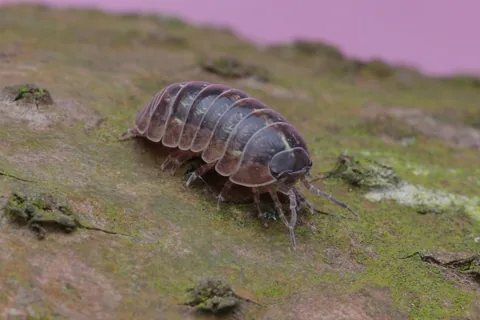 Common Pillbug
Armadillidium vulgare
Sowbugs and pillbugs are land-living crustaceans, more closely related to shrimp and crayfish than to insects, that feed mostly on decaying plant matter. They are harmless indoors, and finding many inside usually points to dampness, a large population outdoors or a gap at a door or window.
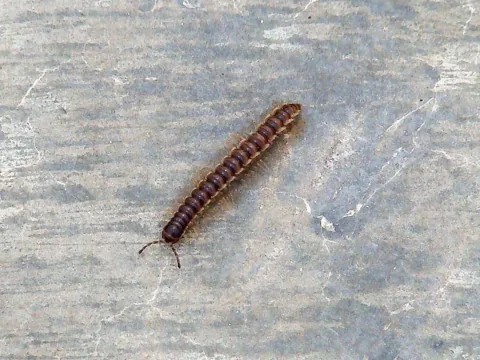 Greenhouse Millipede
Oxidus gracilis
Millipedes live in cool, damp places under leaves, mulch and stones; occasionally they migrate into buildings in large numbers but do no damage and soon die indoors. Clemson says the garden millipede (Oxidus gracilis) is the species that most often invades homes in large numbers.
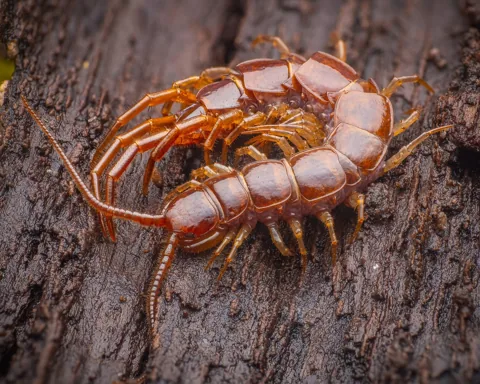 Outdoor centipedes (stone, soil and bark centipedes)
Class Chilopoda: stone centipedes (Lithobiomorpha), soil centipedes (Geophilomorpha) and large centipedes (Scolopendromorpha) (shown: brown centipede, Lithobius forficatus)
Besides the house centipede, homes get visits from outdoor species: the stone, soil and bark centipedes that hunt under rocks, mulch and logs. They wander in through cracks and gaps, especially in wet weather, but most die soon after because they dry out easily, so fixing moisture and entry points works better than spraying indoors.
Make sure it's pillbugs or sowbugs
Pillbugs and sowbugs aren't insects. They're land crustaceans (isopods), oval and armored, with seven pairs of legs; insects have three pairs, and centipedes and millipedes have many more. Pillbugs roll into a ball when disturbed. Sowbugs can't roll up and have two tail-like appendages (uropods) at the rear. Arkansas Extension describes the same split: sowbugs have the two tail-like appendages and can't roll into a tight ball, and pillbugs lack them and can.[1][2][3][8]
Adults are about 1/3 to 3/4 inch long by UC IPM's measure; Clemson Extension gives 1/4 to 5/8 inch. They're gray to brown, and one that has just molted can look bluish or purplish. Kentucky says they rarely reach more than ¾ inch (19 mm), and Arkansas Extension describes them as about 1/2 inch long and slate-gray.[1][3][2][8]
They don't bite or sting and are harmless to people and pets.[2][3]
Because they hide under mulch and boards all day, they're often blamed for damage done by other night feeders. Clemson Extension recommends going out at night to see whether they are actually eating the plants before using any chemical control. Slugs, snails, earwigs and cutworms are listed on the same garden bait labels and also feed mostly at night; our slug and earwig guides are linked below.[3][5]
- Long body with many segments and two (sometimes four) pairs of legs on each one: a millipede. UC IPM says most millipedes curl up when prodded or at rest, which can look like a rolled pillbug, but Penn State describes them as wormlike, and a pillbug has only seven pairs of legs. Our centipede and millipede guide covers both, plus pillbugs that wander indoors.[9][10][1]
What they damage: seedlings, strawberries and fruit on the soil
Their main food is decaying plant material, and they're useful decomposers. Kentucky says their chewing mouthparts tend to feed on plants only if the tissue is tender enough, which is why the damage shows up on seedlings and young plants. Arkansas Extension likewise says they feed mainly on decaying organic matter and only occasionally damage the roots of green plants.[1][2][8]
UC IPM lists seedlings, new roots, lower leaves and fruits or vegetables touching the soil as what they occasionally feed on. Clemson Extension says pillbugs have been documented damaging strawberries, tomatoes, cucumbers, lettuce and beans, and that they may feed on young shoots and their roots. Kentucky's houseplant fact sheet adds that they may attack rootlets and tender seedlings.[1][3][12]
Farm research shows the seedling problem grows where crop residue is left on the field. In southern Australia, the common pillbug (Armadillidium vulgare) is increasingly reported damaging emerging crop seedlings, which researchers link to farmers keeping crop stubble on the ground; in feeding trials it damaged a range of pulses, legumes, cereals and oilseeds. In parts of central Kansas, the same species has shifted from an occasional to a regular early-season pest of soybeans grown under conservation tillage.[6][7]
Cut back moisture, mulch and hiding places
Pillbugs and sowbugs need moisture to live and hide by day under dead leaves, mulch, grass clippings, rocks, boards and logs. Kentucky, Clemson and UC IPM all put taking away moisture and damp cover first. Arkansas Extension says mulches, grass clippings and leaf litter often provide the decaying organic matter they need, and that removing hiding places, food and moisture sources will reduce an infestation; Iowa State says persistent problems mean finding where they're coming from and eliminating or treating those spots.[2][3][4][1][8]
- Water less: reduce irrigation as far as the plants allow, and water early in the day so the surface dries by evening. Clemson Extension warns that overwatering creates the conditions they like.[1][3]
- Switch to drip or furrow irrigation instead of sprinklers where you can.[1]
- Keep compost and mulch back from plants, and remove excess mulch, grass clippings, leaf litter and other dead plant material from the bed.[1][3]
- Reduce decaying organic matter on the soil surface in general. Arkansas Extension suggests keeping piles of leaves, grass clippings and fallen fruit off the ground so they don't become moist shelter.[1][8]
- Grow susceptible crops in raised beds or planting boxes, and use plastic mulch instead of organic mulch around them. UC IPM says black plastic mulch may discourage them more than white or clear plastic.[1]
- Lift pots and planters so air can get under them, and move boards, stones and other damp objects that give them shelter.[3][2]
- Check drainage at the house. Kentucky says good drainage around the foundation is key to keeping those areas dry, and UC IPM says to keep irrigation water back from foundations, especially near entrances.[2][1]
Protecting seedlings and strawberries
UC IPM names seedlings and fruit or vegetables touching damp soil among the things pillbugs and sowbugs feed on, and its fixes for both come back to the same points: a drier soil surface, mulch kept away from the plants, and less decaying debris for them to live in.[1][2]
- Seedlings: keep organic mulch pulled back from young plants and water in the morning. If you use a labeled bait, the label for one iron phosphate and spinosad bait says to spread it around the base of the stem.[1][5]
- Strawberries: Clemson Extension lists strawberries among the fruits pillbugs damage. UC IPM says plastic mulch instead of organic mulch, raised beds and drip or furrow irrigation usually keep pillbugs and sowbugs from becoming serious problems, and that they chew fruit touching damp soil.[3][1]
- Strawberries are a listed use site on the iron phosphate and spinosad bait label checked for this guide, which bars use within 3 days of harvest.[5]
Baits
Clemson Extension says many common garden pesticides work on sowbugs and pillbugs, including sprays, baits and granular products, but that removing dead plant material and debris comes first.[3]
Some baits sold for slugs and snails also list sowbugs and pillbugs. The EPA-registered label checked for this guide is a granular bait with 0.97% iron phosphate and 0.07% spinosad; it lists sowbugs, pillbugs, earwigs, cutworms, crickets, some ants, slugs and snails, on vegetables, fruits, strawberries and other berries, ornamentals and lawns. Check that the product you buy names pillbugs or sowbugs on its label; a bait labeled only for slugs and snails isn't directions for these.[5]
- Timing: the label says evening is the best time to apply because the pests travel and feed mostly at night or early morning.[5]
- Soil: wet dry ground before applying; the bait works best on moist soil with little or no standing water.[5]
- Spreading: scatter the granules on the soil around the plants (the home-garden rate is 0.5 to 1 teaspoon per square yard), don't put them in piles, and treat the edges of the garden where pests move in from their daytime hiding places.[5]
- Limits: no more than 3 applications in any 30 day period, reapply after heavy rain or watering, and none within 3 days of harvest.[5]
- The same kind of bait is covered in our slug and snail guide, along with how iron phosphate baits work on slugs.[5]
Sprays around beds and the foundation
Outdoor insecticides are a second step, used where the pillbugs are living or as a barrier. Clemson Extension says an appropriately labeled pesticide can go on foundation walls, crawl spaces, unfinished basements and plant beds next to the house, and that permethrin and other contact insecticides have proven effective on plant beds and hiding areas. Kentucky Extension says perimeter applications of pyrethroids on the foundation in spring or fall can limit entry. Arkansas Extension says outdoor treatments are usually needed, aimed at and near foundation walls, around steps and damp areas around the house, with thorough treatment of cracks between sidewalks and the foundation; it says granules or dusts are also useful around foundations and crawl spaces.[3][2][8]
Water the treatment in. Clemson says applications to mulched areas should be made with just enough water for the insecticide to get through the mulch to the soil, and Iowa State says outdoor treatments must be applied with enough water to get the insecticide down to the soil surface. Kentucky Extension says to remove leaf litter first so the treatment reaches them.[3][4][2]
Spraying won't fix a moisture problem. Kentucky Extension says outdoor applications are unlikely to solve recurring problems unless the underlying moisture is dealt with. Our perimeter spray guide covers how to apply one safely.[2]
Pillbugs and sowbugs inside the house
Many indoors usually means a big population just outside, often after a long, wet spring, or damp spots and gaps around doors and windows. They can't survive long without high moisture and dry out and die quickly in a house. Arkansas Extension agrees that a heavy infestation indoors usually indicates a large population outdoors, and says they do no damage inside.[3][2][8]
Sweep or vacuum them, or carry them back outside. Fix damp basements and crawl spaces, improve ventilation, add weather stripping and door sweeps, seal cracks, and keep mulch, plants and irrigation water several inches back from the foundation. UC IPM also suggests dimmer, motion-activated or yellow outdoor lights instead of always-on lights, to draw fewer of them toward the house.[2][3][1][4]
Sources differ on indoor insecticides. Kentucky and Clemson Extension say indoor sprays are of little use or not recommended, since the pillbugs die from lack of moisture anyway; Iowa State says a light application of a residual indoor insecticide to cracks and corners may be of some benefit, and Arkansas Extension says indoor residual treatments may kill ones that wander in but that complete control is hard to get and treatments may not last more than one month. Our centipede and millipede guide covers indoor invaders in more detail.[2][3][4][8]
Pillbugs in potted plants and houseplants
Clemson Extension says pillbugs and sowbugs may establish populations in house plants, and its houseplant fact sheet says plants taken outdoors for the summer may come back with pillbugs in the root ball. They may cause minor feeding damage to roots and are usually found along the outside of the root ball in small cavities in the potting mix.[3][11]
- Slide the plant out of its container to check, and scrape any pillbugs off the root ball, as Clemson suggests.[11]
- Let the soil dry more between waterings. Kentucky says these animals need humid conditions to survive, and that allowing the soil to dry more thoroughly should solve the problem.[12]
- Our guides to houseplant pests and to bringing plants indoors cover the other pests that ride in on summered-outdoors plants.[11]
How long they live and how fast they build up
Females carry their eggs in a brood pouch under the body. UC IPM says the eggs hatch in about 1 month and the young stay in the pouch for about 2 weeks; young are pale and about 1/12 inch long when they leave, and they molt every 1 to 2 weeks for several months as they grow. Kentucky Extension says it takes about 2-3 months to reach adulthood.[1][2]
Sources give different numbers. Kentucky Extension gives about 1-2 broods a year with about two dozen offspring and a life span of about 3 years; UC IPM says adults can live 2 to 5 years. Arkansas Extension says there are often 7 to 200 eggs per brood, that the eggs hatch in three to seven weeks and the young stay in the pouch another six to seven weeks, that some species have only one brood a year while others have two or more, and that individuals may live up to three years.[2][1][8]
Removing crop residue isn't a guaranteed fix at farm scale. In a two-year Kansas soybean study, burning off corn residue didn't raise seedling emergence or reduce pillbug feeding damage, and pillbug numbers and residue weights had no consistent link to damage; the researchers discuss other factors, such as variable moisture levels, that may have affected the link between residue and live pillbug numbers. In a home garden, extension sources still put mulch and debris removal near susceptible plants first.[7][1][3]
Common questions
- Are pillbugs bad for my garden?
- Mostly no. They feed on decaying plant matter and help recycle it, but large numbers can chew seedlings, new roots and fruit or vegetables touching damp soil.[1][3][2][8]
- Do pillbugs eat strawberries?
- Yes. Clemson Extension lists strawberries among the fruits pillbugs damage, and UC IPM says they chew fruit that touches damp soil. Plastic mulch and drip irrigation help.[3][1]
- Should I remove mulch to get rid of pillbugs?
- Pull it back from seedlings and susceptible plants and clear out excess mulch and litter. UC IPM suggests plastic mulch, preferably black, where they're a recurring problem.[1][3]
- What bait kills pillbugs and sowbugs?
- Some granular garden baits list them on the label, such as baits combining iron phosphate and spinosad. Use one that names pillbugs or sowbugs, apply in the evening on moist soil, and follow the label limits.[5][3]
- What's the difference between a pillbug and a sowbug?
- Pillbugs roll into a ball. Sowbugs can't, and have two tail-like appendages at the rear.[1][2][3][8]
- Do I need to spray for roly-polies in the house?
- Usually not. They die quickly indoors from lack of moisture, so sweeping or vacuuming and fixing dampness and gaps is enough; Iowa State says a light crack-and-corner treatment may help some. Arkansas Extension adds that indoor treatments may not last more than a month.[2][3][4][8]
- Why are there pillbugs in my potted plant?
- Clemson says they may establish populations in house plants and can ride in on the root ball of a plant that spent the summer outdoors; slide the root ball out and scrape them off, and Kentucky says letting the soil dry more thoroughly should solve the problem.[11][12][3]
- How many babies do pillbugs have?
- Sources differ. Kentucky Extension gives about two dozen offspring with 1-2 broods a year; Arkansas Extension says a brood often holds 7 to 200 eggs, carried in a pouch under the female's body.[2][8]
Photo credits
- Common Pillbug: (c) Carlos Alexandre Mattos Raposo, some rights reserved (CC BY) — via iNaturalist, CC BY 4.0
- Greenhouse Millipede: (c) capacoscar, some rights reserved (CC BY) — via iNaturalist, CC BY 4.0
- Outdoor centipedes (stone, soil and bark centipedes): (c) Alexis Tinker-Tsavalas, some rights reserved (CC BY) — via iNaturalist, CC BY 4.0
Sources
- University of California Statewide IPM Program, “Pillbugs and Sowbugs (Home and Landscape).” ipm.ucanr.edu/PMG/GARDEN/FRUIT/PESTS/sowbugs.html (accessed 2026-11-11)
- University of Kentucky Entomology, “ENTFACT-439: Sowbugs and Pillbugs (aka Rolly-Pollies) (O. Katz, Z. DeVries, J. Larson; 2023).” entomology.mgcafe.uky.edu/ef439 (accessed 2026-11-11)
- Clemson Cooperative Extension Home & Garden Information Center, “HGIC 2444: Sowbugs & Pillbugs (revised 2026).” hgic.clemson.edu/factsheet/sowbugs-pillbugs/ (accessed 2026-11-11)
- Iowa State University Extension and Outreach, “Sowbugs and Pillbugs (Yard and Garden, 2016).” hortnews.extension.iastate.edu/sowbugs-and-pillbugs (accessed 2026-11-11)
- U.S. EPA Pesticide Product Label System, “Iron phosphate 0.97% and spinosad 0.07% insect, slug and snail bait label, EPA Reg. No. 67702-24 (EPA-stamped, Feb. 3, 2014).” www3.epa.gov/pesticides/chem_search/ppls/067702-00024-20140203.pdf (accessed 2026-11-11)
- Journal of Economic Entomology (PubMed 29045654), “Douglas J, Macfadyen S, Hoffmann A, Umina P. Crop seedling susceptibility to Armadillidium vulgare (Isopoda: Armadillidiidae) and Ommatoiulus moreletii (Diplopoda: Iulidae). J Econ Entomol 2017;110(6):2679-2685.” pubmed.ncbi.nlm.nih.gov/29045654/ (accessed 2026-11-11)
- Journal of Economic Entomology (PubMed 23156159), “Johnson WA, Alfaress S, Whitworth RJ, McCornack BP. Crop residue and residue management effects on Armadillidium vulgare (Isopoda: Armadillidiidae) populations and soybean stand densities. J Econ Entomol 2012;105(5):1629-1639.” pubmed.ncbi.nlm.nih.gov/23156159/ (accessed 2026-11-11)
- University of Arkansas Cooperative Extension Service, “Household Pest and Rodent Control, Classification 2 Training Manual (AG1156).” uaex.uada.edu/farm-ranch/pest-management/docs/training-manuals/AG1156.pdf (accessed 2026-11-11)
- University of California Statewide IPM Program, “Pest Notes: Centipedes and Millipedes (Publication 7472).” ipm.ucanr.edu/PMG/PESTNOTES/pn7472.html (accessed 2026-11-11)
- Penn State Extension, “Millipedes.” extension.psu.edu/millipedes (accessed 2026-11-11)
- Clemson Cooperative Extension Home & Garden Information Center, “HGIC: Common Houseplant Insects & Related Pests.” hgic.clemson.edu/factsheet/common-houseplant-insects-related-pests/ (accessed 2026-11-11)
- University of Kentucky Entomology, “ENTFACT-406: Houseplant Insect Control.” entomology.mgcafe.uky.edu/ef406 (accessed 2026-11-11)