The short answer
- Sweep up or vacuum the ones you find. Millipedes and most centipedes that wander in die soon from lack of moisture, so indoor spraying is rarely needed.[3][4][2]
- Lower the humidity in basements, crawl spaces and bathrooms with ventilation or a dehumidifier.[1][6]
- Pull mulch, leaves, grass clippings, boards, stones and firewood back from the foundation, and fix gutters, downspouts and leaks that keep the soil wet there.[3][4][6]
- Seal cracks in the foundation, gaps around pipes, and the bottoms of doors and basement windows; add door sweeps.[4][3]
- For house centipedes, put out sticky traps. They catch centipedes and show you which other insects they are feeding on, so you can deal with those too.[1][6][3]
- If invaders keep coming, a labeled insecticide applied outdoors around the foundation can cut down entry. It works best after the moisture and debris are dealt with.[6][4][5]
Centipedes, millipedes and pillbugs
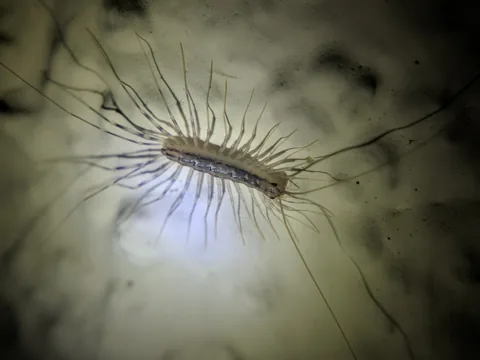 House Centipede
Scutigera coleoptrata
House centipedes are fast, long-legged predators that live in damp parts of buildings and feed on silverfish, cockroaches, carpet beetle larvae and other small arthropods; they are largely harmless.
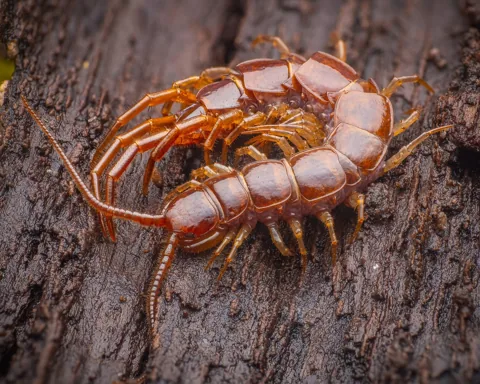 Outdoor centipedes (stone, soil and bark centipedes)
Class Chilopoda: stone centipedes (Lithobiomorpha), soil centipedes (Geophilomorpha) and large centipedes (Scolopendromorpha) (shown: brown centipede, Lithobius forficatus)
Besides the house centipede, homes get visits from outdoor species: the stone, soil and bark centipedes that hunt under rocks, mulch and logs. They wander in through cracks and gaps, especially in wet weather, but most die soon after because they dry out easily, so fixing moisture and entry points works better than spraying indoors.
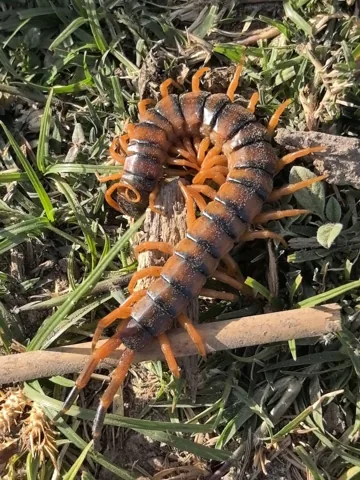 Giant desert centipede (giant redheaded centipede)
Scolopendra heros
The giant desert centipede, also called the giant redheaded centipede, is the largest centipede in North America. It is a fast, brightly colored predator that hides under rocks and wood by day and can give a painful, venomous bite if handled.
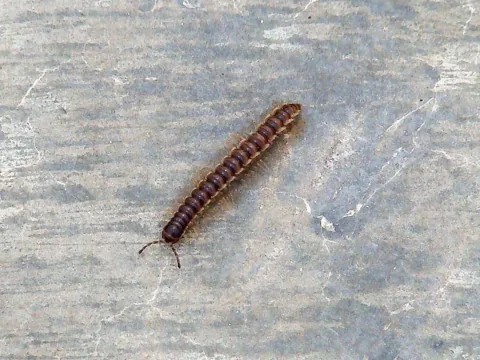 Greenhouse Millipede
Oxidus gracilis
Millipedes live in cool, damp places under leaves, mulch and stones; occasionally they migrate into buildings in large numbers but do no damage and soon die indoors. Clemson says the garden millipede (Oxidus gracilis) is the species that most often invades homes in large numbers.
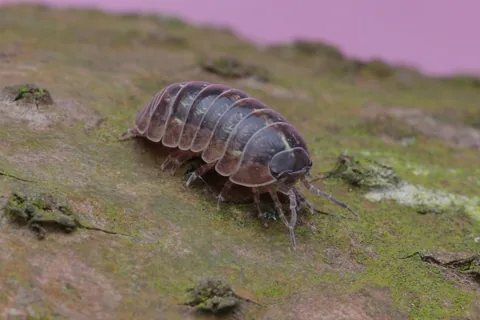 Common Pillbug
Armadillidium vulgare
Sowbugs and pillbugs are land-living crustaceans, more closely related to shrimp and crayfish than to insects, that feed mostly on decaying plant matter. They are harmless indoors, and finding many inside usually points to dampness, a large population outdoors or a gap at a door or window.
Centipede, millipede or pillbug?
Count the legs on one body segment. Centipedes have one pair per segment and millipedes have two, except on the first few segments. Pillbugs and sowbugs have only seven pairs of legs in all.[3][2][7][8]
- Centipedes: flattened bodies, long antennae, and fang-like front legs used to grab prey and inject venom. They run fast and never coil up when disturbed.[3][7]
- Millipedes: rounded, wormlike bodies, short elbowed antennae and many short legs that move in a wave. They are slow and usually curl up when touched or after they die.[3][7][2]
- Pillbugs and sowbugs: oval, armored, gray to brown crustaceans, not insects. Pillbugs roll into a ball; sowbugs have two small tail-like appendages and can't roll up.[5][8]
The house centipede
The house centipede (Scutigera coleoptrata) is the one most people find indoors. Penn State describes a body one to one and one-half inches long, dirty yellow with three dark stripes, and 15 pairs of long legs banded light and dark. With legs and antennae it looks three to four inches long.[1]
It is native to the Mediterranean region and now found across the United States. Unlike other centipedes, it can complete its life indoors, and Penn State notes it doesn't survive Pennsylvania winters outdoors but reproduces readily in heated buildings.[1][3][6]
House centipedes hide in dark, damp spots by day and hunt at night. Ohio State notes the legs come off easily when the centipede is struck and can keep wiggling for several minutes.[1][7][6]
- Where they hide: under concrete slabs (coming in through expansion cracks and around sump pump openings), inside block walls, in floor drains without water traps, under cardboard boxes stored on slabs, and in crawl spaces.[1]
- Where you see them: basements and bathrooms most often, though they can turn up in any room.[6][3]
- How many: females can live for several years and produce up to 150 young, according to Penn State.[1]
Why there are so many: they eat other pests
House centipedes are predators. Penn State lists silverfish, firebrats, carpet beetle larvae, cockroaches and spiders among their prey; Kentucky adds crickets and pillbugs or sowbugs, and UC IPM mentions flies. They don't damage plants or household items.[1][3][7]
Seeing many of them means something they eat is plentiful. Penn State calls cutting their food supply the first step in managing them, and Ohio State suggests sticky traps to find out which other arthropods are in the house.[1][6]
Do centipedes bite?
House centipedes pose very little bite risk. Kentucky's entomologists say their fangs are so small that they have trouble piercing human skin, and Wisconsin's horticulture program says bites are rare and not dangerous.[3][4][9]
Bigger outdoor centipedes can bite if handled. Ohio State says bites from species over two inches long are infrequent and usually cause short-lasting swelling or pain. UC IPM says a bite from a large centipede may cause local swelling, discoloration and numbness. For the large Scolopendra centipedes, Kentucky says the pain usually fades in 4 to 5 hours but the spot may stay irritated for several days, especially if it becomes infected.[6][7][4]
Other centipedes that wander in
Outdoor centipedes live under rocks, logs, leaf litter and mulch. Their bodies lose water easily, so they come indoors by accident, mostly after the spring warm-up and in fall, through expansion cracks, floor drains and gaps around plumbing. Most die quickly in a dry building.[6][3][4]
- Stone centipedes: brown, about an inch long, with 15 pairs of legs as adults; common under rocks.[6][3]
- Soil centipedes: very slender and blind, with 29 or more pairs of legs; usually turned up while digging.[6]
- Large centipedes (Scolopendromorpha): 21 to 23 pairs of legs, relatively rare in Ohio. Kentucky's eastern bark centipede reaches three inches, and Ohio State notes tropical species can top a foot. Don't pick these up.[6][3]
Millipede invasions after rain and in fall
Millipedes usually live unseen under leaves, mulch, compost, grass clippings and stones, eating decaying plant matter. Most that people see are dark brown and about an inch long.[2][3][7]
At times they leave in large numbers and turn up in window wells, basements, garages and on sidewalks and foundation walls. Penn State links these migrations to cooler weather, heavy rain and possibly mating; Kentucky says they often coincide with heavy rain but the cause is unclear; UC IPM says they move, often uphill, when food runs short or their habitat gets too wet or too dry, and some drown in swimming pools.[2][3][7]
They do no damage indoors. Millipedes don't live more than a few days inside and are often found dead in piles, so sweep or vacuum them up and close the gap they came through. UC IPM says invasions are usually over within a few days.[2][3][7]
- Handling: millipedes don't bite, but many release a smelly defensive fluid that can irritate skin, cause a burn-like reaction or hurt the eyes. Use a broom or gloves. Some give off hydrogen cyanide, though Kentucky says not enough to harm people.[7][3]
- Garden damage: in large numbers they may feed on sprouting seeds, seedlings and strawberries or other fruit lying on the ground.[7]
Control moisture and humidity
Kentucky calls cutting moisture and hiding places near the foundation the most effective long-term step, and notes that problems often line up with very wet weather and ease as things dry out.[4]
- Run a dehumidifier in the basement and ventilate basements and crawl spaces.[1][6][4]
- Keep gutters, downspouts and splash blocks working so water goes away from the foundation, and grade the soil to slope away from the house.[4][3][1]
- Repair leaking faucets, pipes and air-conditioning units, and adjust sprinklers so they don't leave puddles by the house.[4][3]
- In damp crawl spaces, Kentucky lists ventilation, sump pumps and polyethylene soil covers.[4]
- Water garden beds early in the day so the surface dries by evening, and keep irrigation water back from foundations and doorways.[8]
Clear mulch and debris near the foundation
Mulch, leaf litter and clutter against the house hold moisture and give centipedes, their prey and millipedes a place to live right at your door.[3][4]
- Remove leaves, grass clippings, heavy mulch, boards, stones, boxes and firewood from beside the foundation. Raise anything that has to stay there off the ground.[4][3]
- Ohio State suggests, where practical, keeping a strip three feet wide around the foundation clear of litter so the soil gets air and sun.[6]
- Watch landscape fabric and plastic under gravel or mulch. Penn State says millipedes thrive under it and insecticide can't get through it; removing it dries and warms the soil.[2]
- Kentucky notes that dethatching the lawn reduces shelter and food for millipedes.[3]
Seal the ways in
Centipedes and millipedes crawl in under doors and through small openings such as foundation cracks and gaps where pipes or wires enter. Kentucky counts sealing these as an effective way to keep both out.[4][3]
- Caulk cracks and openings in the foundation, and seal around pipes and wires where they pass through walls.[4][3][1]
- Fit tight door sweeps or thresholds on exterior doors and caulk along the bottom and sides of thresholds; weather-strip doors and windows.[4][3]
- Seal expansion joints where patios and sidewalks meet the foundation, and along the bottom of basement walls inside.[4][6]
- Seal sump pump covers with screen and caulk, and put screen over basement floor drains that connect to dry sumps.[1]
Sticky traps
Glue or sticky traps placed where you see activity catch house centipedes and can reduce their numbers. They also work as monitors: check what else is stuck on them to find the prey insects keeping the centipedes around.[3][9][1][6]
When an insecticide treatment helps
Usually it doesn't. UC IPM says pesticides are rarely justified for centipedes or millipedes, and Kentucky says spraying baseboards and living areas is of little use because the invaders die indoors anyway. Ohio State says indoor spot treatments are generally not needed and that foggers (total-release aerosols) don't work because they leave no residue and don't reach hiding spots.[7][4][6]
An outdoor perimeter treatment can help when invaders keep coming after you have fixed moisture and sealed gaps. Ohio State describes a band 18 to 36 inches wide around the foundation, notes granules often seem to last longer than sprays, and says to repeat only at the label's interval (14 to 28 days is common). Kentucky adds the bottoms of doors, crawl space entrances, vents, utility openings and the base of the wall, after raking back mulch.[6][4][3]
- Insecticides named by extension: pyrethroids such as cyfluthrin, deltamethrin, lambda-cyhalothrin, cypermethrin and permethrin for sprays; boric acid, diatomaceous earth or silica dusts for cracks, weep holes and voids.[1][4][3]
- Indoors, house centipede hiding places such as cracks in slabs and block walls, crawl spaces and voids are the places to treat, not open floors.[1][3][9]
- For millipedes over landscape plastic, treating the mulch won't work until the plastic is removed.[2]
- Read and follow the label for every product.[1][3]
Pillbugs and sowbugs
Pillbugs and sowbugs are land crustaceans that eat decaying plant matter and sometimes seedlings or fruit touching damp soil. Adults are about 1/3 to 3/4 inch long. They don't bite or sting.[8][5]
They need moisture and can hardly survive indoors, so finding many inside points to a damp spot or a gap at a door, window or seal. Sweep them up or carry them outside. Kentucky says a pyrethroid perimeter treatment in spring or fall can limit entry but won't fix repeat problems until the moisture is fixed.[5]
Common questions
- Should I kill house centipedes?
- They are harmless to people and eat other household pests, so many extension specialists see them as beneficial. If they bother you, sweep them up, use sticky traps, and reduce dampness and the insects they feed on.[1][9][7]
- Can a house centipede bite you?
- Rarely, and it isn't dangerous. Their fangs are so small they have trouble piercing skin. Larger outdoor centipedes can give a painful bite if handled.[3][4][9]
- Why are there hundreds of millipedes around my house?
- Millipedes sometimes migrate in large numbers, often in fall or after heavy rain. They die within days indoors and invasions usually end within a few days; sweep them up, seal gaps and dry out the area around the foundation.[2][3][7]
- Do bug bombs get rid of centipedes?
- No. Ohio State says total-release foggers leave no residue and rarely reach the cracks where centipedes hide.[6]
- Are millipedes poisonous?
- They don't bite, but many release a defensive fluid that can irritate skin or burn the eyes. Use a broom or gloves rather than bare hands.[7][3]
- Do I need to spray for pillbugs?
- Usually not. They die indoors without moisture. Fix damp spots, move mulch back from the foundation and seal gaps; an outdoor perimeter treatment helps only once the moisture problem is solved.[5][8]
Photo credits
- House Centipede: Danijel Ostović, public domain (CC0), via iNaturalist
- Outdoor centipedes (stone, soil and bark centipedes): (c) Alexis Tinker-Tsavalas, some rights reserved (CC BY) — via iNaturalist, CC BY 4.0
- Giant desert centipede (giant redheaded centipede): Sinaloa Silvestre, public domain (CC0), via iNaturalist
- Greenhouse Millipede: (c) capacoscar, some rights reserved (CC BY) — via iNaturalist, CC BY 4.0
- Common Pillbug: (c) Carlos Alexandre Mattos Raposo, some rights reserved (CC BY) — via iNaturalist, CC BY 4.0
Sources
- Penn State Extension, “House Centipedes.” extension.psu.edu/house-centipedes (accessed 2026-11-10)
- Penn State Extension, “Millipedes.” extension.psu.edu/millipedes (accessed 2026-11-10)
- University of Kentucky Entomology, “Centipedes and Millipedes in and Around the Home (ENTFACT-645).” entomology.mgcafe.uky.edu/ef645 (accessed 2026-11-10)
- University of Kentucky Entomology, “Centipedes (ENTFACT-647).” entomology.ca.uky.edu/ef647 (accessed 2026-11-10)
- University of Kentucky Entomology, “Sowbugs and Pillbugs (ENTFACT-439).” entomology.mgcafe.uky.edu/ef439 (accessed 2026-11-10)
- Ohio State University Extension (Ohioline), “Centipedes (ENT-50).” ohioline.osu.edu/factsheet/ENT-50 (accessed 2026-11-10)
- UC Statewide IPM Program, “Centipedes and Millipedes.” ipm.ucanr.edu/PMG/PESTNOTES/pn7472.html (accessed 2026-11-10)
- UC Statewide IPM Program, “Pillbugs and Sowbugs.” ipm.ucanr.edu/PMG/GARDEN/FRUIT/PESTS/sowbugs.html (accessed 2026-11-10)
- University of Wisconsin-Madison Extension, Wisconsin Horticulture, “Centipedes.” hort.extension.wisc.edu/articles/centipedes/ (accessed 2026-11-10)