The short answer
- Fuzzy gray flies resting on the walls near the sink or tub are drain flies. They breed in the slime inside drains, so the cure is scrubbing that film out, not spraying the flies.[1][2]
- A silvery, carrot-shaped insect stuck in the tub is a silverfish. It fell in and can't climb the slick sides; it did not come up the drain.[3][4]
- Tiny jumping specks around the sink or tub are springtails, and tiny pale crawlers on damp walls or paper are booklice. Both point to high moisture and mold and fade once the room dries out.[5][6][8]
- A large reddish-brown or nearly black cockroach near drains and pipes is usually an American or Oriental cockroach coming from damp spaces, basements, crawl spaces or sewers; a smaller tan one is the German cockroach, which lives indoors near plumbing.[10][11][13]
- A fast, many-legged house centipede is a predator that hunts other insects at night. It's harmless to people, but lots of them can mean lots of other bugs.[14][15]
- Ants at the sink or tub may only be after water, but large black or black-and-red carpenter ants coming out of walls near tubs or showers can mean wet, decaying wood.[16][17]
- For all of them, fix leaks, run the exhaust fan when showering, and keep humidity down. EPA advises keeping indoor humidity below 60%, ideally 30 to 50%.[19][4]
Bugs most often found in bathrooms
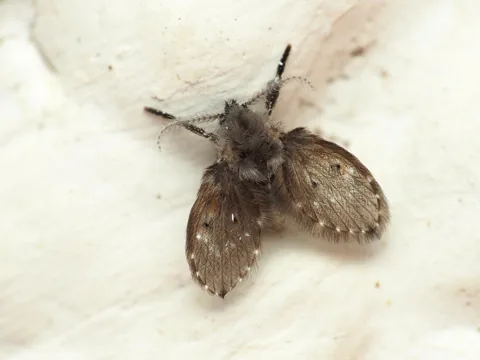 Drain Fly (Moth Fly)
Psychodidae (shown: Clogmia albipunctata)
Drain flies, also called moth flies or filter flies, are small, fuzzy, non-biting flies whose larvae live in the slimy film inside drains, toilets and other places where water stands.
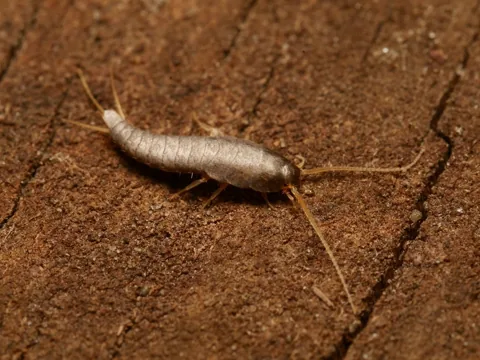 Silverfish
Lepisma saccharinum
Silverfish are nocturnal, wingless insects that hide by day and graze at night on paper, book bindings, starch in clothing and dry foods, preferring damp, warm places such as laundry rooms.
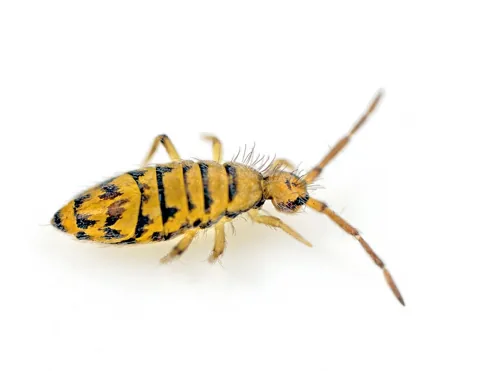 Springtail
Collembola (shown: Entomobrya sp.)
Springtails are tiny jumping creatures that sometimes appear in large numbers in moist spots indoors. They don't bite or sting and don't damage furniture or food; their presence indoors points to a moisture problem.
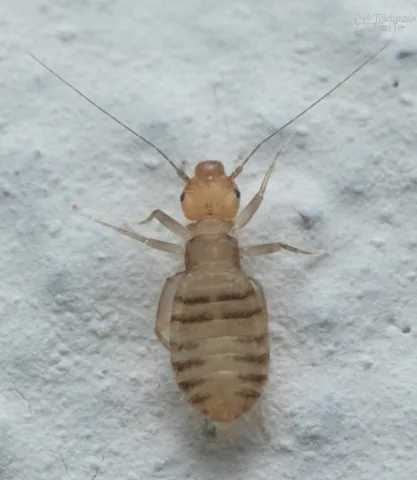 Booklice
Liposcelis species and other psocids (family Liposcelididae)
Booklice, also called psocids, are tiny insects that feed on mold and fungi. Finding them indoors usually means high humidity or a moisture problem, and drying things out is the most effective control.
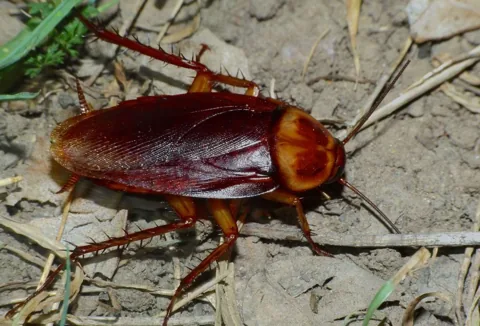 American Cockroach
Periplaneta americana
The American cockroach is the largest of the common pest cockroaches. It prefers warm, humid places and readily lives outdoors, in sewers, storm drains and water meter boxes, coming indoors to forage. Kentucky, Penn State and Minnesota all describe it as the largest cockroach commonly found in buildings.
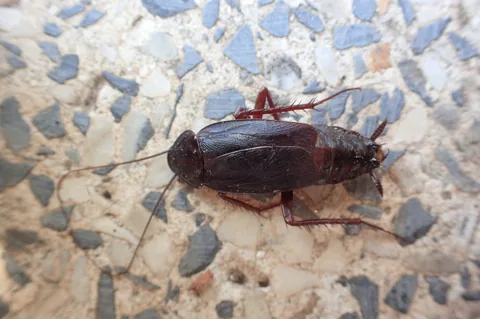 Oriental Cockroach
Blatta orientalis
The oriental cockroach, often called a water bug and sometimes a black beetle, lives in cool, dark, damp places such as basements, crawl spaces, drains and water meter boxes. It usually lives outdoors or in those damp spots and wanders into buildings at night, mostly staying at ground level.
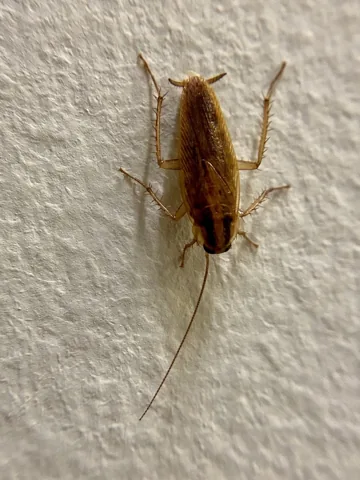 German Cockroach
Blattella germanica
The German cockroach is the most common cockroach living indoors in California and perhaps worldwide, especially in apartment buildings, and it has the fastest reproductive cycle of the common pest cockroaches. Penn State and Kentucky call it the most common cockroach in homes, apartments and other buildings, and Kentucky says it does not live outdoors.
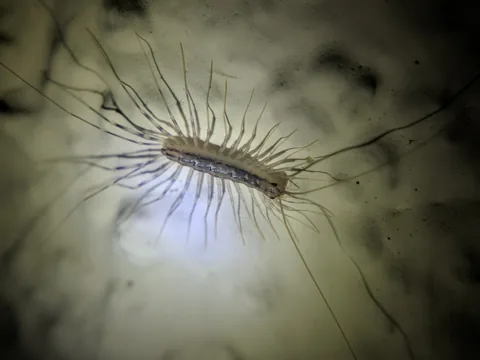 House Centipede
Scutigera coleoptrata
House centipedes are fast, long-legged predators that live in damp parts of buildings and feed on silverfish, cockroaches, carpet beetle larvae and other small arthropods; they are largely harmless.
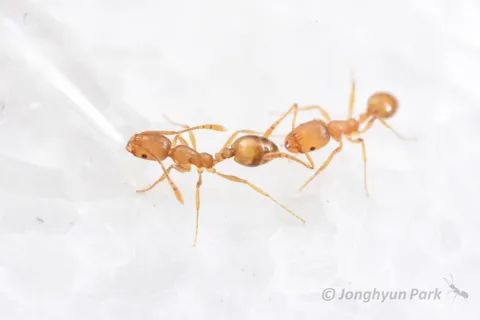 Pharaoh Ant
Monomorium pharaonis
The Pharaoh ant is a tiny, yellowish ant that nests inside heated buildings and is a serious pest in hospitals, apartments, hotels and food businesses. Texas A&M says it occurs throughout the United States but generally only in heated buildings, because it usually can't survive outdoors all year; it does nest outside in subtropical areas such as Hawaii, Florida and southern Texas.
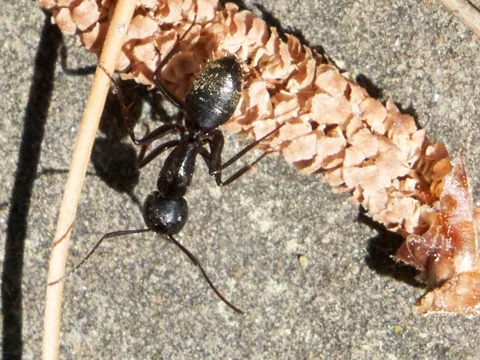 Carpenter Ants
Camponotus species
Carpenter ants don't eat wood the way termites do; they excavate it to nest, usually starting where wood is damp or decayed, and indoor nests are often satellites of a parent colony outdoors. Minnesota and Clemson extension both stress that they don't eat wood; they tunnel into it to make a nest.
Which bathroom bug is it?
Match what you see to the list, then go to that bug's own guide for control. Sizes are adult body length.[1][3]
- Drain flies (moth flies): small, gray to black, densely hairy flies, about 2 to 5 mm (1/16 to 1/5 inch), that hold their wings flat or roof-like and make short hopping flights. Swatted, they smear into a fine dust. Full guide: how to get rid of fruit flies and drain flies.[2][1]
- Silverfish: wingless, flattened and carrot-shaped, silver or gray, about 1/2 inch long (up to 3/4 inch), with two long antennae and three long tail-like appendages at the rear. Full guide: silverfish and firebrats.[3][4]
- Springtails: wingless, about 1/16 inch, whitish, bluish, gray or black, and they jump when disturbed. UC IPM notes they can appear in large numbers in sinks and bathtubs. Full guide: springtails.[5][7]
- Booklice (psocids): soft-bodied and wingless, about 1 to 2 mm, mostly tan but sometimes gray, brown or nearly clear. They feed on mold, so look on damp paper, books, wallpaper and other moldy surfaces. Full guide: booklice and psocids.[8][9]
- American cockroach: about 1½ inches long, reddish brown, with wings covering the abdomen. Oriental cockroach: about 1 inch, very dark brown to nearly black, often called a water bug. Full guide: American and Oriental cockroaches.[10][11][13]
- German cockroach: 1/2 to 5/8 inch, tan to light brown. Minnesota Extension calls it the most common indoor cockroach there and finds it near plumbing fixtures in kitchens and bathrooms. Full guide: German cockroaches.[12][13]
- House centipede: a body 1 to 1½ inches long with 15 pairs of long legs, so it looks 3 to 4 inches long overall. It hides in dark, damp spots by day and hunts at night. Full guide: centipedes and millipedes.[14][15]
- Ants: pharaoh ants are tiny, 1/16 to 1/12 inch, golden yellow to reddish brown; carpenter ants are much larger, black or black and red, with workers 3/16 to 1/2 inch. Full guides: ants in the house, pharaoh ants and carpenter ants.[16][18]
Did it come up the drain?
Only some of them did. Drain flies breed in the drain itself. Their larvae live in the thin film of slime and organic matter that builds up inside sink and floor drains and along the water line of toilets and tanks that rarely get used.[1][2]
Silverfish don't come up drains. UC IPM says they crawl along pipelines and through openings in walls and floors, and ones found in a tub or sink simply fell in and couldn't climb the slippery sides back out. Springtails end up in sinks and tubs the same way, crawling in search of moisture and getting trapped.[3][5]
Cockroaches are different: Penn State and Minnesota Extension list sewers and drains among the places American and Oriental cockroaches live, and Minnesota notes sewers and drain lines may help American cockroaches move into new areas. Penn State also lists floor drains without water traps among the places house centipedes turn up.[10][11][13][14]
Checking a drain for flies
If you see small fuzzy flies near one fixture, test the drains before cleaning everything. Kentucky's method is a clear plastic cup lightly coated inside with vegetable oil or petroleum jelly, turned upside down over the drain for several days. Texas A&M uses a strip of clear packing tape across the drain, leaving part of the opening uncovered so air can still move. Flies stuck to the cup or tape mark the breeding drain.[1][2]
Then clean that drain. Both universities say the slime has to be physically removed. Texas A&M says bleach and drain cleaner are largely ineffective and recommends scrubbing pipes and traps with a stiff brush, then flushing with hot to boiling water. Kentucky says hot water alone gives only short-term control because the larvae can trap air bubbles and survive under water for a day or more. Don't pour insecticide down the drain.[2][1]
A guest bathroom that sits unused is a classic source. Kentucky notes drain flies often show up after a vacation and usually disappear once water moves through the toilets and drain traps again; flies that keep coming for weeks mean a breeding site you still need to find. Texas A&M also describes drain products made to break down the film, which need repeat applications over several weeks; the fruit fly and drain fly guide covers those, and the small flies guide covers phorid flies and other sources.[1][2]
Fix the moisture and most of them leave
Springtails, booklice and silverfish all need damp conditions. Minnesota Extension calls springtails a sign of high moisture that ends when moisture levels drop, Penn State says lowering relative humidity below 50% prevents both mold and booklouse development, and NC State recommends drying humid rooms with a fan or dehumidifier and making sure bathroom ventilation fans work. The same changes take away the water cockroaches and centipedes look for.[6][8][4][13][14]
- Run the bathroom fan or open a window while showering, as EPA advises, and check that the fan actually works.[19][4]
- Keep indoor humidity below 60%, ideally between 30 and 50% (EPA). Condensation on windows, walls or pipes is a sign the air is too humid.[19]
- Fix dripping faucets and leaking pipes promptly. Minnesota lists plumbing leaks inside the home among the causes of springtail problems, and leaky pipes and faucets as something to repair for cockroaches.[6][13][19]
- Dry wet areas within 24 to 48 hours. EPA says most mold won't grow if damp materials are dried in that window.[19]
- Clean mold off hard surfaces with detergent and water and dry them. EPA says mold that keeps coming back in a shower usually responds to more ventilation and more frequent cleaning, and that routine bleach use isn't recommended. Don't caulk or paint over mold.[19]
- If you rent, report leaks and moisture problems to the building owner or manager right away, as EPA recommends.[19]
Seal the gaps around pipes
Cockroaches, ants and silverfish travel along plumbing. Minnesota Extension advises sealing spaces where plumbing passes through walls with steel wool or other rough material and fitting covers (escutcheon plates) where pipes enter the wall. Penn State's cockroach advice includes caulking under the sink, and UC IPM says silverfish move between floors along pipelines and through wall openings.[13][10][3]
When a bathroom bug points to a bigger problem
- Carpenter ants inside: their parent nests indoors are in moist or decayed wood from leaks, condensation or poor air circulation, including behind bathroom tiles and around tubs, sinks and showers. Workers out at night around the tub or toilet are worth a closer look at the wood nearby.[17][16]
- Booklice or springtails that keep coming back: moisture may be trapped inside a wall. Penn State notes that in new construction that didn't dry before drywall went up, holes may need to be cut so the wall void can dry.[8][7]
- Drain flies for weeks with no clear source: Kentucky treats that as a permanent breeding site that has to be found, including outdoor spots such as wet ground at air conditioner drains or clogged gutters if none are emerging inside.[1]
- German cockroaches live indoors near plumbing in kitchens as well as bathrooms, so treat the whole home. Penn State calls baiting an effective way to control them; see the German cockroach guide and the cockroach gel bait guide.[12][13]
- Pharaoh ants: Minnesota says they often seek water in kitchens and bathrooms, and Texas A&M warns that repellent sprays or dusts indoors typically make colonies split. Use the pharaoh ant guide rather than spraying.[16][18]
Common questions
- Why do I have bugs in my bathroom?
- Mostly for moisture. Springtails, booklice, silverfish, drain flies, cockroaches and house centipedes all favor damp places, and bathrooms supply water, humidity and mold. Lower the humidity and fix leaks first.[5][8][4][1][13][14]
- Are the silverfish in my tub coming up the drain?
- No. UC IPM says silverfish can't crawl up through the drain; they fall in while wandering and can't climb the slick sides out.[3]
- Will bleach get rid of drain flies?
- Not reliably. Texas A&M says chlorine bleach and drain cleaner are largely ineffective against the film the larvae live in; scrub the pipes and traps with a stiff brush, then flush with hot water.[2][1]
- Do bathroom bugs bite?
- Drain flies don't bite, and Penn State says booklice don't bite or carry disease and house centipedes are harmless to people. UC IPM notes some large centipedes can bite painfully when provoked.[1][8][14][15]
- What humidity keeps bathroom bugs away?
- EPA advises keeping indoor humidity below 60%, ideally 30 to 50%. Penn State says below 50% prevents mold and booklice.[19][8]
Photo credits
- Drain Fly (Moth Fly): (c) Katja Schulz, some rights reserved (CC BY) — via iNaturalist, CC BY 4.0
- Silverfish: (c) Alexis Tinker-Tsavalas, some rights reserved (CC BY) — via iNaturalist, CC BY 4.0
- Springtail: AJ Cann, public domain (CC0), via iNaturalist
- Booklice: (c) Luis Fernando Valdez Ojeda, some rights reserved (CC BY) — via iNaturalist, CC BY 4.0
- American Cockroach: (c) Steve Kerr, some rights reserved (CC BY) — via iNaturalist, CC BY 4.0
- Oriental Cockroach: (c) Jorge Íñiguez, some rights reserved (CC BY) — via iNaturalist, CC BY 4.0
- German Cockroach: (c) Sandra H Statner, some rights reserved (CC BY) — via iNaturalist, CC BY 4.0
- House Centipede: Danijel Ostović, public domain (CC0), via iNaturalist
- Pharaoh Ant: (c) Jonghyun Park, some rights reserved (CC BY) — via iNaturalist, CC BY 4.0
- Carpenter Ants: (c) Linda Watson, some rights reserved (CC BY) — via iNaturalist, CC BY 4.0
Sources
- University of Kentucky Entomology, “ENTFACT-615: Drain Flies or Moth Flies.” entomology.mgcafe.uky.edu/ef615 (accessed 2026-11-10)
- Texas A&M AgriLife Extension, “Indoor Flies and Their Control.” agrilifeextension.tamu.edu/library/insects/indoor-flies-and-their-control/ (accessed 2026-11-10)
- University of California Statewide IPM Program, “Pest Notes: Silverfish and Firebrats, Publication 7475 (December 2009).” ipm.ucanr.edu/legacy_assets/PDF/PESTNOTES/pnsilverfish.pdf (accessed 2026-11-10)
- NC State Extension, “Silverfish and Firebrats.” content.ces.ncsu.edu/silverfish-and-firebrats (accessed 2026-11-10)
- University of California Statewide IPM Program, “Pest Notes: Springtails (Home and Landscape).” ipm.ucanr.edu/home-and-landscape/springtails/ (accessed 2026-11-10)
- University of Minnesota Extension, “Springtails (household insects).” extension.umn.edu/household-insects/springtails (accessed 2026-11-10)
- Penn State Extension, “Springtails.” extension.psu.edu/springtails (accessed 2026-11-10)
- Penn State Extension, “Booklice (S. Jacobs; revised July 2024 by M. Skvarla).” extension.psu.edu/booklice (accessed 2026-11-10)
- Washington State University Pestsense, “Psocids (booklice or barklice).” pestsense.cahnrs.wsu.edu/fact-sheet/psocids-booklice-or-barklice/ (accessed 2026-11-10)
- Penn State Extension, “American Cockroaches.” extension.psu.edu/american-cockroaches (accessed 2026-11-10)
- Penn State Extension, “Oriental Cockroaches.” extension.psu.edu/oriental-cockroaches (accessed 2026-11-10)
- Penn State Extension, “German Cockroaches.” extension.psu.edu/german-cockroaches (accessed 2026-11-10)
- University of Minnesota Extension, “Cockroaches.” extension.umn.edu/insects-infest-homes/cockroaches (accessed 2026-11-10)
- Penn State Extension, “House Centipedes (reviewed 2023).” extension.psu.edu/house-centipedes (accessed 2026-11-10)
- UC Statewide IPM Program, “Centipedes and Millipedes.” ipm.ucanr.edu/PMG/PESTNOTES/pn7472.html (accessed 2026-11-10)
- University of Minnesota Extension, “Ants.” extension.umn.edu/insects-infest-homes/ants (accessed 2026-11-10)
- University of Minnesota Extension, “Carpenter ants (Hahn and Kells; reviewed 2024).” extension.umn.edu/insects-infest-homes/carpenter-ants (accessed 2026-11-10)
- Texas A&M Urban and Structural Entomology Program, “Pharaoh Ant, Monomorium pharaonis.” urbanentomology.tamu.edu/urban-pests/ants/pharoah/ (accessed 2026-11-10)
- U.S. Environmental Protection Agency, “A Brief Guide to Mold, Moisture and Your Home.” www.epa.gov/mold/brief-guide-mold-moisture-and-your-home (accessed 2026-11-10)