Moisture Indicator Paper & Fabric Destroyer DIY Very Effective

Silverfish

Lepisma saccharinum

One of the oldest insects on Earth โ€” they've existed for 400 million years. They're harmless to humans, but they'll destroy books, paper, clothing, wallpaper, and anything containing starch or cellulose. And their presence always signals high humidity.

Size1/2 โ€“ 3/4 inch, tapered
ColorSilvery-gray, metallic sheen
HumidityThrives above 75% RH
LifespanUp to 8 years
๐Ÿซž
Quick Reference Card
Silverfish โ€” Lepisma saccharinum
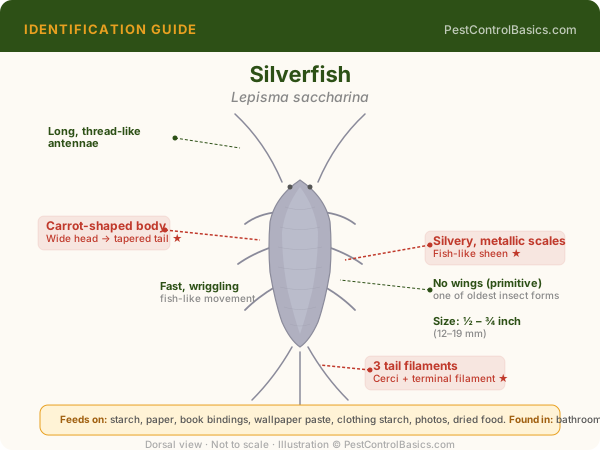
ShapeCarrot-shaped, tapers to 3 tail filaments
MovementWriggling fish-like motion โ€” very fast
Active WhenNighttime โ€” scatter when lights go on
Humidity NeedAbove 75% RH for reproduction
DamageBooks, photos, wallpaper, starched fabrics
Root CauseHigh humidity โ€” fix first
Best TreatmentDesiccant dust + dehumidifier
Health RiskNone โ€” not venomous or disease-carrying
๐Ÿ“ FIELD GUIDE ILLUSTRATION
Silverfish (Lepisma saccharina) identification illustration with labeled anatomical features โ€” PestControlBasics.com

Original illustration by PestControlBasics.com. Use anatomical labels above to confirm your identification.

Biology & Why They're In Your Home

Silverfish are a humidity alarm

Silverfish have survived unchanged for 400 million years โ€” predating dinosaurs โ€” because they are extraordinarily efficient at finding moisture and food. They require high humidity (above 75% relative humidity) to reproduce and thrive. Finding silverfish in your home is an immediate signal that humidity in that area is too high.

Common high-humidity areas: bathrooms, basements, crawlspaces, kitchen under-sink areas, attics with inadequate ventilation, and areas around water heaters. If you're seeing silverfish regularly, a moisture meter inspection of those areas is warranted.

๐Ÿ’ก Fix Humidity First โ€” Everything Else is Temporary

You can trap and poison silverfish indefinitely, but if the underlying humidity problem isn't addressed, they will continue to thrive and reproduce. A dehumidifier maintaining relative humidity below 50% makes the environment inhospitable for silverfish and dramatically accelerates any chemical treatment. This is the single most impactful silverfish control action you can take.

What They Eat โ€” Why They're Damaging

Silverfish eat anything containing polysaccharides (starch, cellulose, dextrin) and proteins. They cause significant damage to paper goods, books, and natural fabrics. They prefer items with adhesive containing starch โ€” old book bindings, envelope glue, wallpaper paste, and photo emulsions.

๐Ÿ“š
Books & Paper
Eat cellulose โ€” leave irregular holes and yellow stains on pages
๐Ÿ›
Photos & Art
Eat photo emulsion and print adhesives โ€” irreplaceable damage
๐Ÿ‘–
Natural Fabrics
Cotton, linen, silk โ€” especially starched clothing and bedding
๐ŸชŸ
Wallpaper & Glue
The adhesive paste behind wallpaper is prime silverfish food
Treatment Guide

Desiccant + dehumidifier = permanent control

Silverfish control has two components: reduce humidity to make the environment hostile, and apply desiccant dust in harborage areas to kill existing populations. Sprays and baits work but are secondary to these two core approaches.

๐ŸชŸ
Desiccant Dust โ€” Best Treatment
CimeXa Dust (Amorphous Silica Gel) in Wall Voids & Cracks
How it works: Physically destroys the silverfish's waxy cuticle through direct contact, causing death by dehydration. Apply a thin layer with a bulb duster in cracks, along baseboards, inside wall voids around pipes, behind bookcases, and in attic spaces. Lasts years undisturbed. Because silverfish travel along surfaces at night, any movement through treated areas is lethal. Also kills other moisture-loving insects in the same areas.
โ˜…โ˜…โ˜…โ˜…โ˜…
Best Method
๐Ÿ’ฆ
Environmental Control โ€” Most Important Step
Dehumidifier (Target: Below 50% RH)
How it works: Silverfish cannot reproduce when relative humidity drops below 50%. A dehumidifier running in a basement, bathroom, or crawlspace will make the environment genuinely inhospitable. Pair with adequate ventilation โ€” exhaust fans in bathrooms and kitchens, crawlspace vapor barriers, and HVAC maintenance. This single step, maintained consistently, resolves most silverfish problems without any chemical treatment at all.
โ˜…โ˜…โ˜…โ˜…โ˜…
Root Cause Fix
๐Ÿซž
Trap โ€” Monitoring & Population Reduction
Dekko Silverfish Paks (Boric Acid Bait Traps)
How it works: Small paper packets containing boric acid bait that silverfish consume. Place in bookcases, closets, file cabinets, dresser drawers โ€” anywhere silverfish forage. Silverfish eat the bait and die from boric acid toxicity. Excellent for protecting stored items in enclosed spaces where desiccant dust isn't practical. Replace every 3 months. Non-staining, odorless, effective in enclosed spaces.
โ˜…โ˜…โ˜…โ˜…โ’ธ
Good Supplement
Prevention & Protection

Protect what silverfish destroy

Store Valuables Properly

Books, photos, documents, and natural fiber clothing stored in areas with humidity fluctuations are at greatest risk. Store irreplaceable items in sealed hard plastic containers โ€” silverfish cannot penetrate hard plastic. Use acid-free archival boxes for photos and documents. Cedar blocks in closets repel silverfish from fabric storage areas (cedar oil is a natural deterrent).

Reduce Entry Points

Silverfish enter through gaps around pipes, under doors, and through vents. Seal baseboards in high-humidity rooms. Install tight-fitting door sweeps. Screen attic vents. Caulk around all plumbing penetrations in bathrooms and kitchens.

Reduce Food Sources

Remove old cardboard boxes, newspaper stacks, and unused paper goods from basements, attics, and closets. Silverfish populations are limited by their food supply โ€” reducing accessible starch and cellulose forces them to spread out or relocate. Use plastic bins for storage instead of cardboard boxes throughout the home.

๐Ÿซž Silverfish vs. Firebrats

Firebrats look nearly identical to silverfish but prefer hot, dry conditions rather than humid ones โ€” they're often found near furnaces, hot water pipes, and attics in summer. Firebrats are brownish-mottled rather than solid silver. Treatment is the same (desiccant dust) but the humidity solution differs โ€” firebrats don't require a dehumidifier, they require finding and reducing heat sources in affected areas.

DG
Derek Giordano
Certified Pest Control Operator ยท Former Business Owner
Derek ran his own pest control company in Florida for several years, servicing thousands of regular customers. All content is based on hands-on field experience and current EPA & university extension guidelines.

Related Resources

๐Ÿ“š Full Pest Library๐Ÿงช DIY vs. Pro Quiz๐Ÿ’ฐ Cost Guide๐ŸŒฟ IPM Guide๐Ÿ” Find a Pro
๐Ÿ”— Related Pests
Paper Silverfish Bed Bugs Carpet Beetle
Compare similar pests to confirm your identification. โ†’ Use our ID Flowchart
๐Ÿ”ฎ
Reviewed by Derek GiordanoContent on PestControlBasics.com is developed with input from certified pest management professionals and cross-referenced against EPA, CDC, and university extension guidance. Last reviewed: April 2026.
๐Ÿ“š Sources: EPA Termite Guide ยท NPMA Termite Info
Published: Jan 1, 2025 ยท Updated: Apr 7, 2026
๐Ÿ”— Deep-dive: Paper Silverfish โ€” The Library Pest
The silverfish that prefers paper, photos, and bookbindings โ€” archival damage and protection.
๐Ÿ”— Deep-dive: Centipede vs Silverfish โ€” Fast ID
Two long, scurrying basement pests confused at first glance โ€” visual ID and what their presence tells you about moisture.

Building a pest management calendar for residential properties

Most pest management problems become much easier to handle with a simple seasonal calendar mapping the high-leverage interventions to their optimal windows. A representative annual calendar for temperate-climate residential properties: February through March, conduct exterior exclusion audit and address gaps before spring pressure begins; March through April, schedule outdoor preventive treatment if appropriate (foundation perimeter, mosquito source reduction setup), inspect for early wasp nest construction; May through July, mosquito source reduction maintenance (weekly standing water check), tick prevention if regionally relevant; August through October, fall rodent exclusion check, schedule pest control inspection if on annual service, address overwintering pest entry points (occasional invaders); November through January, indoor monitoring (sticky traps for pantry pests and incidental species), assess prior year's pressure to plan next year's focus. A calendar entry per month, taking 15-30 minutes most months, produces dramatically better outcomes than reactive treatment after problems become visible.

Children, pets, and pesticide exposure: practical risk reduction

Pesticide safety guidance is often written for licensed applicators and translates awkwardly to households with children and pets. The practical residential framework: keep treated surfaces dry before re-entry (typically two to four hours for most water-based residuals, longer for solvent-based), keep pets away from treated zones until dry plus a buffer, store products in original containers in locked storage out of reach of children, never decant products into food or beverage containers (a documented cause of accidental poisonings), and rinse outdoor toys, dog beds, and similar items before re-introducing them to a treated yard area. The exposure routes that matter most are ingestion (children mouthing treated surfaces or contaminated items) and prolonged dermal contact (pets sleeping on freshly-treated carpet). Targeted application โ€” crack-and-crevice, bait stations, perimeter exterior โ€” produces far lower exposure than broadcast spraying, which is one of several reasons IPM-style targeted treatment has displaced broadcast approaches in residential settings.

Choosing a pest control company: questions worth asking

Pest control companies vary substantially in approach, training, and pricing, and the questions to ask before signing a contract often aren't the obvious ones. Worth asking: what's the technician's training and certification (state pest control certification is the floor; advanced training in IPM, structural inspection, or specific pest specialties is meaningful additional credentialing); what does the service include beyond visiting and spraying (inspection, monitoring, exclusion recommendations, follow-up scheduling); what guarantees apply if pests return between visits; what's the protocol for hard-to-resolve issues (some companies escalate to senior technicians or supervisors; others repeat the same approach); what active ingredients are used and whether the company will use specific products on request (homeowners with chemical sensitivities, pollinator gardens, or other concerns may want specific products); and what's the contract structure (per-visit, annual, multi-year). Worth less than expected: brand recognition and advertising spend (large national chains and small local operators both produce excellent and mediocre service); 'green' or 'organic' labels (which mean different things to different companies and often don't correspond to specific product or practice differences); price alone (typical pricing variance is modest, and the floor of cheap options often includes poor service).

When professional treatment is genuinely worth the cost

Professional pest control isn't always the right answer, but several specific situations genuinely justify the cost over DIY treatment. Severe bed bug infestations rarely yield to homeowner treatment because the required combination of vacuuming, encasements, structural treatment, and follow-up monitoring exceeds what most homeowners execute consistently. Subterranean termite treatment requires equipment (subslab injection) and product (commercial-grade termiticide quantities) not accessible to consumers, and inspection findings often dictate specific treatment that homeowners can't do safely. Roof and attic rodent problems benefit from professional exclusion that addresses access points consumers don't find. Mosquito reduction programs using barrier treatments and breeding-site management produce substantially better results than consumer foggers and yard sprays. Persistent cockroach problems in multi-unit buildings need coordination consumers can't provide. The pattern: professional treatment justifies itself when scale, access, regulatory product restrictions, or coordination requirements exceed what DIY can practically accomplish. Routine ant trails, occasional wasp nests, fruit fly outbreaks, and the like remain reasonable DIY targets where the cost-benefit math favors handling it yourself with the right products and information.

Integrated pest management for households: the practical hierarchy

Integrated pest management (IPM) is a structured approach to pest control developed for agricultural and commercial settings that translates well to residential use. The hierarchy: prevention first (sanitation, exclusion, habitat modification to make conditions unfavorable for pests), monitoring second (sticky monitors, visual inspection, identifying pests at low population before infestation establishes), targeted intervention third (using the least disruptive effective method against an identified pest in an identified location), and broad chemical treatment last (when targeted approaches have failed or aren't feasible). The hierarchy matters because higher-level interventions are durable and address root causes, while lower-level chemical interventions address symptoms and require repeat application. Most residential pest control reverses this hierarchy โ€” chemical treatment first, sometimes prevention later โ€” and produces the predictable consequence of recurring problems. Households that adopt the IPM hierarchy (often without using the term) generally describe spending less time and money on pest issues over years even though specific incidents might take more thought to address than spray-and-forget approaches.

Understanding pest forecast reports and what they signal

Pest forecast reports โ€” issued by some state agricultural agencies, cooperative extension services, and commercial pest control companies โ€” are an underutilized resource for homeowners who want to anticipate rather than react to seasonal pest activity. These reports typically combine historical pest data, current weather conditions, and growing degree day calculations to predict when specific pests will emerge or peak in specific regions. A tick forecast for an upcoming spring season, a mosquito pressure forecast after a wet winter, a termite swarm prediction for a specific week in the Southeast โ€” these aren't speculation but reasonably calibrated predictions based on biological timing. For homeowners, the value is in scheduling preventive treatment and personal protection to match the predicted high-pressure windows rather than reacting after problems have established. Subscribing to a regional pest newsletter from a cooperative extension service or state agriculture department is free or low cost and produces these forecasts during relevant seasons. The information is dramatically more actionable than generic pest control content because it's calibrated to your specific region and current conditions.

The role of inspection in long-term cost reduction

An inspection is the cheapest tool in pest management, and homeowners systematically underspend on it. The economics are unambiguous: an annual or semiannual inspection costs a small fraction of what any moderate treatment costs, and it catches problems while they're still cheap to address. Termite damage detected in its first season requires perimeter treatment; the same damage discovered three years later may require structural repairs running into five figures. Rodent activity detected through droppings before nesting establishes requires sealing and a few traps; the same activity discovered after a multi-generation infestation has set up in wall voids requires removal, exclusion, sanitation, and sometimes drywall work. The pattern repeats across nearly every pest category. Even households that don't engage a regular pest service should treat the annual inspection as a baseline expense โ€” equivalent to the way they probably treat HVAC tune-ups, gutter cleaning, or smoke detector battery changes. The marginal cost of one trained set of eyes on the property each year is one of the most defensible expenses in home maintenance.

Pest control and HOA dynamics: where they overlap

Homeowners' associations vary widely in how they engage with pest control, and the variations create practical issues that affect individual treatment decisions. Some HOAs maintain common-area pest treatment programs that handle perimeter spraying, mosquito treatment, or rodent monitoring on shared property; others leave all pest control to individual homeowners. Some have rules about treatment products or notification requirements; others don't. Some include treatment in the HOA fee structure; others bill separately. For homeowners in HOA communities dealing with persistent pest pressure, understanding what the HOA does and doesn't do is the first step in figuring out what additional individual action is needed. For HOAs without coordinated programs in areas with significant pressure, organizing a neighborhood-level treatment plan often produces dramatically better results than individual treatment efforts that don't coordinate timing or coverage. The conversations are sometimes politically awkward in HOA contexts, but the underlying problem โ€” that some pests are neighborhood-scale and unit-level treatment can't address them โ€” is structural rather than personal. Bringing the issue to an HOA meeting with concrete proposals tends to produce more constructive responses than complaint-style framing.

๐Ÿ—บ๏ธ US Distribution โ€” Silverfish

Common Occasional Not Present
States Present
51
Occasional
0
Primary Region
All 50 states (indoor pest)
๐Ÿ“Š Source: University extension services, USDA, CDC vector data, and published entomological surveys.