The short answer
- Cut the moisture: fix plumbing leaks, run a dehumidifier in damp basements and bathrooms, and use fans and working bathroom vents to dry the air.[1][2][3]
- Clear out old newspapers, magazines, books, boxes and stored fabrics, and keep what you store in sealed plastic bags or containers. Keep cereals, flour, pasta and pet food in airtight containers.[2][3][4]
- Vacuum regularly and seal cracks behind baseboards, around door and window trim, and where pipes pass through walls.[4][6]
- Put sticky traps where you see them or find damage. Traps show where the hot spots are and can control a small population.[2][3]
- For heavy infestations, apply a desiccant dust such as silica gel or diatomaceous earth, or a labeled crack-and-crevice spray, into hiding places. Don't use foggers.[1][4][2]
- Call a licensed pest control company if the problem persists or you can't find where they are coming from.[3][4]
Silverfish and look-alike profiles
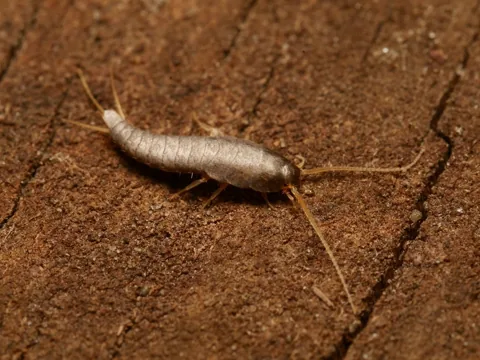 Silverfish
Lepisma saccharinum
Silverfish are nocturnal, wingless insects that hide by day and graze at night on paper, book bindings, starch in clothing and dry foods, preferring damp, warm places such as laundry rooms.
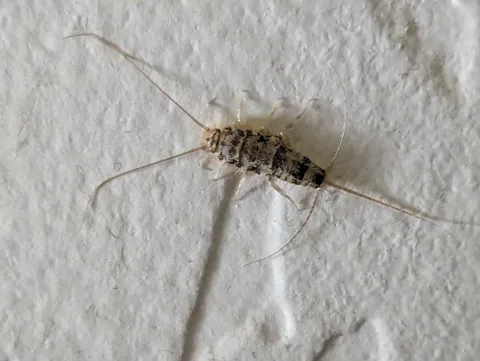 Firebrat
Thermobia domestica
Firebrats are close relatives of silverfish that thrive in very warm, dry spots such as around ovens, heaters, fireplaces and hot water pipes, grazing on paper, starch and dry foods.
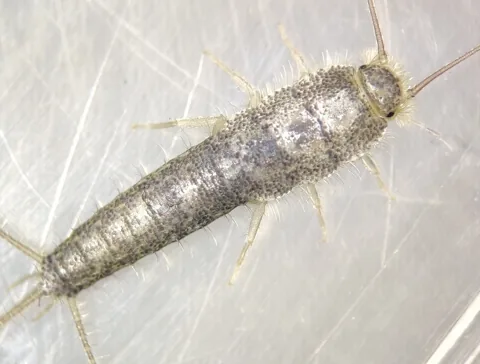 Long-tailed silverfish
Ctenolepisma longicaudatum
The long-tailed silverfish, Ctenolepisma longicaudatum, also called the gray silverfish or paperfish, is a large indoor silverfish that tolerates drier rooms than the common silverfish. It eats paper, book bindings, photos and cotton, and in recent years it has spread quickly in Europe, turning up in homes, museums and archives.
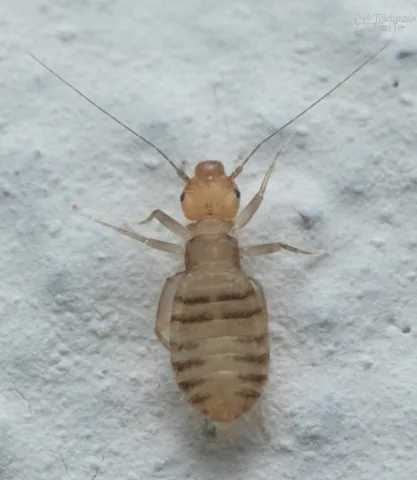 Booklice
Liposcelis species and other psocids (family Liposcelididae)
Booklice, also called psocids, are tiny insects that feed on mold and fungi. Finding them indoors usually means high humidity or a moisture problem, and drying things out is the most effective control.
Silverfish, firebrat or gray silverfish?
All three are flattened, carrot-shaped, wingless insects with two long antennae and three long tail-like appendages at the tip of the abdomen. They move fast and dart for cover when whatever they're hiding under is moved.[2][3][1]
Telling them apart matters mostly because each lives in a different part of the house, and that tells you where to look and what to fix. Our silverfish, firebrat and long-tailed silverfish profiles have more on each species.[2][1][9]
- Common silverfish (Lepisma saccharinum): shiny, silver or pearl gray, about 1/2 inch long and up to 3/4 inch. Lives in cool, damp places: bathrooms, basements, laundry rooms, and shelves where rarely used items are stored. UC IPM says it prefers 71 to 90°F and that at higher temperatures relative humidity must be above 75%.[1][2][3]
- Firebrat (Thermobia domestica): mottled gray or brown, about 1/2 inch long, with antennae longer than its body. Lives in hot places above 90°F: around ovens, furnaces, fireplaces, water heaters and hot water pipes, and in attics in summer. It tolerates relative humidity as low as 30%.[1][2][4][6]
- Gray or long-tailed silverfish (Ctenolepisma longicaudatum): a large species, 13 to 18 mm as an adult, comparable to an adult German cockroach. It survives and breeds at the humidity levels normal indoors, so it turns up in dry rooms as well as damp ones and spreads through a whole building.[7][9]
- Four-lined silverfish (Ctenolepisma lineata): Norwegian researchers group it with the gray silverfish as more drought tolerant and harder to eradicate than the common silverfish, because both tend to be spread through the whole building.[7]
- Booklice are often mistaken for young silverfish. They are much smaller, about 1/25 to 1/12 inch, and lack the three long bristles at the tail end. Small whitish insects in damp, moldy spots are more likely booklice.[5]
What they eat and the damage they cause
Silverfish and firebrats have gut enzymes that digest cellulose. They eat paper with glue or paste, the sizing in paper and wallpaper, book bindings, starch in clothing, and dry foods such as cereals, flour, pasta and pet food. Household dust, dead insects and some fungi also feed them, and they can go several months without food.[1]
Ohio State lists glue, wallpaper paste, photographs, cotton, linen, rayon, dried meats and leather among what they have been seen eating. Firebrats feed heavily on rayon, while silverfish usually damage it only slightly.[3][5]
Their jaws are weak, so they scrape at surfaces rather than bite. Damaged paper has notched edges, grazed areas or irregular holes. Wallpaper may have holes eaten through to reach the paste.[1][2][5]
They do little damage to a house itself. Ohio State calls them generally harmless, and UNL notes that they mostly upset people who are afraid of insects.[3][5]
- Look for scales, cast skins and fecal specks on or under damaged items. Scales on or beneath damaged material are a good sign silverfish or firebrats did it.[2][1]
- Look in bookcases, closet shelves, behind baseboards and window or door frames, and in attics and wall voids. They are active at night and hide during the day, so you may see the damage before the insects.[5][2][1]
- To test whether they are feeding in a spot, coat a 3x5 index card with flour-and-water paste, let it dry and leave it where you found damage. If they are nearby, they'll feed on it within a week and leave scraping marks and notched edges.[5]
- Silverfish found in a bathtub or sink didn't come up the drain. They fell in and can't climb the slippery sides.[1][3]
Step 1: Dry out the house
Moisture is the main thing to fix. Utah State's school IPM fact sheet calls silverfish and firebrats evidence of excessive moisture, and UC IPM says it is almost impossible to control large populations unless dripping water and moist surfaces are removed.[6][1]
UNL adds that moisture left unfixed can also lead to termites, carpenter ants and wood rot, so the work pays off twice.[5]
- Repair leaking plumbing, especially around sinks, laundry areas and roofs.[2][3][1]
- Run a dehumidifier in damp basements and in rooms that stay moist, such as bathrooms.[4][5][1]
- Use fans and ventilation, and make sure bathroom exhaust fans work. UC IPM says fans can lower humidity to a level silverfish can't tolerate.[1][2]
- Keep basements, laundry rooms and bathrooms clean and dry, especially shower stalls.[1]
- Lay plastic sheeting over the ground in dirt crawl spaces, and use ridge vents so humid attic air can escape.[4]
- Outside, keep gutters and downspouts clear and grade the soil so water drains away from the house.[4]
- Firebrats tolerate much drier air; Penn State says they are more resistant to dry conditions. For them, focus on hot spots such as the furnace room and water heater, and seal the openings around hot pipes, which they follow through walls and floors from one level to another.[1][4][3]
Step 2: Declutter and change how you store things
Stacks of paper and boxes are both food and shelter. NC State and Ohio State both recommend getting rid of old newspapers, magazines, books, boxes and fabrics, and spilled or long-stored food.[2][3]
Ohio State notes that sanitation alone won't wipe out an infestation, because the insects also live inside walls and insulation, but once you have them under control it helps keep them from coming back.[3]
- Store papers, photos, fabrics and other keepsakes in airtight plastic bags or sealable containers.[2][6]
- Keep cereals, flour, meal, pasta, pet food and pet treats in airtight containers.[4][1]
- Move books and magazines around on the shelf now and then, and clean out closets, cabinets and storage containers from time to time.[1]
- Vacuum carpets, floors, upholstered furniture and the lint in cracks regularly. Ohio State says infestations in carpets, often fed by cornstarch-based cosmetics or snack crumbs, are usually eliminated by frequent vacuuming and cleaning.[4][3][5]
- Check boxes that have been stored in damp basements or attics before bringing them into living areas. Silverfish often arrive in boxes, furniture, old books and papers.[5][3]
- To clean up infested books or similar items, UNL suggests sealing them in a plastic bag with a drying agent and freezing them for a week, which kills all life stages.[5]
- Mothballs may keep silverfish out of storage containers, but NC State warns they can damage some plastics, so read the label and open sealed boxes in a well-aired area.[2]
Step 3: Seal hiding places
Their flat bodies let them hide in very narrow cracks. Penn State says they reach wall interiors through gaps under and behind baseboards, around window and door trim, and through holes where pipes pass, and recommends caulk, spackle or expanding foam to close them.[4][2]
Sticky traps and jar traps
Because they are nocturnal, traps are the easiest way to find out where they are and how many you have. Use cockroach-type sticky traps, placed in corners and along edges where they forage and wherever you see damage.[1][2][5]
Traps can also give some control of small populations. They won't fix a large infestation: Norwegian researchers found sticky traps have only a limited, non-significant effect on the population density of the gray silverfish.[2][3][9]
- Jar trap: wrap the outside of a small glass jar with masking tape so they can climb up, and set it upright where you've seen them. They fall in and can't climb the slick inside. UNL says bait doesn't make the jars work better; they catch just as well empty.[1][5]
- Traps that catch the most mark the infestation hot spots, which is where to focus drying, cleaning and any treatment.[2][3]
- Trapping is pointless if the moisture problem stays, because more will keep moving to the damp area.[5]
Dusts, sprays and baits
Insecticides usually aren't needed. UC IPM says light infestations and an occasional insect can be handled by reducing water and physical control, and Ohio State says insecticides are generally not needed. Save them for heavy infestations, and expect them to fail unless the moisture, food and hiding places are dealt with too.[1][3][6]
A thorough treatment should show results in a few weeks. Ohio State says it may take 10 to 14 days, because insects in wall voids have to come out and contact the insecticide. UC IPM says if control hasn't happened in 2 or 3 weeks, they are probably coming from untreated hiding places.[3][1]
UC IPM suggests applying dusts with a bulb duster, powder blower or plastic squeeze bottle. Our insecticide dusts guide covers how to do that safely.[1]
- Desiccant dusts: diatomaceous earth and silica aerogel dry the insects out. Apply a fine layer into cracks, crevices and wall voids. A thick layer is too slippery to work. Penn State and UNL say diatomaceous earth must stay dry, while UNL says silica aerogel still works in damp conditions.[4][5][1]
- Dust products containing silica gel with synergized pyrethrin, and diatomaceous earth, stay effective indefinitely in dry spots, according to UC IPM. If they get wet and dry again they cake, and moist areas may need re-treating.[1]
- Boric acid: sources disagree. UC IPM says several boric acid dusts are ineffective against firebrats, while UNL lists borate-based dusts among products that kill these insects as long as they stay dry.[1][5]
- Where to dust: undisturbed areas such as attics, crawl spaces, basements, storage closets and wall voids, and other places people and pets don't reach. Wear a dust mask when applying.[2][5][6]
- Sprays: aerosol or liquid sprays with synergized pyrethrin or pyrethroids such as bifenthrin or cyfluthrin, directed in small amounts into cracks along baseboards, door and window casings, closets, bookcases and where pipes enter walls. Some sprays have oil bases that can start fires, so keep them away from electric motors and gas pilot flames, and out of sinks, drains, water and food.[1][4]
- Baits: UC IPM's 2009 guide says baits haven't worked well because silverfish and firebrats tend not to eat them. NC State says boric acid baits used in museums and preservation facilities work well in homes when used properly, and Norwegian trials found indoxacarb bait cut gray silverfish populations by more than 90% within 15 to 20 weeks; it also controlled the common silverfish.[1][2][7]
- Bait placement matters: in the Norwegian trials it worked best as many small droplets spread evenly along the edges of the treated area and left in place for a long time.[9]
- Foggers: not recommended. In attics the fog doesn't get under insulation, boxes and stored items where the insects live.[1][2]
- Gray silverfish: a 2021 European review found the standard silverfish strategy fails against it and suggests insecticidal baits complemented by dusts.[8]
- Read and follow all label directions, including where the product may and may not be used.[1][3][5]
When to call a pro
Ohio State recommends a licensed pest control operator when an infestation is persistent or the source is hard to find. A large infestation usually means a long-standing one, since their populations build slowly.[3]
Treating wall voids may mean drilling small holes to get dust inside, and some insecticides are restricted-use products that only a licensed applicator can apply.[3][2]
- You keep catching them on traps 2 to 3 weeks after a thorough treatment and moisture fix.[1]
- They are throughout the building, including dry rooms, which points to the gray silverfish. Researchers say baits only work well against it with trained placement and good knowledge of its habits.[9][8]
- Valuable books, documents or art are at risk. The gray silverfish is considered a serious problem in museums and libraries because it damages objects of historical value.[7][8]
Common questions
- What attracts silverfish to my house?
- Moisture, plus food and shelter: paper, book bindings, glue, starch, dry food and clutter. They also come in on boxes, furniture, old books and papers.[1][3][6]
- Are silverfish harmful?
- Ohio State calls them generally harmless. The damage is to paper, books, wallpaper, starched or cotton fabrics, and stored dry food.[3][1]
- Why are there silverfish in my bathtub?
- They wander in looking for moisture or fall in, then can't climb the slippery sides. They don't crawl up through the drain.[1][3]
- Does a dehumidifier get rid of silverfish?
- It helps a lot with the common silverfish, which needs high humidity. It won't do much against firebrats in hot spots or against the gray silverfish, which breeds at normal indoor humidity.[1][4][7]
- Does diatomaceous earth kill silverfish?
- Yes, as long as it stays dry. Apply a thin layer into cracks, crevices and wall voids. If it gets wet, it cakes and loses effect.[4][5][1]
- How long does it take to get rid of silverfish?
- A thorough treatment should show results within a few weeks; Ohio State says 10 to 14 days for insects to leave wall voids and contact insecticide. Bait trials against the gray silverfish took 15 to 20 weeks to cut populations by more than 90%.[1][3][7]
Photo credits
- Silverfish: (c) Alexis Tinker-Tsavalas, some rights reserved (CC BY) — via iNaturalist, CC BY 4.0
- Firebrat: (c) Rachel Stringham, some rights reserved (CC BY) — via iNaturalist, CC BY 4.0
- Long-tailed silverfish: (c) Thomas Gyselinck, some rights reserved (CC BY) — via iNaturalist, CC BY 4.0
- Booklice: (c) Luis Fernando Valdez Ojeda, some rights reserved (CC BY) — via iNaturalist, CC BY 4.0
Sources
- University of California Statewide IPM Program, “Pest Notes: Silverfish and Firebrats (Publication 7475).” ipm.ucanr.edu/legacy_assets/PDF/PESTNOTES/pnsilverfish.pdf (accessed 2026-11-10)
- NC State Extension, “Silverfish and Firebrats.” content.ces.ncsu.edu/silverfish-and-firebrats (accessed 2026-11-10)
- Ohio State University Extension (Ohioline), “Silverfish and Firebrats (ENT-64).” ohioline.osu.edu/factsheet/ENT-64 (accessed 2026-11-10)
- Penn State Extension, “Bristletails (Silverfish and Firebrats).” extension.psu.edu/bristletails-silverfish-and-firebrats (accessed 2026-11-10)
- University of Nebraska-Lincoln, hosted by Utah State University Extension, “IPM for Silverfish, Firebrats, and Booklice (school IPM manual, chapter 14).” extension.usu.edu/planthealth/structural-and-nuisance/files/pest-id-handbook/Silverfish_Firebrats_and_Booklice_2012_IPM_Manual.pdf (accessed 2026-11-10)
- Utah State University Extension, “Pest Press IPM Fact Sheet #20: Silverfish.” extension.usu.edu/planthealth/structural-and-nuisance/files/pest-press-fact-sheets/pdf/silverfish_pestpress.pdf (accessed 2026-11-10)
- Norwegian Institute of Public Health (MDPI Insects), “Development of a Poisoned Bait Strategy against the Silverfish Ctenolepisma longicaudata (Aak et al., Insects 2020).” doi.org/10.3390/insects11120852 (accessed 2026-11-10)
- MDPI Insects, “Ctenolepisma longicaudatum in Europe (Kulma et al., Insects 2021).” doi.org/10.3390/insects12090810 (accessed 2026-11-10)
- PLOS ONE, “Spatiotemporal elements in a poisoned bait strategy against the long-tailed silverfish (Rukke et al., PLoS One 2021).” doi.org/10.1371/journal.pone.0260536 (accessed 2026-11-10)