On this page
How to identify it
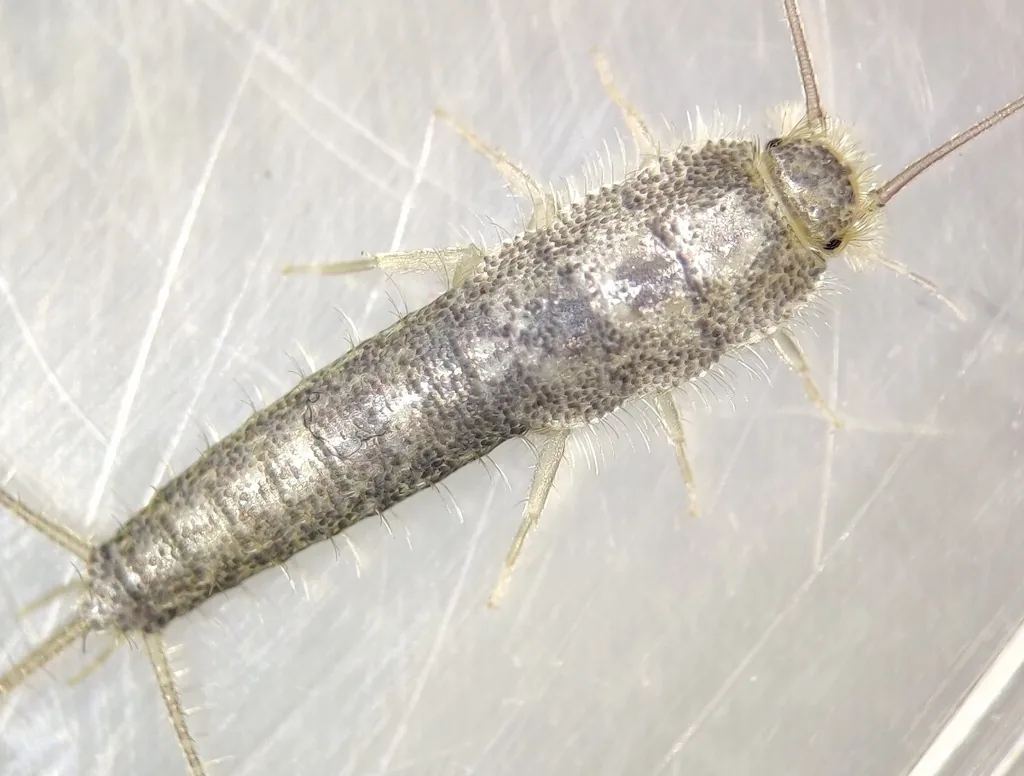
- It is large for a silverfish. Adults reach 13 to 18 mm (about 1/2 to 3/4 inch), comparable to an adult German cockroach.[2][4]
- It has long antennae and long tail filaments. Other common names for it are gray silverfish, giant silverfish and paperfish.[1][4]
- Specialists separate it from other indoor silverfish by its size plus microscopic features: feathered bristles, and combs of bristles on the upper plates of the abdomen, three pairs on segments II to VI and two pairs on segments VII to IX.[4]
- The smallest nymphs, in the first three stages, have no scales. Scales appear from the fourth stage on.[2][3]
Look-alikes
| Look-alike | How to tell them apart |
|---|---|
| Common silverfish (Lepisma saccharinum) | The common silverfish typically lives in very humid places. The long-tailed silverfish spreads more evenly through a building, in dry rooms as well as humid ones, and its adults are larger, up to 18 mm.[3][4] |
| Firebrat (Thermobia domestica) | Firebrats typically live in hot places. The long-tailed silverfish turns up in dry and humid rooms throughout a building.[3] |
Where it lives
Its native range is uncertain. It was described in 1905 from specimens collected in South Africa, has long been a pest in Australia, and is now an indoor pest on most continents. A 2021 review found it in most European countries, as far north as Scandinavia, with records rising sharply over the preceding decade; the first populations in the United Kingdom and Ireland had been found only recently.[1][5][2]
Biology and life cycle
It is active at night. By day it hides in cracks and crevices, often in loose, partly hidden groups. It feeds on paper, pictures, old books, plant-based cloth and protein-rich foods such as dried meat and dead insects.[3]
It develops slowly, through 13 immature stages. Development takes one and a half to two years at 22 degrees C (about 72 degrees F) and can take up to three years. Adults keep molting and may live up to seven years.[2][1]
It survives long periods without food and tolerates low indoor humidity and temperatures. European studies found it particularly troublesome in modern buildings, where it can reach high densities and spread between rooms and apartments, and researchers suggest insulation and central heating help explain its spread into northern Europe.[1][2]
It spreads through a building as the small nymphs move about, as adults disperse, and by hitchhiking on objects. It has likely been carried between countries many times in international trade goods.[3][2]
In Czechia, the United Kingdom and Ireland, homes were the most common place it was found. It also turned up in hotels and other accommodation, warehouses, factories, public institutions, shopping malls, archives, museums and art galleries.[1]
Damage and signs
- It feeds on paper, book bindings, books, wallpaper, papier-mache, photographs and other plant-based materials containing cellulose and starch, and it can damage fabrics, especially cotton.[1]
- Museums and galleries list it as a pest because it can damage paintings, books and documents. In homes it does no structural damage to the building and is mainly a nuisance, though objects of value can be at risk.[1][2]
- High numbers of these large, fast-moving insects cause distress for many homeowners.[2]
Health risk
No direct transmission of disease from this silverfish to people has been recorded. Researchers note that crawling insects, silverfish included, are sources of inhaled allergens, that bacteria and fungal spores have been found on this species, and that the main allergen of the common silverfish is probably present in other silverfish. Whether it contaminates food has not been shown.[1]
Control
Prevention
Keeping rooms dry, the usual silverfish advice, was designed for the common silverfish and is unlikely to be enough for this species, which tolerates dry conditions. Handling incoming materials carefully and getting rid of packaging quickly can reduce the risk of bringing it in.[1]
Traps and physical control
Sticky traps are used to monitor infestations, but they have little effect on the number of silverfish in a well-established population.[3][1]
Pesticides
A 2021 European review found that the standard silverfish control strategy fails against this species, and the researchers consider insecticidal baits, complemented by insecticide dusts, the most promising approach. In Norwegian field trials, bait containing indoxacarb cut populations by more than 90 percent within 15 to 20 weeks and outperformed both mass trapping with sticky traps and a permethrin spray in apartments; bait with clothianidin worked about as well.[1][2]
Bait worked best as many small droplets spread evenly along all the edges of the treated area rather than in a few clusters, left in place for a long time, and combined with removing other food sources.[3]
When to call a professional
Researchers stress that proper training in bait placement and good knowledge of the species' habits are needed for baits to work as well as commonly used sprays.[1]
Common questions
- How can I tell a long-tailed silverfish from a common silverfish?
- Look at size and location. Adult long-tailed silverfish reach 13 to 18 mm, about the size of an adult German cockroach, and turn up in dry rooms as well as humid ones, while the common silverfish typically lives in very humid places. Microscopic bristle patterns confirm the identification.[2][3][4]
- Will a dehumidifier get rid of long-tailed silverfish?
- Probably not on its own. Keeping humidity low was designed as a measure against the common silverfish, and the long-tailed silverfish tolerates low indoor humidity.[1]
- Why are baits recommended over sprays?
- In Norwegian field trials, small amounts of bait cleared infestations and beat both sticky-trap mass trapping and a conventional spray treatment. The researchers also note that heavy pesticide use indoors is undesirable from a health perspective.[2]
Sources
- Insects (MDPI), full text in PubMed Central (PMC8471186), “Kulma, Bubova, Davies, Boiocchi et al. Ctenolepisma longicaudatum Escherich (1905) Became a Common Pest in Europe: Case Studies from Czechia and the United Kingdom. Insects 12: 810 (2021), doi:10.3390/insects12090810.” doi.org/10.3390/insects12090810 (accessed 2026-11-09)
- Insects (MDPI), full text in PubMed Central (PMC7760683), “Aak, Hage, Lindstedt and Rukke. Development of a Poisoned Bait Strategy against the Silverfish Ctenolepisma longicaudata (Escherich, 1905). Insects 11: 852 (2020), doi:10.3390/insects11120852.” doi.org/10.3390/insects11120852 (accessed 2026-11-09)
- PLoS ONE (Public Library of Science), full text in PubMed Central (PMC8629293), “Rukke, Hage and Aak. Spatiotemporal Elements in a Poisoned Bait Strategy against the Long-Tailed Silverfish (Lepismatidae: Zygentoma). PLoS ONE 16: e0260536 (2021), doi:10.1371/journal.pone.0260536.” doi.org/10.1371/journal.pone.0260536 (accessed 2026-11-09)
- Biodiversity Data Journal (Pensoft), full text in PubMed Central (PMC7858561), “Sammet, Martin, Keskula and Kurina. An Update to the Distribution of Invasive Ctenolepisma longicaudatum Escherich in Northern Europe, with an Overview of Other Records of Estonian Synanthropic Bristletails (Insecta: Zygentoma). Biodiversity Data Journal 9: e61848 (2021), doi:10.3897/BDJ.9.e61848.” doi.org/10.3897/BDJ.9.e61848 (accessed 2026-11-09)
- International Biodeterioration and Biodegradation (Elsevier), full text in PubMed Central (PMC9759304), “Brimblecombe and Querner. Silverfish (Zygentoma) in Austrian Museums before and during COVID-19 Lockdown. International Biodeterioration and Biodegradation 164: 105296 (2021), doi:10.1016/j.ibiod.2021.105296.” doi.org/10.1016/j.ibiod.2021.105296 (accessed 2026-11-09)
- iNaturalist, “Ctenolepisma longicaudatum taxon page (order and family).” www.inaturalist.org/taxa/546132 (accessed 2026-11-09)