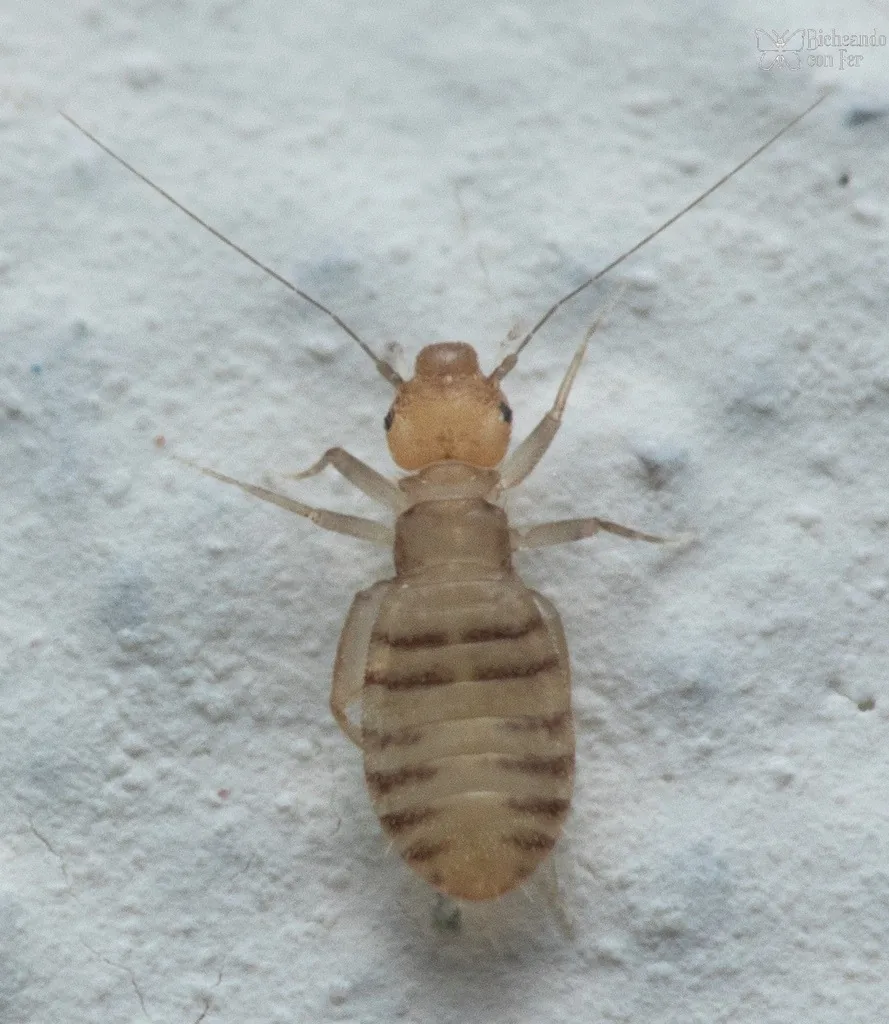
How to identify it
- Indoor booklice are about 1 to 2 millimeters long, soft-bodied and wingless, roughly the size of a newly hatched bed bug.[1][3]
- Most are pale cream to tan or gray; some are orange-brown or nearly clear, especially the young.[1][2]
- They are flattened, with a broad head and a large, nose-like front plate; the head is nearly as wide as the body.[1]
- Despite the name, psocids are not lice and don't bite people or pets.[2][3]
Look-alikes
Where it lives
Booklice occur worldwide and are widely distributed throughout the United States.[1][3]
Biology and life cycle
Indoors they live in humid, damp, dark places, where they feed on mold growing on paper, book bindings, wallpaper, flour and stored grain.[1][3]
They do best at 75 to 82 degrees F and 75 to 90 percent relative humidity, and they can die within weeks if humidity stays low.[3]
In warm months a female lays about 60 eggs, and egg to adult can take less than a month; in cool conditions it can take over three months.[1]
Young booklice look like small adults, and under favorable conditions there can be more than six generations a year.[1][2]
Large numbers sometimes build up in new buildings, where fresh plaster and drywall still hold moisture that supports mold.[3][1]
Damage and signs
- Booklice feed on mold rather than the paper itself; Penn State notes they don't directly damage paper or fabric the way silverfish can.[1]
- Clemson notes that damp books can be harmed when booklice feed on moldy paper and starchy binding glue.[3]
- Their droppings contaminate stored food, and some wingless species infest flour, sugar and cereal.[1][2]
Health risk
Booklice don't bite and aren't known to carry disease; Clemson notes they are suspected of aggravating asthma attacks.[1][3]
Control
Prevention
Bring indoor relative humidity below 50 percent with a dehumidifier or better ventilation; that stops mold growth and booklouse development.[1][3]
Fix leaky pipes and roofs, and leave an air space under potted plants on windowsills to cut down on dampness and mold.[1]
If moisture is trapped inside a wall, such as in new construction, holes may need to be cut in the drywall so the void can dry out.[1]
Sanitation
Throw out infested food, vacuum food debris from cracks and corners, and store dry goods in tightly sealed glass or heavy plastic containers.[1][2]
Keep books and papers in well-ventilated, uncluttered areas.[3]
Pesticides
Pesticides aren't normally necessary; booklice often rest where sprays can't reach, and humidity control alone is very effective.[1][3][2]
Common questions
- Why do I have booklice in my new house?
- New plaster and drywall can hold a lot of moisture that supports mold, and booklice can build up quickly feeding on it; lowering the humidity is the fix.[3][1]
- Are booklice the same as head lice?
- No. Psocids are not lice, don't live on people or pets, and don't bite; they feed on mold and debris.[2][3][1]
- Should I spray for booklice?
- Usually not. Fixing the moisture problem and lowering humidity below 50 percent works better than insecticides.[1][3]
Sources
- Penn State Extension, “Booklice (updated July 23, 2024).” extension.psu.edu/booklice (accessed 2026-10-06)
- Washington State University Extension, PestSense, “Psocids (booklice or barklice).” pestsense.cahnrs.wsu.edu/fact-sheet/psocids-booklice-or-barklice/ (accessed 2026-10-06)
- Clemson Cooperative Extension, Home & Garden Information Center, “Booklice, HGIC 2403.” hgic.clemson.edu/factsheet/booklice/ (accessed 2026-10-06)
- iNaturalist, “Liposcelis taxon page (order and family).” www.inaturalist.org/taxa/252648 (accessed 2026-10-06)