The short answer
- Small round beetles, black or speckled white, brown and yellow, on windowsills are carpet beetles. The adults feed on pollen, but their fuzzy larvae chew wool, fur, feathers and pet hair somewhere in the house.[1][2]
- A dark beetle about 1/3 inch long with a pale yellow band across the front half of its back is a larder beetle, often feeding on dead insects in the attic or on dry pet food.[5][4]
- Little reddish-brown beetles about 1/8 inch long in the kitchen (flour, sawtoothed grain, drugstore or cigarette beetles) or snouted weevils mean an infested food package nearby.[8][12][6]
- Small round holes in wood with flour-like powder are the work of powderpost beetles. Fresh, light-colored powder and holes that look newer than the surrounding wood point to an active infestation.[14][13]
- Orange or red lady beetles clustering in fall, black ground beetles in the basement, and click or June beetles near lights came in from outside. Ground beetles and lady beetles don't reproduce indoors, and click and June beetle larvae live outdoors in soil.[16][18][20][22]
Profiles of beetles found indoors
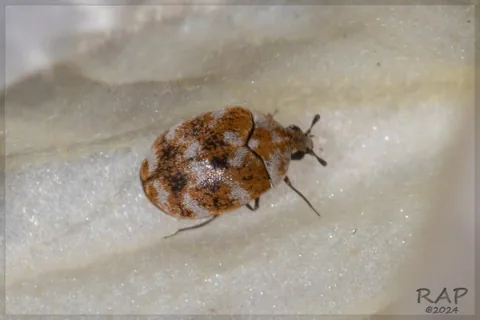 Varied Carpet Beetle
Anthrenus verbasci
Carpet beetles are small beetles whose larvae damage wool, silk, fur, feathers, leather and other animal products; the adults feed on pollen outdoors and often fly in through windows.
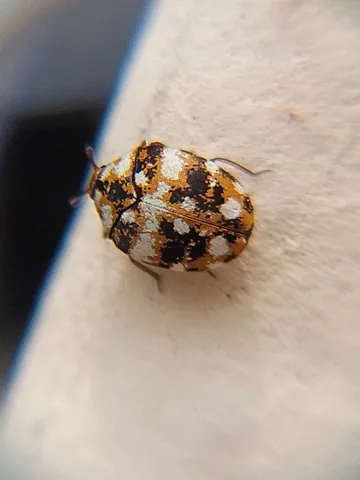 Furniture Carpet Beetle
Anthrenus flavipes
The furniture carpet beetle is a small, round dermestid beetle whose hairy larvae chew upholstery, carpets, fur and other animal-fiber items.
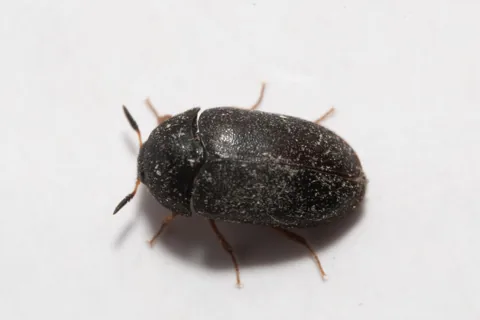 Black Carpet Beetle
Attagenus unicolor
The black carpet beetle is a shiny black carpet beetle whose larvae feed on wool, fur, feathers and other animal products, plus grains and other stored foods. In dry areas such as California, it is more often a pantry pest than a fabric pest. Colorado State Extension calls it one of the most common dermestid beetles.
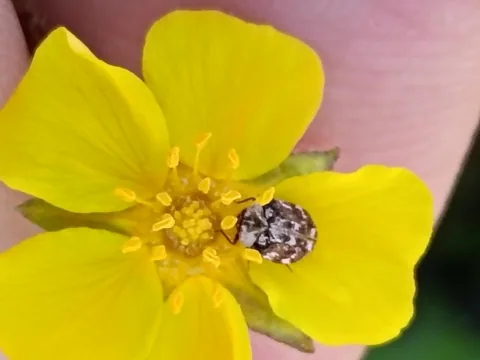 Common Carpet Beetle
Anthrenus scrophulariae
The common carpet beetle is a small, nearly round dermestid beetle whose larvae eat wool, carpets, fur and other animal products.
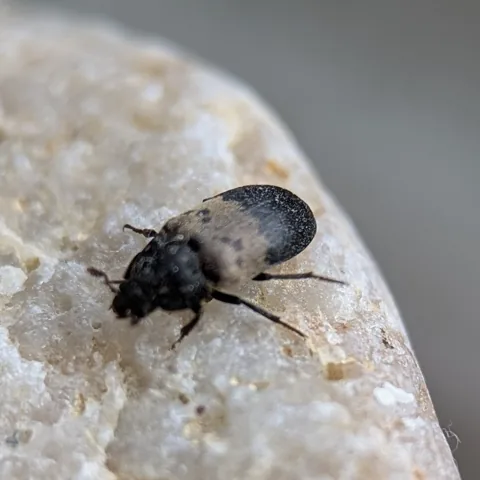 Larder Beetle
Dermestes lardarius
The larder beetle is a dermestid beetle named for its old attraction to larders and cured meats. Home curing is rare now, and it is more often found in dry pet food or feeding on dead insects trapped in attics and wall voids.
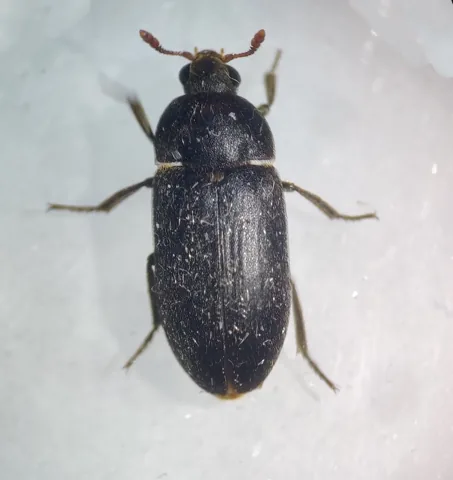 Black Larder Beetle
Dermestes ater
The black larder beetle (Dermestes ater) is a dark, unpatterned dermestid beetle. Adults and larvae feed on animal-based material such as skins, hides, carcasses, cured meat and dead insects, and the larvae can chew pupal chambers into wood.
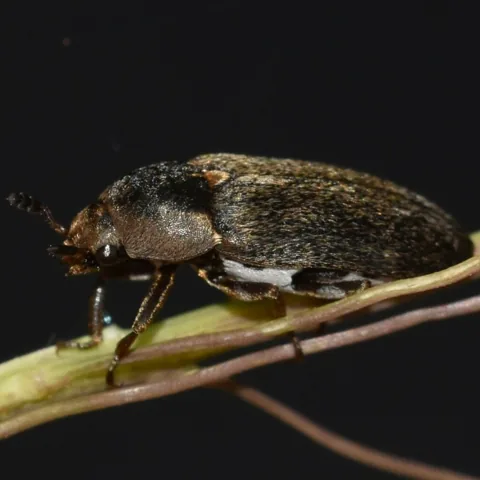 Hide Beetle
Dermestes maculatus
The hide beetle is a dermestid beetle that scavenges carrion and dried animal products. In homes and storage it attacks dried fish, cheese, bacon, dog treats, hides and fur, and taxidermists use it on purpose to clean skulls.
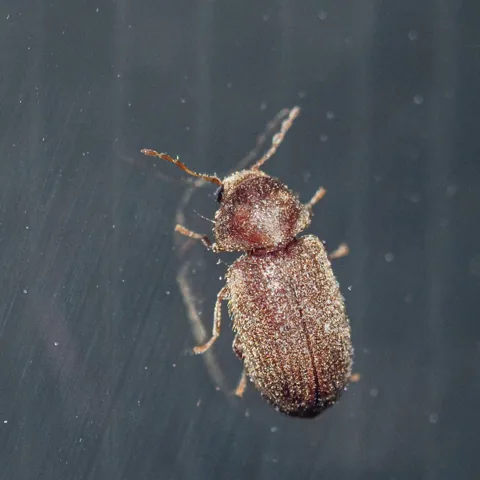 Drugstore Beetle
Stegobium paniceum
The drugstore beetle is a very general feeder said to "eat anything except cast iron"; in homes it most often infests pet food, drugs, cereals and spices.
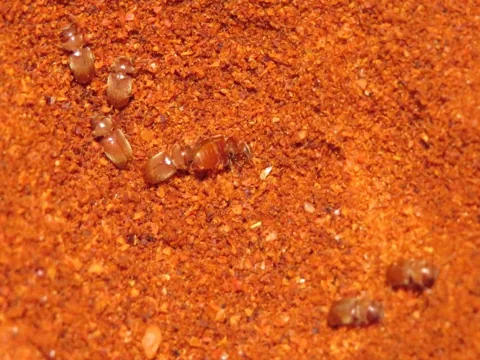 Cigarette Beetle
Lasioderma serricorne
The cigarette beetle is the most important insect pest of stored tobacco, and Texas A&M calls it the most common pantry pest in Texas. In homes its larvae feed in spices, pet food, flour, cereals and dried plant decorations.
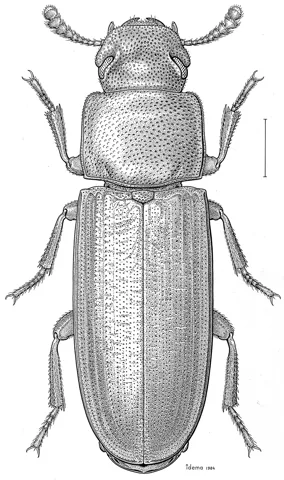 Confused Flour Beetle
Tribolium confusum
The confused flour beetle is a common pantry pest that feeds on flour, cereals, broken grain, nuts, dried fruit and many other dry foods.
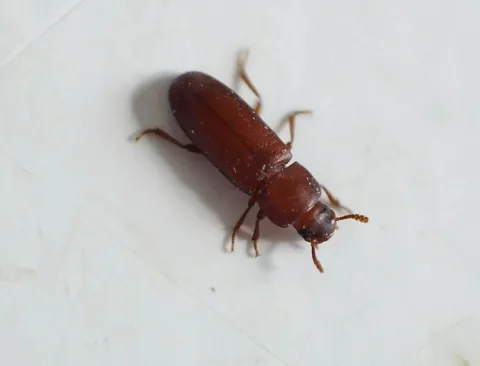 Red Flour Beetle
Tribolium castaneum
The red flour beetle is a shiny reddish-brown beetle that lives in flour, mixes and other processed or broken grain products; it can't chew into whole, sound kernels. Researchers call it a major storage pest.
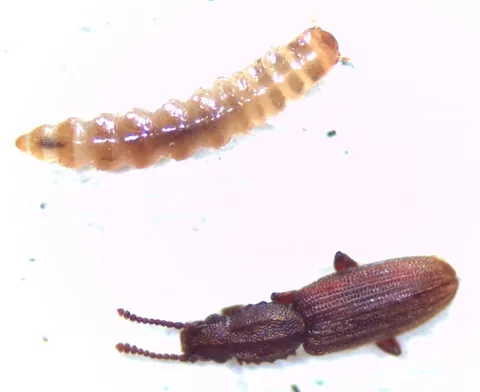 Sawtoothed Grain Beetle
Oryzaephilus surinamensis
The sawtoothed grain beetle is one of the most common beetles in home pantries; Georgia Extension rates it nearly as common as the Indianmeal moth. Both adults and larvae feed in dry foods of plant origin, and the first thing most people notice is small beetles crawling over shelves and counters.
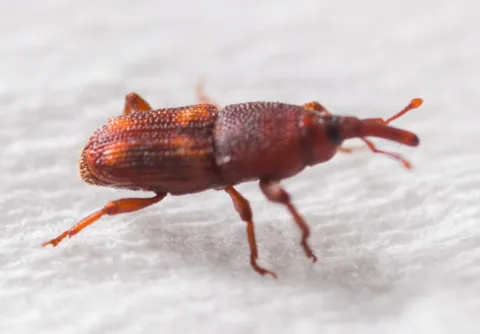 Rice Weevil
Sitophilus oryzae
Rice and granary weevils develop inside whole grains and seeds. Weevils in the house usually mean an infested package of whole grain or seed somewhere, such as popcorn, dried beans, saved seeds or decorative corn.
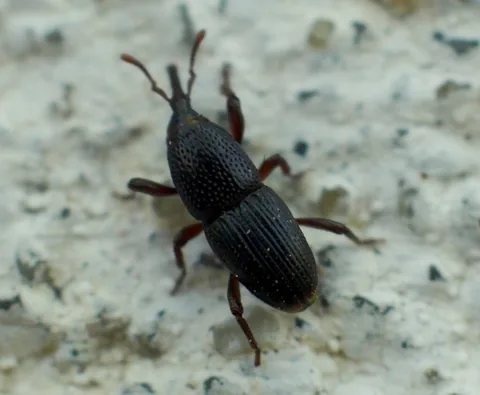 Granary Weevil
Sitophilus granarius
The granary weevil is a pest of stored grain and seeds. Its young develop hidden inside whole kernels, so the first sign in a home is usually small dark weevils near seeds, popcorn or decorative corn.
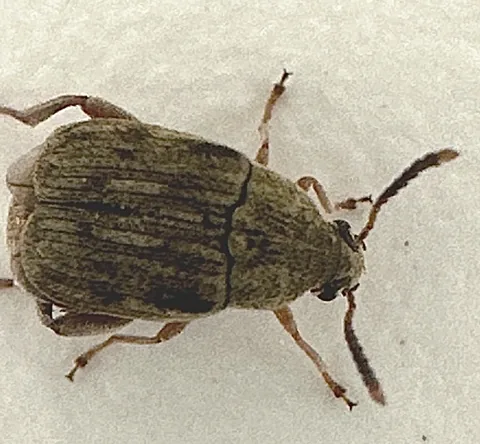 Bean Weevil
Acanthoscelides obtectus
The bean weevil is a small seed beetle, not a true weevil, whose larvae live inside dry beans and related seeds. Infestations can start in the garden and continue in storage, where the beetles breed continuously in warm pantries.
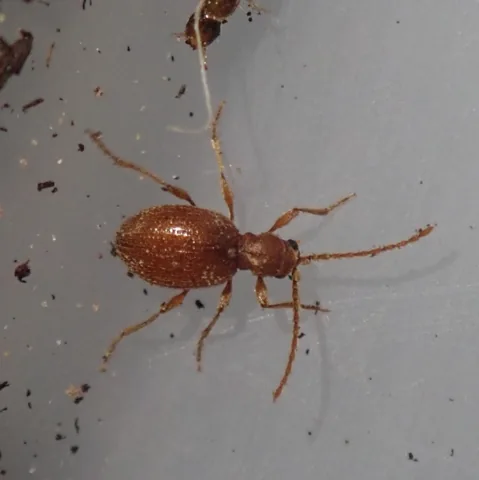 Spider Beetles
Ptinus fur
Spider beetles are small scavenging beetles in the family Ptinidae, named for their long legs and rounded, spider-like bodies; the whitemarked spider beetle is shown here. USDA's stored-grain handbook says several species turn up in grain and cereal products but are rarely abundant enough in the U.S. to cause serious damage, and Washington State University says they are usually a problem only where sanitation is very poor.
 Powderpost Beetles
Lyctinae (e.g., Lyctus brunneus, Lyctus planicollis)
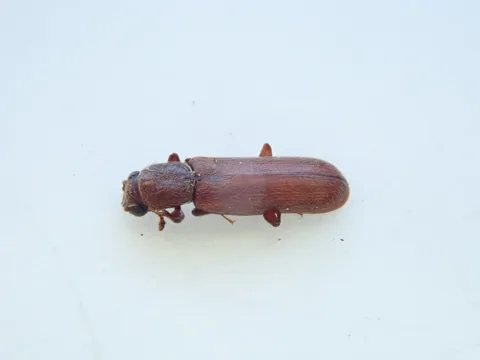
Powderpost beetles are small brown beetles whose larvae tunnel through dry, seasoned hardwood. Often the first clues are tiny round exit holes and little piles of flour-fine dust on floors, furniture or paneling.
 Deathwatch beetles
Anobiinae
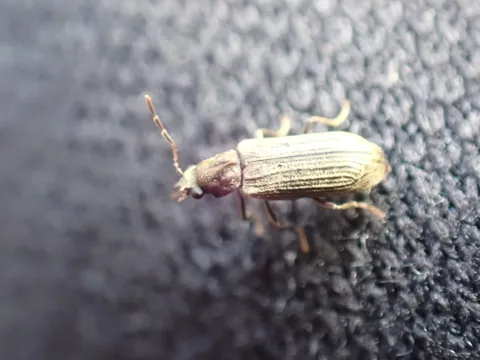
Of the three groups of beetles that bore wood inside buildings, the deathwatch beetles are the ones a crawl space should worry about. True powderpost beetles stick to hardwood trim and furniture, but anobiids attack the spruce, pine, fir and Douglas-fir used for floor joists, studs, sills and beams, and because they digest cellulose rather than depending on the starch that fades from aging wood, they can keep reinfesting a house year after year. They need damp wood to do it, which is why Kentucky and NC State treat them as a moisture problem first and an insecticide problem second.
 Red-shouldered bostrichid
Xylobiops basilaris
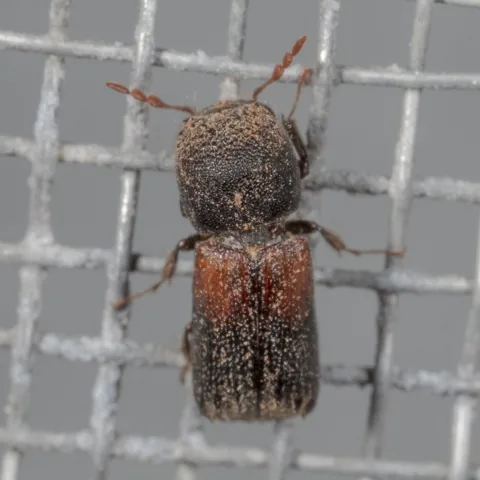
The red-shouldered bostrichid, Xylobiops basilaris, is a small wood-boring beetle of the eastern United States. It favors hickory, pecan and persimmon, mostly attacks stressed, dying or recently dead trees, and poses little threat to healthy ones.
 Foreign Grain Beetle
Ahasverus advena
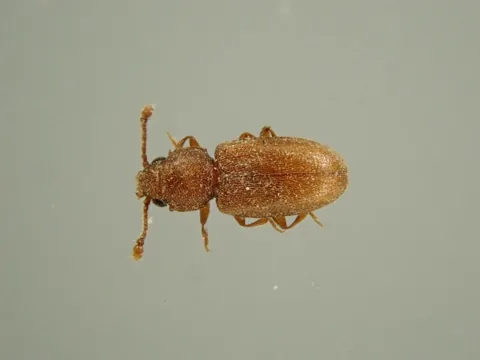
The foreign grain beetle is a tiny, reddish-brown beetle that feeds on molds rather than sound grain. It is best known for showing up in large numbers in newly built homes in late summer, where it feeds on mold growing on damp lumber and drywall inside the walls.
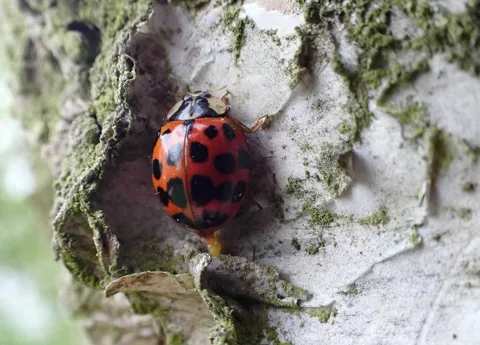 Multicolored Asian Lady Beetle
Harmonia axyridis
The multicolored Asian lady beetle is a beneficial aphid predator outdoors but becomes a nuisance when it flies to buildings in fall to overwinter and ends up indoors. Clemson and Colorado State extension both describe it as a valuable aphid predator on crops, trees and shrubs.
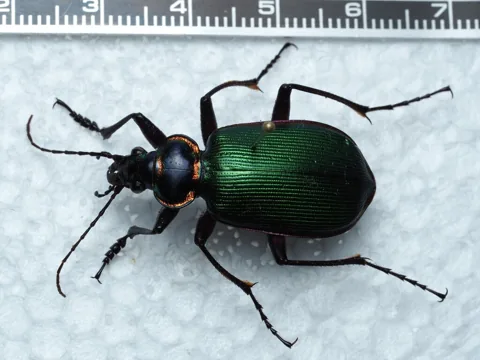 Ground Beetles
Family Carabidae (e.g., Calosoma scrutator, the fiery searcher)
Ground beetles are one of the largest groups of beetles in North America. They sometimes crawl indoors under doors or through small openings, but they prefer to live outside where prey is common, and outdoors they are valuable predators of garden pests.
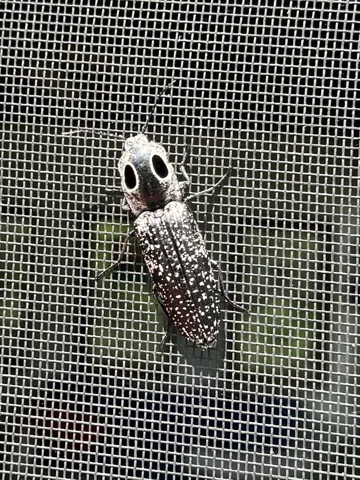 Click Beetles
Elateridae (e.g., Alaus oculatus, the eyed click beetle)
Click beetles are named for the trick they use to escape predators and get back on their feet: a sudden snap that flips them into the air with a click. Adults are mostly nocturnal and do no harm, but the soil-dwelling larvae of some species, called wireworms, are serious pests of potatoes, root crops and grains.
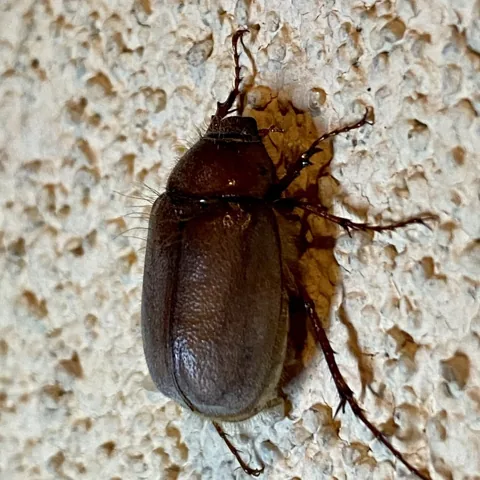 May and June Beetles
Phyllophaga species
May and June beetles, or June bugs, are native scarab beetles in the genus Phyllophaga. The adults buzz around porch lights on early summer nights, while their C-shaped grubs feed on roots, mostly in turf.
Infestation or a stray? Start here
Two questions sort most indoor beetles: what it could be eating in your house, and whether more keep turning up in one spot. Beetles that breed indoors live on a food source (stored food, animal fibers, dead insects or wood), and getting rid of them means finding that source.[8][2][5]
- Breeds indoors: carpet beetles, larder and hide beetles, drugstore and cigarette beetles, flour and sawtoothed grain beetles, rice and granary weevils, and spider beetles. All of them feed on stored food or animal products.[2][4][6][8]
- Develops inside wood: powderpost and deathwatch beetles. The larvae tunnel out of sight, and the round exit holes and powder are often the only sign.[14][13]
- Strays from outside: ground beetles, Asian lady beetles, click beetles and June beetles. Ground beetles are short-lived indoors and don't reproduce there; Asian lady beetles come in to spend the winter and don't attack wood, food or clothing.[18][16][20][22]
- A clue in the attic: overwintering flies, lady beetles and other insects die in attics and wall voids, and larder beetles and carpet beetles feed on those dead insects. One problem can lead to the next.[5][2]
Carpet beetles (varied, furniture and black)
Carpet beetles are common in homes, and the damage they do to woolens is often blamed on clothes moths. The adults are small, round and short-legged, and they are the ones you see on windowsills; the larvae do the damage out of sight.[2][1]
- Size and shape: Kentucky puts adults at 1/16 to 1/8 inch and UC IPM at about 1/10 to 1/8 inch. Round bodies and short antennae make them look like very small lady beetles.[2][1]
- Varied carpet beetle: about 1/10 inch, black with an irregular pattern of white, brown and dark yellow scales. Older adults wear the scales off and look plain brown or black. Clemson calls it one of the most common carpet beetles in homes.[1][3]
- Furniture carpet beetle: slightly larger and rounder than the varied carpet beetle, mottled white, dark yellow to orange and black, with a white underside.[1]
- Black carpet beetle: 1/8 to 3/16 inch, shiny black and dark brown with brownish legs. Its larva is smooth, shiny and hard, tapering to a tail tuft of long hairs. In dry areas such as California it is more of a stored-food pest than a fabric pest.[1][4]
- Larvae: about 1/8 to 1/4 inch in Kentucky's description, tan to brown, slow and densely hairy. Clemson describes them as carrot-shaped with tail bristles. The shed skins they leave behind can make an infestation look larger than it is.[2][3]
- What they eat: the larvae feed on wool, felt, fur, silk, feathers and leather, plus lint, pet hair and dead insects that collect under baseboards and in vents. Some kinds also get into cereals, seeds and pet food. The adults feed on pollen and don't damage fabric.[2][1][3]
- Where to look: seldom-used woolens in closets and boxes, the edges and undersides of rugs, upholstered furniture, floor vents with pet hair, and old bird or wasp nests in the attic. Clothing in regular use and rugs that get vacuumed are seldom attacked.[2][1]
- Eggs: Kentucky says a female lays about 50 to 100 eggs on or near something the larvae can eat. UC IPM's table gives about 40 for the varied, 60 for the furniture and 90 for the black carpet beetle.[2][1]
- Stray or infestation: adults fly in from flowers or come in on cut flowers, so one or two on a sunny window in spring may be visitors. Kentucky notes they often appear on windowsills in spring, which suggests an infestation may be present inside. Look for larvae and shed skins before deciding.[1][2]
Larder beetles and hide beetles
Larder beetles belong to Dermestes, a group of oblong dermestid beetles about 1/4 to 1/3 inch long that feed mostly on meat-based materials such as dried pet food. Hide beetles are dermestids too. Fully grown Dermestes larvae leave the food and chew into wood to make a place to pupate.[4][6]
- Larder beetle look: dark brown, about 1/3 inch, with the front half of the wing covers densely covered in pale yellow hairs and usually six dark spots in that band. Most other Dermestes species are dark all over.[5][4]
- Larder beetle larva: brownish, hairy, about 1/2 inch long, with two curved spines on the last segment.[5]
- What they eat: cured meats, cheese, dried fish, pet food, fur, hides and feathers, and the dead flies, beetles and wasps that pile up in attics and wall voids. Females lay more than 100 eggs; Colorado State gives up to 135.[5][4]
- Damage beyond food: mature larvae bore into nearby materials to pupate. Penn State says they have been known to bore into structural timbers, and Colorado State says they excavate wood beams.[5][4]
- Hide beetles belong to the same family. Missouri describes the family's larvae as brownish, tubular and covered with long hairs, reaching about 1/4 inch.[6]
- Stray or infestation: larder beetles spend the winter outdoors in sheltered spots and enter houses in early spring looking for dead insects to lay eggs on. Several beetles or larvae indoors usually means a food source, such as a dead-insect pile in the attic or a forgotten bag of dog food.[5][4]
Drugstore and cigarette beetles
These two are close relatives with the same humpbacked look: the head is bent down under the body, which shows best from the side. They breed in dry food and are a pantry problem, not a wood problem, though they are sometimes mistaken for powderpost beetles.[10][9][14]
- Drugstore beetle: about one-tenth inch, light brown to reddish brown, with fine silky hairs and distinct lengthwise grooves on the wing covers.[9][8]
- Cigarette beetle: about 0.1 inch (2 to 3 mm), stout, oval and reddish yellow to brownish red, with the head bent down at nearly a right angle. Its wing covers lack the drugstore beetle's grooves.[10][7]
- What they eat: almost any dry household food and spice, plus leather. Kentucky finds cigarette beetles most often in dry dog food and paprika and drugstore beetles in bread, flour, breakfast foods and red pepper. Missouri lists cosmetics, prescription drugs and even books for the drugstore beetle.[8][6]
- Stray or infestation: both fly and come to light, so the first sign is often a beetle on a window or counter. More than a few means a package is infested. The pantry pests guide covers the cleanup.[8][7]
Flour beetles and sawtoothed grain beetles
These are the reddish-brown pantry beetles found in flour, cereal, dried fruit, beans and other starchy foods. They breed in the package, so the fix is finding and discarding it rather than spraying.[7][8][6]
- Red and confused flour beetles: shiny reddish brown, flattened and oval, about 1/7 inch long. Kentucky says the confused flour beetle can fly and is drawn to light.[7][8]
- Sawtoothed grain beetle: slender, flat and brown, about 1/10 inch, with six tooth-like points along each side of the thorax just behind the head. The merchant grain beetle looks almost the same.[7][6]
- Stray or infestation: Kentucky's advice is that beetles crawling on counters are usually the first sign of an infested food package nearby, often a partly used one at the back of a shelf.[8]
Weevils
Weevils are beetles with the head stretched into a snout. The rice weevil and granary weevil develop inside whole kernels, so they turn up with whole grains, seeds, popcorn and dried beans rather than flour.[6][12]
- Rice weevil: about 1/8 inch, reddish brown to nearly black, with four light spots on the wing covers. It can fly.[6][12][8]
- Granary weevil: about 3/16 inch in Missouri's description, chestnut brown to black and evenly colored with no spots. It has no working wings and cannot fly.[6][12]
- Bean weevils: short, stout beetles about 3/16 inch long whose wing covers stop short of the tip of the abdomen. Missouri lists them among the beetles that damage stored dry beans and peas.[6]
- What they mean: Iowa State says weevils in the house usually point to infested whole grain or seeds, including decorative corn, bean bags, saved garden seeds and old grain-based mouse bait. They don't bite, sting or damage furniture, clothing or the house.[12]
- Larvae grow hidden inside the kernel. Iowa State notes there is generally no outside sign until about a month later, when the adult chews its way out.[12][6]
Spider beetles
- Look: small, globe-shaped beetles with long legs that give them a spider-like look. Missouri says the larvae are C-shaped grubs that feed in the same material as the adults.[11][6]
- What they eat: grain products, feathers, rodent droppings and other insects. Washington State lists them among the most common beetles in moldy, old food.[11]
- Stray or infestation: Washington State says spider beetles are typically only a pest where sanitation is very poor, so finding them usually means old food, spills or debris somewhere in storage areas.[11][6]
Powderpost and other wood-boring beetles
Powderpost beetles rank second only to termites in damaging dry, seasoned wood. You rarely see the beetles; the larvae tunnel inside the wood, and what shows is small round exit holes and fine powder.[14][15]
The treatment guide covers fumigation, borates and replacement. This section is about naming the beetle and deciding whether it is still active.[14][13]
- Lyctid powderpost beetles: narrow, reddish brown to black, 1/16 to 1/4 inch. Pinhead-size holes and powder that feels like flour or talc. They attack hardwoods such as oak, ash, walnut and hickory in flooring, paneling, molding, furniture and bamboo, not softwood framing.[14][13]
- Anobiid (deathwatch) beetles: convex, reddish to dark brown, with exit holes 1/16 to 1/8 inch and gritty powder. They can damage beams and joists, but need moist wood (13 to 30% moisture), so they are mainly a crawl-space, basement and outbuilding problem. Adults tap their heads on wood, which gave them their name.[14][13]
- Bostrichid (false powderpost) beetles: reddish brown to black, mostly 1/8 to 1/4 inch, with the head turned down under a hood-like thorax. Their frass is coarser and packed tightly in the tunnels. They often arrive in imported hardwoods and bamboo and seldom reinfest after the first generation.[14][13]
- Beetles from firewood: flatheaded and roundheaded borers and bark beetles may emerge from firewood stored indoors. UC IPM says these forest insects don't attack wood structures or furniture.[13]
- Look-alike: tiny brown foreign grain beetles, about 1/16 inch, swarm in new or damp houses. They feed on surface mold on damp lumber and wallboard and don't damage wood; fixing the moisture ends the problem.[14]
- Kitchen look-alikes: Kentucky warns that flour beetles, drugstore and cigarette beetles, weevils and grain beetles near stored food are often mistaken for powderpost beetles.[14]
Active infestation or old holes?
Powderpost infestations often die out on their own, so check before paying for treatment. Lyctids need starch in the wood, and as the wood ages its starch content falls until the beetles can no longer develop.[14]
- Active signs: powder the color of freshly sawed wood sifting from holes, and holes that look new compared with the surrounding wood. In stained flooring or cabinets, new holes show no stain inside.[14]
- Old signs: powder that is yellowed, caked or covered with dust or debris. Old powder can also be shaken loose from the galleries by vibration, so look carefully.[14]
- A practical check from UC IPM: the frass test, rubbing the powder between your fingers, separates the flour-like powder of powderpost beetles from the grittier frass of deathwatch and false powderpost beetles.[13]
- New house or new furniture: lyctids usually emerge within a year of the wood being processed, and the eggs or larvae were almost always in the wood when it arrived. Kentucky notes the supplier or installer may be responsible.[14]
- Finished wood resists new attack: varnished, painted, waxed or stained surfaces aren't used for egg laying, though larvae already inside can still emerge through them.[14][15]
Asian lady beetles
Swarms of orange lady beetles on sunny walls in fall, and again inside on windows in late winter and spring, are multicolored Asian lady beetles looking for a place to spend the winter. The fall home invaders guide covers keeping them out.[16][17]
- Look: oval and domed, about 1/4 inch (Penn State gives 9/32 inch, 7 mm), tan to orange to red with anywhere from many black spots to none. Most have a black M- or W-shaped mark on the whitish area behind the head.[16][17]
- When: flights to buildings run from September through November depending on location. The beetles that show up indoors in late winter and spring are the same ones that came in the fall.[16]
- Harm: they don't reproduce indoors and don't attack wood, food or clothing. Disturbed beetles give off an odor and a yellowish fluid that can stain, they occasionally bite or pinch, and they can cause allergies in some people.[16][17]
- Removal: vacuuming is the most efficient way to remove clusters indoors. Penn State suggests a nylon stocking secured inside the hose of a bagless vacuum so the beetles can be bagged and discarded.[17]
Ground beetles and other accidental invaders
Ground beetles are common outdoor predators that sometimes wander into basements and ground floors, mostly in mid and late summer. A few indoors is normal; they are a nuisance, not a pest of the house.[18][19]
- Look: usually black or brown and shiny, often with lengthwise grooves on the wing covers, long slender legs and obvious jaws. Minnesota gives 1/8 to 1/2 inch for most; Missouri says most are 1/4 to 3/4 inch.[18][19]
- Behavior: active at night and sometimes drawn to lights. When uncovered they run fast for cover and rarely fly. Some species give off foul or irritating chemicals when handled.[18][19]
- Harm: Minnesota says they don't damage buildings, food or clothing, aren't harmful to people, may pinch if mishandled, and are short-lived indoors and don't reproduce there.[18]
- What to do: sweep or vacuum them up or catch them on sticky traps along walls, then seal gaps around doors and foundation, pull mulch back from the foundation and move firewood and debris away from the house.[18]
Click beetles
- Look: long, narrow beetles with nearly parallel sides, mostly drab brown, black or gray. The back corners of the shield behind the head point rearward. Most are under 1 inch long.[20]
- The click: placed on its back, a click beetle snaps a spine into a groove under the thorax and flips into the air with an audible click.[20]
- Why it's inside: adults are attracted to lights at night and are often found in the morning resting on the side of a house near a light that was left on.[20]
- Harm: none to the house. The larvae, called wireworms, live in soil or rotting logs, and some feed on seeds, roots and young plants in gardens.[20][21]
June beetles at lights
- Look: about 1/2 to 1 inch long and reddish brown to nearly black. Wisconsin describes them as clumsy fliers that collide with windows and cling to screens.[22][24]
- When: in Wisconsin, adults are active after dusk in late May and early June and come to lights at night.[22]
- Harm: none indoors. Their larvae are C-shaped white grubs that live in soil and feed on the roots of turf and other plants, so a June beetle inside came in from the yard.[22][24]
What to do next
- For pantry beetles and weevils, find and discard the infested food, vacuum the shelves and store dry goods in sealed glass, metal or heavy plastic containers. Iowa State says insecticide sprays aren't recommended in food cupboards. The pantry pests guide has the details.[12][8]
- For carpet beetles, find every infested item, wash or dry-clean what can be saved, vacuum rugs, vents and baseboards, and clean up lint, hair and dead insects.[2][1]
- For larder beetles, clear out dead insects in attics and wall voids, check stored pet food and keep foods in tight jars or cans.[5][4]
- For holes in wood, confirm the beetle group and whether the holes are active before deciding on treatment; see the wood-boring beetle guide.[14][13]
- For lady beetles, ground beetles and other strays, vacuum the ones inside and seal cracks and gaps on the outside of the house.[17][18]
Common questions
- What are the little black beetles in my house?
- On windowsills, most often black carpet beetles or varied carpet beetles whose scales have worn off. In the basement, larger shiny black beetles that run fast are usually ground beetles, which don't breed indoors.[1][18]
- What are the tiny brown beetles in my kitchen?
- Usually flour, sawtoothed grain, drugstore or cigarette beetles, all about 1/8 inch and reddish brown, or rice weevils if they have a snout. They are breeding in a food package nearby.[8][6][12]
- Do carpet beetles bite?
- The adults feed on pollen and the larvae feed on wool, fur, feathers and other animal products. Penn State notes that some people react to the hairs of carpet beetle larvae with intense itching and a rash that feels like being bitten.[1][2][23]
- Are the holes in my wood floor still active?
- Look for powder the color of fresh-cut wood under the holes and holes that look newer than the wood around them. Yellowed, caked or dusty powder usually means the damage is old.[14]
- Why are there lady beetles in my house in winter?
- Asian lady beetles fly to houses in fall to spend the winter in walls and attics. On warm days some wander inward and show up on windows and lights. They don't breed indoors.[16]
Photo credits
- Varied Carpet Beetle: (c) RAP, some rights reserved (CC BY) — via iNaturalist, CC BY 4.0
- Furniture Carpet Beetle: (c) Rodolfo Salinas Villarreal, some rights reserved (CC BY) — via iNaturalist, CC BY 4.0
- Black Carpet Beetle: (c) Поляков Александр, some rights reserved (CC BY) — via iNaturalist, CC BY 4.0
- Common Carpet Beetle: (c) Alexander Petrunin-Suharev, some rights reserved (CC BY) — via iNaturalist, CC BY 4.0
- Larder Beetle: (c) Nelson Chu Pavlosky, some rights reserved (CC BY) — via iNaturalist, CC BY 4.0
- Black Larder Beetle: (c) Svavar Martin Andreasen, some rights reserved (CC BY) — via iNaturalist, CC BY 4.0
- Hide Beetle: kbkash, public domain (CC0), via iNaturalist
- Drugstore Beetle: (c) Arsen Vorobei, some rights reserved (CC BY) — via iNaturalist, CC BY 4.0
- Cigarette Beetle: (c) Ezequiel Vera, some rights reserved (CC BY) — via iNaturalist, CC BY 4.0
- Confused Flour Beetle: Bousquet et al. 2018, Catalogue of Tenebrionidae of North America, ZooKeys 728, Figure 30 (CC BY 4.0) — via Wikimedia Commons, CC BY 4.0
- Red Flour Beetle: (c) Roman, some rights reserved (CC BY) — via iNaturalist, CC BY 4.0
- Sawtoothed Grain Beetle: (c) aubrey_moore, some rights reserved (CC BY) — via iNaturalist, CC BY 4.0
- Rice Weevil: (c) portioid, some rights reserved (CC BY) — via iNaturalist, CC BY 4.0
- Granary Weevil: (c) Roman, some rights reserved (CC BY) — via iNaturalist, CC BY 4.0
- Bean Weevil: (c) E. A., some rights reserved (CC BY) — via iNaturalist, CC BY 4.0
- Spider Beetles: (c) agujaceratops, some rights reserved (CC BY) — via iNaturalist, CC BY 4.0
- Powderpost Beetles: Karel Schoonvaere, public domain (CC0), via iNaturalist
- Deathwatch beetles: (c) Lee Cain, some rights reserved (CC BY) — via iNaturalist, CC BY 4.0
- Red-shouldered bostrichid: (c) Victor Engel, some rights reserved (CC BY) — via iNaturalist, CC BY 4.0
- Foreign Grain Beetle: Karel Schoonvaere, public domain (CC0), via iNaturalist
- Multicolored Asian Lady Beetle: (c) Sascha Nunheim, some rights reserved (CC BY) — via iNaturalist, CC BY 4.0
- Ground Beetles: Brighton Lee, public domain (CC0), via iNaturalist
- Click Beetles: Diane, public domain (CC0), via iNaturalist
- May and June Beetles: (c) Elliott Gordon, some rights reserved (CC BY) — via iNaturalist, CC BY 4.0
Sources
- University of California Statewide IPM Program, “Pest Notes: Carpet Beetles (Home and Landscape).” ipm.ucanr.edu/home-and-landscape/carpet-beetles/ (accessed 2026-11-10)
- University of Kentucky Entomology, “ENTFACT-601: Carpet Beetles.” entomology.mgcafe.uky.edu/ef601 (accessed 2026-11-10)
- Clemson Cooperative Extension Home & Garden Information Center, “Fabric Pest Control.” hgic.clemson.edu/factsheet/controlling-fabric-pests/ (accessed 2026-11-10)
- Colorado State University Agricultural Biology, “Dermestid beetles.” agsci.colostate.edu/agbio/ipm-pests/dermestid-beetles/ (accessed 2026-11-10)
- Penn State Extension, “Larder Beetle.” extension.psu.edu/larder-beetle (accessed 2026-11-10)
- University of Missouri Extension, “G7370: Insect Pests of Stored Products.” extension.missouri.edu/publications/g7370 (accessed 2026-11-10)
- University of California Statewide IPM Program, “Pest Notes: Pantry Pests (Home and Landscape).” ipm.ucanr.edu/home-and-landscape/pantry-pests/ (accessed 2026-11-10)
- University of Kentucky Entomology, “ENTFACT-612: Stored Product Pests in the Pantry.” entomology.mgcafe.uky.edu/ef612 (accessed 2026-11-10)
- Penn State Extension, “Drugstore Beetle.” extension.psu.edu/drugstore-beetle (accessed 2026-11-10)
- Penn State Extension, “Cigarette Beetle.” extension.psu.edu/cigarette-beetle (accessed 2026-11-10)
- Washington State University Pestsense, “Spider beetle.” pestsense.cahnrs.wsu.edu/fact-sheet/spider-beetle/ (accessed 2026-11-10)
- Iowa State University Extension and Outreach, “Rice Weevil and Granary Weevil.” yardandgarden.extension.iastate.edu/encyclopedia/rice-weevil-and-granary-weevil (accessed 2026-11-10)
- University of California Statewide IPM Program, “Pest Notes: Wood-Boring Beetles in Homes.” ipm.ucanr.edu/home-and-landscape/wood-boring-beetles-in-homes/ (accessed 2026-11-10)
- University of Kentucky Entomology, “ENTFACT-616: Powderpost Beetles.” entomology.mgcafe.uky.edu/ef616 (accessed 2026-11-10)
- Penn State Extension, “Powderpost Beetles.” extension.psu.edu/powderpost-beetles (accessed 2026-11-10)
- University of Kentucky Entomology, “ENTFACT-416: Asian Lady Beetle Infestation of Structures.” entomology.mgcafe.uky.edu/ef416 (accessed 2026-11-10)
- Penn State Extension, “Multicolored Asian Lady Beetle.” extension.psu.edu/multicolored-asian-lady-beetle (accessed 2026-11-10)
- University of Minnesota Extension, “Ground beetles.” extension.umn.edu/nuisance-insects/ground-beetles (accessed 2026-11-10)
- Missouri Department of Conservation, “Ground Beetles (Carabids) (Field Guide).” mdc.mo.gov/discover-nature/field-guide/ground-beetles (accessed 2026-11-10)
- Missouri Department of Conservation, “Click Beetles (Elaterids) (Field Guide).” mdc.mo.gov/discover-nature/field-guide/click-beetles (accessed 2026-11-10)
- University of California Statewide IPM Program, “Wireworms (Home and Landscape).” ipm.ucanr.edu/home-and-landscape/wireworms/ (accessed 2026-11-10)
- University of Wisconsin-Madison Extension, Wisconsin Horticulture, “May/June Beetles.” hort.extension.wisc.edu/articles/mayjune-beetles/ (accessed 2026-11-10)
- Penn State Extension, “Carpet Beetle Dermatitis.” extension.psu.edu/carpet-beetle-dermatitis (accessed 2026-11-10)
- Utah State University Extension IPM, “May/June Beetles.” extension.usu.edu/planthealth/ipm/notes_orn/list-turf/ar_may-june-beetles (accessed 2026-11-10)