On this page
How to identify it
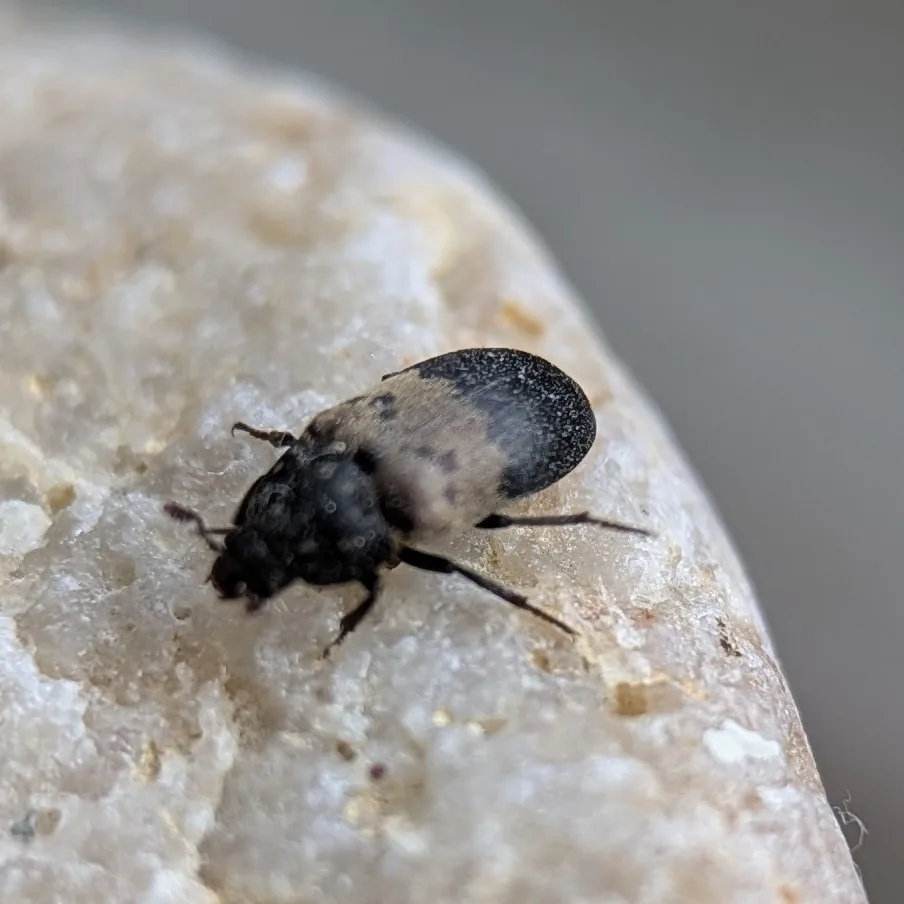
- Adults are oval, dark brown beetles about 1/4 to 1/3 inch long.[1][3][2]
- The front half of the wing covers carries a band of pale yellow hairs, usually with six dark spots in it.[1][3][2]
- The underside of the body and the legs are covered with fine yellow hairs.[1]
- Larvae are hairy, worm-like, reddish to dark brown and about 1/2 inch long when grown, with a pair of backward-curving spines on the tail end.[1][3][2]
Look-alikes
| Look-alike | How to tell them apart |
|---|---|
| Black larder beetle | Colorado State notes that most beetles in the larder beetle's genus, Dermestes, are dark colored all over; the yellow band with dark spots marks the larder beetle.[2] |
| Carpet beetles | Smaller: Colorado State gives about 1/20 to 1/5 inch for black carpet beetle adults. Black carpet beetle larvae feed on plant and animal matter and commonly live in old bee and wasp nests.[2] |
Where it lives
Penn State calls it cosmopolitan, and it is still common in homes, museums, mills, livestock facilities and anywhere with a suitable food source. A review of museum pests lists Dermestes among the most common pests of collections and says most of those pests are found all over the world.[1][4]
Biology and life cycle
Adults spend the winter in bark crevices and other sheltered places outdoors, and also inside walls. In spring they come indoors, drawn to dead insects and other food where they lay eggs.[1][3][2]
Through the summer a female lays more than 100 eggs; Colorado State puts the maximum at 135. Eggs hatch in less than 12 days.[1][2]
Larvae feed until the next-to-last molt; males molt up to five times and females up to six.[1]
When ready to pupate, grown larvae tunnel into the food or anything nearby. Minnesota says they can bore up to 1/2 inch into wood and also into books and insulation.[1][2][3]
The pupal stage lasts 3 to 7 days, and under ideal conditions a generation takes 40 to 50 days.[1]
Damage and signs
- Larvae and adults eat high-protein materials: ham, bacon and other meats, cheese, dried fish, dry pet food, hides, furs and feathers. Infested pet food becomes inedible.[1][3]
- They can destroy preserved animal and museum specimens.[1][3][4]
- In homes the usual food is dead insects. Flies, bugs, beetles and wasps gather in attics in fall, many die, and larder beetles lay eggs on them; Minnesota names cluster flies and boxelder bugs.[1][3]
- Old animal nests attached to the building, dead animals in voids and food hidden by rodents can also support them.[2][3]
- Larvae bore to make a place to pupate, not to feed, so wood and other soft materials near the food can be tunneled.[1][2][3]
Health risk
None of these sources reports larder beetles biting, stinging or spreading disease to people; the harm is to food, pet food and stored animal products.[1][3][2]
Control
Prevention
Keep foods that attract the beetles, including dry pet food, in tight jars, cans or insect-proof containers.[1][2]
Keep them out
Seal the edges of windows and doors, vents and openings under eaves to keep adults out.[2]
Sanitation
Start with inspection: find and remove every infested food or item. Cast larval skins and live larvae point to the breeding site; adults move around and can be far from it.[1][2]
Look where you see the most beetles and check dry pet food first. Minnesota suggests checking for rodent activity, especially in a home or cabin with a crawl space.[3]
Vacuum lint and hair, remove dead insects from windowsills and clean up spills, then throw the vacuumed material out right away.[2]
Traps and physical control
Valuable infested items can be heated or frozen to kill all stages; large items need longer times to heat or chill all the way through.[1][2]
Minnesota's first choice is to physically remove adults and larvae as you see them, for example with a vacuum.[3]
Pesticides
Indoor sprays and dusts won't work while the food source remains. Insecticides alone aren't effective; at most they supplement a thorough cleanout of breeding sites.[3][2]
Where sources disagree
Stored foods: Penn State says many pantry items can become infested, while Minnesota says it is very uncommon for larder beetles to feed on stored food products.[1][3]
Wood damage: Penn State says larvae have been known to bore into structural timbers; Minnesota says serious damage to structural wood is very rare and happens only if larvae bore into the wood repeatedly.[1][3]
Heat and cold: Penn State gives 140 degrees for half an hour or 0 degrees for 3 to 4 days; Colorado State gives a freezer below 0 degrees F for three days or more, or heat above 130 degrees F for several hours.[1][2]
Size: Penn State gives about 1/3 inch for adults; Minnesota gives 1/4 to 1/3 inch.[1][3]
Common questions
- Why do I see larder beetles in spring?
- Adults overwinter outdoors and in walls and come indoors in spring. Minnesota says a few adults in spring don't mean an infestation; larvae, or large numbers of adults, do.[1][3]
- Can larder beetle larvae damage wood?
- Yes, a little. Mature larvae bore into wood and other materials to make a pupal chamber, not to feed; Minnesota says up to 1/2 inch into wood. Penn State notes tests in which larvae bored into lead with ease.[1][3][2]
- Where should I look for the source?
- Check dry pet food and stored meats first, then attics, wall voids and windows for dead insects, plus old animal nests attached to the building.[1][3][2]
- Are larder beetles a museum pest?
- Yes. Penn State lists dried museum specimens among their foods, Minnesota says they can destroy preserved animal specimens, and a review of museum pests names Dermestes beetles among the most common insects damaging collections.[1][3][4]
Sources
- Penn State Extension, “Larder Beetle.” extension.psu.edu/larder-beetle (accessed 2026-11-11)
- Colorado State University, Department of Agricultural Biology, “Dermestid beetles.” agsci.colostate.edu/agbio/ipm-pests/dermestid-beetles/ (accessed 2026-11-11)
- University of Minnesota Extension, “Larder beetles.” extension.umn.edu/household-insects/larder-beetles (accessed 2026-11-11)
- Insects, via PubMed, “Insect Pests and Integrated Pest Management in Museums, Libraries and Historic Buildings (Querner 2015).” pubmed.ncbi.nlm.nih.gov/26463205/ (accessed 2026-11-11)
- iNaturalist, “Dermestes lardarius taxon page (order and family).” www.inaturalist.org/taxa/1617634 (accessed 2026-11-11)