On this page
How to identify it
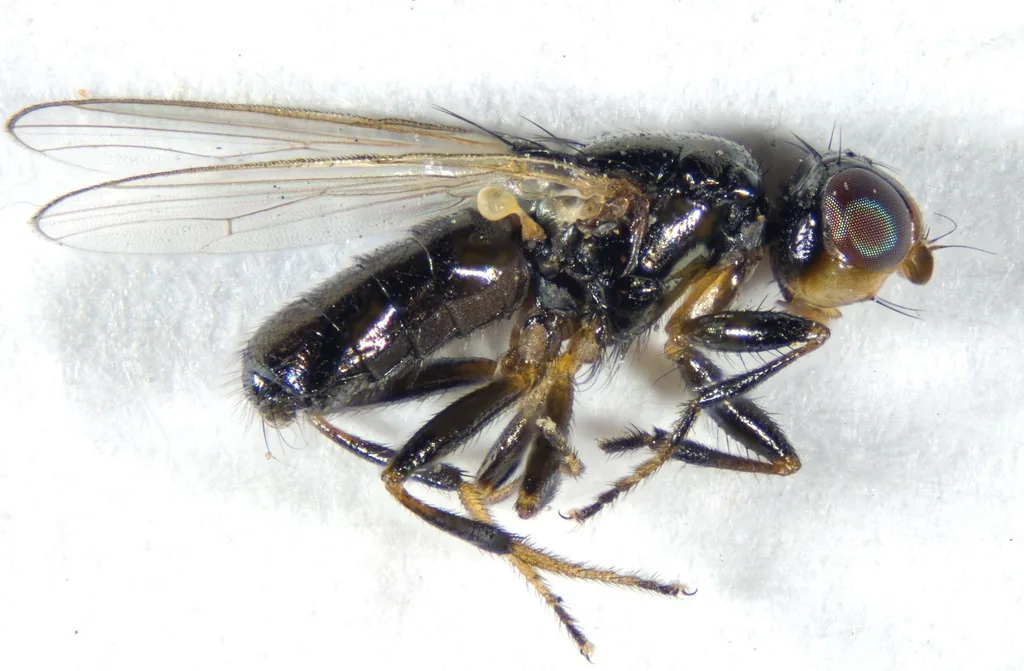
- The adult is about half the size of a house fly: males are about 4.5 mm and females about 5 mm long, measured to the wing tips. It is shiny black to bluish black with bronze tints, reddish-brown eyes and clear, iridescent wings that nearly overlap when the fly is at rest.[1]
- Full-grown maggots are white or yellowish white, about 9 to 10 mm (3/8 inch) long, with black mouth hooks. They can leap 4 to 5 inches through the air by gripping with their mouth hooks and then flexing and jerking themselves forward.[1]
- Signs in food include whitish eggshells and small grooves on the surface of cheese made by young maggots, soft or sunken areas in cheese, and a shiny, greasy liquid dripping from infested meat.[1]
- Pupae are small, oval and dark brown, about 3 to 4 mm long, often found in dry, dark spots near the food or on bare concrete floors.[1]
Look-alikes
| Look-alike | How to tell them apart |
|---|---|
| House fly | Much larger. The cheese skipper is only about half the size of a house fly and is shiny black-bronze.[1] |
| Small fruit flies, black scavenger flies and eye gnats | These small flies are similar groups. The cheese skipper stands out by its metallic black-bronze color and reddish eyes, and by its leaping maggots in cheese and cured meat.[1] |
Where it lives
Found worldwide, including the United States.[1]
Biology and life cycle
Females mate almost as soon as they emerge and lay 140 to 500 pearly white eggs on meat or cheese. Eggs hatch in about 1 to 2 days (23 to 54 hours).[1]
The maggots avoid light, bore deep into the food, and feed for about 14 days through three stages. They then leave the food and pupate, and adults emerge about 12 days later. Adults live only 3 to 7 days.[1]
In good conditions the whole cycle can take as little as 12 days. Temperature and the type of food strongly affect how fast it develops.[1][4]
The maggots are fairly tolerant of heat and cold. The fly also breeds in carcasses and human remains, which makes it useful to forensic entomologists estimating time since death.[1]
Damage and signs
- The maggots damage stored salted meats and aged cheeses, leaving soft, sunken areas in cheese and greasy drips on meat. In ham factories the fly causes serious direct damage and hygiene problems.[1][3]
- Because the flies breed in decaying matter, adults are believed to be able to carry germs on their bodies the way house flies do, and the maggots have been reported to carry bacteria including Clostridium botulinum.[1][3]
Health risk
Eating cheese skipper maggots by accident can cause intestinal myiasis: the maggots, which resist stomach acid, pass through the gut and can cause serious intestinal lesions with diarrhea, pain and nausea. It is one of the flies most often cited in accidental myiasis.[1][3]
Control
Keep them out
Wrap or otherwise protect cheese and cured meats so flies cannot lay eggs on them.[1]
Sanitation
Sanitation is the most important part of control. Keep food processing, curing and storage areas clean.[1]
Traps and physical control
In light infestations, the maggots can be picked out one by one.[1]
Biological control
Small parasitic wasps attack the pupae. In an Italian ham facility, releases of Pachycrepoideus vindemiae and Muscidifurax raptor parasitized cheese skipper pupae, an option where insecticides are not allowed in aging rooms.[1][2][3]
When to call a professional
Severe infestations in food plants often require fumigation.[1]
Common questions
- What are the tiny jumping worms in my cheese or ham?
- They are probably cheese skipper maggots. They are white, up to about 3/8 inch long, and can flip themselves 4 to 5 inches through the air.[1]
- What happens if I eat cheese skipper maggots?
- Swallowed maggots can survive stomach acid and cause intestinal myiasis, with diarrhea, pain and nausea.[1][3]
Sources
- University of Florida/IFAS Extension (Featured Creatures), “Cheese (or Ham) Skipper, Piophila casei (Linnaeus), EENY468 (C. Lewis and P. E. Kaufman, January 2010).” journals.flvc.org/edis/article/view/118381 (accessed 2026-11-09)
- Insects (via NCBI PubMed), “Experimental Releases of Pupal Parasitoids to Control Piophila casei in Ham Production (Insects, 2026; abstract).” pubmed.ncbi.nlm.nih.gov/42783275/ (accessed 2026-11-09)
- Journal of Insect Science (via NCBI PubMed), “Evaluation of Pachycrepoideus vindemiae and Muscidifurax raptor as biological control agents of Piophila casei (Journal of Insect Science, 2023; abstract).” pubmed.ncbi.nlm.nih.gov/37721495/ (accessed 2026-11-09)
- Insects (via NCBI PubMed), “Effect of Temperature on Skipper Fly Piophila casei Reared on Ham (Insects, 2025; abstract).” pubmed.ncbi.nlm.nih.gov/41148862/ (accessed 2026-11-09)
- iNaturalist, “Piophila casei taxon page (order and family).” www.inaturalist.org/taxa/326643 (accessed 2026-11-09)