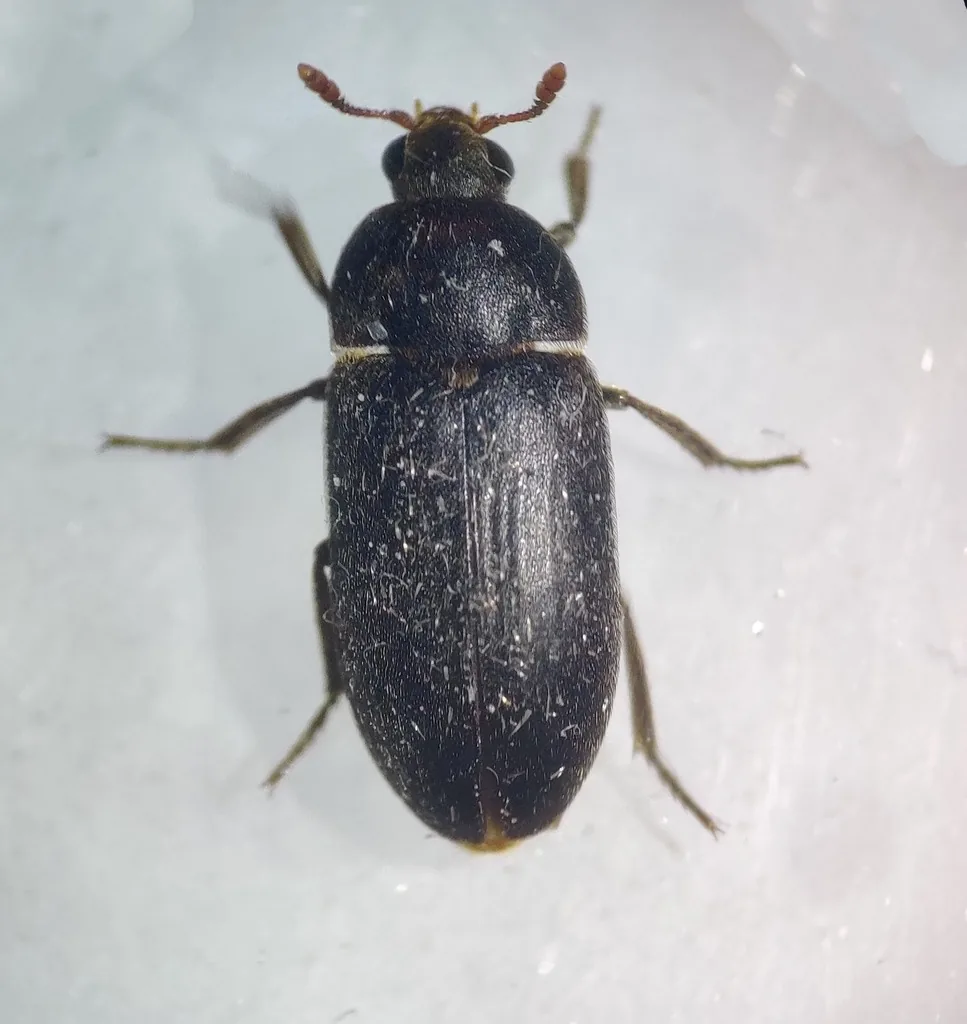
How to identify it
Look-alikes
| Look-alike | How to tell them apart |
|---|---|
| Larder beetle | The larder beetle's underside is lighter; this species has dark brown patches underneath.[1] |
| Hide beetle | The hide beetle larva's rear spines curve inward; this species' spines point straight up.[1] |
Where it lives
Native to North America and Hawaii, it's now found in all regions of the world.[1]
Biology and life cycle
Larvae take about 19 days to develop in heat and about 50 days at cooler temperatures.[1]
Adults and larvae are cannibalistic.[1]
Damage and signs
- It damages cheese, dried fish, leather, silk, wool and milk powder, and feeds on dead insects and animals.[1]
Health risk
UF/IFAS mentions no direct risk to people; it can be an intermediate host of poultry tapeworms.[1]
Control
Prevention
Inspect kitchens, pantries, garages, basements, attics and crawlspaces for stored meat, cheese, pet food and dead animals.[1]
Keep them out
Install screens and seal cracks and crevices to keep beetles out.[1]
Sanitation
Good sanitation is the best way to prevent and control it.[1]
Traps and physical control
Pheromone traps and cold or heat treatment can help.[1]
When to call a professional
For a severe infestation, fumigation may be the best method.[1]
Common questions
Sources
- University of Florida IFAS Extension (Featured Creatures), “Black Larder Beetle, Dermestes ater (EENY-480).” edis.ifas.ufl.edu/publication/IN866 (accessed 2026-10-06)
- iNaturalist, “Dermestes ater taxon page (order and family).” www.inaturalist.org/taxa/218262 (accessed 2026-10-06)