On this page
How to identify it
- Males are long and narrow with thin legs and antennae, and their wing covers meet only along the top third before spreading apart to show the abdomen.[2][1]
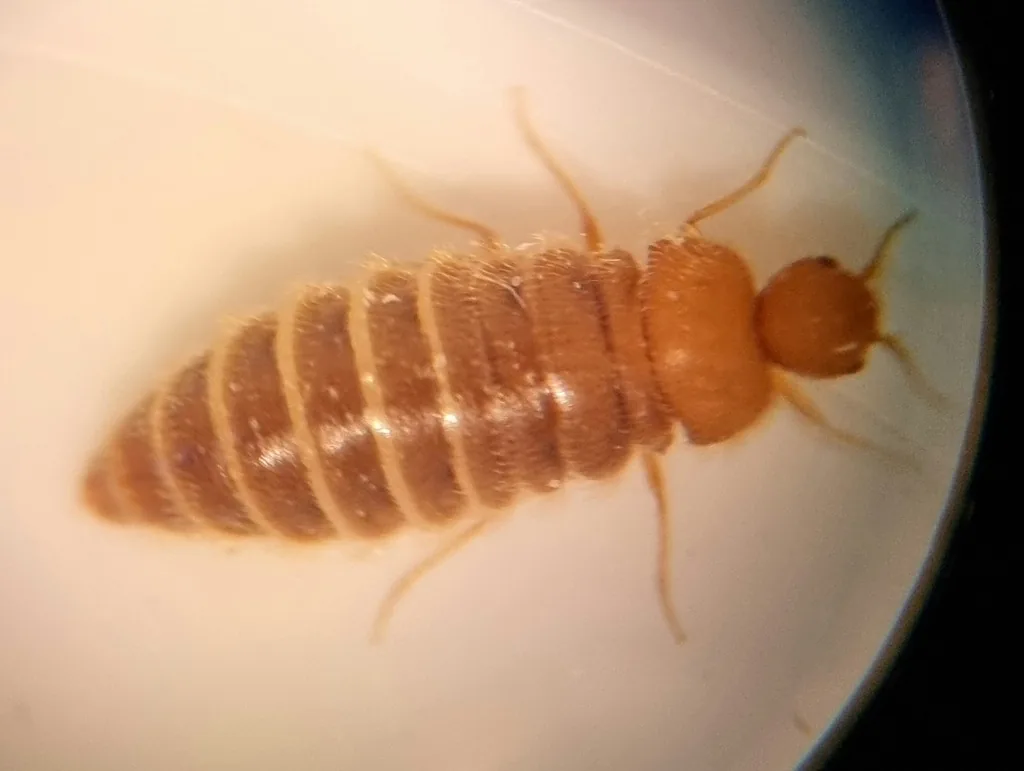
- Females have no wings or wing covers and look like a larva; the University of Arkansas gives average lengths of about 2.9 mm for males and 4.4 mm for females, while MuseumPests.net gives 2 to 3 mm for both.[1][2]
- Larvae are about 3 mm long when full grown, with a row of hairs across each segment, and curl into a C shape when disturbed.[2]
Look-alikes
| Look-alike | How to tell them apart |
|---|---|
| Carpet beetle larvae | Odd beetle larvae look like other carpet beetle larvae but lack the long hairs at the tip of the abdomen and the coat of short hairs on the upper body, and they curl into a C when disturbed.[2] |
Where it lives
Native to Central Asia and spread by people, since the females can't fly; it is now found worldwide in buildings, where it depends on indoor environments in North America.[2][1]
Biology and life cycle
The life cycle usually lasts about a year or a little longer: eggs hatch after 23 to 30 days, and the insects spend most of their lives as larvae.[2][1]
The life cycle can range from about half a year to nearly four years, and larvae can survive three to four years without food.[1]
Damage and signs
- Larvae feed on dry animal matter such as skins, fur, feathers, dead and pinned insects, bird nests and natural fiber fabrics like silk and wool, and they can chew through tissue paper and fabric while searching for food or a place to pupate.[2][1]
- Signs of an infestation are damaged items, droppings and shed larval skins.[2]
Health risk
None of the sources reports bites or harm to people; it damages stored animal materials.[1][2]
Control
Prevention
Natural-history and textile collections are the most vulnerable, so check feathers, furs, wool and insect collections regularly for damage, droppings and shed skins.[2]
Sanitation
The most reliable approach for dermestid beetles is to find and remove the infested items, then clean the area thoroughly.[3]
Common questions
- What is the larva-like bug with long legs in my drawer?
- A small insect that looks like a larva but has long legs and antennae may be a female odd beetle; the males are slender winged beetles.[1][2]
- What do odd beetles eat?
- The larvae feed on dry animal matter such as dead insects, feathers, fur and wool.[2][1]
Sources
- University of Arkansas Arthropod Museum, “Odd beetle (Arthropod Museum notes).” arthropod.uark.edu/odd-beetle/ (accessed 2026-10-17)
- Integrated Pest Management Working Group (MuseumPests.net), “Fact Sheet: Odd Beetle (information current as of April 16, 2007).” museumpests.net/wp-content/uploads/2014/03/Odd-Beetle.pdf (accessed 2026-10-17)
- Colorado State University, College of Agricultural Sciences, “Dermestid beetles (IPM pests).” agsci.colostate.edu/agbio/ipm-pests/dermestid-beetles/ (accessed 2026-10-17)
- iNaturalist, “Thylodrias contractus taxon page (order and family).” www.inaturalist.org/taxa/232585 (accessed 2026-10-06)