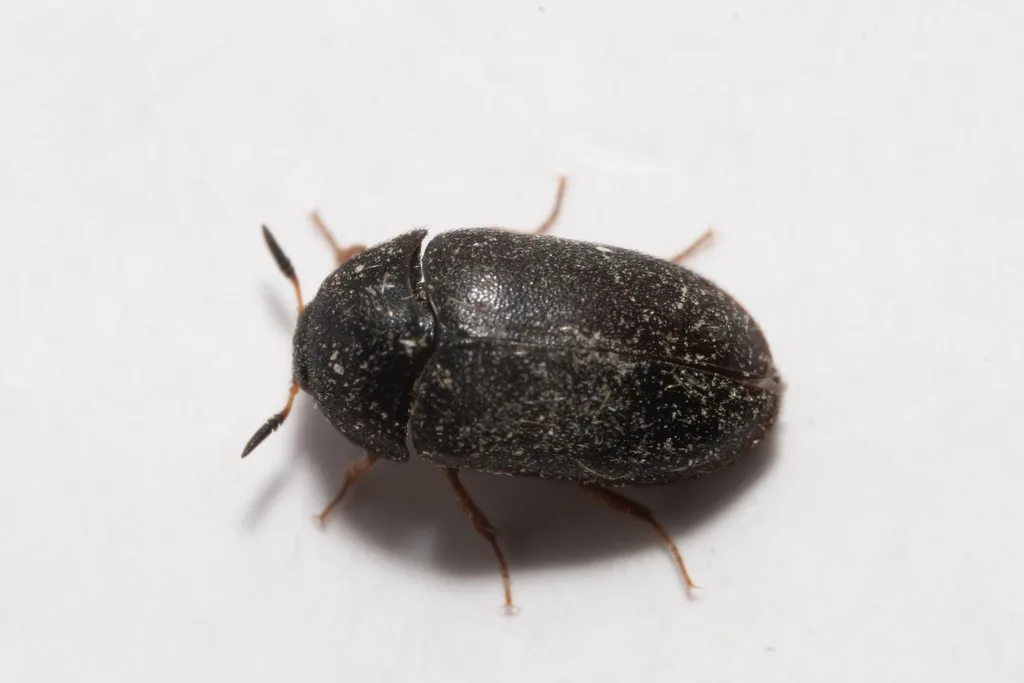
How to identify it
- Adults are oval, shiny black to dark brown beetles with brownish legs, about 1/8 to 3/16 inch long.[1][2]
- Larvae are golden to dark brown, shiny, smooth and hard, covered in short stiff hairs, and grow to about 5/16 to 1/2 inch.[1][2]
- The larva's body tapers toward the rear like a carrot or cigar and ends in a long tuft of bristles.[1][2][3]
- Larvae leave brown, shell-like, bristly cast skins where they feed, and they spin no webbing.[1]
Look-alikes
| Look-alike | How to tell them apart |
|---|---|
| Varied carpet beetle | Adults are smaller and nearly round, mottled gray with white, brown and yellow scales; its larvae are about 1/4 inch and wider at the rear.[2] |
| Furniture carpet beetle | Adults are nearly round and whitish, checkered with black spots outlined in yellow-orange scales, with yellow-scaled legs.[2] |
| Webbing clothes moth | Moth damage tends to be scattered holes with webbing, while carpet beetles chew a larger area in one spot and leave cast skins.[1] |
Where it lives
Found in homes, warehouses and museums; extension guides from California, Ohio and South Carolina all list it among the common household carpet beetles.[1][2][3]
Biology and life cycle
A female usually lays about 90 eggs, more than other common carpet beetles, and the eggs hatch in roughly one to two weeks.[1]
Larvae feed for about 166 to 330 days before pupating, and adults live 4 to 8 weeks; there may be only one generation a year.[1][2]
Larvae avoid light and feed in dark, undisturbed places such as under baseboards and heavy furniture, along carpet edges and in air ducts.[2][1]
Adults feed on flower pollen outdoors, are drawn to light, fly in through open windows and doors, and also ride in on cut flowers.[1][2]
Damage and signs
- Larvae eat wool, silk, leather, fur, feathers, pet hair and natural-bristle brushes, but not synthetic fibers.[1]
- They also infest grains, flour, cereals, dry pet food and other stored foods, and cotton or rayon stained with spilled food or animal waste.[2][1]
- Piano felts and hammers can be damaged badly enough to affect the instrument's tone.[1]
Health risk
Carpet beetles are a damage pest: adults feed on pollen and nectar, and the larvae damage fabrics, furs and stored foods.[1]
Control
Prevention
Store clean woolens and furs in tightly sealed containers; cedar chests alone are not reliable protection.[1][2]
Keep them out
Keep window screens, doors and vents tight, and check cut flowers for beetles before bringing them inside.[1]
Sanitation
Vacuum rugs, upholstery, closets, baseboards and vents often and thoroughly, and empty the vacuum promptly because it can hold eggs and larvae.[1][2]
Remove lint, hair and dead insects, discard badly infested items, and clear out old bird, rodent and wasp nests that can harbor larvae.[1][2]
Traps and physical control
Wash washable items in hot water or dry-clean them; items that tolerate it can be frozen for two weeks below 18 degrees F or heated to 120 degrees F for 30 minutes.[1]
Pesticides
If needed, spot-treat carpet edges, closet floors and cracks with a product labeled for carpet beetles; don't spray clothing or bedding.[1]
Total-release foggers generally don't reach the cracks where larvae hide.[2]
When to call a professional
Hair- or feather-stuffed furniture and pillows can be fumigated in a vault by a licensed pest control, dry-cleaning or storage firm.[1]
Common questions
- I found a few small black beetles on a windowsill. Should I worry?
- A few adult carpet beetles indoors aren't cause for alarm; take action if you find larvae developing in fabrics or other materials.[1]
- Can black carpet beetles get into my pantry?
- Yes. Besides fabrics, the larvae feed on grains, flour, cereals and pet food, and in dry climates they are mainly a stored-food pest.[1][2]
- Where should I look for the source?
- Use a flashlight under baseboards, in upholstered furniture, air ducts, closets and stored cereals; cast skins are often easier to find than larvae.[2]
Sources
- University of California Statewide IPM Program, “Pest Notes: Carpet Beetles, Publication 7436 (web version).” ipm.ucanr.edu/home-and-landscape/carpet-beetles/ (accessed 2026-10-06)
- Ohio State University Extension (David J. Shetlar), “Carpet Beetles, HYG-2103 (October 2011).” ohioline.osu.edu/factsheet/HYG-2103-10 (accessed 2026-10-06)
- Clemson Cooperative Extension, Home and Garden Information Center, “Controlling Fabric Pests (HGIC).” hgic.clemson.edu/factsheet/controlling-fabric-pests/ (accessed 2026-10-06)
- iNaturalist, “Attagenus unicolor taxon page (order and family).” www.inaturalist.org/taxa/1571455 (accessed 2026-10-06)