The short answer
- Inspect every package, especially opened ones; webbing in corners or tiny holes in containers are signs. Throw out anything infested.[2]
- Vacuum the corners and crevices of cupboards and wash shelves with soap and water.[2]
- Store dry foods and pet food in containers with tight lids, not plastic bags, and keep rarely used flour, spices and grains in the freezer.[2]
- Keep using pheromone traps after cleanup; pantry pests can live for weeks without food. Check them weekly.[2]
Pantry pest profiles
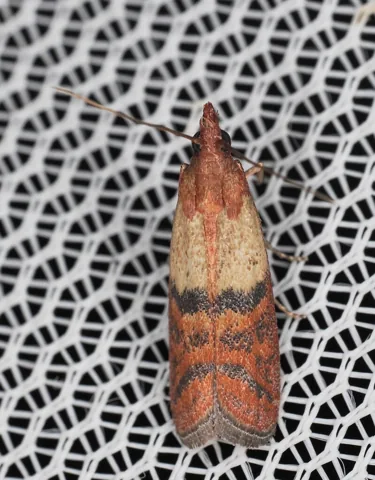 Indianmeal Moth
Plodia interpunctella
The Indianmeal moth is the most common moth infesting stored food in the home; all damage is done by the larvae, which feed in cereals, flour, nuts, dried fruit, chocolate and pet food.
Sourced profile →
Indianmeal Moth
Plodia interpunctella
The Indianmeal moth is the most common moth infesting stored food in the home; all damage is done by the larvae, which feed in cereals, flour, nuts, dried fruit, chocolate and pet food.
Sourced profile →
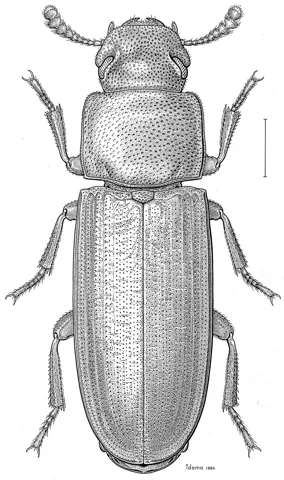 Confused Flour Beetle
Tribolium confusum
The confused flour beetle is a common pantry pest that feeds on flour, cereals, broken grain, nuts, dried fruit and many other dry foods.
Sourced profile →
Confused Flour Beetle
Tribolium confusum
The confused flour beetle is a common pantry pest that feeds on flour, cereals, broken grain, nuts, dried fruit and many other dry foods.
Sourced profile →
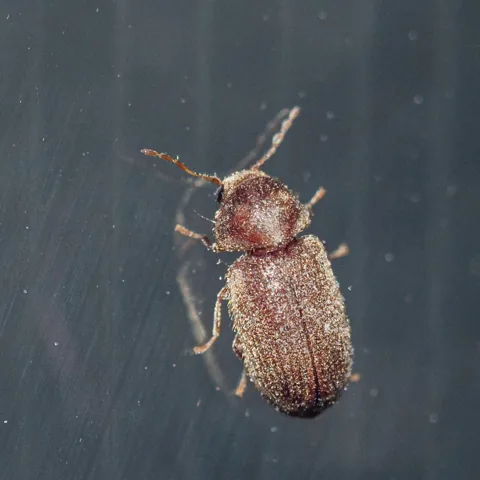 Drugstore Beetle
Stegobium paniceum
The drugstore beetle is a very general feeder said to "eat anything except cast iron"; in homes it most often infests pet food, drugs, cereals and spices.
Sourced profile →
Drugstore Beetle
Stegobium paniceum
The drugstore beetle is a very general feeder said to "eat anything except cast iron"; in homes it most often infests pet food, drugs, cereals and spices.
Sourced profile →
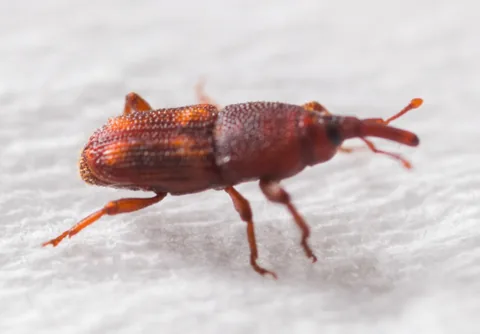 Rice Weevil
Sitophilus oryzae
Rice and granary weevils develop inside whole grains and seeds. Weevils in the house usually mean an infested package of whole grain or seed somewhere, such as popcorn, dried beans, saved seeds or decorative corn.
Sourced profile →
Rice Weevil
Sitophilus oryzae
Rice and granary weevils develop inside whole grains and seeds. Weevils in the house usually mean an infested package of whole grain or seed somewhere, such as popcorn, dried beans, saved seeds or decorative corn.
Sourced profile →
Indian meal moth
The most common pantry moth: 1/3 to 2/5 inch long with reddish-brown forewings that shine coppery on the outer two-thirds. Larvae leave silk webbing wherever they crawl and may wander far from the food to pupate. Clothes moths are smaller and hairier.[2]
Pantry beetles
- Sawtoothed and merchant grain beetles: slender, flat, brown, about 1/10 inch, with six sawlike teeth on each side of the thorax; they eat almost any plant-based food, including pet food, bird seed and rodent bait, and adults live 6 to 10 months on average, some up to 3 years.[2]
- Confused and red flour beetles: shiny reddish brown, about 1/7 inch; the red flour beetle's antennae end in an abrupt three-segment club. Adults can live about a year, some nearly four.[2]
- Cigarette and drugstore beetles: about 1/8 inch, cylindrical and light brown; the drugstore beetle has grooved wing covers. Both infest spices, pet food, cereals and dried decorations, and the drugstore beetle feeds on medicines too.[2]
- Warehouse beetle: oval, about 1/8 inch, with a brown and yellow pattern. Its larvae shed hairs that can irritate the mouth, throat and gut, so throw out anything it has infested.[2]
- Rice and granary weevils, lesser grain borers and bean weevils develop inside whole seeds and grains and are managed the same way.[2]
Grain mites
- Grain mites feed on flour, wheat germ, yeast, cheese, powdered milk and mold, multiplying fast in hot, humid conditions; a fine, dust-like layer of mites on a shelf usually means a heavily infested package nearby.[3]
- Find and discard infested items, wipe every item and shelf with hot, soapy water, vacuum cracks, and lower the humidity. There are no good chemical solutions, and insecticides aren't recommended in kitchens.[3]
Larder beetles
- Adults are dark brown, about 1/3 inch, with a band of pale yellow hairs across the front half of the wing covers, usually with six dark spots; the hairy brown larvae have two curved spines at the tail.[1]
- They feed on animal products such as dried dog food, cured meats, cheese, fur, hides and feathers, and on dead insects that pile up in attics and wall voids after overwintering, which is how many homes get them.[1]
- Mature larvae bore into nearby materials, even wood, to pupate. Clean out and discard infested food, store attractive foods in tight jars or cans, and heat (140°F for 30 minutes) or freeze (0°F for 3 to 4 days) valuable infested items.[1]
Booklice (psocids)
- Psocids are tiny, 1/25 to 1/8 inch, pale to gray insects that aren't true lice; they feed on mold and fungi and favor warm, damp, undisturbed places, including damp books, cardboard and stored food.[4][5]
- They're a nuisance and a sign of excess moisture: reduce humidity, vacuum, clean up spilled food and buy dry goods in amounts you'll use within a few months.[5][4]
Photo credits
- Indianmeal Moth: (c) Rosario Douglas, some rights reserved (CC BY) — via iNaturalist, CC BY 4.0
- Confused Flour Beetle: Bousquet et al. 2018, Catalogue of Tenebrionidae of North America, ZooKeys 728, Figure 30 (CC BY 4.0) — via Wikimedia Commons, CC BY 4.0
- Drugstore Beetle: (c) Arsen Vorobei, some rights reserved (CC BY) — via iNaturalist, CC BY 4.0
- Rice Weevil: (c) portioid, some rights reserved (CC BY) — via iNaturalist, CC BY 4.0
Sources
- Penn State Extension, “Larder Beetle (updated June 24, 2026).” extension.psu.edu/larder-beetle (accessed 2026-10-06)
- University of California Statewide IPM Program, “Pantry Pests (Pest Notes, Home and Landscape).” ipm.ucanr.edu/home-and-landscape/pantry-pests/ (accessed 2026-10-06)
- University of Kentucky Entomology, “ENTFACT-629: Grain Mites (revised March 2026).” entomology.mgcafe.uky.edu/ef629 (accessed 2026-10-06)
- Washington State University PestSense, “Psocids (booklice or barklice).” pestsense.cahnrs.wsu.edu/fact-sheet/psocids-booklice-or-barklice/ (accessed 2026-10-06)
- Utah State University Extension, “Booklice and Psocids (Structural Pest ID Guide).” extension.usu.edu/planthealth/ipm/structural-pest-id-guide/booklice-psocids (accessed 2026-10-06)