On this page
How to identify it
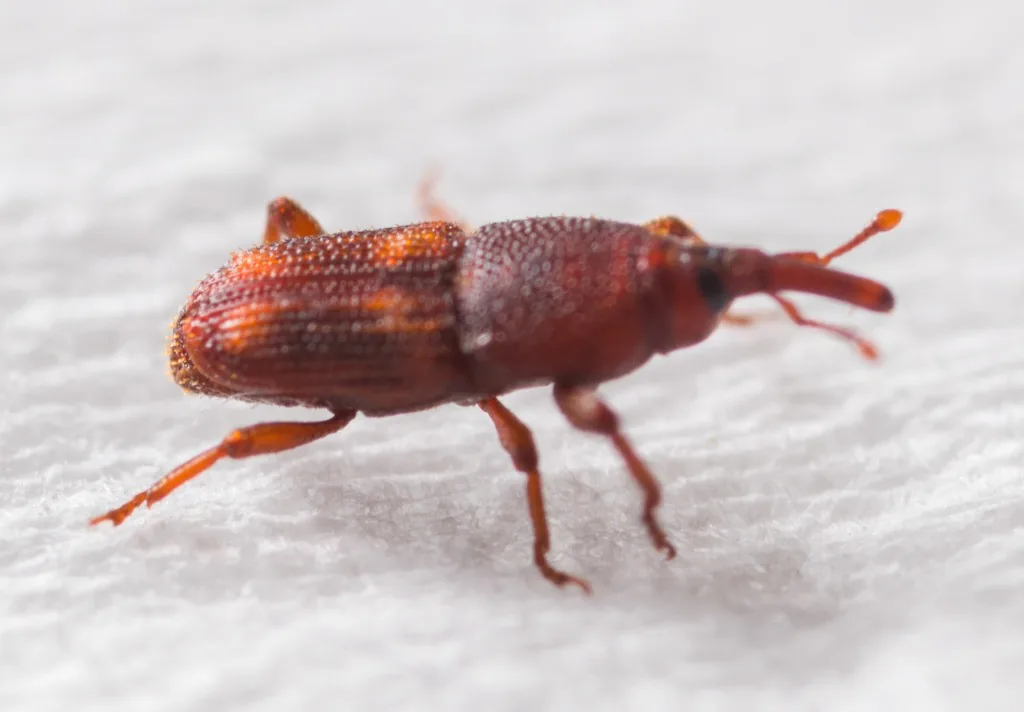
- Adults are small, slender, hard-shelled snout beetles covered with tiny pits: Iowa State gives about 1/8 inch and brown to reddish brown, and Kentucky 1/8 to 1/4 inch and reddish brown to black.[1][3]
- The rice weevil has four faint yellowish spots on the wing covers (Washington State describes two light spots on each wing cover); the granary weevil is uniformly colored and its wings don't work.[1][4]
- Larvae are white, legless, grub-like and live hidden inside kernels; there's no outside sign until the adult chews out through the seed coat.[1][3]
Look-alikes
| Look-alike | How to tell them apart |
|---|---|
| Flour beetles | Flour beetles have no snout and infest flour and broken grain products rather than developing inside whole kernels. Kentucky notes that flour beetles can't attack whole or undamaged grain.[2][1][3] |
| Granary weevil | Same size, food and life cycle, but uniformly colored with no spots, slightly larger, and unable to fly. Washington State says it is more common in cooler climates and the rice weevil in warmer ones.[1][4] |
Where it lives
Canada's Grain Commission says the rice weevil is distributed worldwide and across Canada; it prefers tropical or subtropical conditions but can survive in temperate regions in protected places. Washington State University Extension says it is most abundant in warmer climates, while the granary weevil is more common in cooler ones, and both do well in heated buildings. Unlike the granary weevil, the rice weevil has working wings and can fly considerable distances.[6][4]
Biology and life cycle
The female chews a small hole in a kernel of wheat, corn, rice or another grain, lays one egg in it and seals the opening with a glue-like substance. Washington State says she can lay as many as 250 eggs in a lifetime of about eight months, and that in warm conditions egg to adult takes four weeks; Kentucky says as little as 1 month.[4][3]
There's usually no outside sign until about a month later, when adults chew out through the seed coat.[1]
Kentucky says adults can live 6 to 8 months and may be found some distance from the infested food.[3]
Rice weevils have working wings and can fly considerable distances, so they may come from an infested package somewhere else in the house. Both weevils do well in heated buildings.[4]
Damage and signs
Health risk
Iowa State says rice and granary weevils can't bite or sting and won't feed on furniture or the house itself; the harm they do is destroying the seeds they infest.[1]
Control
Prevention
Store susceptible foods in sealable glass, metal or heavy plastic containers, or in the refrigerator or freezer, until you're sure they're gone. Washington State also suggests buying dried foods in amounts you'll use up quickly and using older packages first, and Clemson suggests buying no more than about a two-month supply.[1][4][5]
Washington State says there's no evidence that bay leaves or sticks of spearmint gum in a cupboard keep stored-food insects away.[4]
Sanitation
Find and get rid of every infested whole-grain or seed item, including bean bags, seed decorations and old grain-based mouse bait. Washington State suggests checking the top of each product with a flashlight or pouring it onto a cookie sheet to look for weevils.[1][4]
Empty and vacuum the shelves, especially cracks and corners. Washing shelves with bleach or detergent doesn't affect the insects, and sprays aren't recommended in food cupboards. Washington State adds that household insecticides don't reach insects inside food packages.[1][4]
Traps and physical control
Small amounts can be saved with heat or cold, but the times differ by source: Iowa State says 140°F for 15 minutes or 0°F for 3 days kills all stages; Washington State gives 130°F for 30 minutes or -1°F for at least 5 hours; Kentucky gives 155°F for about 20 minutes or 0°F for 4 days for decorative items and bird seed.[1][4][3]
Where sources disagree
Heat and cold: 140°F for 15 minutes or 0°F for 3 days (Iowa State), 130°F for 30 minutes or -1°F for at least 5 hours (Washington State), or 155°F for about 20 minutes or 0°F for 4 days (Kentucky). Spots: four faint spots on the wing covers (Iowa State) or two on each wing cover (Washington State). Size: about 1/8 inch (Iowa State, Washington State) or up to 1/4 inch (Kentucky).[1][4][3]
Common questions
- Where are the weevils in my kitchen coming from?
- Almost always from a package of whole grain or seeds they developed inside. Check popcorn, rice, dried beans, bird seed and decorative corn.[1]
- Can rice weevils fly?
- Yes. Washington State says rice weevils have working wings and can fly considerable distances, while the granary weevil's wings don't work.[4]
- Should I spray the cupboard for weevils?
- No. Iowa State and Washington State say insecticide sprays aren't recommended in food cupboards; get rid of the infested grain, vacuum and store food in sealed containers.[1][4]
Sources
- Iowa State University Extension and Outreach, “Rice Weevil and Granary Weevil (Yard and Garden).” yardandgarden.extension.iastate.edu/encyclopedia/rice-weevil-and-granary-weevil (accessed 2026-11-11)
- University of California Statewide IPM Program, “Pest Notes: Pantry Pests, Publication 7452 (March 2013).” ipm.ucanr.edu/legacy_assets/PDF/PESTNOTES/pnpantrypests.pdf (accessed 2026-11-11)
- University of Kentucky Entomology, “Stored Product Pests in the Pantry (ENTFACT-612).” entomology.mgcafe.uky.edu/ef612 (accessed 2026-11-11)
- Washington State University Extension, “The Granary Weevil (Skagit County Master Gardener column).” wpcdn.web.wsu.edu/extension/uploads/sites/57/2014/03/011411.pdf (accessed 2026-11-11)
- Clemson Cooperative Extension, Home & Garden Information Center, “Pantry Pests (HGIC 2439).” hgic.clemson.edu/factsheet/pantry-pests/ (accessed 2026-11-11)
- Canadian Grain Commission (Government of Canada), “Rice weevil (Identify an insect: primary insect pests).” grainscanada.gc.ca/en/grain-quality/manage/identify-an-insect/primary-insect-pests/rice-weevil.html (accessed 2026-11-11)
- iNaturalist, “Sitophilus oryzae taxon page (order and family).” www.inaturalist.org/taxa/231087 (accessed 2026-11-11)