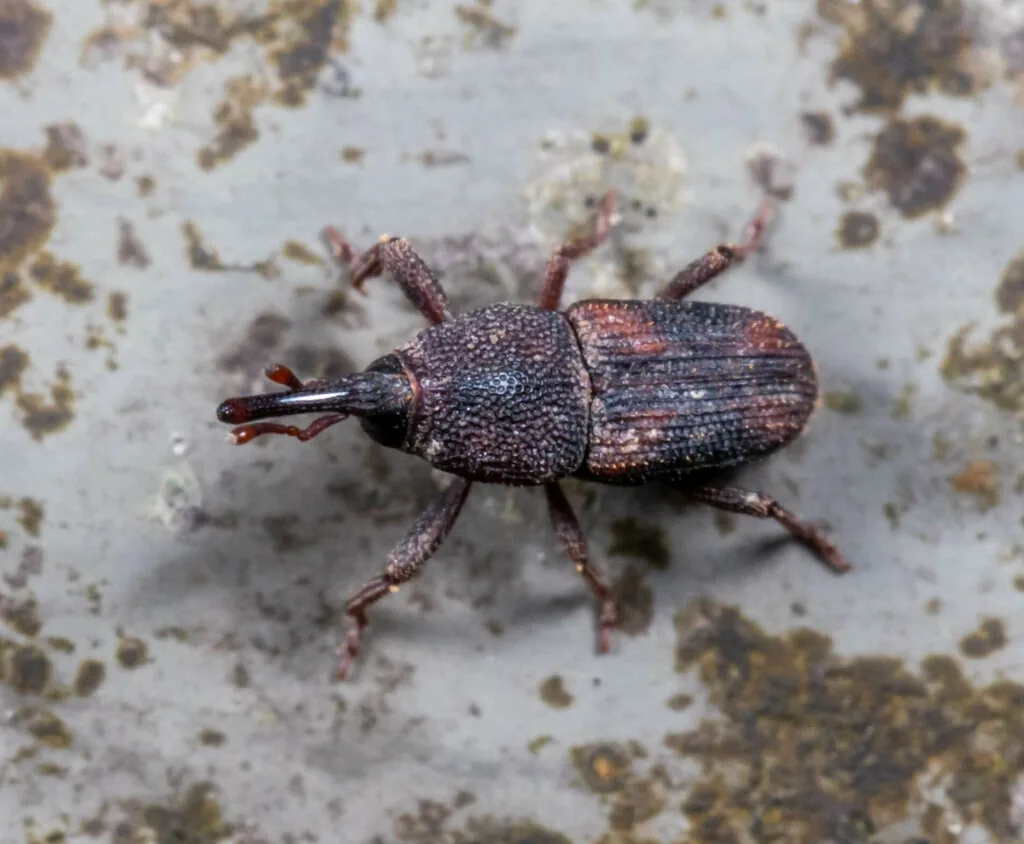
How to identify it
- A snout beetle, with its chewing mouthparts at the tip of a long snout.[1][2]
- Adults are about 2.3 to 2.9 millimeters long, slightly smaller than the rice weevil.[1]
- The wing covers carry small, distinct colored spots, and the thorax is covered with deep pits.[2][1]
- Unlike the rice weevil, the maize weevil usually has pits along the midline of the thorax too.[1][2]
- Adults can fly, and when disturbed they pull their legs in and stay motionless.[2]
Look-alikes
| Look-alike | How to tell them apart |
|---|---|
| Rice weevil | Nearly identical in looks and habits; the rice weevil is a bit larger and its thorax midline is usually free of pits. Precise identification is best left to experts.[1][2] |
| Granary weevil | Slightly larger at about 3/16 inch, with no spots on the wing covers, long oval pits on the thorax, and no ability to fly.[2][3] |
Where it lives
Worldwide in distribution, like the other grain weevils in its genus, wherever whole grain is stored.[1][2]
Biology and life cycle
Females lay 80 to 200 eggs on kernels or in holes made by other insects, and each newly hatched larva bores in and stays inside until it emerges as an adult.[2]
Two or three larvae can develop in one corn kernel, but only one adult comes from a kernel of smaller grains.[2]
Adults chew out through a small round hole; development from egg to adult takes about 30 days at 86 degrees F and about 40 days at 77 degrees F.[2]
The life cycle can be completed in as little as 30 days, so numbers build fast in warm storage.[1]
Damage and signs
- Attacks all cereal grains; Purdue lists corn, oats, barley, rye and wheat as most common, and UF notes it is more often found in wheat than the rice weevil is.[2][1]
- It can't breed in finely processed flour but readily breeds in macaroni, noodles and milled cereals that have caked from moisture.[2]
- Each larva feeds and pupates inside a kernel, and the adult leaves a small round exit hole.[2]
Health risk
Texas A&M AgriLife describes its close relative the rice weevil as medically harmless; the damage is to the infested grain.[3]
Control
Prevention
Move dry goods from paper, cardboard or thin plastic into jars or containers that seal tightly.[4]
Sanitation
General pantry-pest advice applies: find and discard the infested items; killing the adults you see doesn't solve the problem while the source remains.[4]
Check every grain product, including forgotten bags at the back of shelves, decorative items and bird seed, then vacuum shelves and cracks with a crevice tool.[4]
Traps and physical control
Decorative items such as Indian corn can be heated at 155 degrees F for about 20 minutes or frozen at 0 degrees F for 4 days.[4]
When to call a professional
Because the young develop inside kernels, surface insecticides kill only exposed adults; bulk grain needs fumigation, which is professional work.[2]
Common questions
- How can I tell a maize weevil from a rice weevil?
- Not easily. They look and behave almost the same; the maize weevil is slightly smaller and usually has pits on the thorax midline. UF advises leaving precise identification to experts.[1][2]
- Why do I keep seeing weevils after cleaning the pantry?
- Larvae develop hidden inside kernels, so an infested item you missed keeps producing adults. Kentucky stresses a thorough search, including decorations and bird seed.[2][4]
Sources
- University of Florida, Entomology and Nematology Department, “Maize weevil, Sitophilus zeamais (stored product pests image gallery).” entnemdept.ufl.edu/projex/gallery/dl/stored_product_pests/text/maize_weevil.htm (accessed 2026-10-06)
- Purdue University Extension Entomology, “E-237: Rice, Granary, and Maize Weevils (November 2018).” www.extension.entm.purdue.edu/publications/E-237/E-237.html (accessed 2026-10-06)
- Texas A&M AgriLife Extension, “Rice weevil, Sitophilus oryzae (Field Guide to Common Texas Insects).” texasinsects.tamu.edu/?p=247 (accessed 2026-10-06)
- University of Kentucky Entomology, “ENTFACT-612: Stored Product Pests in the Pantry.” entomology.mgcafe.uky.edu/ef612 (accessed 2026-10-06)
- iNaturalist, “Sitophilus zeamais taxon page (order and family).” www.inaturalist.org/taxa/231088 (accessed 2026-10-06)