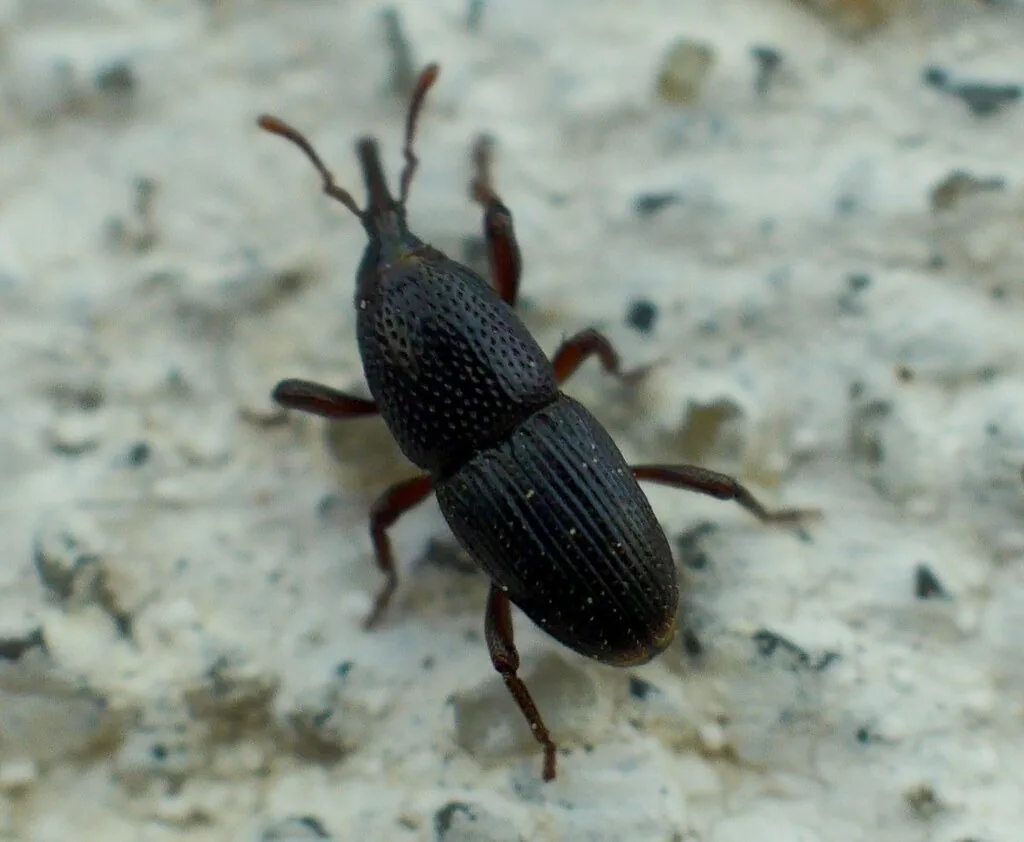
How to identify it
- A snout beetle with its chewing mouthparts at the tip of a long snout.[1][3]
- Adults are about 1/8 to 3/16 inch long, shiny reddish brown to black-brown, and uniformly colored with no spots.[1][3][2]
- The thorax has elongated oval pits, which separate it from the round-pitted rice weevil.[1][3]
- Adults can't fly, and when disturbed they draw up their legs and play dead.[3][1]
Look-alikes
| Look-alike | How to tell them apart |
|---|---|
| Rice weevil | Has round pits on the thorax, four reddish to yellowish spots on the wing covers, and can fly.[3][2] |
| Maize weevil | Also has colored spots on the wing covers and can fly; the granary weevil has neither spots nor working flight.[3] |
Where it lives
Common in cooler regions of the world; in the U.S. it is not often found south of North Carolina, and it spreads mainly in grain moved by people.[1][3]
Biology and life cycle
Females lay about 80 to 200 or more eggs on grain kernels, and each newly hatched larva bores in and stays inside until it emerges as an adult.[3][1]
Larvae are small, white, legless grubs, and there is usually no outside sign of them until the adult chews out through the seed coat.[2][1]
The life cycle takes one to five months, depending on temperature, and there are commonly four generations a year.[1]
The University of Florida reports adults living seven to eight months.[1]
Damage and signs
- Feeds mainly on whole grains such as wheat, corn, oats, barley and rye, and can also infest beans, nuts, seeds and pasta.[1][3]
- It can't breed in finely processed flour but will breed in pasta and milled cereals that have caked from moisture.[3]
- In homes the source is usually whole grain or seeds: popcorn, dried beans, saved garden seed, decorative corn, bean bags or old grain-based mouse bait.[2]
Health risk
Granary weevils can't bite or sting, don't carry disease, and won't damage furniture, clothing or the house; the harm is to the seeds they infest.[2]
Control
Prevention
Store seeds and grains in sealed glass, metal or heavy plastic containers, or in the refrigerator or freezer, until you're sure the problem is gone.[2]
Sanitation
Find and get rid of the infested whole grain or seed; that is the only real fix in a home.[2]
Empty and vacuum the cupboards, paying attention to cracks and corners; washing shelves with detergent or bleach has no effect on the insects.[2]
Traps and physical control
Small amounts of grain can be saved by heating to 140 degrees F for 15 minutes or freezing at 0 degrees F for 3 days.[2]
Pesticides
Insecticide sprays aren't recommended in food cupboards; surface treatments only kill exposed adults, because the young are inside the kernels.[2][3]
When to call a professional
Larger quantities of infested grain may need disposal or professional fumigation.[2][3]
Common questions
- Is a granary weevil the same as a rice weevil?
- They are close relatives with similar habits, but the granary weevil has no spots, has oval pits on the thorax, and can't fly.[3][2]
- Can I still eat grain that had weevils in it?
- Iowa State says the weevils are harmless to people and that small amounts of grain can be saved by heating or freezing it; larger amounts may need to be discarded.[2]
Sources
- University of Florida, Entomology and Nematology Department, “Granary weevil, Sitophilus granarius (stored product pests image gallery).” entnemdept.ufl.edu/projex/gallery/dl/stored_product_pests/text/granary_weevil.htm (accessed 2026-10-06)
- Iowa State University Extension and Outreach, “Rice Weevil and Granary Weevil (Yard and Garden).” yardandgarden.extension.iastate.edu/encyclopedia/rice-weevil-and-granary-weevil (accessed 2026-10-06)
- Purdue University Extension Entomology, “E-237: Rice, Granary, and Maize Weevils (November 2018).” www.extension.entm.purdue.edu/publications/E-237/E-237.html (accessed 2026-10-06)
- iNaturalist, “Sitophilus granarius taxon page (order and family).” www.inaturalist.org/taxa/231086 (accessed 2026-10-06)