On this page
How to identify it
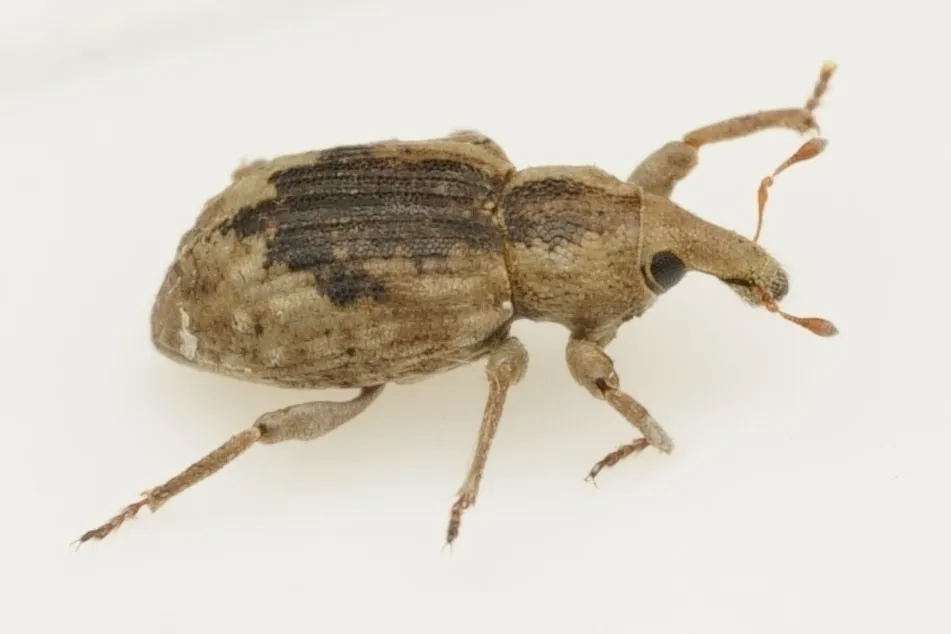
- Adults are about 1/8 inch (4 mm) long with a prominent snout. They are gray with a dark patch on the back that runs from the base of the head to the middle of the wing covers.[1]
- Adult feeding leaves narrow scars or slits running lengthwise on the upper surface of rice leaves.[1]
- Larvae are legless and milky white with light-brown heads, and have spinelike hooks on the back that they push into roots to get oxygen. They live in the soil among the roots.[1]
- Pupae form in small mud-coated cocoons attached to the roots of rice, sedges or grasses.[1]
Where it lives
Native to the southern and eastern United States. In California it occurs in the Sacramento Valley and the upper and central San Joaquin Valley. Populations that reproduce without males have spread to rice areas in Europe and Asia.[3][1][2]
Biology and life cycle
Adults spend the winter at the base of grass clumps, in weedy debris, on levees and ditch banks and in soil cracks. When daytime temperatures rise above 70°F in late winter or spring, they feed on grasses, then fly on calm, warm evenings to plants growing in water, especially flooded rice.[1]
California has no males; females lay fertile eggs without mating. In southern Texas both mating and all-female populations occur.[1][3]
Females lay eggs one at a time under water inside the leaf sheath, and one female may lay more than 200 eggs over several weeks. Adults lay eggs only after the field is flooded, and plants in deep floods receive more eggs than plants in shallow floods.[1][2]
Eggs hatch in about 7 days. Young larvae mine the leaf sheath for about a day, then move into the soil and feed on roots through four larval stages. Egg to adult takes about 78 days at 73°F in the lab and at least 60 to 65 days in the field.[1]
New adults emerge from early July to late September. A few lay eggs in July or August, but most enter a resting state and fly to overwintering sites. In California there is one generation a year.[1]
Damage and signs
- Root pruning by larvae stunts plants, reduces the number of tillers and panicles, delays maturity and lets weeds get established, all of which cut yield.[1]
- Damage is heaviest from late May to July within 15 to 20 feet of field edges and levees, where the weevils concentrate, with moderate damage 20 to 35 feet in.[1]
- Adult leaf feeding usually does not cause economic loss, though large numbers feeding on seedlings just emerging through shallow water may kill some. Infestations in Missouri, Arkansas and Mississippi tend to be less severe than in south Louisiana.[1][2]
Health risk
The sources describe it only as a rice pest; they mention no harm to people.[1][2]
Control
Prevention
Dry or drill seeding, with the field kept moist for 4 to 6 weeks before flooding, means plants are older and more tolerant when the weevils arrive. Winter flooding for straw breakdown and waterfowl can cut weevil numbers by about half, and larger, laser-leveled fields have less of the edge area the weevils prefer.[1]
In field trials in three mid-southern states, plots with a shallow flood had about 20 percent fewer larvae and pupae three weeks after flooding than deep-flooded plots.[2]
Early, effective weed control helps rice recover from root pruning, since injured plants tiller less.[1]
Sanitation
Remove weedy vegetation on levees in spring, near the time of seeding, and control weeds around the field to reduce infestations.[1]
Pesticides
In fields with a history of damaging populations, UC IPM lists lambda-cyhalothrin, zeta-cypermethrin and diflubenzuron as treatments applied after flooding against adults, often only to the 30 to 50 feet next to levees. They do not kill larvae, so timing is critical; follow the label and local guidelines.[1]
Common questions
- Why is my rice stunted along the levees?
- Rice water weevil larvae are a likely cause. The weevils concentrate within about 15 to 20 feet of levees and field edges, where larval root feeding from late May to July does the most damage.[1]
- If I only see a few leaf scars, can I ignore rice water weevil?
- Not always. Eggs can be laid before plants emerge from the water, so serious root injury can occur even when few adult feeding scars are visible. UC IPM bases treatment decisions mainly on the field's history and its nearness to overwintering sites such as ditch banks and weedy canal banks.[1]
Sources
- University of California Statewide IPM Program, “Rice Water Weevil, UC IPM Pest Management Guidelines: Rice.” ipm.ucanr.edu/agriculture/rice/rice-water-weevil/ (accessed 2026-11-09)
- Journal of Insect Science (Entomological Society of America), “Effect of depth of flooding on the rice water weevil, Lissorhoptrus oryzophilus, and yield of rice (Journal of Insect Science 13:65, 2013).” pmc.ncbi.nlm.nih.gov/articles/PMC3740922/ (accessed 2026-11-09)
- Frontiers in Plant Science, “Assessing the establishment risk for parthenogenetic populations of Lissorhoptrus oryzophilus in global rice growing areas (Frontiers in Plant Science, 2024).” pmc.ncbi.nlm.nih.gov/articles/PMC11794189/ (accessed 2026-11-09)
- iNaturalist, “Lissorhoptrus oryzophilus taxon page (order and family).” www.inaturalist.org/taxa/269432 (accessed 2026-11-09)