On this page
How to identify it
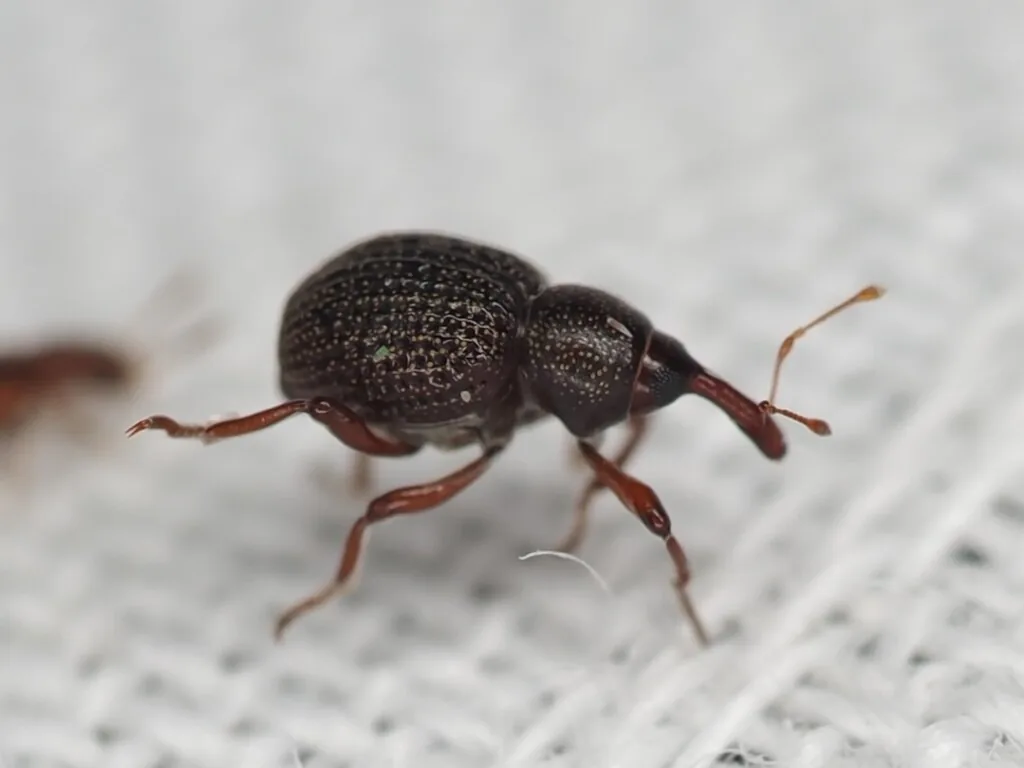
- Adults are up to 2 mm long with a long snout; females are usually larger than males. They emerge brown and turn shiny black within a few days, with ridges and pits along the body bearing tiny golden scales. They sit at the base of the buds or down among the submerged filaments, breathing from a film of air trapped under the body, and are very hard to spot with the naked eye.[1]
- Larvae are under 2 mm, white, C-shaped, with a brown head; they feed first on the buds and then inside the rhizomes. Eggs are white, elliptical and half a millimetre long.[1]
- Adult feeding leaves a distinctive shot-hole pattern and scarring on the buds, and attacked fronds discolor from green to yellow to brown before the mat breaks up and sinks. Because salinity, heat, poor nutrients and cold fronts also brown salvinia, presence must be confirmed by finding adults or larvae, or by extracting them from collected plants with Berlese funnels.[1]
Look-alikes
| Look-alike | How to tell them apart |
|---|---|
| Water hyacinth weevils (Neochetina) | Larger rounded weevils of water hyacinth, not salvinia, whose adults leave 2 to 3 mm scars on hyacinth leaves and whose larvae mine the leaf stalks.[1] |
| Browning from weather or water | Salinity, intense heat, lack of nutrients and cold fronts all brown salvinia fronds the same way. Feeding scars point to the weevil, but only adults or larvae confirm it.[1] |
Where it lives
Native to South America. There are two ecotypes in the United States. The smaller one feeds on common salvinia; it probably arrived in Florida by accident with the plant before 1960 and is now abundant on common salvinia throughout Florida and Louisiana, where it was redistributed from 2002. The larger ecotype, collected in Brazil and released first in Australia, was released on giant salvinia at Toledo Bend Reservoir on the Texas-Louisiana border in 2001, in California and Arizona in 2003, and in Alabama, Florida and South Carolina in 2021; it is established in Louisiana, Texas, California and Arizona. The weevil does well between about 55 and 91 F, prefers plants rich in nitrogen, and tends to fail in temperate climates. Texas A&M lists it among the biological options for giant salvinia in Texas ponds.[1][2]
Biology and life cycle
A female lays about 300 eggs in her lifetime, in young plant tissue. The larvae feed on the buds, then burrow into the rhizomes, passing through three stages, and pupate under water in cocoons attached to the rhizome.[1]
New adults feed on buds and fronds and can live 20 to 38 weeks under good conditions. The number of generations depends on climate: probably one a year at cold sites and three at warm ones such as southern Louisiana and Texas.[1]
Winter is the limiting factor. In Texas A&M laboratory trials, adult mortality after two, four and six cycles of repeated cold exposure was 22, 70 and 82 percent, and the survivors fed less; the results were matched against caged weevils through four winters on two northeast Texas lakes to help predict when spring releases will be needed.[3]
Louisiana State University researchers have worked out how to grade female weevils by the state of their ovaries, which shows whether a field population or a rearing colony is reproducing.[4]
Damage and signs
- Adult feeding suppresses growth, but the larvae do the real damage: boring in the rhizomes cuts off nutrient uptake. Plants yellow, brown, disintegrate and sink. Under ideal conditions this alone is enough to manage salvinia; at many other sites it has to be combined with other control.[1]
- In southern Louisiana the large ecotype has reduced giant salvinia biomass and surface cover by more than 98 percent, and on the Lower Colorado River in California and Arizona its impact has ranged from substantial to complete. In northern Louisiana and at more northern latitudes colder winters and a shorter season cut both the weevil's reproduction and the control it gives.[1]
- Populations are self-sustaining in central and southern Louisiana and Texas, but through much of the rest of its range they are knocked back by floods, saltwater intrusion, heat waves and hard freezes and have to be topped up with new releases. At some Louisiana sites red imported fire ants prey on the small ecotype enough to spoil control of common salvinia.[1]
- No nontarget feeding has been reported; more than 30 years of experience suggest the weevil is a specialist on Salvinia and will not harm other plants.[1]
Health risk
A tiny aquatic plant-feeding weevil; none of these sources describes any risk to people.[1][3]
Control
Prevention
No control of the weevil is needed; it is an approved biological control agent of common and giant salvinia, and Texas A&M notes it may be effective for salvinia management.[1][2]
Biological control
Expect self-sustaining control only in warm, mild-winter water. Elsewhere plan on inoculative releases in spring after cold winters, floods or saltwater intrusion, and integrate the weevil with other salvinia control.[1][3]
Common questions
- My giant salvinia is turning brown. Is that the weevil?
- Maybe. The weevil's shot-hole scars on the buds and browning fronds are typical, but salinity, heat, low nutrients and cold fronts brown salvinia too. Confirm it by finding the 2 mm black adults at the base of the buds or among the submerged filaments, or by collecting plants and extracting weevils in a Berlese funnel.[1]
- Why did the weevils disappear over winter?
- Repeated freezes kill overwintering adults: in Texas A&M trials mortality reached 70 percent after four cold cycles and 82 percent after six. North of the mild-winter zone, releases usually have to be repeated in spring.[3][1]
- Will it attack other pond plants?
- No nontarget feeding has been reported in more than 30 years of use; the weevil is considered a specialist on Salvinia.[1]
Sources
- North American Invasive Species Management Association (PDF hosted on Bugwood), “Pham and Diaz (Louisiana State University) and Nachtrieb (US Army Engineer Research and Development Center). Salvinia Biocontrol Agents: History and Ecology in North America. In: Winston, ed., Biological Control of Weeds in North America, NAISMA-BCW-2022-20-SALVINIAS-A (2022).” bugwoodcloud.org/resource/files/26407.pdf (accessed 2026-11-10)
- Texas A&M AgriLife Extension, “How to Control Giant Salvinia (AquaPlant: Management of Pond Plants and Algae).” aquaplant.tamu.edu/management-options/giant-salvinia/ (accessed 2026-11-10)
- Environmental Entomology (Entomological Society of America), “Obeysekara, Knutson, Mukherjee and Heinz (Texas A&M University). Repeated cold exposure effects on mortality and feeding activity of the salvinia weevil, Cyrtobagous salviniae (Coleoptera: Curculionidae). Environmental Entomology 44: 1590-1598 (2015), doi:10.1093/ee/nvv123.” doi.org/10.1093/ee/nvv123 (accessed 2026-11-10)
- International Journal of Insect Science (SAGE), full text in PubMed Central (PMC5772501), “Eisenberg, Johnson (Louisiana State University) and Grodowitz. The reproductive morphology and physiological age grading of the female salvinia weevil, Cyrtobagous salviniae Calder and Sands. International Journal of Insect Science 10 (2018), doi:10.1177/1179543317751909.” doi.org/10.1177/1179543317751909 (accessed 2026-11-10)
- iNaturalist, “Cyrtobagous salviniae taxon page (order and family).” www.inaturalist.org/taxa/637197 (accessed 2026-11-10)