On this page
How to identify it
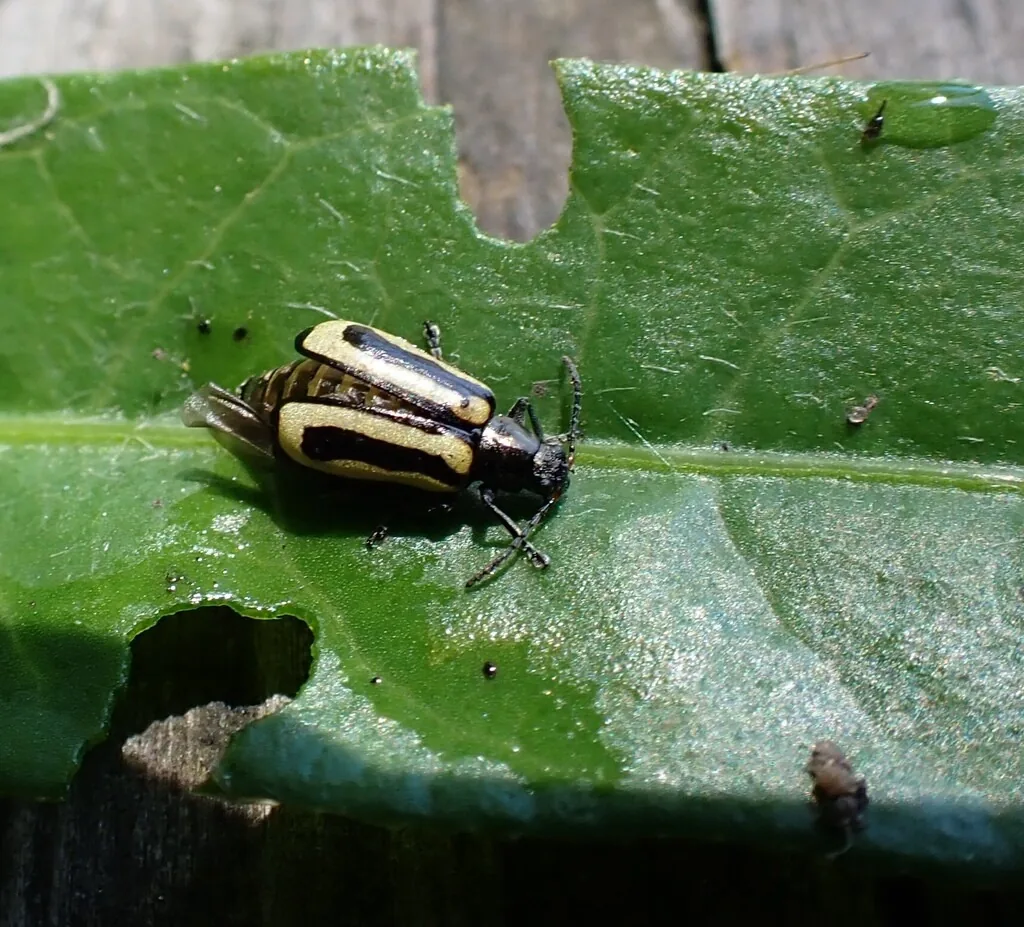
- Adults are 4 to 6 mm long and black with four yellow-gold stripes running the length of the body, two on each wing cover. Like other flea beetles they have enlarged hind thighs and jump long distances when disturbed. Females are slightly larger than males.[1]
- Larvae start out yellow and darken to dark gray or nearly black as they grow, reaching about 6 mm with a brown or black head. Their feeding leaves transparent 'windows' in alligatorweed leaves.[1]
- Eggs are cylindrical and pale yellow, laid in two rows of 12 to 54 on the undersides of alligatorweed leaves; the dark head capsules of the larvae show through just before hatching. Pupae are cream-colored at first and darken, hidden inside the plant's stems.[1]
- Adults are the easiest stage to recognize, and where the beetle is established they can be seen feeding and laying eggs on alligatorweed from spring through fall.[1]
Look-alikes
| Look-alike | How to tell them apart |
|---|---|
| Alligatorweed stem borer (Macrorrhinia endonephele) | A moth also released against alligatorweed. Its young larvae are yellowish like young flea beetle larvae but much bigger, and older moth larvae are brown with wavy lengthwise stripes rather than nearly black. Plants heavily attacked by the moth wilt, turn yellow and sink instead of showing windows and chew holes.[1] |
| Alligatorweed thrips (Amynothrips andersoni) | The third approved agent. It is under 2 mm long and should not be confused with the beetle. Plants it attacks are stunted with deformed leaves and tips rather than chewed.[1] |
Where it lives
Native to South America, the beetle was released in California and the southeastern United States starting in 1964. It failed in California but established in the Southeast and has been recorded in nine states. It overwinters only in warmer places and spreads into colder areas each summer and fall; northern records come from yearly reintroductions of Florida stock and from beetles moving north in spring. Releases at northern sites in North Carolina, Arkansas and Tennessee all failed, and only about 16 percent of alligatorweed's United States range is predicted to be highly or moderately suitable for it.[1][2]
Biology and life cycle
Adults emerge in early spring and begin mating and laying eggs. A female lays an average of 1,100 eggs over her life, in two-row clusters on the undersides of leaves.[1]
Larvae feed on leaf tissue through three stages, then chew into the stems and pupate inside them. New adults feed on leaves and stems. There are four to six generations a year, and adults of the last generation overwinter among alligatorweed roots and stems along the water's edge.[1]
Populations peak early in the season and then fall off as high temperatures reduce egg laying and the nitrogen content of the host leaves declines. Hot, dry summers reduce beetle numbers at some sites.[1]
The beetle attacks both the floating and the land-growing forms of alligatorweed, but it pupates poorly in the smaller, denser stems of the terrestrial form and is not effective against it.[1]
Damage and signs
- Feeding by larvae and adults on leaves and stems is often severe, eventually sinking the floating mat and clearing the waterway. In the United States the beetle controls alligatorweed across much of the weed's introduced range, though control falls short at temperate latitudes.[1][2]
- It is a specialist: no feeding on other plants has been reported in North America.[1]
- The beetle does well in northern Florida and warmer coastal areas where it can overwinter, but its abundance and impact vary with location and season elsewhere.[1]
Health risk
A plant-feeding beetle and a weed biological control agent; none of these sources describes any risk to people.[1][2][3]
Control
Prevention
Because the beetle overwinters only in warm areas and declines in summer heat, do not expect it alone to clear alligatorweed in cooler regions or in the terrestrial form of the weed.[1][2]
Biological control
The beetle is the control, not the pest. It has demonstrated effective control of alligatorweed but is not commercially available; depending on location and conditions, populations may already be present in the wild. Texas A&M AgriLife advises that even where the beetle is present, biological control usually works best combined with other methods in an integrated program.[3]
Common questions
- What is eating holes in the alligatorweed in my pond?
- If the leaves show see-through windows and chew holes and you can find small black beetles with yellow stripes, the alligatorweed flea beetle is at work. Its gray to black larvae make the windows; the adults chew leaves and stems.[1]
- Can I buy alligatorweed flea beetles?
- No. They are not commercially available. In the Southeast they may already be present in the wild, and they move north each spring from warmer overwintering sites.[3][1]
- Why doesn't the beetle control alligatorweed farther north?
- It can only overwinter where winters are warm. Releases in North Carolina, Arkansas and Tennessee failed, and modeling of its cold tolerance predicts that most of alligatorweed's United States range is poorly suited to it; the alligatorweed thrips tolerates cold better.[1][2]
Sources
- North American Invasive Species Management Association (PDF hosted on Bugwood), “Harms (US Army Engineer Research and Development Center), Knight and Pratt (USDA-ARS). Alligatorweed Biocontrol Agents: History and Ecology in North America. In: Winston, ed., Biological Control of Weeds in North America, NAISMA-BCW-2022-25-ALLIGATORWEED-A (2022).” bugwoodcloud.org/resource/files/23221.pdf (accessed 2026-11-10)
- Environmental Entomology (Entomological Society of America), full text in PubMed Central (PMC12716278), “Knight, Bingham, Harlow, Huang, Bohaty and Harms. A proposed method for estimating habitat suitability of weed biological control agents with experimentally derived thermal injury and weather data. Environmental Entomology 54: 1179-1186 (2025), doi:10.1093/ee/nvaf099.” doi.org/10.1093/ee/nvaf099 (accessed 2026-11-10)
- Texas A&M AgriLife Extension, “How to Control Alligator Weed (AquaPlant: Management of Pond Plants and Algae).” aquaplant.tamu.edu/management-options/alligator-weed/ (accessed 2026-11-10)
- iNaturalist, “Agasicles hygrophila taxon page (order and family).” www.inaturalist.org/taxa/408341 (accessed 2026-11-10)