On this page
How to identify it
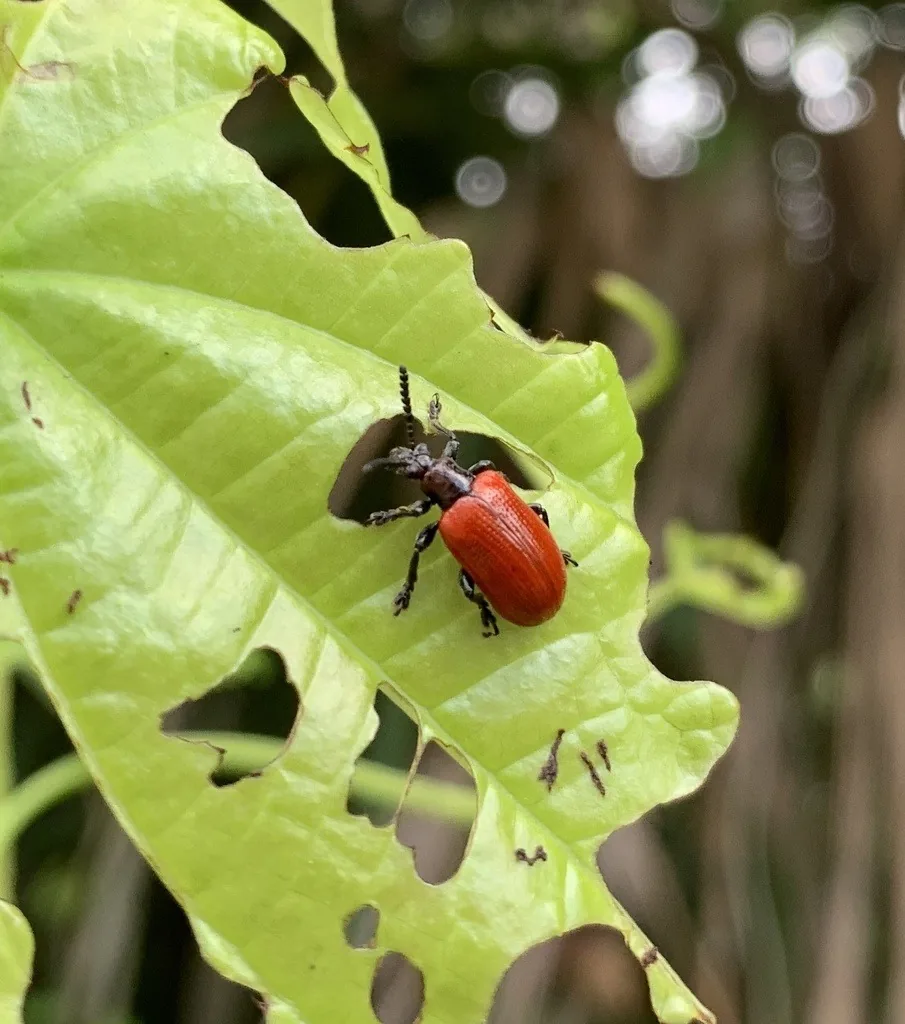
- Adults are about 9 mm long (roughly 3/8 inch) and 4 mm wide. The wing covers range from brown to orange or red, and the head, thorax, abdomen and legs are black.[1]
- The body is elongate, with a rectangular abdomen, a thorax about half as wide and a narrow head with bulging eyes. The University of Florida likens the shape to a square violin with a short neck.[1]
- Young larvae are yellowish to reddish; older ones are grayish to reddish, with a black head, legs and plate just behind the head. Larvae are often coated in a sticky secretion with their own droppings stuck to it.[1]
- Eggs are pale white, oblong and about 1 mm long, laid in loose clusters on the undersides of young leaves, which curl at the edges into a cup around them.[1]
Look-alikes
| Look-alike | How to tell them apart |
|---|---|
| Air potato bulbil beetle (Lilioceris egena) | A second biological control beetle of air potato, approved for release in Florida in 2021. It is colored the same way, with a black head, thorax, abdomen and legs and brownish-orange to bright red wing covers, but is slightly larger, about 10 mm long, and its adults bore into and feed mainly on the aerial bulbils rather than the leaves.[2] |
Where it lives
It is native to Asia, with records from China, India, Nepal, Laos and Thailand. From 2014 to 2021, Florida's state rearing program released beetles at nearly 7,000 sites in Florida, Georgia, Mississippi, Alabama, Louisiana and Texas.[1][3]
Biology and life cycle
Both adults and larvae feed on air potato leaves. The larvae feed in groups on the growing tips and skeletonize leaves from the underside. They prefer young, tender leaves but also eat older ones and can feed on the aerial bulbils.[1]
Development is fast. Eggs hatch in about four days, and the four larval stages take about eight days in all. Grown larvae drop to the soil and pupate in groups inside a whitish, foam-like cocoon about 7 mm long, made from an oral secretion.[1]
Adults emerge 12 to 16 days later, start mating after about 10 days and begin laying eggs five days after that. They live five months or longer, and a female lays more than 1,200 eggs on average.[1]
Air potato dies back in winter, so the adults go several months without food, presumably resting under leaf litter and other debris. They come out in spring, and the females start laying eggs.[1]
Adults find the vine by smell. In laboratory tests they moved toward air potato leaves only when moving air carried the leaves' odor to them, and wandered at random when there was no airflow or no leaves.[4]
Releases in the southern half of Florida have established poorly, with lower reproduction and less damage to the vines than beetles released farther north, according to unpublished data cited by the state rearing team.[3]
Damage and signs
- It damages only its target. Larvae and adults eat air potato leaves and occasionally the bulbils, which slows the vine's growth and reproduction, and damage to the growing tips keeps vines from lengthening and may limit their climbing. At the first release sites, heavy damage to air potato was visible within three months.[1]
- Host-range testing by the USDA Agricultural Research Service showed it will not complete development on any other plant found in Florida, and in its native range it is known to feed only on air potato.[1]
Health risk
It is a plant-feeding beetle that specializes on air potato, and none of these sources describes any risk to people.[1][3]
Control
Prevention
Leave it alone: it is a biological control agent at work on an invasive vine. Florida's state program has mass-reared and distributed hundreds of thousands of these beetles, and most releases have been made by residents and scientists who received beetles by mail. The rearing team recommends releasing them in groups of 50 to 100, depending on how heavy the vine infestation is and how large the area.[3]
Common questions
- Should I kill the red beetles on my air potato vine?
- No. The air potato leaf beetle was introduced on purpose to control air potato, an invasive vine, and testing showed it cannot complete development on any other plant found in Florida.[1]
- Will it eat my other plants?
- It is not expected to. In host-range tests it would not complete development on any Florida plant other than air potato, and in Asia it is known to feed only on air potato.[1]
- How do the beetles find air potato?
- By scent. In laboratory tests, adults moved toward air potato leaves when moving air carried the leaves' odor to them.[4]
Sources
- University of Florida IFAS Extension (Featured Creatures), “Air Potato Leaf Beetle (Suggested Common Name), Lilioceris cheni Gressitt and Kimoto, EENY-547 (R. Diaz, W. A. Overholt and K. Hibbard; January 2013).” journals.flvc.org/edis/article/view/120480 (accessed 2026-11-09)
- University of Florida IFAS Extension (Featured Creatures), “Lilioceris egena (Weise) (Coleoptera: Chrysomelidae: Criocerinae), Biological Control Agent of Air Potato Vine, EENY-804 (F. A. Dray Jr., O. Menocal, R. Murray, E. Rohrig and C. Minteer; 2023).” journals.flvc.org/edis/article/view/132789 (accessed 2026-11-09)
- Insects (MDPI), full text in PubMed Central (PMC8781818), “Kraus, Murray, Kelm, Poffenberger, Rohrig and Fairbanks. Advancements in Mass Rearing the Air Potato Beetle Lilioceris cheni. Insects 13: 65 (2022), doi:10.3390/insects13010065.” doi.org/10.3390/insects13010065 (accessed 2026-11-09)
- Journal of Chemical Ecology (Springer), indexed in PubMed (PMID 37278905), “Griesheimer, Gaffke, Minteer, Mass, Hight and Martini. Attraction of the Air Potato Leaf Beetle, Lilioceris cheni, to Leaf Volatiles of the Air Potato, Dioscorea bulbifera. Journal of Chemical Ecology 49: 498-506 (2023), doi:10.1007/s10886-023-01436-z (abstract).” doi.org/10.1007/s10886-023-01436-z (accessed 2026-11-09)
- iNaturalist, “Lilioceris cheni taxon page (order and family).” www.inaturalist.org/taxa/464044 (accessed 2026-11-09)