On this page
How to identify it
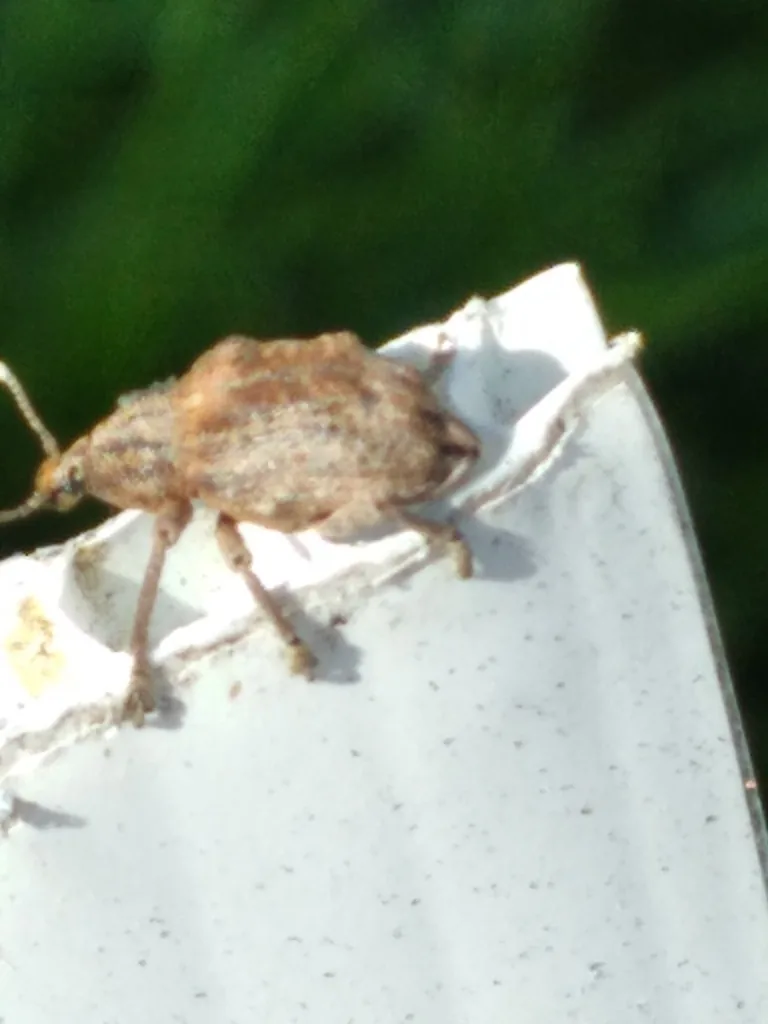
- Adults are up to 9 mm long with a stout snout and knobby protuberances on the hardened wing covers. They are reddish-brown when new and turn darker gray with age.[1]
- Mature larvae are up to 14 mm long, grayish and slug-like, covered in an orangish oily secretion that darkens as feces stick to it, and they leave long, thin coils of feces behind them. Young larvae are small and yellow. Eggs are 1 mm, yellow, under a dark protective coating, laid singly on young leaves, expanding buds and twigs.[1]
- Larval feeding takes every layer of a young leaf except the cuticle, leaving window scars; adult feeding leaves holes and gouges in young tissue and defoliates young leaves, while on tough older leaves it only scratches narrow scars along the surface. The other melaleuca agents established in Florida, a psyllid and two gall midges, are all 5 mm or less and show up as filamentous wax or as galls on leaves and stems rather than defoliation.[1]
Look-alikes
| Look-alike | How to tell them apart |
|---|---|
| Melaleuca psyllid (Boreioglycaspis melaleucae) | A tiny sap-sucking agent released five years after the beetle whose colonies leave filamentous wax on melaleuca foliage year-round. It now covers slightly more of the infestation than the beetle, and the two occur together at the same densities with no sign of competing.[1][2] |
Where it lives
Native to Australia and released on melaleuca in Florida beginning in 1997. It established well throughout the state, with the highest densities in southern Florida, and USDA-ARS surveys found it on 71 percent of the melaleuca infestation; the stands without it or the psyllid lie mainly at the northern extremes of the tree's range. It is more than twice as likely to be found in cells dominated by sandy soils as on organic-rich soils.[1][2]
Biology and life cycle
The beetle breeds year-round in Florida, with two or three overlapping generations a year, and the adults live more than a year. A female lays 500 to 1,000 eggs singly on young leaves, expanding buds and twigs.[1]
The larvae are specialists on the seasonal flush of young leaves, feeding through four stages, and when mature they drop from the tree and burrow into the soil to pupate. That need for soil is the beetle's weak point: it cannot maintain populations at permanently flooded melaleuca sites, which is where the gall midge Lophodiplosis trifida complements it.[1]
The tree's chemistry decides which trees the larvae eat. Melaleuca comes in two terpene types, one rich in E-nerolidol and one rich in viridiflorol; viridiflorol is a strong feeding deterrent for the weevil and slows larval development, so the larvae avoid those trees, while the psyllid prefers to lay its eggs on them. Each chemotype is held in check by a different insect.[3]
Damage and signs
- Heavy larval and adult feeding defoliates the tree and kills the shoot tips. The tree responds with new growth, which drains its reserves and reduces flowering and seed, and the next generation of beetles attacks that new growth in turn.[1]
- The beetle reduces melaleuca seed production and seed weight, raises seedling mortality and premature leaf fall, and disrupts the nutrient cycling that makes the tree so invasive; repeated attack lets other plants colonize melaleuca sites. With the other established agents, mature trees show reduced height, branching and biomass of the coppice shoots that survive, and the beetle and psyllid together have been very effective at reducing the weed's survival and reproduction. Damage is heavier on sandy soils than on organic-rich soils. No nontarget effects have been reported.[1][3][2]
Health risk
A leaf-feeding weevil of melaleuca; none of these sources describes any risk to people.[1][2]
Control
Prevention
Expect gaps. The beetle persists poorly where melaleuca stands in permanent water, because its larvae must pupate in soil, and it does best at sites with dry winters, plenty of young foliage and sandy soil; wet, humid sites are where the gall midge does its work instead.[1][2]
Biological control
No control is wanted; this beetle is the control. The USDA-ARS program has already moved millions of agents around Florida, and the beetle and psyllid are found together without competing, so established stands need nothing added.[2][1]
Common questions
- What are the gray slug-like things covered in slime on my melaleuca?
- Melaleuca snout beetle larvae. They are grayish, up to 14 mm, coated in an orange oily secretion that darkens with their droppings, and they trail long thin coils of frass as they eat the young leaves down to the cuticle.[1]
- Will the beetle kill the trees?
- The sources describe defoliation, tip dieback, lower seed output, more seedling deaths and smaller, less branched regrowth, and say the beetle and psyllid have been very effective at reducing survival and reproduction of the weed, with repeated attack letting other plants move in.[1][3]
- Does it attack other trees?
- No nontarget effects have been reported; its larvae are specialized feeders on melaleuca's young leaves.[1]
Sources
- North American Invasive Species Management Association (PDF hosted on Bugwood), “Smith and Rayamajhi. Melaleuca Biocontrol Agents: History and Ecology in North America. In: Winston, ed., Biological Control of Weeds in North America, NAISMA-BCW-2022-26-MELALEUCA-A (2022).” bugwoodcloud.org/resource/files/25232.pdf (accessed 2026-11-10)
- Environmental Entomology (Entomological Society of America), “Balentine, Pratt, Dray, Rayamajhi and Center (USDA-ARS Invasive Plant Research Laboratory). Geographic distribution and regional impacts of Oxyops vitiosa (Coleoptera: Curculionidae) and Boreioglycaspis melaleucae (Hemiptera: Psyllidae), biological control agents of the invasive tree Melaleuca quinquenervia. Environmental Entomology 38: 1145-1154 (2009), doi:10.1603/022.038.0422.” doi.org/10.1603/022.038.0422 (accessed 2026-11-10)
- Phytochemistry (Elsevier), “Padovan, Keszei, Kollner, Degenhardt and Foley (Australian National University). The molecular basis of host plant selection in Melaleuca quinquenervia by a successful biological control agent. Phytochemistry 71: 1237-1244 (2010), doi:10.1016/j.phytochem.2010.05.013.” doi.org/10.1016/j.phytochem.2010.05.013 (accessed 2026-11-10)
- iNaturalist, “Oxyops vitiosus taxon page (order and family).” www.inaturalist.org/taxa/957914 (accessed 2026-11-10)