On this page
How to identify it
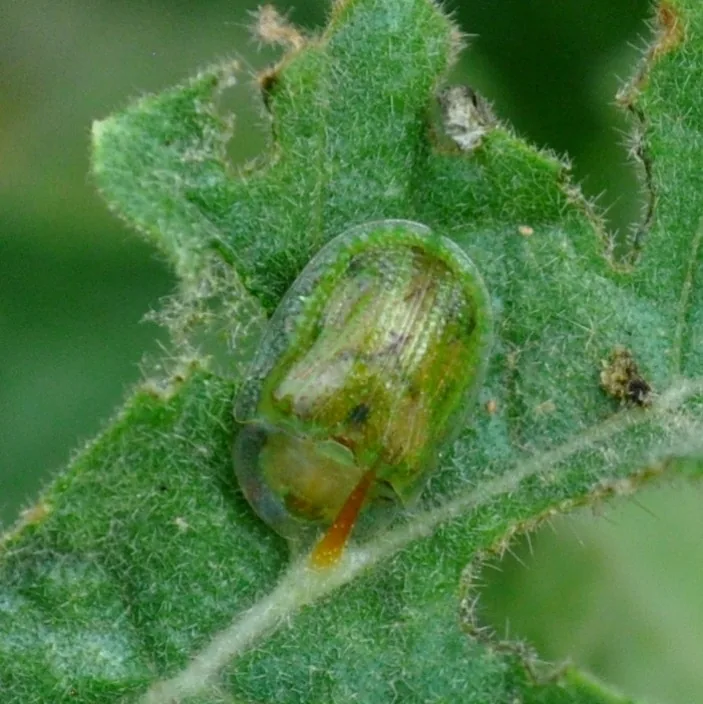
- Adults are up to 6 mm long and 5 mm wide with a hard protective covering; females are slightly larger. Breeding adults are green, and adults in winter diapause turn light brown and hide in the leaf litter under the plants.[1]
- Larvae are pale green, up to 6 mm, with spines along their margins on which they pile their molted skins and frass as camouflage. They feed on the undersides of young leaves, and the pupae are attached there too.[1]
- Eggs are oval, up to 1.8 mm, each wrapped in two translucent papery membranes and laid singly on the leaves. Both adults and larvae leave a shot-hole feeding pattern, and a tropical soda apple plant riddled with shot holes points to the beetle even when none is in sight.[1]
Where it lives
Native to South America. Beetles from Argentina and Paraguay were released in the southeastern United States beginning in 2003, in Florida, Texas, Alabama and Georgia. They overwintered at first in the last three states, but permanent establishment has been confirmed only in Florida, where the beetle is widespread and abundant in the south and center and limited or absent in the north, apparently held back by cold winters.[1]
Biology and life cycle
Adults emerge in early spring and feed on the foliage. A female lays up to 300 eggs in her life, singly on the leaves; the larvae feed on the undersides of young leaves through five stages and pupate on the leaf. The whole cycle can be finished in a month, giving seven or eight generations a year in Florida, and the last generation's adults spend the winter in diapause in the leaf litter, which carries them through cold and food shortage.[1]
Shade changes the beetle's fortunes. Tropical soda apple leaves grown in shade are less tough, hold more water and nitrogen and carry fewer, smaller glandular hairs, and beetles reared on them survive better as larvae, eat more, grow larger and lay more eggs. In the field the beetle is more numerous in open pastures but does more leaf damage and survives better from egg to adult in shaded woods, and predators, which track beetle numbers, are more abundant in the open.[2][1]
Damage and signs
- Adult and larval feeding reduces the plant's photosynthesis and opens it to secondary attack by plant pathogens, and together these stresses cut the growth, reproduction and competitive ability of tropical soda apple.[1]
- At high densities the beetle has been credited with up to a 90 percent decline in plant density within three years of release, and tropical soda apple is now limited at many Florida sites. No nontarget effects have been reported.[1]
Health risk
A leaf-feeding beetle of tropical soda apple; neither source describes any risk to people.[1][2]
Control
Prevention
Expect patchy results in cold or open country: beetle numbers are higher in open pasture, but survival and feeding damage are higher in shade, where the leaves are softer and richer and predators fewer.[1][2]
Biological control
Leave the beetle alone; it is the control, and in Florida it is already widespread. It does best where winters are mild, and NAISMA notes it appears to be hindered by cold temperatures.[1]
Where the plants must be killed outright, NAISMA describes a registered bioherbicide, a strain of tobacco mild green mosaic virus sold as SolviNix, that kills tropical soda apple of any age, roots included, within about six weeks of being applied by contact.[1]
Common questions
- What is the green beetle with holes all over my tropical soda apple?
- The tropical soda apple leaf beetle, a 6 mm green tortoise beetle released in Florida from 2003. The shot-hole feeding pattern on the leaves is its signature; look under young leaves for the spiny pale green larvae wearing a cap of shed skins and frass.[1]
- Why hasn't it spread north?
- Cold. It established permanently only in Florida and is limited or absent in the northern part of the state; it overwintered for a while in Texas, Alabama and Georgia but did not persist.[1]
- Will it eat my tomatoes or eggplant?
- No nontarget effects have been reported; its feeding is on tropical soda apple.[1]
Sources
- North American Invasive Species Management Association (PDF hosted on Bugwood), “Diaz (Louisiana State University) and Charudattan. Tropical Soda Apple Biocontrol Agents: History and Ecology in North America. In: Winston, ed., Biological Control of Weeds in North America, NAISMA-BCW-2022-24-TROPICAL SODA APPLE-A (2022).” bugwoodcloud.org/resource/files/24234.pdf (accessed 2026-11-10)
- Environmental Entomology (Entomological Society of America), “Diaz, Aguirre, Wheeler, Lapointe, Rosskopf and Overholt (University of Florida, USDA-ARS). Differential performance of tropical soda apple and its biological control agent Gratiana boliviana (Coleoptera: Chrysomelidae) in open and shaded habitats. Environmental Entomology 40: 1437-1447 (2011), doi:10.1603/EN11124.” doi.org/10.1603/EN11124 (accessed 2026-11-10)
- iNaturalist, “Gratiana boliviana taxon page (order and family).” www.inaturalist.org/taxa/716674 (accessed 2026-11-10)